

A Course-Specific Agentic RAG Chatbot for IT Student Support: Architecture, Local Deployment, and Preliminary Evaluation at Hai Phong University



Article Information
Abstract
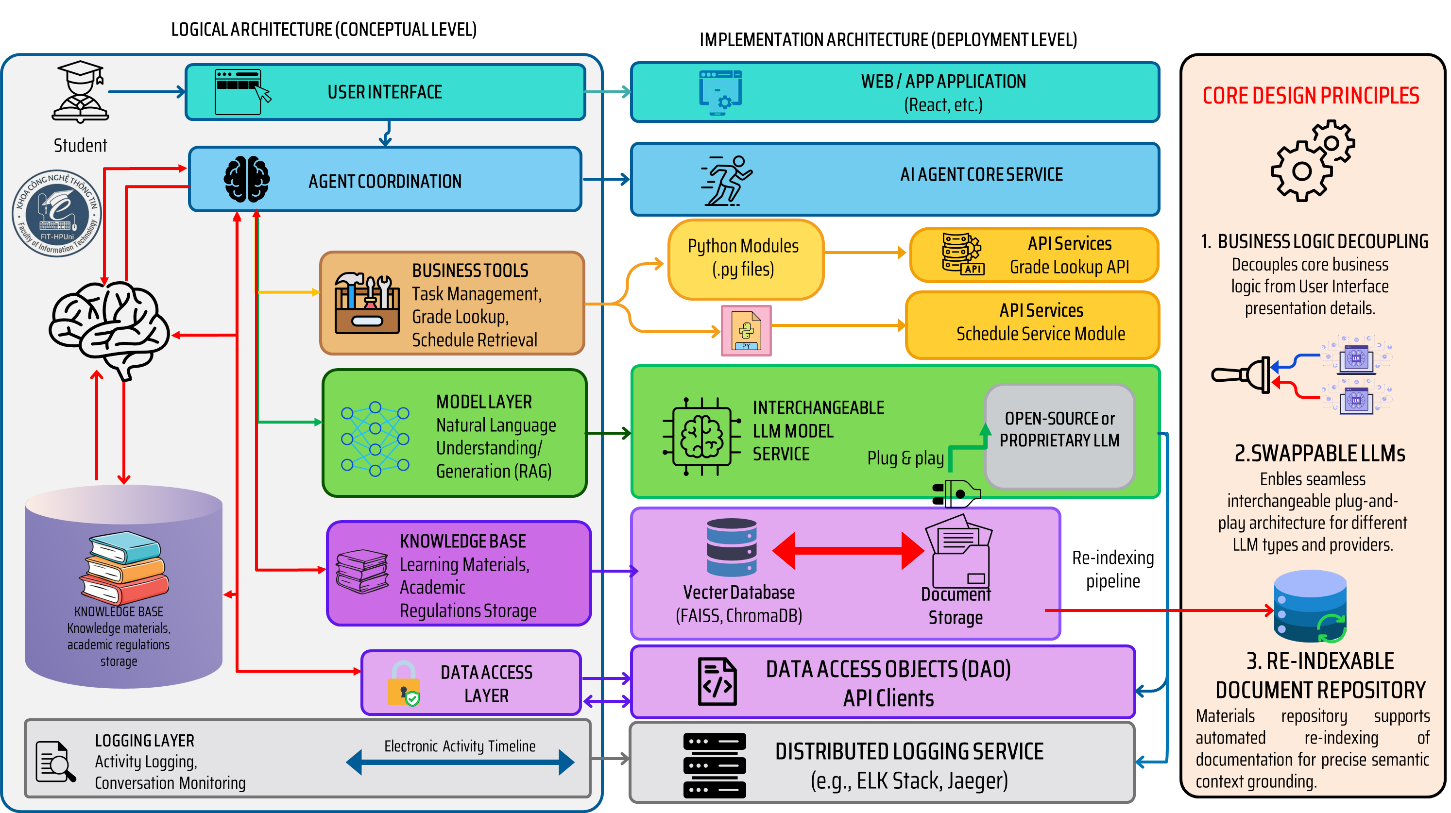
This paper introduces a course-specific agentic retrieval-augmented generation (RAG) chatbot developed to support Information Technology students at Hai Phong University. The proposed system addresses the limitations of static FAQ bots, which are unable to manage open-ended academic tasks, and model-only large language model (LLM) assistants, which may generate fluent yet insufficiently grounded responses. The prototype combines local LLM deployment, semantic retrieval of course materials, and constrained, tool-oriented orchestration to perform four key tasks: question answering, document summarization, study planning, and quiz generation. The primary contributions include a six-layer privacy-aware architecture, a semi-agentic workflow for task routing and source-grounded response generation, and an evaluation protocol that compares LLM-only, RAG, and RAG-plus-orchestration scenarios using a five-dimensional academic rubric. Preliminary local testing demonstrates response times ranging from approximately 2 to 45 seconds for inputs of 1,000-20,000 words, with summary outputs compressed to 10–30% of the original source length. These findings suggest that department-level, course-grounded academic assistance is achievable with modest infrastructure, provided that retrieval, logging, and bounded orchestration are prioritized as core design requirements.
Graphical Abstract
Keywords
Data Availability Statement
Funding
Conflicts of Interest
AI Use Statement
Ethical Approval and Consent to Participate
References
- Chiu, T. K. F., Xia, Q., Zhou, X., Chai, C. S., & Cheng, M. (2023). Systematic literature review on opportunities, challenges, and future research recommendations of artificial intelligence in education. Computers and Education: Artificial Intelligence, 4, 100118.
[CrossRef] [Google Scholar] - Garzón, J., Patiño, E., & Marulanda, C. (2025). Systematic review of artificial intelligence in education: Trends, benefits, and challenges. Multimodal Technologies and Interaction, 9(8), 84.
[CrossRef] [Google Scholar] - Lo, C. K., Hew, K. F., & Jong, M. S. Y. (2024). The influence of ChatGPT on student engagement: A systematic review and future research agenda. Computers & Education, 219, 105100.
[CrossRef] [Google Scholar] - Qadir, J. (2023, May). Engineering education in the era of ChatGPT: Promise and pitfalls of generative AI for education. In 2023 IEEE global engineering education conference (EDUCON) (pp. 1-9). IEEE.
[CrossRef] [Google Scholar] - Raihan, N., Siddiq, M. L., Santos, J. C., & Zampieri, M. (2025, February). Large language models in computer science education: A systematic literature review. In Proceedings of the 56th ACM technical symposium on computer science education V. 1 (pp. 938-944).
[CrossRef] [Google Scholar] - Kim, M., Kim, J., Knotts, T. L., & Albers, N. D. (2025). AI for academic success: Investigating the role of usability, enjoyment, and responsiveness in ChatGPT adoption. Education and Information Technologies, 30(10), 14393-14414.
[CrossRef] [Google Scholar] - Denny, P., Leinonen, J., Prather, J., Luxton-Reilly, A., Amarouche, T., Becker, B. A., & Reeves, B. N. (2024, March). Prompt Problems: A new programming exercise for the generative AI era. In Proceedings of the 55th ACM Technical Symposium on Computer Science Education V. 1 (pp. 296-302).
[CrossRef] [Google Scholar] - Lewis, P., Perez, E., Piktus, A., Petroni, F., Karpukhin, V., Goyal, N., ... & Kiela, D. (2020). Retrieval-augmented generation for knowledge-intensive nlp tasks. Advances in neural information processing systems, 33, 9459-9474.
[Google Scholar] - Swacha, J., & Gracel, M. (2025). Retrieval-augmented generation (RAG) chatbots for education: A survey of applications. Applied Sciences, 15(8), 4234.
[CrossRef] [Google Scholar] - Johnson, J., Douze, M., & Jégou, H. (2019). Billion-scale similarity search with GPUs. IEEE transactions on big data, 7(3), 535-547.
[CrossRef] [Google Scholar] - Pan, J. J., Wang, J., & Li, G. (2024). Survey of vector database management systems. The VLDB Journal, 33(5), 1591-1615.
[CrossRef] [Google Scholar] - Reimers, N., & Gurevych, I. (2019, November). Sentence-bert: Sentence embeddings using siamese bert-networks. In Proceedings of the 2019 conference on empirical methods in natural language processing and the 9th international joint conference on natural language processing (EMNLP-IJCNLP) (pp. 3982-3992).
[CrossRef] [Google Scholar] - Schick, T., Dwivedi-Yu, J., Dessì, R., Raileanu, R., Lomeli, M., Hambro, E., ... & Scialom, T. (2023). Toolformer: Language models can teach themselves to use tools. Advances in neural information processing systems, 36, 68539-68551.
[Google Scholar] - Wang, L., Ma, C., Feng, X., Zhang, Z., Yang, H., Zhang, J., ... & Wen, J. (2024). A survey on large language model based autonomous agents. Frontiers of Computer Science, 18(6), 186345.
[CrossRef] [Google Scholar] - Madaan, A., Tandon, N., Gupta, P., Hallinan, S., Gao, L., Wiegreffe, S., ... & Clark, P. (2023). Self-refine: Iterative refinement with self-feedback. Advances in neural information processing systems, 36, 46534-46594.
[Google Scholar] - Phung, T. N. (2026). Using explainable AI to diagnose institutional inequality in student dropout across ethnic and regional groups in Vietnam. AI & SOCIETY, 1-18.
[CrossRef] [Google Scholar] - Phung, T. N., Do, D. C., Nguyen, T. T., Nguyen, V. S., Nguyen, T. V., & Le, D. N. (2026). An integrated framework for outcome based education and AI supported blended learning in curriculum redesign and intelligent training management. Discover Computing, 29(1), 196.
[CrossRef] [Google Scholar]
Cite This Article
TY  - JOUR
AU  - Van, Tran Huu
AU  - Vinh, Nguyen Phu
AU  - Ngan, Vu Thi Tuyet
AU  - Phuong, Luong Ha
AU  - Le, Dac-Nhuong
PY  - 2026
DA  - 2026/05/30
TI  - A Course-Specific Agentic RAG Chatbot for IT Student Support: Architecture, Local Deployment, and Preliminary Evaluation at Hai Phong University
JO  - Next-Generation Computing Systems and Technologies
T2  - Next-Generation Computing Systems and Technologies
JF  - Next-Generation Computing Systems and Technologies
VL  - 2
IS  - 2
SP  - 21
EP  - 34
DO  - 10.62762/NGCST.2026.601800
UR  - https://www.icck.org/article/abs/NGCST.2026.601800
KW  - agentic AI
KW  - educational chatbot
KW  - retrieval-augmented generation
KW  - local large language model
KW  - academic support
KW  - information technology education
AB  - This paper introduces a course-specific agentic retrieval-augmented generation (RAG) chatbot developed to support Information Technology students at Hai Phong University. The proposed system addresses the limitations of static FAQ bots, which are unable to manage open-ended academic tasks, and model-only large language model (LLM) assistants, which may generate fluent yet insufficiently grounded responses. The prototype combines local LLM deployment, semantic retrieval of course materials, and constrained, tool-oriented orchestration to perform four key tasks: question answering, document summarization, study planning, and quiz generation. The primary contributions include a six-layer privacy-aware architecture, a semi-agentic workflow for task routing and source-grounded response generation, and an evaluation protocol that compares LLM-only, RAG, and RAG-plus-orchestration scenarios using a five-dimensional academic rubric. Preliminary local testing demonstrates response times ranging from approximately 2 to 45 seconds for inputs of 1,000-20,000 words, with summary outputs compressed to 10–30% of the original source length. These findings suggest that department-level, course-grounded academic assistance is achievable with modest infrastructure, provided that retrieval, logging, and bounded orchestration are prioritized as core design requirements.
SN  - 3070-3328
PB  - Institute of Central Computation and Knowledge
LA  - English
ER  -
@article{Van2026A,
  author = {Tran Huu Van and Nguyen Phu Vinh and Vu Thi Tuyet Ngan and Luong Ha Phuong and Dac-Nhuong Le},
  title = {A Course-Specific Agentic RAG Chatbot for IT Student Support: Architecture, Local Deployment, and Preliminary Evaluation at Hai Phong University},
  journal = {Next-Generation Computing Systems and Technologies},
  year = {2026},
  volume = {2},
  number = {2},
  pages = {21-34},
  doi = {10.62762/NGCST.2026.601800},
  url = {https://www.icck.org/article/abs/NGCST.2026.601800},
  abstract = {This paper introduces a course-specific agentic retrieval-augmented generation (RAG) chatbot developed to support Information Technology students at Hai Phong University. The proposed system addresses the limitations of static FAQ bots, which are unable to manage open-ended academic tasks, and model-only large language model (LLM) assistants, which may generate fluent yet insufficiently grounded responses. The prototype combines local LLM deployment, semantic retrieval of course materials, and constrained, tool-oriented orchestration to perform four key tasks: question answering, document summarization, study planning, and quiz generation. The primary contributions include a six-layer privacy-aware architecture, a semi-agentic workflow for task routing and source-grounded response generation, and an evaluation protocol that compares LLM-only, RAG, and RAG-plus-orchestration scenarios using a five-dimensional academic rubric. Preliminary local testing demonstrates response times ranging from approximately 2 to 45 seconds for inputs of 1,000-20,000 words, with summary outputs compressed to 10–30\% of the original source length. These findings suggest that department-level, course-grounded academic assistance is achievable with modest infrastructure, provided that retrieval, logging, and bounded orchestration are prioritized as core design requirements.},
  keywords = {agentic AI, educational chatbot, retrieval-augmented generation, local large language model, academic support, information technology education},
  issn = {3070-3328},
  publisher = {Institute of Central Computation and Knowledge}
}
Article Metrics
Publisher's Note
ICCK stays neutral with regard to jurisdictional claims in published maps and institutional affiliations.
Rights and Permissions
 Copyright © 2026 by the Author(s). Published by Institute of Central Computation and Knowledge. This article is an open access article distributed under the terms and conditions of the Creative Commons Attribution (CC BY) license (https://creativecommons.org/licenses/by/4.0/), which permits use, sharing, adaptation, distribution and reproduction in any medium or format, as long as you give appropriate credit to the original author(s) and the source, provide a link to the Creative Commons licence, and indicate if changes were made.


Portico
