by
,
,
,
,
,



Reservoir Science | Volume 3, Issue 1: 1-25, 2026 | DOI: 10.62762/RS.2026.344933
Abstract
Deep saline aquifers offer the largest global capacity potential for geologic carbon storage, yet storage performance is frequently constrained by coupled limitations on \COtwo{} dissolution (solubility trapping) and injectivity under high-salinity conditions. Elevated ionic strength suppresses \COtwo{} solubility via ``salting-out'' effects. Meanwhile, near-wellbore dry-out during injection of dry or undersaturated \COtwo{} can concentrate brine and precipitate salts, reducing permeability and injectivity. Mineralogy and \COtwo{}-brine-rock wettability further control multiphase flow topology, interfacial area for dissolution, capillary trapping, and compatibility of additives with reservoi... More >
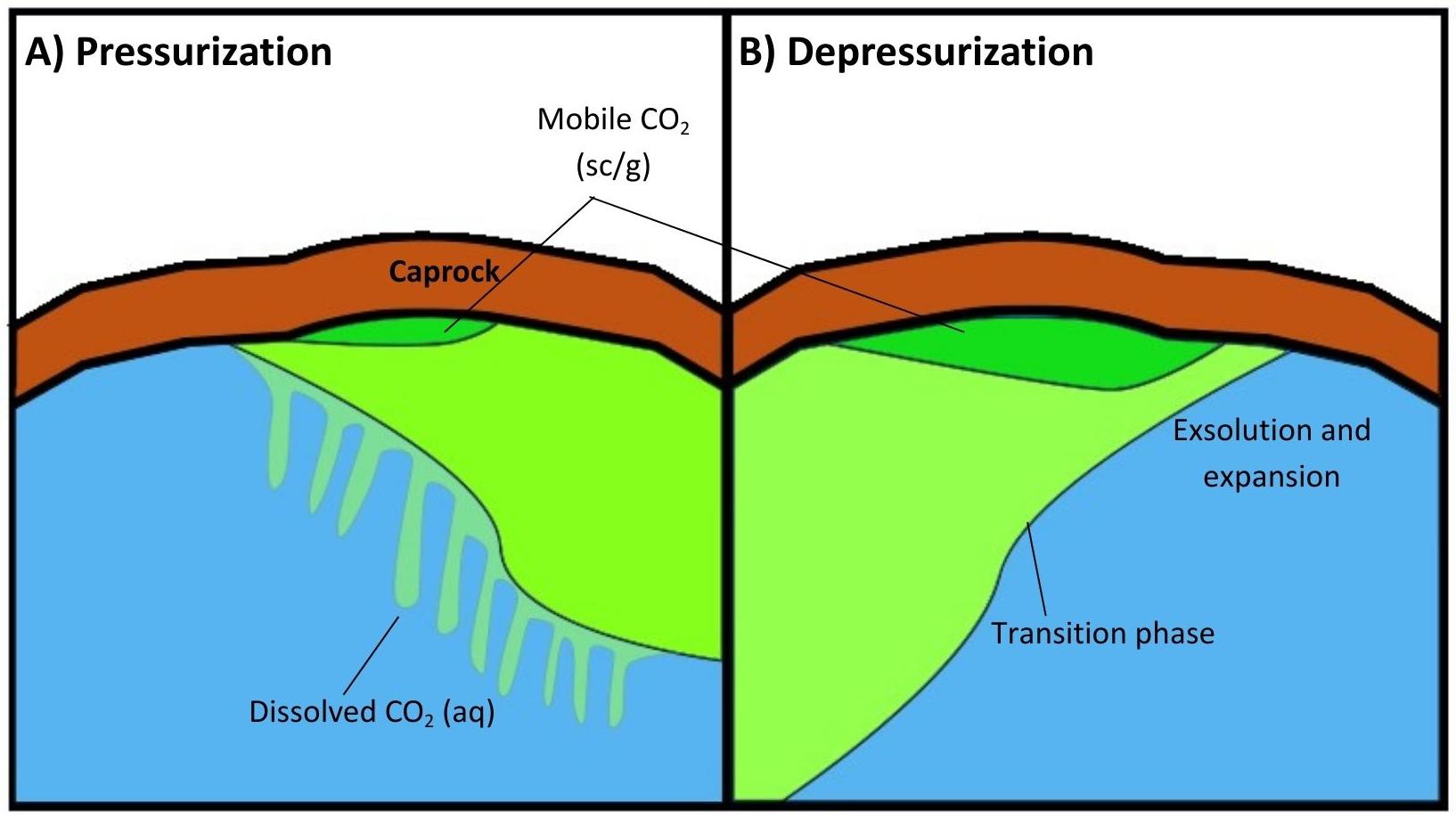
Graphical Abstract