

Electronic Structure Engineering of Cathode Materials: Mechanisms and Perspectives



Article Information
Abstract
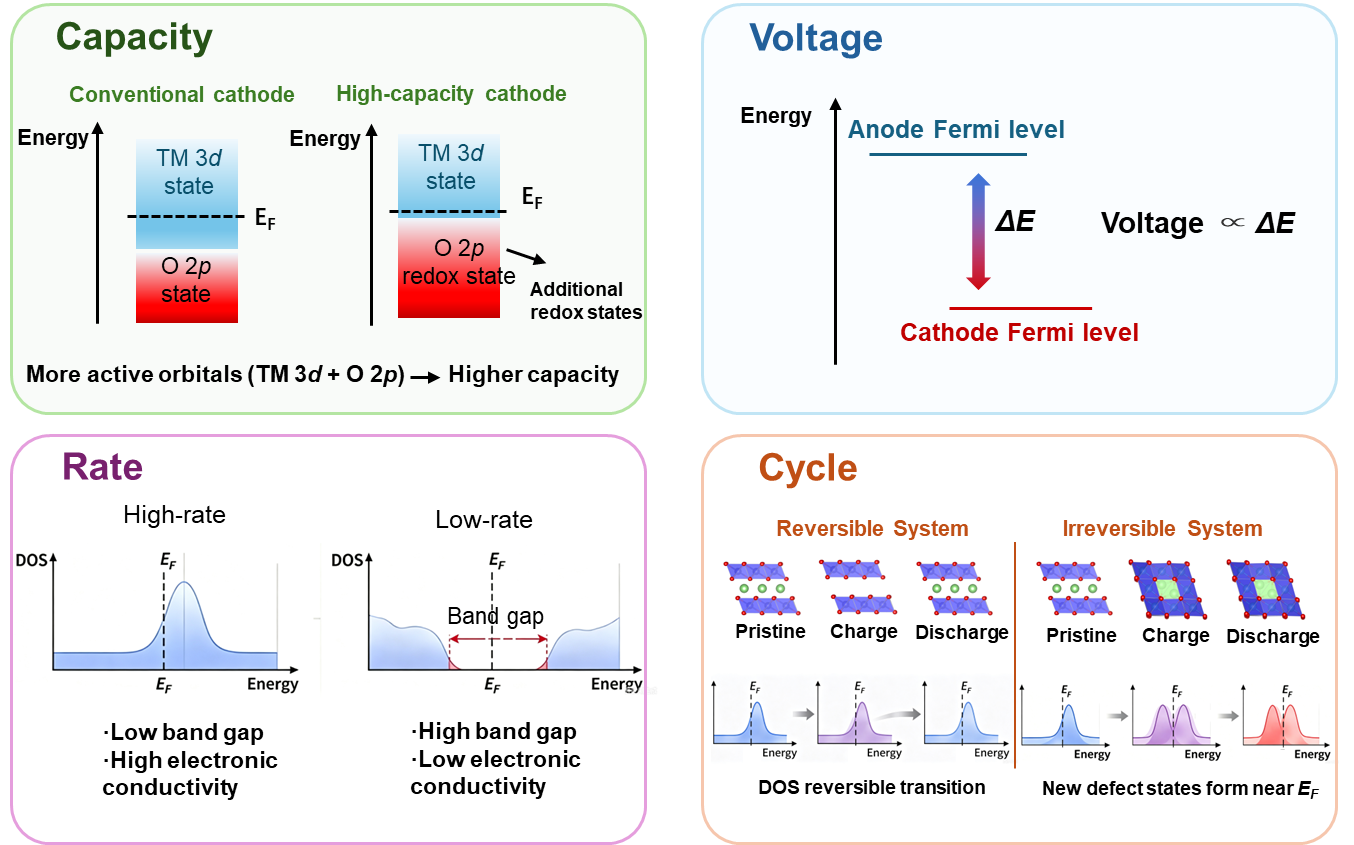
The electronic structure of a cathode material sets its redox chemistry, energy density, transport kinetics and structural stability, yet it is rarely discussed in conjunction with the structural design strategies that are used to improve performance. This perspective links electronic energy levels to the electrochemical properties of cathode materials. We first describe how transition-metal 3d and O 2p states, orbital hybridization, charge distribution and interfacial energy-level alignment control capacity, voltage, rate capability and cycling stability. We then re-examine four common strategies, namely elemental doping, defect engineering, composite-structure design and surface modification, in terms of what each does to the electronic states: dopant-induced orbital reconstruction, defect-related states, interfacial charge redistribution, band alignment and surface electronic modulation. These changes act on redox activity, on ion and electron transport and on interfacial stability. We close by arguing that the evolution of the electronic structure during cycling, and the deliberate engineering of energy levels, should guide the design of high-energy-density, durable cathodes.
Graphical Abstract
Keywords
Data Availability Statement
Funding
Conflicts of Interest
AI Use Statement
Ethical Approval and Consent to Participate
References
- Manthiram, A. (2020). A reflection on lithium-ion battery cathode chemistry. Nature Communications, 11(1), 1550.
[CrossRef] [Google Scholar] - Li, W., Erickson, E. M., & Manthiram, A. (2020). High-nickel layered oxide cathodes for lithium-based automotive batteries. Nature Energy, 5(1), 26-34.
[CrossRef] [Google Scholar] - Rozier, P., & Tarascon, J. M. (2015). Li-rich layered oxide cathodes for next-generation Li-ion batteries: chances and challenges. Journal of The Electrochemical Society, 162(14), A2490-A2499.
[CrossRef] [Google Scholar] - Wu, Z., Zhang, C., Yuan, F., Lyu, M., Yang, P., Zhang, L., ... & Wang, L. (2024). Ni-rich cathode materials for stable high-energy lithium-ion batteries. Nano Energy, 126, 109620.
[CrossRef] [Google Scholar] - Li, S., Li, Y., Zhang, Z., Shen, X., Ji, H., Liu, Z., ... & Chen, L. (2025). Interplays between TM migration, cation mixing and oxygen defects and their impacts on degradation of layer-structured oxide cathode materials. Energy Storage Materials, 79, 104337.
[CrossRef] [Google Scholar] - Zheng, J., Ye, Y., Liu, T., Xiao, Y., Wang, C., Wang, F., & Pan, F. (2019). Ni/Li disordering in layered transition metal oxide: electrochemical impact, origin, and control. Accounts of chemical research, 52(8), 2201-2209.
[CrossRef] [Google Scholar] - Zheng, H., Zhang, C., Zhang, Y., Lin, L., Liu, P., Wang, L., ... & Peng, D. L. (2021). Manipulating the local electronic structure in Li‐rich layered cathode towards superior electrochemical performance. Advanced Functional Materials, 31(30), 2100783.
[CrossRef] [Google Scholar] - Yu, H., & Zhou, H. (2013). High-energy cathode materials (Li$_2$MnO$_3$-LiMO$_2$) for lithium-ion batteries. The Journal of Physical Chemistry Letters, 4(8), 1268-1280.
[CrossRef] [Google Scholar] - Zhao, S., Yan, K., Zhang, J., Sun, B., & Wang, G. (2021). Reaction mechanisms of layered lithium‐rich cathode materials for high‐energy lithium‐ion batteries. Angewandte Chemie International Edition, 60(5), 2208-2220.
[CrossRef] [Google Scholar] - Hausbrand, R. (2020). Electronic energy levels at Li-ion cathode-liquid electrolyte interfaces: Concepts, experimental insights, and perspectives. The Journal of Chemical Physics, 152(18), 180902.
[CrossRef] [Google Scholar] - Ben Yahia, M., Vergnet, J., Saubanère, M., & Doublet, M.-L. (2019). Unified picture of anionic redox in Li/Na-ion batteries. Nature Materials, 18(5), 496-502.
[CrossRef] [Google Scholar] - Zhang, H., Liu, H., Piper, L. F. J., Whittingham, M. S., & Zhou, G. (2022). Oxygen loss in layered oxide cathodes for Li-ion batteries: Mechanisms, effects, and mitigation. Chemical Reviews, 122(6), 5641-5681.
[CrossRef] [Google Scholar] - Li, M., Liu, T., Bi, X., Chen, Z., Amine, K., Zhong, C., & Lu, J. (2020). Cationic and anionic redox in lithium-ion based batteries. Chemical Society Reviews, 49(6), 1688-1705.
[CrossRef] [Google Scholar] - Oishi, M., Yamanaka, K., Watanabe, I., Shimoda, K., Matsunaga, T., Arai, H., ... & Ohta, T. (2016). Direct observation of reversible oxygen anion redox reaction in Li-rich manganese oxide, Li2MnO3, studied by soft X-ray absorption spectroscopy. Journal of Materials Chemistry A, 4(23), 9293-9302.
[CrossRef] [Google Scholar] - Padhi, A. K., Nanjundaswamy, K. S., & Goodenough, J. B. (1997). Phospho‐olivines as positive‐electrode materials for rechargeable lithium batteries. Journal of the electrochemical society, 144(4), 1188-1194.
[CrossRef] [Google Scholar] - Liu, X., Wang, Y. J., Barbiellini, B., Hafiz, H., Basak, S., Liu, J., ... & Yang, W. (2015). Why LiFePO4 is a safe battery electrode: Coulomb repulsion induced electron-state reshuffling upon lithiation. Physical Chemistry Chemical Physics, 17(39), 26369-26377.
[CrossRef] [Google Scholar] - Yan, H., Li, B., Yu, Z., Chu, W., & Xia, D. (2017). First-principles study: tuning the redox behavior of lithium-rich layered oxides by chlorine doping. The Journal of Physical Chemistry C, 121(13), 7155-7163.
[CrossRef] [Google Scholar] - Wu, S., Luo, E., Ouyang, J., Lu, Q., Zhang, X., Wei, D., ... & Wei, L. (2024). Tuning the graphitization of the carbon coating layer on LiFePO4 enables superior properties. International Journal of Electrochemical Science, 19(1), 100450.
[CrossRef] [Google Scholar] - Meng, F., Li, Y., Wang, S., Luo, D., Zhang, X., Wagner, M., ... & Zhi, L. (2025). Grain-boundary-rich cathode enabling fast ion diffusion kinetics for low-temperature and high-rate lithium-ion batteries. Energy & Environmental Science, 18(10), 4775-4786.
[CrossRef] [Google Scholar] - Han, S. M., Park, G. T., Kim, D. H., Seo, M. G., Park, N. Y., & Sun, Y. K. (2024). Introducing Co nanoshells onto Ni-rich cathode materials for high-rate long-life Li-Ion batteries. ACS Energy Letters, 9(12), 5859-5868.
[CrossRef] [Google Scholar] - Wang, J. Z., Teng, Y. X., Su, G. Q., Bao, S., & Lu, J. L. (2022). A dual-modification strategy for P2-type layered oxide via bulk Mg/Ti co-substitution and MgO surface coating for sodium ion batteries. Journal of colloid and interface science, 608, 3013-3021.
[CrossRef] [Google Scholar] - She, S., Zhou, Y., Hong, Z., Huang, Y., & Wu, Y. (2022). Surface coating of NCM-811 cathode materials with g-C$_3$N$_4$ for enhanced electrochemical performance. ACS Omega, 7(28), 24851-24857.
[CrossRef] [Google Scholar] - Susai, F. A., Kovacheva, D., Chakraborty, A., Kravchuk, T., Ravikumar, R., Talianker, M., ... & Aurbach, D. (2019). Improving performance of LiNi$_{0.8$Co$_{0.1$Mn$_{0.1$O$_2$ cathode materials for lithium-ion batteries by doping with molybdenum-ions: Theoretical and experimental studies. ACS Applied Energy Materials, 2(6), 4521-4534.
[CrossRef] [Google Scholar] - Cao, B., Fang, H. T., Li, D., & Chen, Y. (2024). Single-crystalline LiNi$_{0.8$Co$_{0.1$Mn$_{0.1$O$_2$ stabilized by F-doping-induced superlattice for 4.8 V lithium-ion batteries. Chemical Engineering Journal, 496, 153821.
[CrossRef] [Google Scholar] - Lun, Z., Ouyang, B., Kitchaev, D. A., Clément, R. J., Papp, J. K., Balasubramanian, M., ... & Ceder, G. (2019). Improved cycling performance of Li‐excess cation‐disordered cathode materials upon fluorine substitution. Advanced Energy Materials, 9(2), 1802959.
[CrossRef] [Google Scholar] - Yu, H. L., Ibrahim, K. B., Chi, P. W., Su, Y. H., Chen, W. T., Tseng, S. C., ... & Wu, H. L. (2022). Modulating the voltage decay and cationic redox kinetics of Li‐rich cathodes via controlling the local electronic structure. Advanced Functional Materials, 32(24), 2112394.
[CrossRef] [Google Scholar] - Wang, E., Xiao, D., Wu, T., Liu, X., Zhou, Y., Wang, B., ... & Yu, H. (2022). Al/Ti synergistic doping enhanced cycle stability of Li‐rich layered oxides. Advanced Functional Materials, 32(26), 2201744.
[CrossRef] [Google Scholar] - Tang, Z., Feng, Z., Deng, D., Chen, M., Han, K., Ye, H., ... & Tang, Y. (2022). Optimization of Sr-doping boosting the structural stability for single crystalline LiNi$_{0.8$Co$_{0.1$Mn$_{0.1$O$_2$ cathode to enhance its electrochemical performance at elevated voltage and temperature. Journal of Power Sources, 545, 231915.
[CrossRef] [Google Scholar] - Guo, H., Wei, Z., Jia, K., Qiu, B., Yin, C., Meng, F., ... & Liu, Z. (2019). Abundant nanoscale defects to eliminate voltage decay in Li-rich cathode materials. Energy Storage Materials, 16, 220-227.
[CrossRef] [Google Scholar] - Das, H., Urban, A., Huang, W., & Ceder, G. (2017). First-principles simulation of the (Li–Ni–vacancy) O phase diagram and its relevance for the surface phases in Ni-rich Li-ion cathode materials. Chemistry of Materials, 29(18), 7840-7851.
[CrossRef] [Google Scholar] - Cui, S. L., Zhang, X., Wu, X. W., Liu, S., Zhou, Z., Li, G. R., & Gao, X. P. (2020). Understanding the structure–performance relationship of lithium-rich cathode materials from an oxygen-vacancy perspective. ACS applied materials & interfaces, 12(42), 47655-47666.
[CrossRef] [Google Scholar] - Xiao, B., Wang, Y., Tan, S., Song, M., Li, X., Zhang, Y., ... & Li, X. (2021). Vacancy‐enabled O3 phase stabilization for manganese‐rich layered sodium cathodes. Angewandte Chemie International Edition, 60(15), 8258-8267.
[CrossRef] [Google Scholar] - Wang, R., Chen, X., Huang, Z., Yang, J., Liu, F., Chu, M., ... & Xiao, Y. (2021). Twin boundary defect engineering improves lithium-ion diffusion for fast-charging spinel cathode materials. Nature communications, 12(1), 3085.
[CrossRef] [Google Scholar] - Chung, H., Li, Y., Zhang, M., Grenier, A., Mejia, C., Cheng, D., ... & Meng, Y. S. (2022). Mitigating anisotropic changes in classical layered oxide materials by controlled twin boundary defects for long cycle life Li-ion batteries. Chemistry of Materials, 34(16), 7302-7312.
[CrossRef] [Google Scholar] - Shen, Q., Liu, Y., Zhao, X., Jin, J., Wang, Y., Li, S., ... & Jiao, L. (2021). Transition‐metal vacancy manufacturing and sodium‐site doping enable a high‐performance layered oxide cathode through cationic and anionic redox chemistry. Advanced Functional Materials, 31(51), 2106923.
[CrossRef] [Google Scholar] - Tang, Z. K., Xue, Y. F., Teobaldi, G., & Liu, L. M. (2020). The oxygen vacancy in Li-ion battery cathode materials. Nanoscale horizons, 5(11), 1453-1466.
[CrossRef] [Google Scholar] - Wang, B., Zhuo, Z., Li, H., Liu, S., Zhao, S., Zhang, X., ... & Yu, H. (2023). Stacking faults inducing oxygen anion activities in Li$_2$MnO$_3$. Advanced Materials, 35(22), 2207904.
[CrossRef] [Google Scholar] - Tao, S., Huang, W., Chu, S., Qian, B., Liu, L., & Xu, W. (2021). Dynamic structural evolution of oxygen vacancies in lithium rich layered composites cathodes for Li-ion batteries. Materials Today Physics, 18, 100403.
[CrossRef] [Google Scholar] - Zhuo, H., Peng, H., Xiao, B., Wang, Z., Liu, X., Li, Z., ... & Sun, X. (2023). Atomic-scale revealing the structure distribution between LiMO$_2$ and Li$_2$MnO$_3$ in Li-rich and Mn-based oxide cathode materials. Advanced Energy Materials, 13(14), 2203354.
[CrossRef] [Google Scholar] - Wang, Z., Zhou, Q., Li, Y., Li, Q., Qiu, Z., Wu, C., & Bai, Y. (2025). Constructing coherent O3@ P2 heterostructures enables enhanced reversibility and kinetics of layered cathodes for sodium-ion batteries. Chemical Engineering Journal, 513, 162946.
[CrossRef] [Google Scholar] - Guo, S., Liu, P., Yu, H., Zhu, Y., Chen, M., Ishida, M., & Zhou, H. (2015). A layered P2‐and O3‐type composite as a high‐energy cathode for rechargeable sodium‐ion batteries. Angewandte Chemie International Edition, 54(20), 5894-5899.
[CrossRef] [Google Scholar] - Thackeray, M. M., Kang, S.-H., Johnson, C. S., Vaughey, J. T., Benedek, R., & Hackney, S. A. (2007). Li$_2$MnO$_3$-stabilized LiMO$_2$ (M = Mn, Ni, Co) electrodes for lithium-ion batteries. Journal of Materials Chemistry, 17(30), 3112-3125.
[CrossRef] [Google Scholar] - Lin, J., Mu, D., Jin, Y., Wu, B., Ma, Y., & Wu, F. (2013). Li-rich layered composite Li[Li$_{0.2$Ni$_{0.2$Mn$_{0.6$]O$_2$ synthesized by a novel approach as cathode material for lithium ion battery. Journal of Power Sources, 230, 76-80.
[CrossRef] [Google Scholar] - You, Y., Liu, H., & Yuan, M. (2024). Origin of enhanced electrochemical performance in lithium-rich cathode materials via the fast ion conductor Li$_2$O-B$_2$O$_3$-LiBr. Particuology, 94, 245-251.
[CrossRef] [Google Scholar] - Jenkins, T., Alarco, J. A., Cowie, B., & Mackinnon, I. D. R. (2022). Regulation of surface oxygen activity in Li-rich layered cathodes using band alignment of vanadium phosphate surface coatings. Journal of Materials Chemistry A, 10(46), 24487-24509.
[CrossRef] [Google Scholar] - Xu, J. (2022). Critical review on cathode-electrolyte interphase toward high-voltage cathodes for Li-ion batteries. Nano-Micro Letters, 14(1), 166.
[CrossRef] [Google Scholar] - Ma, J., Li, Y., Grundish, N. S., Goodenough, J. B., Chen, Y., Guo, L., ... & Wan, L. J. (2021). The 2021 battery technology roadmap. Journal of Physics D: Applied Physics, 54(18), 183001.
[CrossRef] [Google Scholar]
Cite This Article
TY  - JOUR
AU  - Wang, Boya
AU  - Bocharova, Valentina A.
AU  - Gu, Lin
PY  - 2026
DA  - 2026/10/13
TI  - Electronic Structure Engineering of Cathode Materials: Mechanisms and Perspectives
JO  - Journal of Advanced Materials Research
T2  - Journal of Advanced Materials Research
JF  - Journal of Advanced Materials Research
VL  - 2
IS  - 4
SP  - 299
EP  - 312
DO  - 10.62762/JAMR.2026.826110
UR  - https://www.icck.org/article/abs/JAMR.2026.826110
KW  - electronic structure
KW  - cathode materials
KW  - energy-level engineering
KW  - layered oxides
KW  - elemental doping
AB  - The electronic structure of a cathode material sets its redox chemistry, energy density, transport kinetics and structural stability, yet it is rarely discussed in conjunction with the structural design strategies that are used to improve performance. This perspective links electronic energy levels to the electrochemical properties of cathode materials. We first describe how transition-metal 3d and O 2p states, orbital hybridization, charge distribution and interfacial energy-level alignment control capacity, voltage, rate capability and cycling stability. We then re-examine four common strategies, namely elemental doping, defect engineering, composite-structure design and surface modification, in terms of what each does to the electronic states: dopant-induced orbital reconstruction, defect-related states, interfacial charge redistribution, band alignment and surface electronic modulation. These changes act on redox activity, on ion and electron transport and on interfacial stability. We close by arguing that the evolution of the electronic structure during cycling, and the deliberate engineering of energy levels, should guide the design of high-energy-density, durable cathodes.
SN  - 3070-5851
PB  - Institute of Central Computation and Knowledge
LA  - English
ER  -
@article{Wang2026Electronic,
  author = {Boya Wang and Valentina A. Bocharova and Lin Gu},
  title = {Electronic Structure Engineering of Cathode Materials: Mechanisms and Perspectives},
  journal = {Journal of Advanced Materials Research},
  year = {2026},
  volume = {2},
  number = {4},
  pages = {299-312},
  doi = {10.62762/JAMR.2026.826110},
  url = {https://www.icck.org/article/abs/JAMR.2026.826110},
  abstract = {The electronic structure of a cathode material sets its redox chemistry, energy density, transport kinetics and structural stability, yet it is rarely discussed in conjunction with the structural design strategies that are used to improve performance. This perspective links electronic energy levels to the electrochemical properties of cathode materials. We first describe how transition-metal 3d and O 2p states, orbital hybridization, charge distribution and interfacial energy-level alignment control capacity, voltage, rate capability and cycling stability. We then re-examine four common strategies, namely elemental doping, defect engineering, composite-structure design and surface modification, in terms of what each does to the electronic states: dopant-induced orbital reconstruction, defect-related states, interfacial charge redistribution, band alignment and surface electronic modulation. These changes act on redox activity, on ion and electron transport and on interfacial stability. We close by arguing that the evolution of the electronic structure during cycling, and the deliberate engineering of energy levels, should guide the design of high-energy-density, durable cathodes.},
  keywords = {electronic structure, cathode materials, energy-level engineering, layered oxides, elemental doping},
  issn = {3070-5851},
  publisher = {Institute of Central Computation and Knowledge}
}
Article Metrics
Publisher's Note
ICCK stays neutral with regard to jurisdictional claims in published maps and institutional affiliations.
Rights and Permissions
 Copyright © 2026 by the Author(s). Published by Institute of Central Computation and Knowledge. This article is an open access article distributed under the terms and conditions of the Creative Commons Attribution (CC BY) license (https://creativecommons.org/licenses/by/4.0/), which permits use, sharing, adaptation, distribution and reproduction in any medium or format, as long as you give appropriate credit to the original author(s) and the source, provide a link to the Creative Commons licence, and indicate if changes were made.


Portico
