

Next-Generation Cement-based Engineering Materials for Reliable and Sustainable Infrastructure


Article Information
Abstract
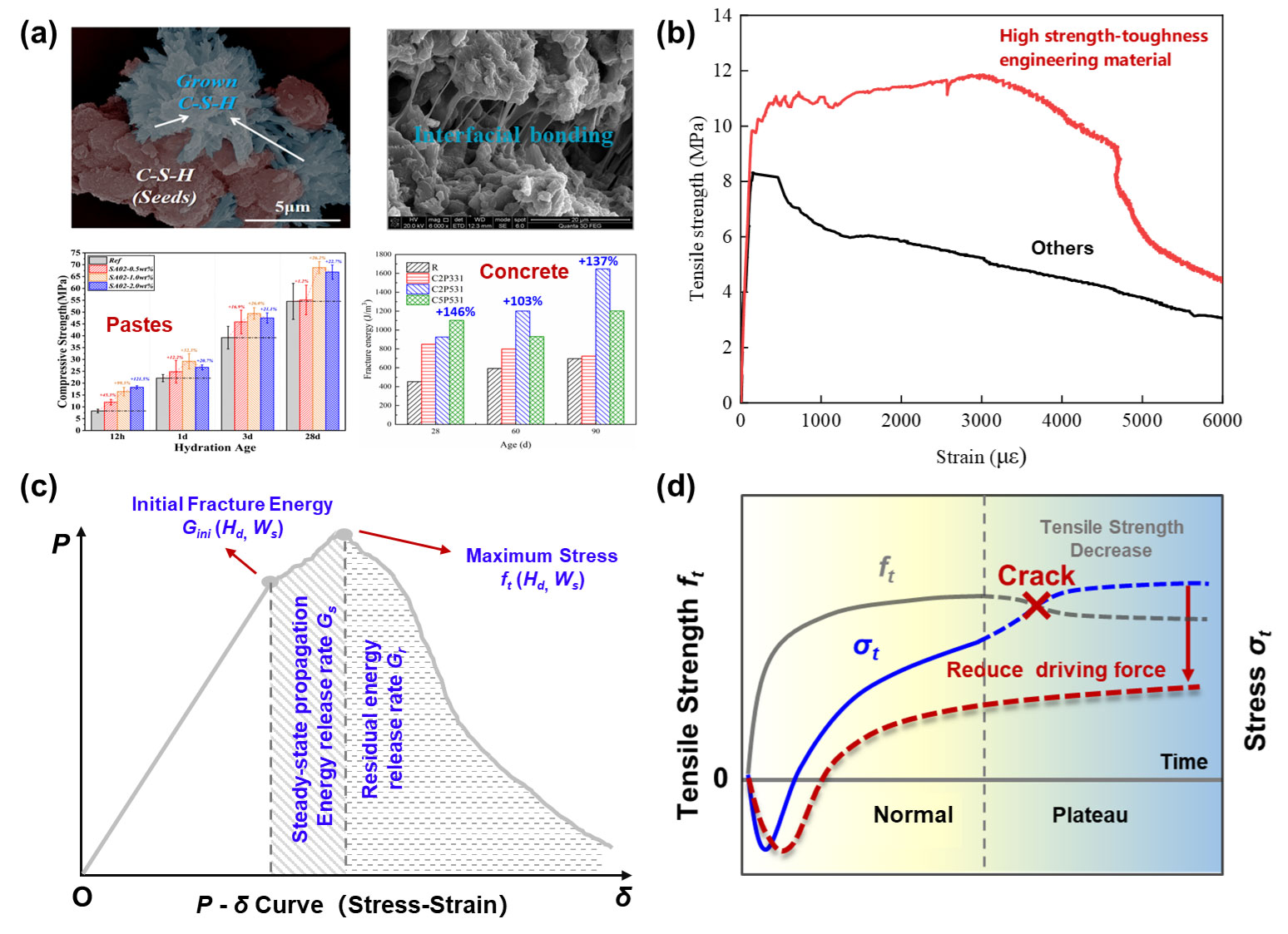
The demand for reliable and sustainable infrastructure necessitates a fundamental shift in engineering materials, moving beyond incremental improvements toward an integrated paradigm combining intrinsic performance enhancement, functional adaptability, and intelligent design. In this perspective, we highlight the key opportunities and challenges of advanced cement-based engineering materials, focusing on high strength-toughness, long-service-life, frontier engineering materials, and intelligent design. These interdependent areas collectively pave the way for a new generation of engineering materials capable of withstanding unprecedented service conditions while substantially reducing environmental impact. Infrastructure stands as the cornerstone of modern civilization, ensuring economic prosperity, public safety, and sustainable development. Rapid urbanization, climate change, and intensifying resource constraints are reshaping performance expectations of infrastructure systems, which must increasingly withstand complex loading conditions, severe service environments, and extreme scenarios from deep-sea installations to prospective lunar construction. These challenges call for a fundamental transformation in cement-based engineering materials, driving development of a new generation characterized by inherent reliability, extended service life, environmental compatibility, and resource efficiency. Breakthroughs are needed across four interdependent frontiers: collaborative enhancement of strength-toughness, ultra-long service life under harsh environments, material functionality and scalable fabrication, and AI-driven material design. Each domain will be discussed, exploring cutting-edge advances, engineering applications, and future potential in establishing a robust material foundation for major infrastructure.
Graphical Abstract
Keywords
Data Availability Statement
Funding
Conflicts of Interest
AI Use Statement
Ethical Approval and Consent to Participate
References
- Richardson, I. G. (2008). The calcium silicate hydrates. Cement and concrete research, 38(2), 137-158.
[CrossRef] [Google Scholar] - Yin, B., Hua, X., Qi, D., Han, K., Wang, P., Hou, D., & Liu, C. (2023). Multi-scale synergistic modification and mechanical properties of cement-based composites based on in-situ polymerization. Cement and Concrete Composites, 137, 104945.
[CrossRef] [Google Scholar] - Tang, J., Gao, C., Li, Y., Xu, J., Huang, J., Xu, D., ... & Liu, J. (2024). A review on multi-scale toughening and regulating methods for modern concrete: from toughening theory to practical engineering application. Research, 7, 0518.
[CrossRef] [Google Scholar] - Xu, J., Gao, C., Xiang, X., Xu, D., Tang, J., Liu, J., & Tao, Z. (2025). Synergistic acrylamide (AM) in-situ polymerization and wollastonite whisker (CS) modification towards multi-scale toughness enhancement in cement paste, mortar, and concrete. Construction and Building Materials, 494, 143559.
[CrossRef] [Google Scholar] - Wang, X. Q., Chow, C. L., & Lau, D. (2024). Multiscale perspectives for advancing sustainability in fiber reinforced ultra-high performance concrete. Npj Materials Sustainability, 2(1), 13.
[CrossRef] [Google Scholar] - Chu, Y., Guo, L. P., Dai, G. Z., Wu, J. D., Lyu, B. C., Fei, X. P., ... & Chen, B. (2024). Effects of the early curing regime on the properties and pore structure of concrete in an environment with high altitudes and low atmospheric pressures. Journal of Building Engineering, 82, 108195.
[CrossRef] [Google Scholar] - Marchon, D., & Flatt, R. J. (2016). Impact of chemical admixtures on cement hydration. In Science and technology of concrete admixtures (pp. 279-304). Woodhead Publishing.
[CrossRef] [Google Scholar] - Yao, J., Song, H., & Chen, J. (2023). Effect of temperature on damage of mortars with different supplementary cementitious materials (SCMs) under sulfate attack. Construction and Building Materials, 394, 132183.
[CrossRef] [Google Scholar] - Liu, T., Zhang, M., Zou, D., Liu, J., & Ou, J. (2024). Analysis and zonation of freeze–thaw action in the Chinese Plateau region considering spatiotemporal climate characteristics. Engineering, 42, 308-325.
[CrossRef] [Google Scholar] - Metalssi, O. O., Touhami, R. R., Barberon, F., de Lacaillerie, J. B. D. E., Roussel, N., Divet, L., & Torrenti, J. M. (2023). Understanding the degradation mechanisms of cement-based systems in combined chloride-sulfate attack. Cement and Concrete Research, 164, 107065.
[CrossRef] [Google Scholar] - Zhuang, Z., Mu, S., Guo, Z., Liu, G., Zhang, J., & Miao, C. (2024). Diffusion-reaction models for concrete exposed to chloride-sulfate attack based on porosity and water saturation. Cement and Concrete Composites, 146, 105378.
[CrossRef] [Google Scholar] - Cai, J., Ran, Q., Mu, S., Liu, J., & Hong, J. (2025). Long-term corrosion inhibition of a water-soluble silane for reinforced steel under immersion and wet-dry cycles. Journal of Building Engineering, 105, 112398.
[CrossRef] [Google Scholar] - Mu, S., Ma, Q., Cai, J., & Liu, G. (2025). Novel rebar rust inhibitor of imidazoline derivatives: Anti-corrosion performance and mechanism. Transactions of Materials Research, 1(7), 100120.
[CrossRef] [Google Scholar] - Mu, S., Wang, T., Liu, G., Jin, M., Liu, L., Tan, H., & Ma, Q. (2025). Durability evaluation and microstructure optimization of spray concrete for undersea tunnel: Role of hydrophobic agent and densifying material. Construction and Building Materials, 470, 140591.
[CrossRef] [Google Scholar] - Du, F., Jin, Z., Yang, R., Hao, M., Wang, J., Xu, G., ... & She, W. (2023). Thermally insulating and fire‐retardant bio‐mimic structural composites with a negative Poisson's ratio for battery protection. Carbon Energy, 5(12), e353.
[CrossRef] [Google Scholar] - Du, F., Zhu, W., Yang, R., Zhang, Y., Wang, J., Li, W., ... & Li, T. (2023). Bioinspired super thermal insulating, strong and low carbon cement aerogel for building envelope. Advanced Science, 10(18), 2300340.
[CrossRef] [Google Scholar] - Wang, Y., Zheng, Y., Li, W., Xiao, S., Chen, S., Xing, J., ... & Miao, C. (2025). Bio-inspired thermoelectric cement with interfacial selective immobilization towards self-powered buildings. Science Bulletin, 70(12), 1994-2003.
[CrossRef] [Google Scholar] - Liu, R., Feng, P., Liu, Z., Yuan, L., Tao, G., Yu, Z., ... & Chen, J. (2025). An innovative structural energy storage solution using fly ash-cement composites for net-zero energy buildings. Cement and Concrete Composites, 157, 105960.
[CrossRef] [Google Scholar] - Liu, Z., Feng, P., Liu, R., Yuan, L., Meng, X., Tao, G., ... & Miao, C. (2024). Integration of zinc anode and cement: unlocking scalable energy storage. National Science Review, 11(10), nwae309.
[CrossRef] [Google Scholar] - Chanut, N., Stefaniuk, D., Weaver, J. C., Zhu, Y., Shao-Horn, Y., Masic, A., & Ulm, F. J. (2023). Carbon–cement supercapacitors as a scalable bulk energy storage solution. Proceedings of the National Academy of Sciences, 120(32), e2304318120.
[CrossRef] [Google Scholar] - Li, Z., Yoon, J., Zhang, R., Rajabipour, F., Srubar III, W. V., Dabo, I., & Radlińska, A. (2022). Machine learning in concrete science: applications, challenges, and best practices. npj computational materials, 8(1), 127.
[CrossRef] [Google Scholar] - Qoku, E., Xu, K., Li, J., Monteiro, P. J., & Kurtis, K. E. (2023). Advances in imaging, scattering, spectroscopy, and machine learning-aided approaches for multiscale characterization of cementitious systems. Cement and Concrete Research, 174, 107335.
[CrossRef] [Google Scholar] - Casanova, L., Ceriani, F., Messinese, E., Paterlini, L., Beretta, S., Bolzoni, F. M., ... & Pedeferri, M. (2023). Recent advances in the use of green corrosion inhibitors to prevent chloride-induced corrosion in reinforced concrete. Materials, 16(23), 7462.
[CrossRef] [Google Scholar] - Wang, W., Zhong, Y., Liao, G., Ding, Q., Zhang, T., & Li, X. (2024). Prediction of compressive strength of concrete specimens based on interpretable machine learning. Materials, 17(15), 3661.
[CrossRef] [Google Scholar] - Hill, J., Mannodi-Kanakkithodi, A., Ramprasad, R., & Meredig, B. (2017). Materials data infrastructure and materials informatics. In Computational Materials System Design (pp. 193-225). Cham: Springer International Publishing.
[CrossRef] [Google Scholar] - Childs, C., Miller, A., Neiswanger, W., Poczos, B., Stewart, L., Kurtis, K., & Washburn, N. (2025). Bayesian machine learning for inverse design of ultra-high-performance concrete. Philosophical Transactions of the Royal Society A: Mathematical, Physical and Engineering Sciences, 383(2305).
[CrossRef] [Google Scholar] - Li, P., Chen, Y., Liu, X., Wang, X. H., Chen, F. R., Qi, Z. X., ... & Chen, G. (2023). Strengthening in gradient TiAl alloys. Journal of Materials Science & Technology, 166, 98-105.
[CrossRef] [Google Scholar] - Xiang, H., & Guo, W. (2022). Synergistic effects of twin boundary and phase boundary for enhancing ultimate strength and ductility of lamellar TiAl single crystals. International Journal of Plasticity, 150, 103197.
[CrossRef] [Google Scholar]
Cite This Article
TY  - JOUR
AU  - She, Wei
AU  - Mu, Song
AU  - Hu, Zhangli
AU  - Han, Fangyu
AU  - Yan, Yu
AU  - Liu, Jiaping
PY  - 2026
DA  - 2026/05/07
TI  - Next-Generation Cement-based Engineering Materials for Reliable and Sustainable Infrastructure
JO  - Journal of Advanced Materials Research
T2  - Journal of Advanced Materials Research
JF  - Journal of Advanced Materials Research
VL  - 2
IS  - 2
SP  - 142
EP  - 150
DO  - 10.62762/JAMR.2026.589060
UR  - https://www.icck.org/article/abs/JAMR.2026.589060
KW  - engineering material
KW  - major infrastructure
KW  - sustainability
KW  - intelligent design
AB  - The demand for reliable and sustainable infrastructure necessitates a fundamental shift in engineering materials, moving beyond incremental improvements toward an integrated paradigm combining intrinsic performance enhancement, functional adaptability, and intelligent design. In this perspective, we highlight the key opportunities and challenges of advanced cement-based engineering materials, focusing on high strength-toughness, long-service-life, frontier engineering materials, and intelligent design. These interdependent areas collectively pave the way for a new generation of engineering materials capable of withstanding unprecedented service conditions while substantially reducing environmental impact. Infrastructure stands as the cornerstone of modern civilization, ensuring economic prosperity, public safety, and sustainable development. Rapid urbanization, climate change, and intensifying resource constraints are reshaping performance expectations of infrastructure systems, which must increasingly withstand complex loading conditions, severe service environments, and extreme scenarios from deep-sea installations to prospective lunar construction. These challenges call for a fundamental transformation in cement-based engineering materials, driving development of a new generation characterized by inherent reliability, extended service life, environmental compatibility, and resource efficiency. Breakthroughs are needed across four interdependent frontiers: collaborative enhancement of strength-toughness, ultra-long service life under harsh environments, material functionality and scalable fabrication, and AI-driven material design. Each domain will be discussed, exploring cutting-edge advances, engineering applications, and future potential in establishing a robust material foundation for major infrastructure.
SN  - 3070-5851
PB  - Institute of Central Computation and Knowledge
LA  - English
ER  -
@article{She2026NextGenera,
  author = {Wei She and Song Mu and Zhangli Hu and Fangyu Han and Yu Yan and Jiaping Liu},
  title = {Next-Generation Cement-based Engineering Materials for Reliable and Sustainable Infrastructure},
  journal = {Journal of Advanced Materials Research},
  year = {2026},
  volume = {2},
  number = {2},
  pages = {142-150},
  doi = {10.62762/JAMR.2026.589060},
  url = {https://www.icck.org/article/abs/JAMR.2026.589060},
  abstract = {The demand for reliable and sustainable infrastructure necessitates a fundamental shift in engineering materials, moving beyond incremental improvements toward an integrated paradigm combining intrinsic performance enhancement, functional adaptability, and intelligent design. In this perspective, we highlight the key opportunities and challenges of advanced cement-based engineering materials, focusing on high strength-toughness, long-service-life, frontier engineering materials, and intelligent design. These interdependent areas collectively pave the way for a new generation of engineering materials capable of withstanding unprecedented service conditions while substantially reducing environmental impact. Infrastructure stands as the cornerstone of modern civilization, ensuring economic prosperity, public safety, and sustainable development. Rapid urbanization, climate change, and intensifying resource constraints are reshaping performance expectations of infrastructure systems, which must increasingly withstand complex loading conditions, severe service environments, and extreme scenarios from deep-sea installations to prospective lunar construction. These challenges call for a fundamental transformation in cement-based engineering materials, driving development of a new generation characterized by inherent reliability, extended service life, environmental compatibility, and resource efficiency. Breakthroughs are needed across four interdependent frontiers: collaborative enhancement of strength-toughness, ultra-long service life under harsh environments, material functionality and scalable fabrication, and AI-driven material design. Each domain will be discussed, exploring cutting-edge advances, engineering applications, and future potential in establishing a robust material foundation for major infrastructure.},
  keywords = {engineering material, major infrastructure, sustainability, intelligent design},
  issn = {3070-5851},
  publisher = {Institute of Central Computation and Knowledge}
}
Article Metrics
Publisher's Note
ICCK stays neutral with regard to jurisdictional claims in published maps and institutional affiliations.
Rights and Permissions
 Copyright © 2026 by the Author(s). Published by Institute of Central Computation and Knowledge. This article is an open access article distributed under the terms and conditions of the Creative Commons Attribution (CC BY) license (https://creativecommons.org/licenses/by/4.0/), which permits use, sharing, adaptation, distribution and reproduction in any medium or format, as long as you give appropriate credit to the original author(s) and the source, provide a link to the Creative Commons licence, and indicate if changes were made.


Portico
