

Molecular Junction Photocatalysts in Graphitic Carbon Nitride: Precise Characterization of Built-in Electric Fields and Challenges in Spatial Charge Separation




Article Information
Abstract
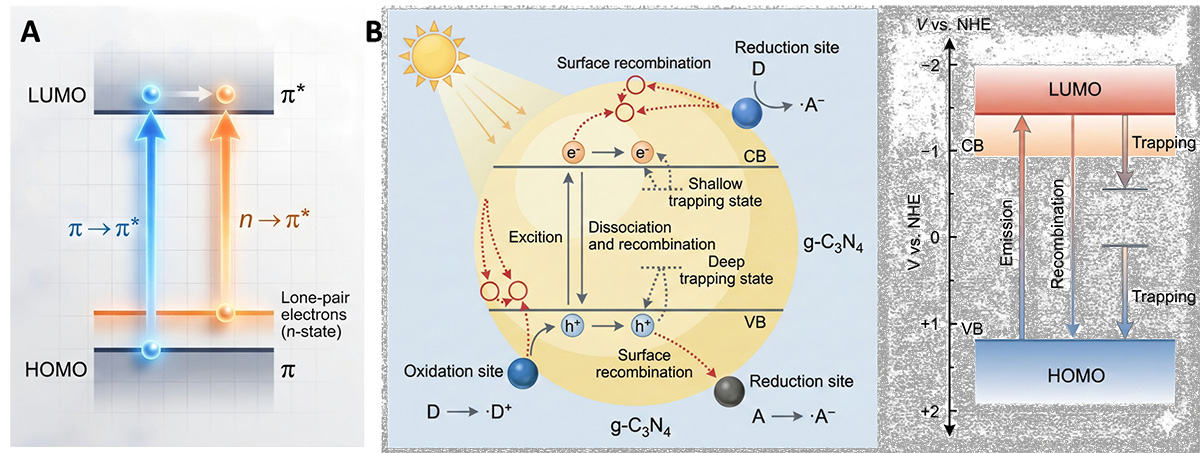
Graphitic carbon nitride (g-C$_3$N$_4$) has garnered interest as a versatile photocatalytic platform owing to its tailorable electronic architecture; however, its solar-to-chemical conversion is bottlenecked by high exciton binding energies and slow charge-carrier transport. To circumvent these impediments, the construction of ``molecular junctions'' within the conjugated polymeric scaffold enables atomically precise modulation of spatial electron configurations. Unlike conventional heterostructures relying on physical contact, molecular junctions employ robust covalent bridging, facilitating molecular orbital hybridization and $\pi$-conjugation. This review summarizes recent advances in molecular-junction-functionalized g-C$_3$N$_4$ photocatalysts, focusing on built-in electric field (BIEF) induction and its effects on charge-carrier dynamics. Molecular junctions are categorized into homojunctions exploiting structural polymorphisms and heterojunctions incorporating donor–acceptor moieties or single-atom sites. Structural asymmetry engenders steep potential gradients, mitigating exciton binding and promoting unidirectional charge migration. State-of-the-art BIEF characterization techniques—including Kelvin probe force microscopy (KPFM), density functional theory (DFT), and ultrafast transient absorption spectroscopy—are systematically examined. Finally, the catalytic efficacy of these molecular junction paradigms is assessed across solar-driven applications, including photocatalytic hydrogen evolution, overall water splitting, and hydrogen peroxide synthesis. The review concludes by outlining key bottlenecks and future directions, emphasizing atomically precise synthesis and operando characterization.
Graphical Abstract
Keywords
Data Availability Statement
Funding
Conflicts of Interest
AI Use Statement
Ethical Approval and Consent to Participate
References
- Wang, X., Maeda, K., Thomas, A., Takanabe, K., Xin, G., Carlsson, J. M., Domen, K., & Antonietti, M. (2009). A metal-free polymeric photocatalyst for hydrogen production from water under visible light. Nature Materials, 8(1), 76-80.
[CrossRef] [Google Scholar] - Babu, P., Park, H., & Park, J. Y. (2023). Surface chemistry of graphitic carbon nitride: doping and plasmonic effect, and photocatalytic applications. Surface Science and Technology, 1(1), 29.
[CrossRef] [Google Scholar] - Lu, X. J., Ullah, I., Li, J. H., Chen, S., Yuan, C. Z., & Xu, A. W. (2024). A bimetallic CoZn metal–organic-framework derived CoZnS@ NSC Co-catalyst loaded on gC 3 N 4 for significantly augmented photocatalytic H 2 evolution. Inorganic Chemistry Frontiers, 11(12), 3435-3445.
[CrossRef] [Google Scholar] - Kumar, P., Laishram, D., Sharma, R. K., Vinu, A., Hu, J., & Kibria, M. G. (2021). Boosting photocatalytic activity using carbon nitride based 2D/2D van der Waals heterojunctions. Chemistry of Materials, 33(23), 9012-9092.
[CrossRef] [Google Scholar] - Gunawan, D., Zhang, J., Li, Q., Toe, C. Y., Scott, J., Antonietti, M., ... & Amal, R. (2024). Materials advances in photocatalytic solar hydrogen production: integrating systems and economics for a sustainable future. Advanced Materials, 36(42), 2404618.
[CrossRef] [Google Scholar] - Ruan, X., Huang, C., Cheng, H., Zhang, Z., Cui, Y., Li, Z., ... & Yu, J. (2023). A twin S‐scheme artificial photosynthetic system with self‐assembled heterojunctions yields superior photocatalytic hydrogen evolution rate. Advanced Materials, 35(6), 2209141.
[CrossRef] [Google Scholar] - Panchal, P., Sharma, R., Reddy, A. S., Nehra, K., Sharma, A., & Nehra, S. P. (2023). Eco-friendly synthesis of Ag-doped ZnO/MgO as a potential photocatalyst for antimicrobial and dye degradation applications. Coordination Chemistry Reviews, 493, 215283.
[CrossRef] [Google Scholar] - Li, Z., Gao, T., Chu, H., Liao, L., Wang, X., Guo, L., ... & Zhou, W. (2024). Unraveling the nature of local field distortion-induced dual electron-trapping centers for efficient photocatalytic fuel evolution. Applied Catalysis B: Environment and Energy, 358, 124370.
[CrossRef] [Google Scholar] - Zhang, L., Li, R. H., Li, X. X., Wang, S., Liu, J., Hong, X. X., ... & Lan, Y. Q. (2024). Photocatalytic aerobic oxidation of C (sp3)-H bonds. Nature communications, 15(1), 537.
[CrossRef] [Google Scholar] - Luo, Z., Ye, X., Zhang, S., Xue, S., Yang, C., Hou, Y., ... & Wang, X. (2022). Unveiling the charge transfer dynamics steered by built-in electric fields in BiOBr photocatalysts. Nature Communications, 13(1), 2230.
[CrossRef] [Google Scholar] - Low, J., Yu, J., Jaroniec, M., Wageh, S., & Al‐Ghamdi, A. A. (2017). Heterojunction photocatalysts. Advanced materials, 29(20), 1601694.
[CrossRef] [Google Scholar] - Wang, H., Zhang, L., Chen, Z., Hu, J., Li, S., Wang, Z., ... & Wang, X. (2014). Semiconductor heterojunction photocatalysts: design, construction, and photocatalytic performances. Chemical Society Reviews, 43(15), 5234-5244.
[CrossRef] [Google Scholar] - Liu, J., Jin, L., Dai, Z., Ji, Y., Qian, J., Lu, Y., ... & Zhai, J. (2025). Single atom embedding enhanced macroscopic polarization in carbon nitride nanosheets for pH-universal Piezo-photocatalytic nitrate reduction over a wide concentration range. ACS Catalysis, 15(5), 4025-4038.
[CrossRef] [Google Scholar] - Bi, F., Su, Y., Zhang, Y., Chen, M., Darr, J. A., Weng, X., & Wu, Z. (2022). Vacancy-defect semiconductor quantum dots induced an S-scheme charge transfer pathway in 0D/2D structures under visible-light irradiation. Applied Catalysis B: Environmental, 306, 121109.
[CrossRef] [Google Scholar] - Kofuji, Y., Ohkita, S., Shiraishi, Y., Sakamoto, H., Tanaka, S., Ichikawa, S., & Hirai, T. (2016). Graphitic carbon nitride doped with biphenyl diimide: efficient photocatalyst for hydrogen peroxide production from water and molecular oxygen by sunlight. Acs Catalysis, 6(10), 7021-7029.
[CrossRef] [Google Scholar] - Kofuji, Y., Ohkita, S., Shiraishi, Y., Sakamoto, H., Ichikawa, S., Tanaka, S., & Hirai, T. (2017). Mellitic triimide-doped carbon nitride as sunlight-driven photocatalysts for hydrogen peroxide production. ACS Sustainable Chemistry & Engineering, 5(8), 6478-6485.
[CrossRef] [Google Scholar] - Kofuji, Y., Isobe, Y., Shiraishi, Y., Sakamoto, H., Ichikawa, S., Tanaka, S., & Hirai, T. (2018). Hydrogen peroxide production on a carbon nitride–boron nitride‐reduced graphene oxide hybrid photocatalyst under visible light. ChemCatChem, 10(9), 2070-2077.
[CrossRef] [Google Scholar] - Fang, X., Gao, R., Yang, Y., & Yan, D. (2019). A cocrystal precursor strategy for carbon-rich graphitic carbon nitride toward high-efficiency photocatalytic overall water splitting. Iscience, 16, 22-30.
[CrossRef] [Google Scholar] - Pan, Z., Niu, P., Liu, M., Zhang, G., Zhu, Z., & Wang, X. (2020). Molecular junctions on polymeric carbon nitrides with enhanced photocatalytic performance. ChemSusChem, 13(5), 888-892.
[CrossRef] [Google Scholar] - Pan, Z., Liu, M., Zhang, G., Zhuzhang, H., & Wang, X. (2021). Molecular triazine–heptazine junctions promoting exciton dissociation for overall water splitting with visible light. The Journal of Physical Chemistry C, 125(18), 9818-9826.
[CrossRef] [Google Scholar] - Li, Y., Jiang, Z., Dong, G., & Ho, W. (2022). Construction and Activity of an All‐Organic Heterojunction Photocatalyst Based on Melem and Pyromellitic Dianhydride. ChemSusChem, 15(12), e202200477.
[CrossRef] [Google Scholar] - Chang, J. N., Li, Q., Shi, J. W., Zhang, M., Zhang, L., Li, S., ... & Lan, Y. Q. (2023). Oxidation‐reduction molecular junction covalent organic frameworks for full reaction photosynthesis of H2O2. Angewandte Chemie, 135(9), e202218868.
[CrossRef] [Google Scholar] - Yang, M. Y., Zhang, S. B., Zhang, M., Li, Z. H., Liu, Y. F., Liao, X., ... & Lan, Y. Q. (2024). Three-motif molecular junction type covalent organic frameworks for efficient photocatalytic aerobic oxidation. Journal of the American Chemical Society, 146(5), 3396-3404.
[CrossRef] [Google Scholar] - Xiao, T., Li, K., Tang, J., Xu, Y., Li, Z., Du, R., ... & Wu, M. (2025). Achieving Efficient Solar Hydrogen Production via a Three-Motif Molecular Junction with Spatially Separated Dual Reduction Sites. ACS nano, 19(36), 32891-32908.
[CrossRef] [Google Scholar] - Yan, Y., Zhou, T., Liu, C., Hu, B., & Che, G. (2025). Dual-pathway photosynthesis H2O2 realized by carbon nitride with strong built-in electric field and awakened n-π* electron transition: Based on theoretical calculation guidance. Chemical Engineering Journal, 516, 164108.
[CrossRef] [Google Scholar] - Yang, H., Sun, S., Yang, Q., Chen, A., & Cui, J. (2025). Emerging In‐Plane Junctions in Graphitic Carbon Nitride for Remarkably Enhanced Photocatalysis. Advanced Functional Materials, 35(52), e10882.
[CrossRef] [Google Scholar] - Zhao, D., Wang, Y., Dong, C. L., Meng, F., Huang, Y. C., Zhang, Q., ... & Shen, S. (2022). Electron-deficient Zn-N6 configuration enabling polymeric carbon nitride for visible-light photocatalytic overall water splitting. Nano-Micro Letters, 14(1), 223.
[CrossRef] [Google Scholar] - Lin, J., Tian, W., Zhang, H., Sun, H., & Wang, S. (2024). Electronic structure and functions of carbon nitride in frontier green catalysis. Accounts of chemical research, 57(16), 2303-2315.
[CrossRef] [Google Scholar] - Pei, J., Li, H., Yu, D., & Zhang, D. (2024). g-C3N4-based heterojunction for enhanced photocatalytic performance: a review of fabrications, applications, and perspectives. Catalysts, 14(11), 825.
[CrossRef] [Google Scholar] - Li, Y., Zhou, M., Cheng, B., & Shao, Y. (2020). Recent advances in g-C3N4-based heterojunction photocatalysts. Journal of Materials Science & Technology, 56, 1-17.
[CrossRef] [Google Scholar] - Che, W., Zhao, S., Byun, W. J., Tao, T., Jeon, J. P., Zhao, Q., ... & Baek, J. B. (2025). From carbon nitrides to COFs: Opportunities and prospects in photocatalytic CO2 reduction. Advanced Materials, 37(45), e06961.
[CrossRef] [Google Scholar] - Zhang, L., Li, R. H., Li, X. X., Liu, J., Guan, W., Dong, L. Z., ... & Lan, Y. Q. (2022). Molecular oxidation-reduction junctions for artificial photosynthetic overall reaction. Proceedings of the National Academy of Sciences, 119(40), e2210550119.
[CrossRef] [Google Scholar] - Liang, H., Xu, Q., Cheng, R., Jing, S., Chen, F., & Tsiakaras, P. (2025). Triggering n→ π* electronic transitions by thiazole modified graphitic carbon nitride for enhanced photocatalytic hydrogen peroxide production and Rhodamine B degradation. Carbon, 120603.
[CrossRef] [Google Scholar] - Ye, Q., Yang, R., Huang, L., Li, Q., Zhang, Q., Li, D., ... & Jiang, D. (2023). Bridging engineering of polymeric carbon nitride for boosting photocatalytic CO2 reduction. Journal of Colloid and Interface Science, 652, 813-824.
[CrossRef] [Google Scholar] - Li, J., Zhang, H., Li, Y., Wu, S., Wei, S., Zhang, F., ... & Xiao, H. (2025). Asymmetrical intra-molecular junction enables redox active sites on bio-decorated carbon nitride toward H2O2 photosynthesis. Chemical Engineering Journal, 519, 165018.
[CrossRef] [Google Scholar] - Li, K., Xiao, T., Tang, J., Du, R., Tu, J., Xie, F., ... & Wu, M. (2025). Synergetic non-covalent and covalent functionalization of carbon nitride with donor-acceptor molecules for enhanced photocatalytic hydrogen evolution performance. Applied Catalysis B: Environment and Energy, 371, 125201.
[CrossRef] [Google Scholar] - Nesaragi, A. R., Dongre, S., Iqbal, A., Thapa, R., Balakrishna, R. G., & Patil, S. A. (2025). Graphitic-carbon nitride immobilized Schiff base Palladium (II): Highly efficient electrocatalyst for hydrogen evolution reaction and density functional theory calculations. International Journal of Hydrogen Energy, 117, 314-324.
[CrossRef] [Google Scholar] - Zhou, J., Li, J., Kan, L., Zhang, L., Huang, Q., Yan, Y., ... & Lan, Y. Q. (2022). Linking oxidative and reductive clusters to prepare crystalline porous catalysts for photocatalytic CO2 reduction with H$_2$O. Nature Communications, 13(1), 4681.
[CrossRef] [Google Scholar] - Yang, J., Wu, Z., He, B., & She, W. (2026). Superhydrophobic Surface for Ice Mitigation: Mechanisms, Fabrication Strategies, and Applications. Journal of Advanced Materials Research, 2(1), 14-39.
[CrossRef] [Google Scholar] - Li, J. L., Deng, X. Y., Chen, J., Fu, P. X., Tian, S. Y., Wang, Y., ... & Lei, T. (2025). Cationic conjugated polymers with enhanced doped-state planarity for n-type organic thermoelectrics. CCS Chemistry, 7(5), 1449-1458.
[CrossRef] [Google Scholar] - Bisquert, J. (2002). Theory of the impedance of electron diffusion and recombination in a thin layer. The Journal of Physical Chemistry B, 106(2), 325-333.
[CrossRef] [Google Scholar] - Li, Y., Gong, F., Zhou, Q., Feng, X., Fan, J., & Xiang, Q. (2020). Crystalline isotype heptazine-/triazine-based carbon nitride heterojunctions for an improved hydrogen evolution. Applied Catalysis B: Environmental, 268, 118381.
[CrossRef] [Google Scholar] - Ruan, X., Cui, X., Jia, G., Wu, J., Zhao, J., Singh, D. J., ... & Zheng, W. (2022). Intramolecular heterostructured carbon nitride with heptazine-triazine for enhanced photocatalytic hydrogen evolution. Chemical Engineering Journal, 428, 132579.
[CrossRef] [Google Scholar] - Chen, X., Li, X., Wu, J., Fang, C., Ding, J., Wan, H., & Guan, G. (2022). Boosting photocatalytic H$_2$ evolution by ingenious construction of isotype heptazine/triazine based porous carbon nitride heterojunction. Separation and Purification Technology, 297, 121490.
[CrossRef] [Google Scholar] - Yang, J., Liang, Y., Li, K., Yang, G., Wang, K., Xu, R., & Xie, X. (2020). One-step synthesis of novel K+ and cyano groups decorated triazine-/heptazine-based g-C3N4 tubular homojunctions for boosting photocatalytic H2 evolution. Applied Catalysis B: Environmental, 262, 118252.
[CrossRef] [Google Scholar] - Xia, J., Mark, G., Tong, Y., Hu, T., Volokh, M., Han, F., ... & Shalom, M. (2024). Enhancing the Activity of a Carbon Nitride Photocatalyst by Constructing a Triazine–Heptazine Homojunction. Inorganic Chemistry, 63(21), 10050-10056.
[CrossRef] [Google Scholar] - Zhang, Y., Cao, Q., Meng, A., Wu, X., Xiao, Y., Su, C., & Zhang, Q. (2023). Molecular heptazine–triazine junction over carbon nitride frameworks for artificial photosynthesis of hydrogen peroxide. Advanced Materials, 35(48), 2306831.
[CrossRef] [Google Scholar] - Han, S. G., Zhang, M., Fu, Z. H., Zheng, L., Ma, D. D., Wu, X. T., & Zhu, Q. L. (2022). Enzyme-inspired microenvironment engineering of a single-molecular heterojunction for promoting concerted electrochemical CO$_2$ reduction. Advanced Materials, 34(34), 2202830.
[CrossRef] [Google Scholar] - Roncali, J. (2009). Molecular bulk heterojunctions: An emerging approach to organic solar cells. Accounts of Chemical Research, 42(11), 1719-1730.
[CrossRef] [Google Scholar] - Li, L., Zhou, Z., Shi, Y., Tang, R., Li, W., Deng, Y., & Huang, Y. (2025). Donor–acceptor type carbon nitride photocatalysts in photocatalysis: current understanding, applications and challenges. Small, 21(8), 2409903.
[CrossRef] [Google Scholar] - Yang, C., Wan, S., Zhu, B., Yu, J., & Cao, S. (2022). Calcination-regulated microstructures of donor-acceptor polymers towards enhanced and stable photocatalytic H2O2 production in pure water. Angewandte Chemie International Edition, 61(39), e202208438.
[CrossRef] [Google Scholar] - Wang, L., Liu, L., Li, Y., Xu, Y., Nie, W., Cheng, Z., ... & Fan, Z. (2024). Molecular‐level regulation strategies toward efficient charge separation in donor-acceptor type conjugated polymers for boosted energy‐related photocatalysis. Advanced Energy Materials, 14(5), 2303346.
[CrossRef] [Google Scholar] - Hu, Y., Zhang, S., Zhang, Z., Zhou, H., Li, B., Sun, Z., ... & Wang, S. (2023). Enhancing photocatalytic-transfer semi-hydrogenation of alkynes over Pd/C3N4 through dual regulation of nitrogen defects and the Mott–Schottky effect. Advanced Materials, 35(41), 2304130.
[CrossRef] [Google Scholar] - Rao, S., Lu, Z., Xie, J., Li, Z., Liu, H., Yu, X., ... & Yang, J. (2024). Atomic Zn–N4 site-regulated donor–acceptor catalyst for boosting photocatalytic bactericidal activity. Nano Letters, 24(49), 15598-15606.
[CrossRef] [Google Scholar] - Xie, Z. K., Jia, Y. J., Huang, Y. Y., Xu, D. B., Wu, X. J., Chen, M., & Shi, W. D. (2023). Near-infrared light-driven photocatalytic reforming lignocellulose into H2 and chemicals over heterogeneous carbon nitride. ACS Catalysis, 13(20), 13768-13776.
[CrossRef] [Google Scholar] - Zhang, Z., Ren, L., Li, H., Jiang, D., Fang, Y., Du, H., ... & Yuan, Y. (2023). π‐conjugated in-plane heterostructure enables long-lived shallow trapping in graphitic carbon nitride for increased photocatalytic hydrogen generation. Small, 19(18), 2207173.
[CrossRef] [Google Scholar] - Jia, G., Wang, Y., Cui, X., Yang, Z., Liu, L., Zhang, H., ... & Zheng, W. (2019). Asymmetric embedded benzene ring enhances charge transfer of carbon nitride for photocatalytic hydrogen generation. Applied Catalysis B: Environmental, 258, 117959.
[CrossRef] [Google Scholar] - Shan, T., Wang, Y., Luo, D., Huang, Z., Zhang, F., Wu, H., ... & Xiao, H. (2024). Extended H-bonds/π-bonds networks for boosting electron transfer over polydopamine-covered nanocellulose/g-C3N4 toward efficient photocatalytic H2O2 production. Applied Catalysis B: Environment and Energy, 349, 123872.
[CrossRef] [Google Scholar] - Shan, T., Li, J., Wu, S., Wu, H., Zhang, F., Liao, G., ... & Chen, L. (2023). Boosting H2O2 production over carboxymethyl cellulose modified g-C3N4 via hydrogen-bonding-assisted charge transfer. Chemical Engineering Journal, 478, 147509.
[CrossRef] [Google Scholar] - Li, J., Zhan, G., Yu, Y., & Zhang, L. (2016). Superior visible light hydrogen evolution of Janus bilayer junctions via atomic-level charge flow steering. Nature Communications, 7(1), 11480.
[CrossRef] [Google Scholar] - Ruan, Q., Miao, T., Wang, H., & Tang, J. (2020). Insight on shallow trap states-introduced photocathodic performance in n-type polymer photocatalysts. Journal of the American Chemical Society, 142(6), 2795-2802.
[CrossRef] [Google Scholar] - Kosco, J., Gonzalez-Carrero, S., Howells, C. T., Fei, T., Dong, Y., Sougrat, R., ... & McCulloch, I. (2022). Generation of long-lived charges in organic semiconductor heterojunction nanoparticles for efficient photocatalytic hydrogen evolution. Nature Energy, 7(4), 340-351.
[CrossRef] [Google Scholar] - Godin, R., Wang, Y., Zwijnenburg, M. A., Tang, J., & Durrant, J. R. (2017). Time-resolved spectroscopic investigation of charge trapping in carbon nitrides photocatalysts for hydrogen generation. Journal of the American Chemical Society, 139(14), 5216-5224.
[CrossRef] [Google Scholar] - Lin, H., Wang, J., Zhao, J., Zhuang, Y., Liu, B., Zhu, Y., ... & Long, J. (2022). Molecular dipole‐induced photoredox catalysis for hydrogen evolution over self‐assembled naphthalimide nanoribbons. Angewandte Chemie International Edition, 61(12), e202117645.
[CrossRef] [Google Scholar] - Corp, K. L., & Schlenker, C. W. (2017). Ultrafast spectroscopy reveals electron-transfer cascade that improves hydrogen evolution with carbon nitride photocatalysts. Journal of the American Chemical Society, 139(23), 7904-7912.
[CrossRef] [Google Scholar] - Zhang, P., Sun, D., Cho, A., Weon, S., Lee, S., Lee, J., ... & Choi, W. (2019). Modified carbon nitride nanozyme as bifunctional glucose oxidase-peroxidase for metal-free bioinspired cascade photocatalysis. Nature communications, 10(1), 940.
[CrossRef] [Google Scholar] - Bahruji, H., Bowker, M., Davies, P. R., Al-Mazroai, L. S., Dickinson, A., Greaves, J., ... & Pedrono, F. (2010). Sustainable H$_2$ gas production by photocatalysis. Journal of Photochemistry and Photobiology A: Chemistry, 216(2-3), 115-118.
[CrossRef] [Google Scholar] - Frei, H. (2017). Photocatalytic fuel production. Current Opinion in Electrochemistry, 2(1), 128-135.
[CrossRef] [Google Scholar] - Nishioka, S., Osterloh, F. E., Wang, X., Mallouk, T. E., & Maeda, K. (2023). Photocatalytic water splitting. Nature Reviews Methods Primers, 3(1), 42.
[CrossRef] [Google Scholar] - Villa, K., Galán-Mascarós, J. R., López, N., & Palomares, E. (2021). Photocatalytic water splitting: advantages and challenges. Sustainable Energy & Fuels, 5(18), 4560-4569.
[CrossRef] [Google Scholar] - Hu, W., Lin, L., Zhang, R., Yang, C., & Yang, J. (2017). Highly efficient photocatalytic water splitting over edge-modified phosphorene nanoribbons. Journal of the American Chemical Society, 139(43), 15429-15436.
[CrossRef] [Google Scholar] - Shu, C., Yang, X., Liu, L., Hu, X., Sun, R., Yang, X., ... & Wang, X. (2024). Mixed‐linker strategy for the construction of sulfone‐containing D–A–A covalent organic frameworks for efficient photocatalytic hydrogen peroxide production. Angewandte Chemie International Edition, 63(22), e202403926.
[CrossRef] [Google Scholar] - Nie, L., Chen, H., Wang, J., Yang, Y., & Fang, C. (2024). Enhanced visible-light H2O2 production over Pt/g-C3N4 Schottky junction photocatalyst. Inorganic Chemistry, 63(10), 4770-4782.
[CrossRef] [Google Scholar] - Wang, L., Sun, J., Cheng, B., He, R., & Yu, J. (2023). S-scheme heterojunction photocatalysts for H2O2 production. The Journal of Physical Chemistry Letters, 14(20), 4803-4814.
[CrossRef] [Google Scholar] - Zhao, J., Wang, L., Zhou, T., Yan, Y., Sun, J., Hu, B., ... & Che, G. (2025). Molecularly tunable donor–acceptor integrated carbon nitride for sunlight-driven H2O2 synthesis: Mechanism and performance insights. Small, 21(17), 2500679.
[CrossRef] [Google Scholar] - Windle, C. D., & Perutz, R. N. (2012). Advances in molecular photocatalytic and electrocatalytic CO2 reduction. Coordination Chemistry Reviews, 256(21-22), 2562–2570.
[CrossRef] [Google Scholar] - Xie, W., Ce, M., Chen, T., Liu, X. H., Yan, H., Zhang, X., ... & Huang, H. (2026). Reversing V=O orientation of vanadyl phthalocyanine as ``molecular switch'' on carbon nitride boosts CO2 photoreduction. Angewandte Chemie, e23201.
[CrossRef] [Google Scholar] - Nosaka, Y., & Nosaka, A. Y. (2017). Generation and detection of reactive oxygen species in photocatalysis. Chemical Reviews, 117(17), 11302-11336.
[CrossRef] [Google Scholar] - Wang, D., Chen, S., Lai, S., Dai, W., Yang, L., Deng, L., ... & Luo, S. L. (2023). Advanced municipal wastewater treatment and simultaneous energy/resource recovery via photo (electro) catalysis. Chinese Chemical Letters, 34(5), 107861.
[CrossRef] [Google Scholar] - Ran, B., Ran, L., Wang, Z., Liao, J., Li, D., Chen, K., ... & Peng, X. (2023). Photocatalytic antimicrobials: principles, design strategies, and applications. Chemical reviews, 123(22), 12371-12430.
[CrossRef] [Google Scholar] - Li, H., Cheng, Z., Zhou, Z., Hu, C., Ye, J., Huang, D., ... & Li, J. (2026). High Luminous Efficacy and Thermal Stability of LuAG: Ce Phosphor Ceramics with Porosity for High-brightness Laser Lighting. Journal of Advanced Materials Research, 2(2), 86-96.
[CrossRef] [Google Scholar] - Guo, Q., Wei, M., Zheng, Z., Huang, X., Song, X., Qiu, S. B., ... & Dong, G. (2019). Full-color chemically modulated g-C3N4 for white-light-emitting device. Advanced Optical Materials, 7(21), 1900775.
[CrossRef] [Google Scholar]
Cited By (5)
-
Zimu Zhang, Qiutong Han, Xiaotian Yang, Peiting Hao, Haoqiang Chi, Tingting Cheng, Yubin Zheng, Wentao Hou, Zhigang Zou, Yong Zhou. UV-laser-induced oxygen vacancy engineering of In(OH)3 for boosted CO2 photoreduction.
Catalysis Science & Technology, 2026 , 16 (11).
[CrossRef] -
Qunhua Zhong, Qin Li, Ran Yang, Zhanzhen Ma, Sirui Liu, Yingxue Cui, Huachen Lin, Di Li. Constructing Carbon Nitride Donor–Acceptor Structures by Vacancy Engineering and Sulfone‐Containing Molecule Grafting for Photocatalytic CO2 Reduction.
ChemSusChem, 2026 , 19 (11).
[CrossRef] -
Junnan Qu, Kaichi Chen, Jinhao Chen, Jiahao Lei, Zhicheng Zheng, Jingxuan Ren, Beinuo Zhang, Yukun Fang, Huiwen Lin, Yanmei Zheng, Xinli Guo. Phosphate-induced polarization and defect engineering synergized with interfacial activation for dual-pathway H2O2 photosynthesis.
Chemical Engineering Journal, 2026 , 541 .
[CrossRef] -
Juan Long, Gui Yang, Yang Wu, Lin Wang, Yawen Xiao, Shiping Zhang, Huachao Che, Juhong Zhan, Xiaoyong Wu, Bin Huang, Fengzhi Jiang, Shaowen Cao, Xuejun Pan. Synergistic Na-K dual active sites on ultrathin g-C3N5 nanosheets boost electron delocalization for natural-oxygen-condition H2O2 photosynthesis.
Applied Catalysis B: Environment and Energy, 2026 , 398 .
[CrossRef] -
Shuya Zhang, Zhenyu An, Jingling Yang, Xin Guo, Yafeng Liu, Zhiliang Jin. Non‐Metallic Molecular Engineering of Anthraquinone‐grafted G‐C3N4: Constructing an Internal Electric Field for Efficient Photocatalytic Hydrogen Evolution.
Advanced Sustainable Systems, 2026 , 10 (8).
[CrossRef]
Cite This Article
TY  - JOUR
AU  - Chen, Kaichi
AU  - Zheng, Zhicheng
AU  - Fang, Yukun
AU  - Liu, Yuanyuan
AU  - Guo, Xinli
PY  - 2026
DA  - 2026/04/03
TI  - Molecular Junction Photocatalysts in Graphitic Carbon Nitride: Precise Characterization of Built-in Electric Fields and Challenges in Spatial Charge Separation
JO  - Journal of Advanced Materials Research
T2  - Journal of Advanced Materials Research
JF  - Journal of Advanced Materials Research
VL  - 2
IS  - 2
SP  - 119
EP  - 141
DO  - 10.62762/JAMR.2026.848022
UR  - https://www.icck.org/article/abs/JAMR.2026.848022
KW  - graphitic carbon nitride
KW  - molecular junction
KW  - photocatalysis
KW  - built-in electric field
KW  - spatial charge separation
AB  - Graphitic carbon nitride (g-C$_3$N$_4$) has garnered interest as a versatile photocatalytic platform owing to its tailorable electronic architecture; however, its solar-to-chemical conversion is bottlenecked by high exciton binding energies and slow charge-carrier transport. To circumvent these impediments, the construction of ``molecular junctions'' within the conjugated polymeric scaffold enables atomically precise modulation of spatial electron configurations. Unlike conventional heterostructures relying on physical contact, molecular junctions employ robust covalent bridging, facilitating molecular orbital hybridization and $\pi$-conjugation. This review summarizes recent advances in molecular-junction-functionalized g-C$_3$N$_4$ photocatalysts, focusing on built-in electric field (BIEF) induction and its effects on charge-carrier dynamics. Molecular junctions are categorized into homojunctions exploiting structural polymorphisms and heterojunctions incorporating donor–acceptor moieties or single-atom sites. Structural asymmetry engenders steep potential gradients, mitigating exciton binding and promoting unidirectional charge migration. State-of-the-art BIEF characterization techniques—including Kelvin probe force microscopy (KPFM), density functional theory (DFT), and ultrafast transient absorption spectroscopy—are systematically examined. Finally, the catalytic efficacy of these molecular junction paradigms is assessed across solar-driven applications, including photocatalytic hydrogen evolution, overall water splitting, and hydrogen peroxide synthesis. The review concludes by outlining key bottlenecks and future directions, emphasizing atomically precise synthesis and operando characterization.
SN  - 3070-5851
PB  - Institute of Central Computation and Knowledge
LA  - English
ER  -
@article{Chen2026Molecular,
  author = {Kaichi Chen and Zhicheng Zheng and Yukun Fang and Yuanyuan Liu and Xinli Guo},
  title = {Molecular Junction Photocatalysts in Graphitic Carbon Nitride: Precise Characterization of Built-in Electric Fields and Challenges in Spatial Charge Separation},
  journal = {Journal of Advanced Materials Research},
  year = {2026},
  volume = {2},
  number = {2},
  pages = {119-141},
  doi = {10.62762/JAMR.2026.848022},
  url = {https://www.icck.org/article/abs/JAMR.2026.848022},
  abstract = {Graphitic carbon nitride (g-C\$\_3\$N\$\_4\$) has garnered interest as a versatile photocatalytic platform owing to its tailorable electronic architecture; however, its solar-to-chemical conversion is bottlenecked by high exciton binding energies and slow charge-carrier transport. To circumvent these impediments, the construction of ``molecular junctions'' within the conjugated polymeric scaffold enables atomically precise modulation of spatial electron configurations. Unlike conventional heterostructures relying on physical contact, molecular junctions employ robust covalent bridging, facilitating molecular orbital hybridization and \$\pi\$-conjugation. This review summarizes recent advances in molecular-junction-functionalized g-C\$\_3\$N\$\_4\$ photocatalysts, focusing on built-in electric field (BIEF) induction and its effects on charge-carrier dynamics. Molecular junctions are categorized into homojunctions exploiting structural polymorphisms and heterojunctions incorporating donor–acceptor moieties or single-atom sites. Structural asymmetry engenders steep potential gradients, mitigating exciton binding and promoting unidirectional charge migration. State-of-the-art BIEF characterization techniques—including Kelvin probe force microscopy (KPFM), density functional theory (DFT), and ultrafast transient absorption spectroscopy—are systematically examined. Finally, the catalytic efficacy of these molecular junction paradigms is assessed across solar-driven applications, including photocatalytic hydrogen evolution, overall water splitting, and hydrogen peroxide synthesis. The review concludes by outlining key bottlenecks and future directions, emphasizing atomically precise synthesis and operando characterization.},
  keywords = {graphitic carbon nitride, molecular junction, photocatalysis, built-in electric field, spatial charge separation},
  issn = {3070-5851},
  publisher = {Institute of Central Computation and Knowledge}
}
Publisher's Note
ICCK stays neutral with regard to jurisdictional claims in published maps and institutional affiliations.
Rights and Permissions
 Copyright © 2026 by the Author(s). Published by Institute of Central Computation and Knowledge. This article is an open access article distributed under the terms and conditions of the Creative Commons Attribution (CC BY) license (https://creativecommons.org/licenses/by/4.0/), which permits use, sharing, adaptation, distribution and reproduction in any medium or format, as long as you give appropriate credit to the original author(s) and the source, provide a link to the Creative Commons licence, and indicate if changes were made.


Portico
