

Shaping the Future of Underground Monitoring with Carbon-fiber Self-sensing Smart Materials




Article Information
Abstract
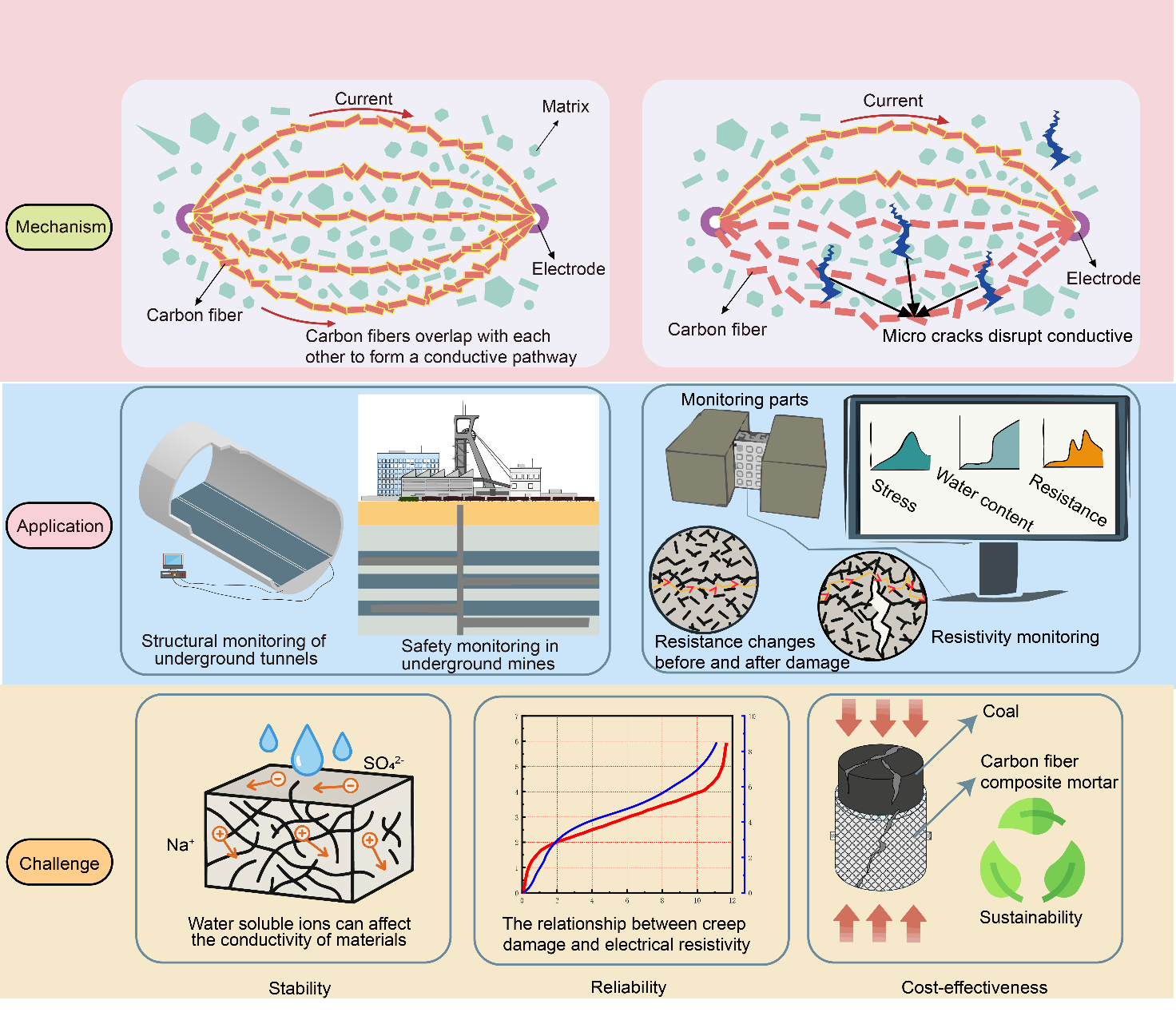
Amid global warming, energy shortages, and the increasing frequency of extreme climate events, the development of sustainable and intelligent underground infrastructure has become a critical strategy for addressing major societal challenges. Unlike surface structures, underground infrastructures are subjected to high stress, dynamic loading, and groundwater erosion. Under such conditions, traditional cement-based materials are prone to strength degradation, fatigue damage, and permeability failure, which significantly limits the service life and operational safety of underground constructions. Incorporating short carbon fibers into cement-based materials not only enhances their mechanical strength but also enables real-time monitoring of internal stress, deformation, and damage states through changes in the electrical resistivity of the carbon fiber network. The application of this material in underground engineering leverages its dual functions of structural reinforcement and damage monitoring, realizing the concept of "material as a sensor." However, several challenges remain in the practical application of this material. First, groundwater erosion may affect the stability of the mechanical and damage monitoring performance of carbon fiber composites. Second, the reliability of its damage monitoring performance under long-term high-stress environments has yet to be verified. Additionally, large-scale engineering applications must also consider the economic feasibility of the material. Conducting in-depth research in these areas will vigorously promote the large-scale application of carbon fiber composites in high-stress and water-bearing underground environments, providing key technical support for the long-term safe operation of engineering structures.
Graphical Abstract
Keywords
Data Availability Statement
Funding
Conflicts of Interest
Ethical Approval and Consent to Participate
References
- Yang, Z., Zhang, R., Ai, T., Lv, Y., Zhang, Z., Xie, J., & ... (2024). Triaxial failure behavior and microfracture source time–frequency characteristics of marble under in situ stress conditions at different depths considering engineering disturbance. Measurement, 237, 115274.
[CrossRef] [Google Scholar] - Xue, Y., Kong, F., Yang, W., Qiu, D., Su, M., Fu, K., & ... (2020). Main unfavorable geological conditions and engineering geological problems along Sichuan-Tibet railway. Chinese Journal of Rock Mechanics and Engineering, 39(3), 445–468.
[CrossRef] [Google Scholar] - Xu, J., Gao, M., Wang, Y., Yu, Z., Zhao, J., & DeJong, M. J. (2025). Numerical investigation of the effects of separated footings on tunnel-soil-structure interaction. Journal of Geotechnical and Geoenvironmental Engineering, 151(7), 04025057.
[CrossRef] [Google Scholar] - Sithole, S. M., van Laar, J. H., Gous, A. G. S., & Schutte, C. S. L. (2025). A constructive method to improve mine tertiary cooling systems planning and efficiency evaluation. Applied Thermal Engineering, 279, 127768.
[CrossRef] [Google Scholar] - Gao, G., & Meguid, M. A. (2022). Microscale characterization of fracture growth in increasingly jointed rock samples. Rock Mechanics and Rock Engineering, 55(10), 6033–6061.
[CrossRef] [Google Scholar] - Liu, Z., Zhang, Y., Liu, G., Wang, Y., Yu, W., & Jiang, J. (2025). Damage evolution of UHPC under coupled high stress, temperature, and osmotic pressure: New multi-field experiment and non-destructive techniques. Powder Technology, 455, 120793.
[CrossRef] [Google Scholar] - Singh, A. K., Ram, S., Kumar, A., Waclawik, P., & Kukutsch, R. (2024). Stability study of coal pillars due to induced stress-driven spalling during development and mechanised depillaring at different depths of cover. Canadian Geotechnical Journal, 62, 1-16.
[CrossRef] [Google Scholar] - Gao, G., Meguid, M. A., & Zhang, L. (2024). Exploring the role of sample size on fracture growth mechanisms in intact rock: insights from 3D DEM-DFN analysis. Canadian Geotechnical Journal, 62(1), 1–24.
[CrossRef] [Google Scholar] - Shen, B., Duan, Y., Luo, X., Werken, M. V. D., Dlamini, B., Chen, L., & ... (2020). Monitoring and modelling stress state near major geological structures in an underground coal mine for coal burst assessment. International Journal of Rock Mechanics and Mining Sciences, 129, 104294.
[CrossRef] [Google Scholar] - Mngadi, S. B., Durrheim, R. J., Manzi, M. S. D., Ogasawara, H., Yabe, Y., Yilmaz, H., & ... (2019). Integration of underground mapping, petrology, and high-resolution microseismicity analysis to characterise weak geotechnical zones in deep South African gold mines. International Journal of Rock Mechanics and Mining Sciences, 114, 79–91.
[CrossRef] [Google Scholar] - Xu, W., Ma, C., Li, T., Shi, S., Peng, F., Chen, Z., & ... (2025). Dynamic interpretation of stress adjustment types in high geostress hard rock tunnels based on microseismic monitoring. International Journal of Mining Science and Technology, 35(4), 801–816.
[CrossRef] [Google Scholar] - Duan, Y., Luo, X., Si, G., & Canbulat, I. (2022). Seismic source location using the shortest path method based on boundary discretisation scheme for microseismic monitoring in underground mines. International Journal of Rock Mechanics and Mining Sciences, 149, 104982.
[CrossRef] [Google Scholar] - Khanal, M., Shen, B., Duan, Y., & Luo, X. (2023). Application of seismic sensors on measurement while drilling for real-time rock property detection. In IOP Conference Series: Earth and Environmental Science (Vol. 1124, No. 1, p. 012096). IOP Publishing.
[CrossRef] [Google Scholar] - Zhou, G., & Sim, L. (2002). Damage detection and assessment in fibre-reinforced composite structures with embedded fibre optic sensors - review. Smart Materials and Structures, 11(6), 925–939.
[CrossRef] [Google Scholar] - Han, B., Zhang, K., Yu, X., Kwon, E., & Ou, J. (2012). Electrical characteristics and pressure-sensitive response measurements of carboxyl MWNT/cement composites. Cement and Concrete Composites, 34(6), 794-800.
[CrossRef] [Google Scholar] - Toutanji, H. A., El-Korchi, T., & Katz, R. N. (1994). Strength and reliability of carbon-fiber-reinforced cement composites. Cement and Concrete Composites, 16(1), 15–21.
[CrossRef] [Google Scholar] - Dardar, S., Eamon, C. D., & Parra-Montesinos, G. (2024). Flexural reliability of CFRP-strengthened bridge girders. Journal of Performance of Constructed Facilities, 38(1), 04023065.
[CrossRef] [Google Scholar] - Panda, P. N., Chakrabarti, A., & Prakash, V. (2024). Theoretical study of self-balancing pretensioned CFRP cable braces for seismic resistance of buildings. Journal of Composites for Construction, 28(4), 04024029.
[CrossRef] [Google Scholar] - Teti, R., Segreto, T., Caggiano, A., & Nele, L. (2020). Smart multi-sensor monitoring in drilling of CFRP/CFRP composite material stacks for aerospace assembly applications. Applied Sciences, 10(3), 758.
[CrossRef] [Google Scholar] - Zhao, B., Ning, S., Xu, J., Li, T., Luo, W., Gao, P., & Zhu, W. (2025). A Carbon Fiber-Reinforced Backfill Composite with Self-Sensing Capability for Mine Stability Monitoring. Rock Mechanics and Rock Engineering, 58(11), 12737-12754.
[CrossRef] [Google Scholar] - Zhou, Z., Xie, N., Cheng, X., Feng, L., Hou, P., Huang, S., & Zhou, Z. (2020). Electrical properties of low dosage carbon nanofiber/cement composite: Percolation behavior and polarization effect. Cement and Concrete Composites, 109, 103539.
[CrossRef] [Google Scholar] - Vujović, I., Šoda, J., & Golub Medvešek, I. (2025). Review of Trends in Wavelets with Possible Maritime Applications. Signals, 6(4), 70.
[CrossRef] [Google Scholar]
Cited By (1)
-
Jing Guo, Zonglin Li, Jinglei Liu, Songhua Wu, Haiyang Li, Shuzheng Shi, Qingzhi Ye, Xuanwei Wang. Analysis of segment uplift during shield tunnel construction considering stratum seepage effects.
Scientific Reports, 2026 , 16 (1).
[CrossRef]
Cite This Article
TY  - JOUR
AU  - Ning, Shan
AU  - Gao, Xing
AU  - Zhu, Weibing
AU  - Ding, Jiaxing
AU  - Xu, Guang
AU  - Xu, Jingmin
PY  - 2026
DA  - 2026/01/15
TI  - Shaping the Future of Underground Monitoring with Carbon-fiber Self-sensing Smart Materials
JO  - Journal of Advanced Materials Research
T2  - Journal of Advanced Materials Research
JF  - Journal of Advanced Materials Research
VL  - 2
IS  - 1
SP  - 1
EP  - 7
DO  - 10.62762/JAMR.2025.621965
UR  - https://www.icck.org/article/abs/JAMR.2025.621965
KW  - smart materials
KW  - self-sensing composites
KW  - underground engineering monitoring
KW  - carbon-fiber reinforcement
AB  - Amid global warming, energy shortages, and the increasing frequency of extreme climate events, the development of sustainable and intelligent underground infrastructure has become a critical strategy for addressing major societal challenges. Unlike surface structures, underground infrastructures are subjected to high stress, dynamic loading, and groundwater erosion. Under such conditions, traditional cement-based materials are prone to strength degradation, fatigue damage, and permeability failure, which significantly limits the service life and operational safety of underground constructions. Incorporating short carbon fibers into cement-based materials not only enhances their mechanical strength but also enables real-time monitoring of internal stress, deformation, and damage states through changes in the electrical resistivity of the carbon fiber network. The application of this material in underground engineering leverages its dual functions of structural reinforcement and damage monitoring, realizing the concept of "material as a sensor." However, several challenges remain in the practical application of this material. First, groundwater erosion may affect the stability of the mechanical and damage monitoring performance of carbon fiber composites. Second, the reliability of its damage monitoring performance under long-term high-stress environments has yet to be verified. Additionally, large-scale engineering applications must also consider the economic feasibility of the material. Conducting in-depth research in these areas will vigorously promote the large-scale application of carbon fiber composites in high-stress and water-bearing underground environments, providing key technical support for the long-term safe operation of engineering structures.
SN  - 3070-5851
PB  - Institute of Central Computation and Knowledge
LA  - English
ER  -
@article{Ning2026Shaping,
  author = {Shan Ning and Xing Gao and Weibing Zhu and Jiaxing Ding and Guang Xu and Jingmin Xu},
  title = {Shaping the Future of Underground Monitoring with Carbon-fiber Self-sensing Smart Materials},
  journal = {Journal of Advanced Materials Research},
  year = {2026},
  volume = {2},
  number = {1},
  pages = {1-7},
  doi = {10.62762/JAMR.2025.621965},
  url = {https://www.icck.org/article/abs/JAMR.2025.621965},
  abstract = {Amid global warming, energy shortages, and the increasing frequency of extreme climate events, the development of sustainable and intelligent underground infrastructure has become a critical strategy for addressing major societal challenges. Unlike surface structures, underground infrastructures are subjected to high stress, dynamic loading, and groundwater erosion. Under such conditions, traditional cement-based materials are prone to strength degradation, fatigue damage, and permeability failure, which significantly limits the service life and operational safety of underground constructions. Incorporating short carbon fibers into cement-based materials not only enhances their mechanical strength but also enables real-time monitoring of internal stress, deformation, and damage states through changes in the electrical resistivity of the carbon fiber network. The application of this material in underground engineering leverages its dual functions of structural reinforcement and damage monitoring, realizing the concept of "material as a sensor." However, several challenges remain in the practical application of this material. First, groundwater erosion may affect the stability of the mechanical and damage monitoring performance of carbon fiber composites. Second, the reliability of its damage monitoring performance under long-term high-stress environments has yet to be verified. Additionally, large-scale engineering applications must also consider the economic feasibility of the material. Conducting in-depth research in these areas will vigorously promote the large-scale application of carbon fiber composites in high-stress and water-bearing underground environments, providing key technical support for the long-term safe operation of engineering structures.},
  keywords = {smart materials, self-sensing composites, underground engineering monitoring, carbon-fiber reinforcement},
  issn = {3070-5851},
  publisher = {Institute of Central Computation and Knowledge}
}
Publisher's Note
ICCK stays neutral with regard to jurisdictional claims in published maps and institutional affiliations.
Rights and Permissions
 Copyright © 2026 by the Author(s). Published by Institute of Central Computation and Knowledge. This article is an open access article distributed under the terms and conditions of the Creative Commons Attribution (CC BY) license (https://creativecommons.org/licenses/by/4.0/), which permits use, sharing, adaptation, distribution and reproduction in any medium or format, as long as you give appropriate credit to the original author(s) and the source, provide a link to the Creative Commons licence, and indicate if changes were made.


Portico
