

Mitigating Thermal Cracking in Mass Concrete with Temperature Rise Inhibitor: A Sustainable and Efficient Strategy



Article Information
Abstract
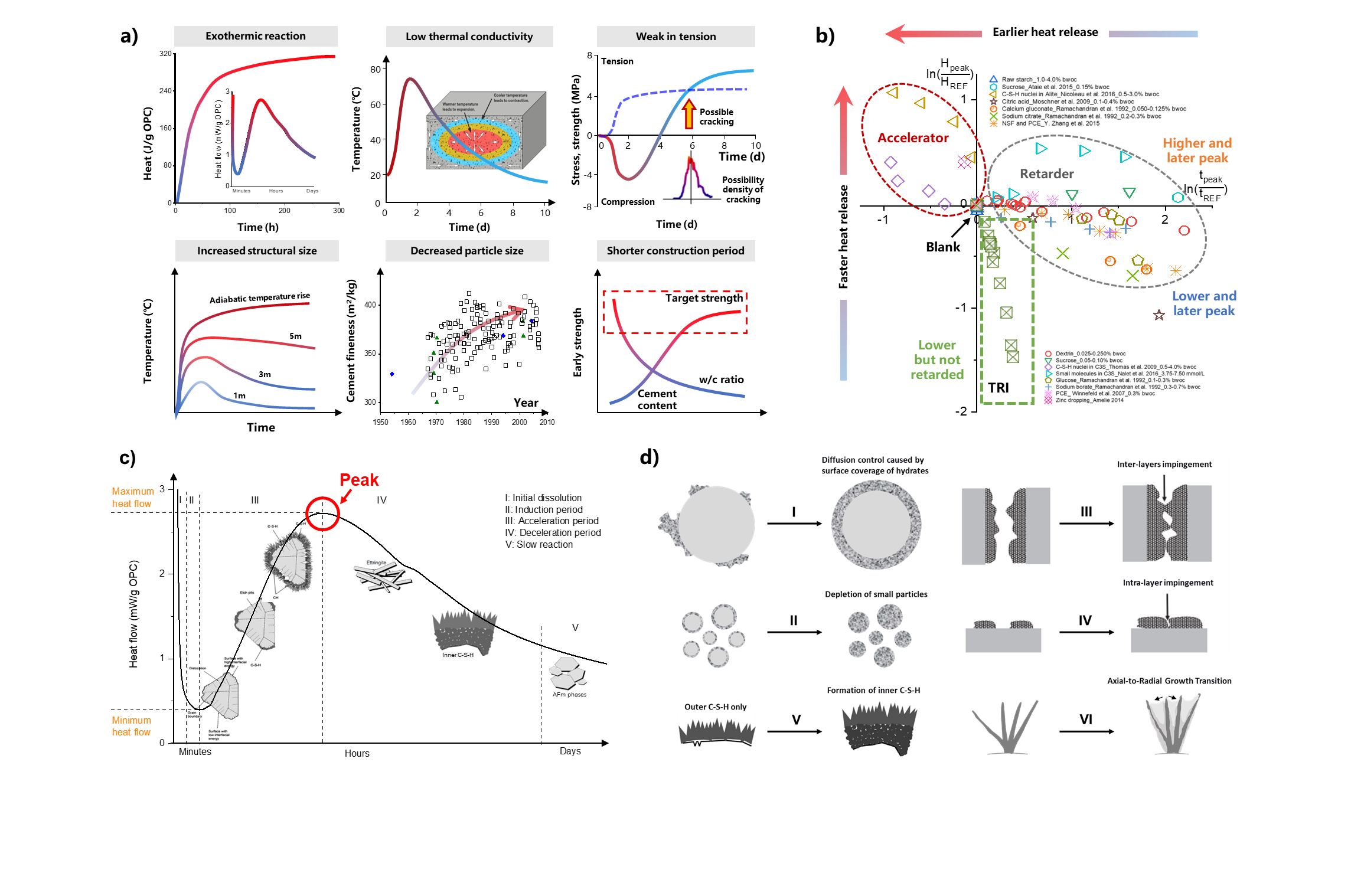
Thermal cracking poses a significant threat to the structural integrity and service life of mass concrete. The starch-based Temperature Rise Inhibitor (TRI) emerges as a sustainable and efficient bio-based solution that directly addresses the root cause - the intense heat release during early-age cement hydration. Unlike conventional chemical admixtures, TRI features a special "controlled dissolution" mechanism in the high-pH environment of cement paste. This characteristic ensures a continuous release of organic molecules that selectively inhibit the nucleation of calcium silicate hydrates (C-S-H) gel, the primary hydrates of cement hydration. Consequently, TRI significantly slow down the heat release during the first 24 hours after casting without substantially delaying the setting time or compromising long-term strength gain. Here, we highlight the exceptional efficacy of TRI in regulating exothermic process of cement hydration, discussing mechanisms in cement and blended systems and the main challenges regarding their molecular-scale interaction with C-S-H nucleation. As discussed in this perspective, TRI exemplifies the potential of sustainable materials to address fundamental engineering challenges, bridging environmental responsibility with high performance in modern concrete.
Graphical Abstract
Keywords
Data Availability Statement
Funding
Conflicts of Interest
AI Use Statement
Ethical Approval and Consent to Participate
References
- Biernacki, J. J., Bullard, J. W., Sant, G., Brown, K., Glasser, F. P., Jones, S., ... & Prater, T. (2017). Cements in the 21st century: challenges, perspectives, and opportunities. Journal of the American Ceramic Society, 100(7), 2746-2773.
[CrossRef] [Google Scholar] - Springenschmid, R. (2004). Prevention of thermal cracking in concrete at early ages. CRC Press.
[CrossRef] [Google Scholar] - Aretxabaleta, X. M., López-Zorrilla, J., Etxebarria, I., & Manzano, H. (2023). Multi-step nucleation pathway of CSH during cement hydration from atomistic simulations. Nature Communications, 14(1), 7979.
[CrossRef] [Google Scholar] - Bentz, D. P., Sant, G., & Weiss, J. (2008). Early-age properties of cement-based materials. I: Influence of cement fineness. Journal of materials in civil engineering, 20(7), 502-508.
[CrossRef] [Google Scholar] - Dong, L., Zhang, Y., Guo, Y., Shu, X., Shen, X., Ran, Q., & Feng, P. (2023). Effects of controlled release silica nanocapsules containing sucrose on the heat release of cement hydration. Colloids and Surfaces A: Physicochemical and Engineering Aspects, 670, 131593.
[CrossRef] [Google Scholar] - Gajda, J., & Vangeem, M. (2002). Controlling temperatures in mass concrete. Concrete International, 24(1), 58–62.
[Google Scholar] - Juilland, P., Gallucci, E., Flatt, R., & Scrivener, K. (2010). Dissolution theory applied to the induction period in alite hydration. Cement and Concrete Research, 40(6), 831-844.
[CrossRef] [Google Scholar] - Nalet, C., & Nonat, A. (2016). Effects of functionality and stereochemistry of small organic molecules on the hydration of tricalcium silicate. Cement and Concrete Research, 87, 97–104.
[CrossRef] [Google Scholar] - Ouzia, A., & Scrivener, K. (2019). The needle model: A new model for the main hydration peak of alite. Cement and Concrete Research, 115, 339–360.
[CrossRef] [Google Scholar] - Scanlon, J. M., & West, T. W. (1993). Cooling and Insulating Systems for Mass. Retrieved from http://civilwares.free.fr/ACI/MCP04/2074r_93.pdf
[Google Scholar] - Scherer, G. W., Zhang, J., & Thomas, J. J. (2012). Nucleation and growth models for hydration of cement. Cement and Concrete Research, 42(7), 982–993.
[CrossRef] [Google Scholar] - Snellings, R., Suraneni, P., & Skibsted, J. (2023). Future and emerging supplementary cementitious materials. Cement and concrete research, 171, 107199.
[CrossRef] [Google Scholar] - Yan, Y., Ouzia, A., Yu, C., Liu, J., & Scrivener, K. L. (2020). Effect of a novel starch-based temperature rise inhibitor on cement hydration and microstructure development. Cement and Concrete Research, 129, 105961.
[CrossRef] [Google Scholar] - Yan, Y., Wang, R., Wang, W., Chu, Y., Wang, Y., Li, L., ... & Liu, J. (2023). Robustness improvement of starch-based temperature rise inhibitor: Study on the effect of casting/curing temperatures. Journal of Building Engineering, 74, 106758.
[CrossRef] [Google Scholar] - Zhiguang, C., Haixia, Z., Min, C., Fayong, G., & Jing, L. (2025). The fine structure of starch: a review. Npj Science of Food, 9(50), 1–8.
[CrossRef] [Google Scholar] - Zhou, Y., Yan, Y., Qin, Y., Yu, C., Wang, W., Liu, J., & Wang, K. (2023). The effect of temperature rise inhibitor on the hydration and strength development of slag/fly ash blended cement paste. Construction and Building Materials, 395(September 2022), 132307.
[CrossRef] [Google Scholar]
Cite This Article
TY  - JOUR
AU  - Yan, Yu
AU  - Zhou, Yichuan
AU  - Wang, Wenbin
AU  - He, Junhui
AU  - Wang, Rui
PY  - 2026
DA  - 2026/01/21
TI  - Mitigating Thermal Cracking in Mass Concrete with Temperature Rise Inhibitor: A Sustainable and Efficient Strategy
JO  - Journal of Advanced Materials Research
T2  - Journal of Advanced Materials Research
JF  - Journal of Advanced Materials Research
VL  - 2
IS  - 1
SP  - 8
EP  - 13
DO  - 10.62762/JAMR.2025.738370
UR  - https://www.icck.org/article/abs/JAMR.2025.738370
KW  - mass concrete
KW  - chemical admixture
KW  - starch
KW  - cement hydration
AB  - Thermal cracking poses a significant threat to the structural integrity and service life of mass concrete. The starch-based Temperature Rise Inhibitor (TRI) emerges as a sustainable and efficient bio-based solution that directly addresses the root cause - the intense heat release during early-age cement hydration. Unlike conventional chemical admixtures, TRI features a special "controlled dissolution" mechanism in the high-pH environment of cement paste. This characteristic ensures a continuous release of organic molecules that selectively inhibit the nucleation of calcium silicate hydrates (C-S-H) gel, the primary hydrates of cement hydration. Consequently, TRI significantly slow down the heat release during the first 24 hours after casting without substantially delaying the setting time or compromising long-term strength gain. Here, we highlight the exceptional efficacy of TRI in regulating exothermic process of cement hydration, discussing mechanisms in cement and blended systems and the main challenges regarding their molecular-scale interaction with C-S-H nucleation. As discussed in this perspective, TRI exemplifies the potential of sustainable materials to address fundamental engineering challenges, bridging environmental responsibility with high performance in modern concrete.
SN  - 3070-5851
PB  - Institute of Central Computation and Knowledge
LA  - English
ER  -
@article{Yan2026Mitigating,
  author = {Yu Yan and Yichuan Zhou and Wenbin Wang and Junhui He and Rui Wang},
  title = {Mitigating Thermal Cracking in Mass Concrete with Temperature Rise Inhibitor: A Sustainable and Efficient Strategy},
  journal = {Journal of Advanced Materials Research},
  year = {2026},
  volume = {2},
  number = {1},
  pages = {8-13},
  doi = {10.62762/JAMR.2025.738370},
  url = {https://www.icck.org/article/abs/JAMR.2025.738370},
  abstract = {Thermal cracking poses a significant threat to the structural integrity and service life of mass concrete. The starch-based Temperature Rise Inhibitor (TRI) emerges as a sustainable and efficient bio-based solution that directly addresses the root cause - the intense heat release during early-age cement hydration. Unlike conventional chemical admixtures, TRI features a special "controlled dissolution" mechanism in the high-pH environment of cement paste. This characteristic ensures a continuous release of organic molecules that selectively inhibit the nucleation of calcium silicate hydrates (C-S-H) gel, the primary hydrates of cement hydration. Consequently, TRI significantly slow down the heat release during the first 24 hours after casting without substantially delaying the setting time or compromising long-term strength gain. Here, we highlight the exceptional efficacy of TRI in regulating exothermic process of cement hydration, discussing mechanisms in cement and blended systems and the main challenges regarding their molecular-scale interaction with C-S-H nucleation. As discussed in this perspective, TRI exemplifies the potential of sustainable materials to address fundamental engineering challenges, bridging environmental responsibility with high performance in modern concrete.},
  keywords = {mass concrete, chemical admixture, starch, cement hydration},
  issn = {3070-5851},
  publisher = {Institute of Central Computation and Knowledge}
}
Article Metrics
Publisher's Note
ICCK stays neutral with regard to jurisdictional claims in published maps and institutional affiliations.
Rights and Permissions
 Copyright © 2026 by the Author(s). Published by Institute of Central Computation and Knowledge. This article is an open access article distributed under the terms and conditions of the Creative Commons Attribution (CC BY) license (https://creativecommons.org/licenses/by/4.0/), which permits use, sharing, adaptation, distribution and reproduction in any medium or format, as long as you give appropriate credit to the original author(s) and the source, provide a link to the Creative Commons licence, and indicate if changes were made.


Portico
