
Periodontal Disease and Persistent Severe Vitamin D Deficiency in a Young Adult: A Concise Review with an Illustrative Case Report




Article Information
Abstract
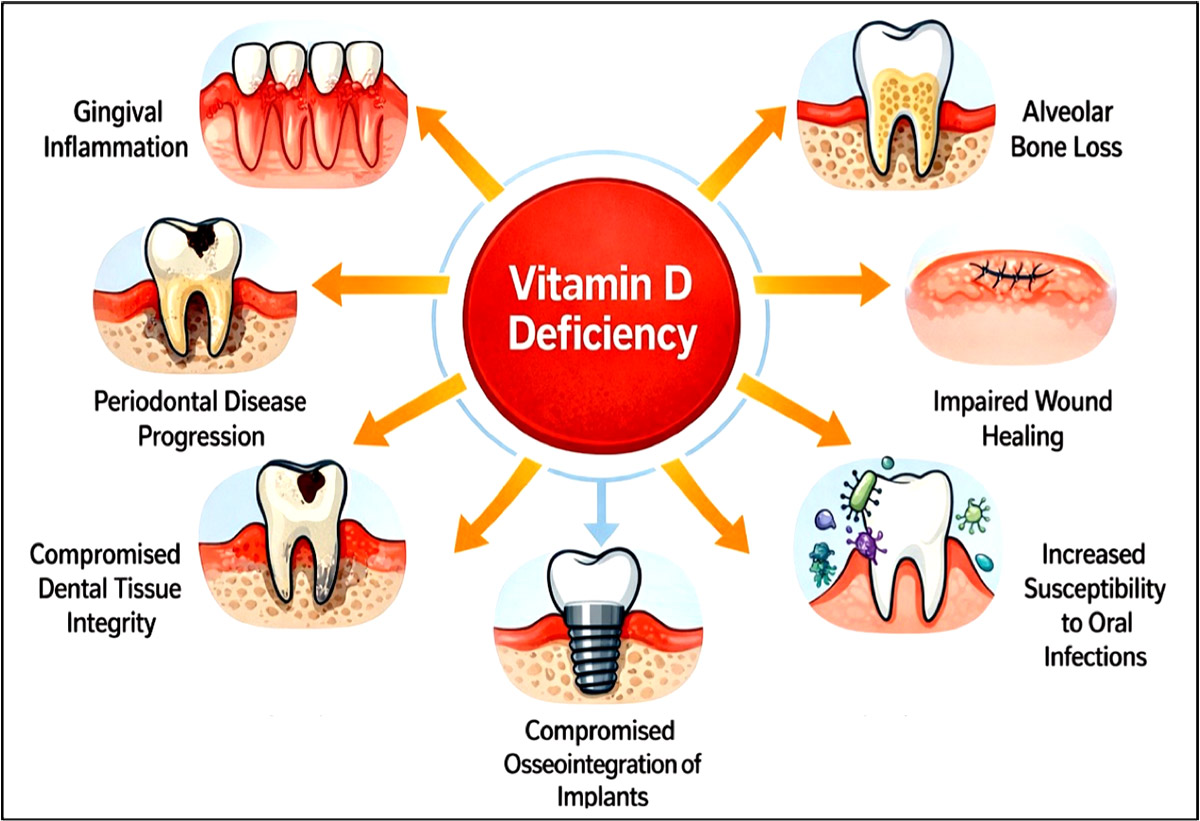
Background: Vitamin D plays an important role in bone metabolism, immune regulation, and periodontal health, although its independent contribution to periodontal disease remains uncertain. Aim: This report describes periodontal treatment outcomes in a young adult with periodontitis and persistent severe vitamin D deficiency, supported by a concise literature review. Case presentation: A 25-year-old female presented with gingival bleeding, dental hypersensitivity, tooth mobility, and radiographic alveolar bone loss. Baseline serum 25-hydroxyvitamin D [25(OH)D] was 8.3 ng/mL. Treatment included non-surgical periodontal therapy, restorative procedures, oral hygiene instruction, and medical referral for vitamin D supplementation. Results: At six months, bleeding on probing decreased from 78% to 22%, mean probing pocket depth decreased from 4.6 to 3.2 mm, and sites with probing depth $\geq$ 5 mm decreased from 18 to 5. However, serum 25(OH)D increased only to 8.9 ng/mL, indicating persistent severe deficiency. Supplementation adherence was inconsistent. Residual plaque and gingival inflammation remained evident. Incomplete clinical attachment level measurements prevented assessment of attachment gain. Conclusions: Periodontal inflammatory parameters improved following conventional dental treatment despite persistent severe vitamin D deficiency. However, the single-patient design and incomplete longitudinal measurements preclude causal conclusions regarding vitamin D status or supplementation. These findings emphasize conventional periodontal care, medical follow-up, and the need for further controlled investigations.
Graphical Abstract
Keywords
Data Availability Statement
Funding
Conflicts of Interest
AI Use Statement
Ethical Approval and Consent to Participate
References
- Grant, W. B., van Amerongen, B. M., & Boucher, B. J. (2023). Periodontal disease and other adverse health outcomes share risk factors, including dietary factors and vitamin D status. Nutrients, 15(12), 2787.
[CrossRef] [Google Scholar] - Sahota, O. (2014). Understanding vitamin D deficiency. Age and Ageing, 43(5), 589–591.
[CrossRef] [Google Scholar] - Delrue, C., & Speeckaert, M. M. (2023). Vitamin D and vitamin D-binding protein in health and disease. International Journal of Molecular Sciences, 24(5), 4642.
[CrossRef] [Google Scholar] - Uwitonze, A. M., Murererehe, J., Ineza, M. C., Harelimana, E. I., Nsabimana, U., Uwambaye, P., Gatarayiha, A., Haq, A., & Razzaque, M. S. (2018). Effects of vitamin D status on oral health. Journal of Steroid Biochemistry and Molecular Biology, 175, 190–194.
[CrossRef] [Google Scholar] - Lu, E. M. (2023). The role of vitamin D in periodontal health and disease. Journal of Periodontal Research, 58(2), 213–224.
[CrossRef] [Google Scholar] - Liu, K., Meng, H., & Hou, J. (2012). Activity of 25-hydroxylase in human gingival fibroblasts and periodontal ligament cells. PLoS ONE, 7(12), e52053.
[CrossRef] [Google Scholar] - Khammissa, R. A. G., Ballyram, R., Jadwat, Y., Fourie, J., Lemmer, J., & Feller, L. (2018). Vitamin D deficiency as it relates to oral immunity and chronic periodontitis. International journal of dentistry, 2018(1), 7315797.
[CrossRef] [Google Scholar] - Kobyra, J. A., Shehabeldin, M., Little, S. R., & Sfeir, C. (2026). Treating periodontal disease: From antimicrobials to immunomodulation. Trends in Pharmacological Sciences, 47(1), 40–52.
[CrossRef] [Google Scholar] - Machado, V., Lobo, S., Proença, L., Mendes, J. J., & Botelho, J. (2020). Vitamin D and periodontitis: A systematic review and meta-analysis. Nutrients, 12(8), 2177.
[CrossRef] [Google Scholar] - Botelho, J., Machado, V., Proença, L., Delgado, A. S., & Mendes, J. J. (2020). Vitamin D deficiency and oral health: A comprehensive review. Nutrients, 12(5), 1471.
[CrossRef] [Google Scholar] - Fulton, A., Amlani, M., & Parekh, S. (2020). Oral manifestations of vitamin D deficiency in children. British Dental Journal, 228(7), 515–518.
[CrossRef] [Google Scholar] - Al-Jubori, S. H., Al-Murad, M. A., & Al-Mashhadane, F. A. (2022). Effect of oral vitamin D3 on dental caries: An in vivo and in vitro study. Cureus, 14(5), e25360.
[CrossRef] [Google Scholar] - Olszewska-Czyz, I., & Firkova, E. (2022). Vitamin D3 serum levels in periodontitis patients: A case-control study. Medicina, 58(5), 585.
[CrossRef] [Google Scholar] - Zhan, Y., Samietz, S., Holtfreter, B., Hannemann, A., Meisel, P., Nauck, M., Völzke, H., ... Kocher, T. (2014). Prospective study of serum 25-hydroxy vitamin D and tooth loss. Journal of Dental Research, 93(7), 639–644.
[CrossRef] [Google Scholar] - Papapanou, P. N., Sanz, M., Buduneli, N., Dietrich, T., Feres, M., Fine, D. H., ... & Tonetti, M. S. (2018). Periodontitis: Consensus report of workgroup 2 of the 2017 World Workshop on the Classification of Periodontal and Peri‐Implant Diseases and Conditions. Journal of periodontology, 89, S173-S182.
[CrossRef] [Google Scholar] - Holick, M. F., Binkley, N. C., Bischoff-Ferrari, H. A., Gordon, C. M., Hanley, D. A., Heaney, R. P., ... & Weaver, C. M. (2011). Evaluation, treatment, and prevention of vitamin D deficiency: an Endocrine Society clinical practice guideline. The Journal of clinical endocrinology & metabolism, 96(7), 1911-1930.
[CrossRef] [Google Scholar] - Miley, D. D., Garcia, M. N., Hildebolt, C. F., Shannon, W. D., Couture, R. A., Anderson Spearie, C. L., Dixon, D. A., ... Civitelli, R. (2009). Cross-sectional study of vitamin D and calcium supplementation effects on chronic periodontitis. Journal of Periodontology, 80(9), 1433–1439.
[CrossRef] [Google Scholar] - Garcia, M. N., Hildebolt, C. F., Miley, D. D., Dixon, D. A., Couture, R. A., Spearie, C. L., Langenwalter, E. M., ... Civitelli, R. (2011). One-year effects of vitamin D and calcium supplementation on chronic periodontitis. Journal of Periodontology, 82(1), 25–32.
[CrossRef] [Google Scholar] - Ustianowski, Ł., Ustianowska, K., Gurazda, K., Rusiński, M., Ostrowski, P., & Pawlik, A. (2023). The role of vitamin C and vitamin D in the pathogenesis and therapy of periodontitis: Narrative review. International Journal of Molecular Sciences, 24(7), 6774.
[CrossRef] [Google Scholar] - Jódar, E., Campusano, C., de Jongh, R. T., & Holick, M. F. (2023). Calcifediol: A review of its pharmacological characteristics and clinical use in correcting vitamin D deficiency. European Journal of Nutrition, 62(4), 1579–1597.
[CrossRef] [Google Scholar] - Pérez-Castrillón, J. L., Usategui-Martín, R., & Pludowski, P. (2022). Treatment of vitamin D deficiency with calcifediol: Efficacy and safety profile and predictability of efficacy. Nutrients, 14(9), 1943.
[CrossRef] [Google Scholar] - Bouden, S., Ben Messaoud, M., Saidane, O., Rouached, L., Ben Tekaya, A., Mahmoud, I., Tekaya, R., ... Abdelmoula, L. (2025). Effect of cholecalciferol versus calcifediol on serum 25(OH)D concentrations: A systematic review with meta-analysis. European Journal of Clinical Nutrition, 79(4), 296–305.
[CrossRef] [Google Scholar] - Quesada-Gómez, J. M., & Bouillon, R. (2018). Is calcifediol better than cholecalciferol for vitamin D supplementation? Osteoporosis International, 29(8), 1697–1711.
[CrossRef] [Google Scholar]
Cite This Article
TY  - JOUR
AU  - Meto, Aida
AU  - Kordhoku, Drita
PY  - 2026
DA  - 2026/11/19
TI  - Periodontal Disease and Persistent Severe Vitamin D Deficiency in a Young Adult: A Concise Review with an Illustrative Case Report
JO  - Journal of Oral and Dental Approaches
T2  - Journal of Oral and Dental Approaches
JF  - Journal of Oral and Dental Approaches
VL  - 1
IS  - 1
SP  - 30
EP  - 48
DO  - 10.62762/JODA.2026.238301
UR  - https://www.icck.org/article/abs/joda.2026.238301
KW  - alveolar bone loss
KW  - dental caries
KW  - oral health
KW  - periodontal disease
KW  - vitamin D deficiency
AB  - Background: Vitamin D plays an important role in bone metabolism, immune regulation, and periodontal health, although its independent contribution to periodontal disease remains uncertain. Aim: This report describes periodontal treatment outcomes in a young adult with periodontitis and persistent severe vitamin D deficiency, supported by a concise literature review. Case presentation: A 25-year-old female presented with gingival bleeding, dental hypersensitivity, tooth mobility, and radiographic alveolar bone loss. Baseline serum 25-hydroxyvitamin D [25(OH)D] was 8.3 ng/mL. Treatment included non-surgical periodontal therapy, restorative procedures, oral hygiene instruction, and medical referral for vitamin D supplementation. Results: At six months, bleeding on probing decreased from 78% to 22%, mean probing pocket depth decreased from 4.6 to 3.2 mm, and sites with probing depth $\geq$ 5 mm decreased from 18 to 5. However, serum 25(OH)D increased only to 8.9 ng/mL, indicating persistent severe deficiency. Supplementation adherence was inconsistent. Residual plaque and gingival inflammation remained evident. Incomplete clinical attachment level measurements prevented assessment of attachment gain. Conclusions: Periodontal inflammatory parameters improved following conventional dental treatment despite persistent severe vitamin D deficiency. However, the single-patient design and incomplete longitudinal measurements preclude causal conclusions regarding vitamin D status or supplementation. These findings emphasize conventional periodontal care, medical follow-up, and the need for further controlled investigations.
SN  - pending
PB  - Institute of Central Computation and Knowledge
LA  - English
ER  -
@article{Meto2026Periodonta,
  author = {Aida Meto and Drita Kordhoku},
  title = {Periodontal Disease and Persistent Severe Vitamin D Deficiency in a Young Adult: A Concise Review with an Illustrative Case Report},
  journal = {Journal of Oral and Dental Approaches},
  year = {2026},
  volume = {1},
  number = {1},
  pages = {30-48},
  doi = {10.62762/JODA.2026.238301},
  url = {https://www.icck.org/article/abs/joda.2026.238301},
  abstract = {Background: Vitamin D plays an important role in bone metabolism, immune regulation, and periodontal health, although its independent contribution to periodontal disease remains uncertain. Aim: This report describes periodontal treatment outcomes in a young adult with periodontitis and persistent severe vitamin D deficiency, supported by a concise literature review. Case presentation: A 25-year-old female presented with gingival bleeding, dental hypersensitivity, tooth mobility, and radiographic alveolar bone loss. Baseline serum 25-hydroxyvitamin D [25(OH)D] was 8.3 ng/mL. Treatment included non-surgical periodontal therapy, restorative procedures, oral hygiene instruction, and medical referral for vitamin D supplementation. Results: At six months, bleeding on probing decreased from 78\% to 22\%, mean probing pocket depth decreased from 4.6 to 3.2 mm, and sites with probing depth \$\geq\$ 5 mm decreased from 18 to 5. However, serum 25(OH)D increased only to 8.9 ng/mL, indicating persistent severe deficiency. Supplementation adherence was inconsistent. Residual plaque and gingival inflammation remained evident. Incomplete clinical attachment level measurements prevented assessment of attachment gain. Conclusions: Periodontal inflammatory parameters improved following conventional dental treatment despite persistent severe vitamin D deficiency. However, the single-patient design and incomplete longitudinal measurements preclude causal conclusions regarding vitamin D status or supplementation. These findings emphasize conventional periodontal care, medical follow-up, and the need for further controlled investigations.},
  keywords = {alveolar bone loss, dental caries, oral health, periodontal disease, vitamin D deficiency},
  issn = {pending},
  publisher = {Institute of Central Computation and Knowledge}
}
Article Metrics
Publisher's Note
ICCK stays neutral with regard to jurisdictional claims in published maps and institutional affiliations.
Rights and Permissions
 Copyright © 2026 by the Author(s). Published by Institute of Central Computation and Knowledge. This article is an open access article distributed under the terms and conditions of the Creative Commons Attribution (CC BY) license (https://creativecommons.org/licenses/by/4.0/), which permits use, sharing, adaptation, distribution and reproduction in any medium or format, as long as you give appropriate credit to the original author(s) and the source, provide a link to the Creative Commons licence, and indicate if changes were made.