
The Role of Dietary Acids and Acidic Beverages in Dental Enamel Erosion: A Narrative Review



Article Information
Abstract
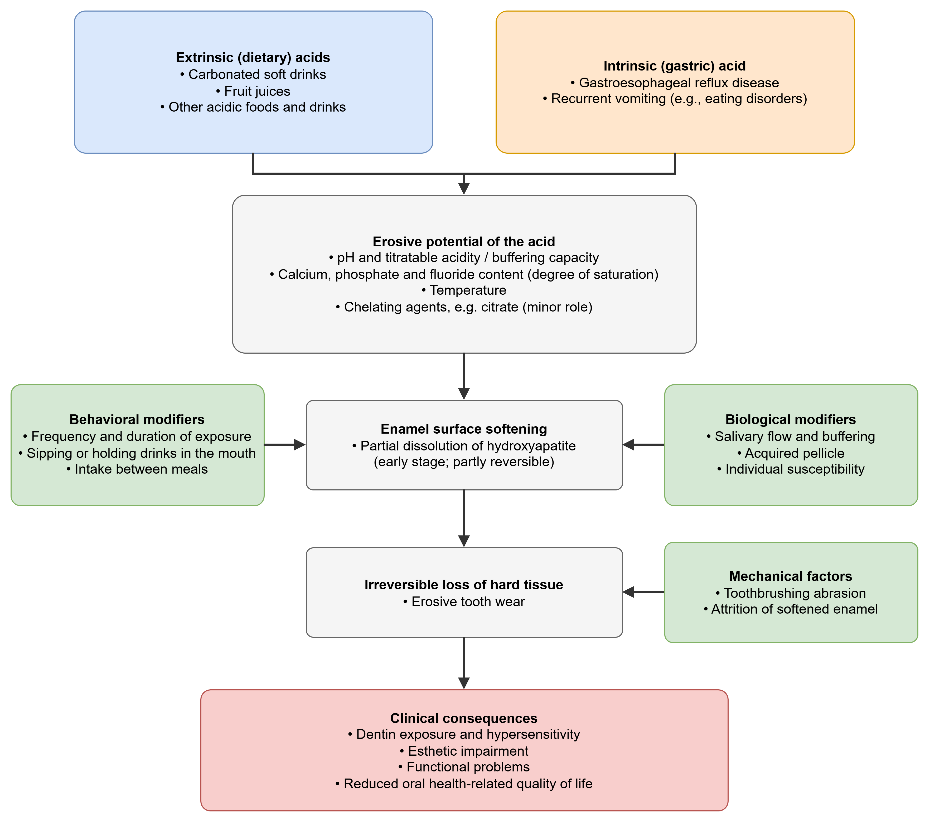
Dental erosion is the dissolution of dental hard tissues by acids of non-bacterial origin and contributes to cumulative erosive tooth wear. This narrative review examines dietary acids and acidic beverages, population-related patterns, biological and behavioral modifiers, and implications for prevention. Evidence from PubMed, Scopus, Google Scholar, and other sources was synthesized qualitatively; no formal risk-of-bias assessment was performed. Laboratory and in situ studies show acid-related mineral loss and surface changes, and observational studies link some acidic-beverage exposure to erosive tooth wear, though findings vary by beverage, exposure pattern, population, and diagnostic method. Erosive potential depends on solution composition and mineral saturation as well as pH. Saliva, intrinsic gastric-acid exposure, and mechanical factors modify the clinical expression of wear. Prevention should prioritize reducing avoidable acidic exposure and behaviors that prolong contact with dental surfaces. Fluoride-containing products may offer additional protection, but experimental findings should not be taken as established long-term clinical effectiveness. Current evidence does not support a universally applicable waiting interval before toothbrushing after acidic exposure, and clinical advice should consider individual risk and fluoride use. Interpretation is limited by heterogeneous evidence and non-systematic source selection; longitudinal clinical studies and more consistent outcome measurement remain necessary.
Graphical Abstract
Keywords
Data Availability Statement
Funding
Conflicts of Interest
AI Use Statement
Ethical Approval and Consent to Participate
References
- Schlueter, N., & Luka, B. (2018). Erosive tooth wear-A review on global prevalence and on its prevalence in risk groups. British Dental Journal, 224(5), 364-370.
[CrossRef] [Google Scholar] - Papagianni, C. E., van der Meulen, M. J., Naeije, M., & Lobbezoo, F. (2013). Oral health-related quality of life in patients with tooth wear. Journal of Oral Rehabilitation, 40(3), 185-190.
[CrossRef] [Google Scholar] - Shellis, R. P., Featherstone, J. D. B., & Lussi, A. (2014). Understanding the chemistry of dental erosion. Monographs in Oral Science, 25, 163-179.
[CrossRef] [Google Scholar] - Al-Dlaigan, Y. H., Shaw, L., & Smith, A. (2001). Dental erosion in a group of British 14-year-old school children. Part I: Prevalence and influence of differing socioeconomic backgrounds. British Dental Journal, 190(3), 145-149.
[CrossRef] [Google Scholar] - Mafla, A. C., Cerón-Bastidas, X. A., Munoz-Ceballos, M. E., Vallejo-Bravo, D. C., & Fajardo-Santacruz, M. C. (2017). Prevalence and extrinsic risk factors for dental erosion in adolescents. Journal of Clinical Pediatric Dentistry, 41(2), 102-111.
[CrossRef] [Google Scholar] - Ab Halim, N., Esa, R., & Chew, H. P. (2018). General and erosive tooth wear of 16-year-old adolescents in Kuantan, Malaysia: prevalence and association with dental caries. BMC oral health, 18(1), 11.
[CrossRef] [Google Scholar] - Bartlett, D. W., Lussi, A., West, N. X., Bouchard, P., Sanz, M., & Bourgeois, D. (2013). Prevalence of tooth wear on buccal and lingual surfaces and possible risk factors in young European adults. Journal of Dentistry, 41(11), 1007-1013.
[CrossRef] [Google Scholar] - Casaña Ruiz, D., Marqués Martínez, L., & García Miralles, E. (2023). Dental erosion and diet in young children and adolescents: a systematic review. Applied Sciences, 13(6), 3519.
[CrossRef] [Google Scholar] - El Aidi, H., Bronkhorst, E. M., Huysmans, M. C. D. N. J. M., & Truin, G. J. (2010). Dynamics of tooth erosion in adolescents: A 3-year longitudinal study. Journal of Dentistry, 38(2), 131-137.
[CrossRef] [Google Scholar] - Li, H., Zou, Y., & Ding, G. (2012). Dietary factors associated with dental erosion: A meta-analysis. PLoS ONE, 7(8), e42626.
[CrossRef] [Google Scholar] - Hasselkvist, A., Johansson, A., & Johansson, A. K. (2010). Dental erosion and soft drink consumption in Swedish children and adolescents and the development of a simplified erosion partial recording system. Swedish Dental Journal, 34(4), 187-195. \url{https://pubmed.ncbi.nlm.nih.gov/21306084/
[Google Scholar] - Chan, A. S., Tran, T. T. K., Hsu, Y. H., Liu, S. Y. S., & Kroon, J. (2020). A systematic review of dietary acids and habits on dental erosion in adolescents. International Journal of Paediatric Dentistry, 30(6), 713-733.
[CrossRef] [Google Scholar] - Pattem, J., Field, J., Waterhouse, P. J., & German, M. J. (2022). The dynamic interplay of dietary acid pH and concentration during early-stage human enamel and dentine erosion. Frontiers in Dental Medicine, 3, 1040565.
[CrossRef] [Google Scholar] - Khamverdi, Z., Vahedi, M., Abdollahzadeh, S., & Ghambari, M. H. (2013). Effect of a common diet and regular beverage on enamel erosion in various temperatures: An in-vitro study. Journal of Dentistry (Tehran), 10(5), 411-416. \url{https://pmc.ncbi.nlm.nih.gov/articles/PMC4025425/
[Google Scholar] - Ablal, M. A., Milosevic, A., Preston, A. J., & Higham, S. M. (2017). A novel approach to study in situ enamel erosion and abrasion lesions. Journal of Dentistry, 59, 78-85.
[CrossRef] [Google Scholar] - Tantbirojn, D., Huang, A., Ericson, M. D., & Poolthong, S. (2008). Change in surface hardness of enamel by a cola drink and a CPP-ACP paste. Journal of Dentistry, 36(1), 74-79.
[CrossRef] [Google Scholar] - Jensdottir, T., Holbrook, P., Nauntofte, B., Buchwald, C., & Bardow, A. (2006). Immediate erosive potential of cola drinks and orange juices. Journal of Dental Research, 85(3), 226-230.
[CrossRef] [Google Scholar] - Azadi-Schossig, P., Becker, K., & Attin, T. (2016). Chelating effect of citric acid is negligible for development of enamel erosions. Clinical Oral Investigations, 20(7), 1577-1587.
[CrossRef] [Google Scholar] - Ganss, C., Lussi, A., & Schlueter, N. (2014). The histological features and physical properties of eroded dental hard tissues. Monographs in Oral Science, 25, 99-107.
[CrossRef] [Google Scholar] - Johansson, A. K., Johansson, A., Birkhed, D., Omar, R., Baghdadi, S., Khan, N., & Carlsson, G. E. (1997). Dental erosion associated with soft-drink consumption in young Saudi men. Acta Odontologica Scandinavica, 55(6), 390-397.
[CrossRef] [Google Scholar] - Jaeggi, T., & Lussi, A. (2014). Prevalence, incidence and distribution of erosion. Monographs in Oral Science, 25, 55-73.
[CrossRef] [Google Scholar] - O'Sullivan, E., & Milosevic, A. (2008). UK National Clinical Guidelines in Paediatric Dentistry: Diagnosis, prevention and management of dental erosion. International Journal of Paediatric Dentistry, 18(Suppl. 1), 29-38.
[CrossRef] [Google Scholar] - Salas, M. M. S., Nascimento, G. G., Huysmans, M. C., & Demarco, F. F. (2015). Estimated prevalence of erosive tooth wear in permanent teeth of children and adolescents: An epidemiological systematic review and meta-regression analysis. Journal of Dentistry, 43(1), 42-50.
[CrossRef] [Google Scholar] - Ludovichetti, F. S., Signoriello, A. G., Colussi, N., Zuccon, A., Stellini, E., & Mazzoleni, S. (2022). Soft drinks and dental erosion during pediatric age: A clinical investigation. Minerva Dental and Oral Science, 71(5), 262-269.
[CrossRef] [Google Scholar] - Al-Dlaigan, Y. H., Al-Meedania, L. A., & Anil, S. (2017). The influence of frequently consumed beverages and snacks on dental erosion among preschool children in Saudi Arabia. Nutrition journal, 16(1), 80.
[CrossRef] [Google Scholar] - Hara, A. T., & Zero, D. T. (2014). The potential of saliva in protecting against dental erosion. Monographs in Oral Science, 25, 197-205.
[CrossRef] [Google Scholar] - Alghilan, M. A., Cook, N. B., Platt, J. A., Eckert, G. J., & Hara, A. T. (2015). Susceptibility of restorations and adjacent enamel/dentine to erosion under different salivary flow conditions. Journal of Dentistry, 43(12), 1476-1482.
[CrossRef] [Google Scholar] - Uhlen, M. M., Mulic, A., Holme, B., Tveit, A. B., & Stenhagen, K. R. (2016). The susceptibility to dental erosion differs among individuals. Caries Research, 50(2), 117-123.
[CrossRef] [Google Scholar] - Lussi, A., Lussi, J., Carvalho, T. S., & Cvikl, B. (2014). Toothbrushing after an erosive attack: Will waiting avoid tooth wear? European Journal of Oral Sciences, 122(5), 353-359.
[CrossRef] [Google Scholar] - Hong, D. W., Lin, X. J., Wiegand, A., & Yu, H. (2020). Does delayed toothbrushing after the consumption of erosive foodstuffs or beverages decrease erosive tooth wear? A systematic review and meta-analysis. Clinical Oral Investigations, 24(12), 4169-4183.
[CrossRef] [Google Scholar] - Fernández, C. E., Silva-Acevedo, C. A., Padilla-Orellana, F., Zero, D., Carvalho, T. S., & Lussi, A. (2024). Should we wait to brush our teeth? A scoping review regarding dental caries and erosive tooth wear. Caries research, 58(4), 454-468.
[CrossRef] [Google Scholar] - Trentin, G. A., Mendes, L. T., Silva, B. S., Casagrande, L., Araujo, F. B., & Lenzi, T. L. (2021). Reduction in erosive tooth wear using stannous fluoride-containing dentifrices: A meta-analysis. Brazilian Oral Research, 35, e114.
[CrossRef] [Google Scholar] - Carvalho, T. S., Colon, P., Ganss, C., Huysmans, M. C., Lussi, A., Schlueter, N., ... & Wiegand, A. (2015). Consensus report of the European Federation of Conservative Dentistry: erosive tooth wear—diagnosis and management. Clinical oral investigations, 19(7), 1557-1561.
[CrossRef] [Google Scholar] - Bartlett, D., Ganss, C., & Lussi, A. (2008). Basic Erosive Wear Examination (BEWE): a new scoring system for scientific and clinical needs. Clinical oral investigations, 12(Suppl 1), 65-68.
[CrossRef] [Google Scholar] - Paepegaey, A. M., Barker, M. L., Bartlett, D. W., Mistry, M., West, N. X., Hellin, N., Brown, L. J., & Bellamy, P. G. (2013). Measuring enamel erosion: A comparative study of contact profilometry, non-contact profilometry and confocal laser scanning microscopy. Dental Materials, 29(12), 1265-1272.
[CrossRef] [Google Scholar]
Cite This Article
TY  - JOUR
AU  - Kamberi, Alba
AU  - Shpati, Adora
AU  - Lubonja, Irian
AU  - Bermuca, Bianka
AU  - Mucollari, Oksana
AU  - Delimeta, Inesa
PY  - 2026
DA  - 2026/11/17
TI  - The Role of Dietary Acids and Acidic Beverages in Dental Enamel Erosion: A Narrative Review
JO  - Journal of Oral and Dental Approaches
T2  - Journal of Oral and Dental Approaches
JF  - Journal of Oral and Dental Approaches
VL  - 1
IS  - 1
SP  - 20
EP  - 29
DO  - 10.62762/JODA.2026.844372
UR  - https://www.icck.org/article/abs/joda.2026.844372
KW  - dental enamel erosion
KW  - dietary acids
KW  - acidic beverages
KW  - erosive tooth wear
KW  - children
KW  - adolescents
KW  - prevention
AB  - Dental erosion is the dissolution of dental hard tissues by acids of non-bacterial origin and contributes to cumulative erosive tooth wear. This narrative review examines dietary acids and acidic beverages, population-related patterns, biological and behavioral modifiers, and implications for prevention. Evidence from PubMed, Scopus, Google Scholar, and other sources was synthesized qualitatively; no formal risk-of-bias assessment was performed. Laboratory and in situ studies show acid-related mineral loss and surface changes, and observational studies link some acidic-beverage exposure to erosive tooth wear, though findings vary by beverage, exposure pattern, population, and diagnostic method. Erosive potential depends on solution composition and mineral saturation as well as pH. Saliva, intrinsic gastric-acid exposure, and mechanical factors modify the clinical expression of wear. Prevention should prioritize reducing avoidable acidic exposure and behaviors that prolong contact with dental surfaces. Fluoride-containing products may offer additional protection, but experimental findings should not be taken as established long-term clinical effectiveness. Current evidence does not support a universally applicable waiting interval before toothbrushing after acidic exposure, and clinical advice should consider individual risk and fluoride use. Interpretation is limited by heterogeneous evidence and non-systematic source selection; longitudinal clinical studies and more consistent outcome measurement remain necessary.
SN  - pending
PB  - Institute of Central Computation and Knowledge
LA  - English
ER  -
@article{Kamberi2026The,
  author = {Alba Kamberi and Adora Shpati and Irian Lubonja and Bianka Bermuca and Oksana Mucollari and Inesa Delimeta},
  title = {The Role of Dietary Acids and Acidic Beverages in Dental Enamel Erosion: A Narrative Review},
  journal = {Journal of Oral and Dental Approaches},
  year = {2026},
  volume = {1},
  number = {1},
  pages = {20-29},
  doi = {10.62762/JODA.2026.844372},
  url = {https://www.icck.org/article/abs/joda.2026.844372},
  abstract = {Dental erosion is the dissolution of dental hard tissues by acids of non-bacterial origin and contributes to cumulative erosive tooth wear. This narrative review examines dietary acids and acidic beverages, population-related patterns, biological and behavioral modifiers, and implications for prevention. Evidence from PubMed, Scopus, Google Scholar, and other sources was synthesized qualitatively; no formal risk-of-bias assessment was performed. Laboratory and in situ studies show acid-related mineral loss and surface changes, and observational studies link some acidic-beverage exposure to erosive tooth wear, though findings vary by beverage, exposure pattern, population, and diagnostic method. Erosive potential depends on solution composition and mineral saturation as well as pH. Saliva, intrinsic gastric-acid exposure, and mechanical factors modify the clinical expression of wear. Prevention should prioritize reducing avoidable acidic exposure and behaviors that prolong contact with dental surfaces. Fluoride-containing products may offer additional protection, but experimental findings should not be taken as established long-term clinical effectiveness. Current evidence does not support a universally applicable waiting interval before toothbrushing after acidic exposure, and clinical advice should consider individual risk and fluoride use. Interpretation is limited by heterogeneous evidence and non-systematic source selection; longitudinal clinical studies and more consistent outcome measurement remain necessary.},
  keywords = {dental enamel erosion, dietary acids, acidic beverages, erosive tooth wear, children, adolescents, prevention},
  issn = {pending},
  publisher = {Institute of Central Computation and Knowledge}
}
Article Metrics
Publisher's Note
ICCK stays neutral with regard to jurisdictional claims in published maps and institutional affiliations.
Rights and Permissions
 Copyright © 2026 by the Author(s). Published by Institute of Central Computation and Knowledge. This article is an open access article distributed under the terms and conditions of the Creative Commons Attribution (CC BY) license (https://creativecommons.org/licenses/by/4.0/), which permits use, sharing, adaptation, distribution and reproduction in any medium or format, as long as you give appropriate credit to the original author(s) and the source, provide a link to the Creative Commons licence, and indicate if changes were made.

