

How Do Multiple-Choice Assessments Reflect Student Performance? An Educational Data Mining Analysis Using Machine Learning Classifiers


Article Information
Abstract
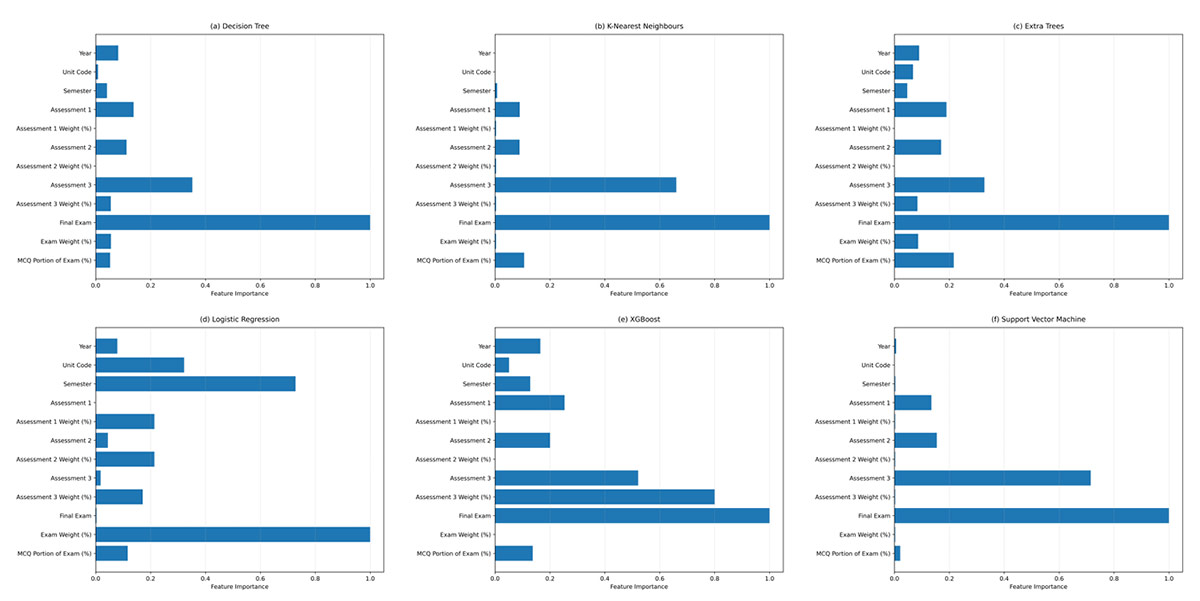
Multiple-choice questions (MCQs) are widely used in higher education because they efficiently assess knowledge and a broad range of cognitive skills across disciplines. This study examines how MCQ-based assessments contribute to predicting final student grades, using data from 2,390 students (comprising 26,698 non-missing attribute values) enrolled in sixteen offerings of three undergraduate and postgraduate economics units at Charles Darwin University (CDU) between 2016 and 2019. Six machine learning classifiers were trained on assessment marks, assessment weightings, final examination performance, and the proportion of MCQs in the examination. Feature importance analysis was then used to quantify the contribution of each assessment component. The study compares MCQ and task-based examination questions, online MCQ and task-based assessments, and online and written MCQ components. Support Vector Machines achieved the highest accuracy (96.07%), followed by XGBoost (93.76%). Across the higher-performing classifiers, final examination performance and the task-based assessment were the strongest predictors of final grades. Online and written MCQ components contributed less strongly, although MCQs remain useful indicators of foundational knowledge. These findings support balanced assessment designs that combine MCQs with task-based activities, and they demonstrate how explainable AI can inform assessment analytics within Educational Data Mining.
Graphical Abstract
Keywords
Data Availability Statement
Funding
Conflicts of Interest
AI Use Statement
Ethical Approval and Consent to Participate
References
- Keivanian, F., & Fan, Z. (2026). Beyond accuracy: Toward interpretable, multi-objective, and trustworthy educational data mining systems. ICCK Transactions on Educational Data Mining, 2(2), 52-55.
[CrossRef] [Google Scholar] - Nair, G. G., & Feroze, M. (2023). Effectiveness of multiple-choice questions (MCQs) discussion as a learning enhancer in conventional lecture class of undergraduate medical students. Medical Journal of Dr. D.Y. Patil Vidyapeeth, 16(Suppl 2), S183-S188.
[CrossRef] [Google Scholar] - Manoharan, S. (2019). Cheat-resistant multiple-choice examinations using personalization. Computers & Education, 130, 139-151.
[CrossRef] [Google Scholar] - Williams, J. B., & Wong, A. (2009). The efficacy of final examinations: A comparative study of closed‐book, invigilated exams and open‐book, open‐web exams. British Journal of Educational Technology, 40(2), 227-236.
[CrossRef] [Google Scholar] - Liu, Q., Wald, N., Daskon, C., & Harland, T. (2024). Multiple-choice questions (MCQs) for higher-order cognition: Perspectives of university teachers. Innovations in Education and Teaching International, 61(4), 802-814.
[CrossRef] [Google Scholar] - Butler, A. C. (2018). Multiple-choice testing in education: Are the best practices for assessment also good for learning? Journal of Applied Research in Memory and Cognition, 7(3), 323-331.
[CrossRef] [Google Scholar] - Joorabchi, B., & Chawhan, A. R. (1975). Multiple choice questions. The debate goes on. British Journal of Medical Education, 9(4), 275-280.
[CrossRef] [Google Scholar] - Brown, G. T., & Abdulnabi, H. H. (2017, June). Evaluating the quality of higher education instructor-constructed multiple-choice tests: Impact on student grades. In Frontiers in Education (Vol. 2, p. 24). Frontiers Media SA.
[CrossRef] [Google Scholar] - Palmer, E. J., & Devitt, P. G. (2007). Assessment of higher order cognitive skills in undergraduate education: modified essay or multiple choice questions? BMC medical education, 7(1), 49.
[CrossRef] [Google Scholar] - Koretsky, M. D., Brooks, B. J., & Higgins, A. Z. (2016). Written justifications to multiple-choice concept questions during active learning in class. International Journal of Science Education, 38(11), 1747-1765.
[CrossRef] [Google Scholar] - Bhatt, M., & Dua, S. (2016). Use of multiple choice questions during lectures helps medical students improve their performance in written formative assessment in physiology. National Journal of Physiology, Pharmacy and Pharmacology, 6(6), 576.
[CrossRef] [Google Scholar] - Hauer, K. E., Boscardin, C., Brenner, J. M., van Schaik, S. M., & Papp, K. K. (2020). Twelve tips for assessing medical knowledge with open-ended questions: Designing constructed response examinations in medical education. Medical Teacher, 42(8), 880-885.
[CrossRef] [Google Scholar] - Kang, S. H., McDermott, K. B., & Roediger III, H. L. (2007). Test format and corrective feedback modify the effect of testing on long-term retention. European journal of cognitive psychology, 19(4-5), 528-558.
[CrossRef] [Google Scholar] - Kuechler, W. L., & Simkin, M. G. (2010). Why is performance on multiple‐choice tests and constructed‐response tests not more closely related? Theory and an empirical test. Decision Sciences Journal of Innovative Education, 8(1), 55-73.
[CrossRef] [Google Scholar] - Bennett, R. E., Rock, D. A., & Wang, M. (1991). Equivalence of free‐response and multiple‐choice items. Journal of Educational Measurement, 28(1), 77-92.
[CrossRef] [Google Scholar] - Kennedy, P., & Walstad, W. B. (1997). Combining multiple-choice and constructed-response test scores: An economist's view. Applied measurement in education, 10(4), 359-375.
[CrossRef] [Google Scholar] - Becker, W. E., & Johnston, C. (1999). The relationship between multiple choice and essay response questions in assessing economics understanding. Economic Record, 75(4), 348-357.
[CrossRef] [Google Scholar] - Dufresne, R. J., Leonard, W. J., & Gerace, W. J. (2002). Making sense of students' answers to multiple-choice questions. The Physics Teacher, 40(3), 174-180.
[CrossRef] [Google Scholar] - Rodriguez, M. C. (2003). Construct equivalence of multiple‐choice and constructed‐response items: A random effects synthesis of correlations. Journal of Educational Measurement, 40(2), 163-184.
[CrossRef] [Google Scholar] - Bognár, L., Fauszt, T., & Váraljai, M. (2021). The impact of online quizzes on student success. International Journal of Emerging Technologies in Learning (iJET), 16(11), 225-244.
[CrossRef] [Google Scholar] - Massoudi, D., Koh, S., Hancock, P. J., & Fung, L. (2017). The effectiveness of usage of online multiple choice questions on student performance in introductory accounting. Issues in Accounting Education, 32(4), 1-17.
[CrossRef] [Google Scholar] - Blondeel, E., Everaert, P., & Opdecam, E. (2024). Does practice make perfect? The effect of online formative assessments on students' self-efficacy and test anxiety. The British Accounting Review, 56(4), 101189.
[CrossRef] [Google Scholar] - Broadbent, J., & Poon, W. L. (2015). Self-regulated learning strategies & academic achievement in online higher education learning environments: A systematic review. The internet and higher education, 27, 1-13.
[CrossRef] [Google Scholar] - Xu, D., & Jaggars, S. S. (2014). Performance gaps between online and face-to-face courses: Differences across types of students and academic subject areas. The Journal of Higher Education, 85(5), 633-659.
[CrossRef] [Google Scholar] - Marsh, E. J., Roediger, H. L., Bjork, R. A., & Bjork, E. L. (2007). The memorial consequences of multiple-choice testing. Psychonomic Bulletin & Review, 14(2), 194-199.
[CrossRef] [Google Scholar] - Zakay, D., & Glicksohn, J. (1992). Overconfidence in a multiple-choice test and its relationship to achievement. The Psychological Record, 42(4), 519-524.
[CrossRef] [Google Scholar] - Funk, S. C., & Dickson, K. L. (2011). Multiple-choice and short-answer exam performance in a college classroom. Teaching of Psychology, 38(4), 273-277.
[CrossRef] [Google Scholar] - Rovai, A., Ponton, M., Wighting, M., & Baker, J. (2007, July). A comparative analysis of student motivation in traditional classroom and e-learning courses. In International Journal on E-learning (Vol. 6, No. 3, pp. 413-432). Association for the Advancement of Computing in Education (AACE).
[CrossRef] [Google Scholar] - Broadbent, J. (2017). Comparing online and blended learner's self-regulated learning strategies and academic performance. The Internet and Higher Education, 33, 24-32.
[CrossRef] [Google Scholar] - Butler, A. C., & Roediger, H. L. (2008). Feedback enhances the positive effects and reduces the negative effects of multiple-choice testing. Memory & Cognition, 36(3), 604-616.
[CrossRef] [Google Scholar] - Nicol, D. (2007). E-assessment by design: Using multiple-choice tests to good effect. Journal of Further and Higher Education, 31(1), 53-64.
[CrossRef] [Google Scholar] - Wilkie, R. M., Harley, C., & Morrison, C. (2009). High level multiple choice questions in advanced psychology modules. Psychology Learning & Teaching, 8(2), 30-36.
[CrossRef] [Google Scholar] - Scouller, K. (1998). The influence of assessment method on students' learning approaches: Multiple choice question examination versus assignment essay. Higher Education, 35(4), 453-472.
[CrossRef] [Google Scholar] - Jordan, M. I., & Mitchell, T. M. (2015). Machine learning: Trends, perspectives, and prospects. Science, 349(6245), 255-260.
[CrossRef] [Google Scholar] - Chen, T., & Guestrin, C. (2016, August). Xgboost: A scalable tree boosting system. In Proceedings of the 22nd acm sigkdd international conference on knowledge discovery and data mining (pp. 785-794).
[CrossRef] [Google Scholar] - Tomasevic, N., Gvozdenovic, N., & Vranes, S. (2020). An overview and comparison of supervised data mining techniques for student exam performance prediction. Computers & education, 143, 103676.
[CrossRef] [Google Scholar] - Hu, J. (2021). Teaching evaluation system by use of machine learning and artificial intelligence methods. International Journal of Emerging Technologies in Learning (iJET), 16(5), 87-101.
[CrossRef] [Google Scholar] - Bishop, C. M., & Nasrabadi, N. M. (2006). Pattern recognition and machine learning (Vol. 4, No. 4, p. 738). New York: springer. https://link.springer.com/book/9780387310732
[Google Scholar] - Mahesh, B. (2020). Machine learning algorithms - A review. International Journal of Science and Research (IJSR), 9(1), 381-386.
[CrossRef] [Google Scholar] - Balaji, P., Alelyani, S., Qahmash, A., & Mohana, M. (2021). Contributions of machine learning models towards student academic performance prediction: A systematic review. Applied Sciences, 11(21), 10007.
[CrossRef] [Google Scholar] - Sen, P. C., Hajra, M., & Ghosh, M. (2019). Supervised classification algorithms in machine learning: A survey and review. In Emerging technology in modelling and graphics: Proceedings of IEM graph 2018 (pp. 99-111). Singapore: Springer Singapore.
[CrossRef] [Google Scholar] - Cervantes, J., Garcia-Lamont, F., Rodr\'iguez-Mazahua, L., & Lopez, A. (2020). A comprehensive survey on support vector machine classification: Applications, challenges and trends. Neurocomputing, 408, 189-215.
[CrossRef] [Google Scholar] - Romero, C., & Ventura, S. (2020). Educational data mining and learning analytics: An updated survey. Wiley interdisciplinary reviews: Data mining and knowledge discovery, 10(3), e1355.
[CrossRef] [Google Scholar] - Cortes, C., & Vapnik, V. (1995). Support-vector networks. Machine Learning, 20(3), 273-297.
[CrossRef] [Google Scholar] - Cristianini, N., & Shawe-Taylor, J. (2000). An introduction to support vector machines and other kernel-based learning methods. Cambridge University Press.
[CrossRef] [Google Scholar] - Schölkopf, B., & Smola, A. J. (2001). Learning with kernels: support vector machines, regularization, optimization, and beyond. the MIT Press.
[CrossRef] [Google Scholar] - Bansal, M., Goyal, A., & Choudhary, A. (2022). A comparative analysis of K-nearest neighbor, genetic, support vector machine, decision tree, and long short term memory algorithms in machine learning. Decision analytics journal, 3, 100071.
[CrossRef] [Google Scholar] - Aha, D. W., Kibler, D., & Albert, M. K. (1991). Instance-based learning algorithms. Machine learning, 6(1), 37-66.
[CrossRef] [Google Scholar] - Cover, T., & Hart, P. (1967). Nearest neighbor pattern classification. IEEE Transactions on Information Theory, 13(1), 21-27.
[CrossRef] [Google Scholar] - Priyanka, & Kumar, D. (2020). Decision tree classifier: a detailed survey. International Journal of Information and Decision Sciences, 12(3), 246-269.
[CrossRef] [Google Scholar] - Geurts, P., Ernst, D., & Wehenkel, L. (2006). Extremely randomized trees. Machine learning, 63(1), 3-42.
[CrossRef] [Google Scholar] - Hosmer, D. W., Lemeshow, S., & Sturdivant, R. X. (2013). Applied logistic regression (3rd ed.). Wiley.
[CrossRef] [Google Scholar] - James, G., Witten, D., Hastie, T., & Tibshirani, R. (2021). An introduction to statistical learning: with applications in R (Vol. 2). New York: springer.
[CrossRef] [Google Scholar] - Alamri, R., & Alharbi, B. (2021). Explainable student performance prediction models: A systematic review. IEEE Access, 9, 33132-33143.
[CrossRef] [Google Scholar] - Khosravi, H., Shum, S. B., Chen, G., Conati, C., Tsai, Y. S., Kay, J., ... & Gašević, D. (2022). Explainable artificial intelligence in education. Computers and education: artificial intelligence, 3, 100074.
[CrossRef] [Google Scholar] - Scouller, K. M., & Prosser, M. (1994). Students' experiences in studying for multiple choice question examinations. Studies in Higher Education, 19(3), 267-279.
[CrossRef] [Google Scholar] - Scully, D. (2017). Constructing multiple-choice items to measure higher-order thinking. Practical Assessment, Research, and Evaluation, 22, 1-13.
[CrossRef] [Google Scholar] - Fernández-Delgado, M., Cernadas, E., Barro, S., & Amorim, D. (2014). Do we need hundreds of classifiers to solve real world classification problems?. The journal of machine learning research, 15(1), 3133-3181. https://www.jmlr.org/papers/volume15/delgado14a/delgado14a.pdf
[Google Scholar]
Cite This Article
TY  - JOUR
AU  - Shafiabady, Niusha
AU  - Pfitzner, Darius
AU  - Nawaz, Talha
AU  - Dianati, Seb
AU  - Brady, Mark
PY  - 2026
DA  - 2026/10/23
TI  - How Do Multiple-Choice Assessments Reflect Student Performance? An Educational Data Mining Analysis Using Machine Learning Classifiers
JO  - ICCK Transactions on Educational Data Mining
T2  - ICCK Transactions on Educational Data Mining
JF  - ICCK Transactions on Educational Data Mining
VL  - 2
IS  - 2
SP  - 85
EP  - 101
DO  - 10.62762/TEDM.2026.107680
UR  - https://www.icck.org/article/abs/TEDM.2026.107680
KW  - Educational data mining
KW  - learning analytics
KW  - multiple-choice questions
KW  - student performance prediction
KW  - assessment analytics
KW  - artificial intelligence
KW  - machine learning
KW  - explainable AI
AB  - Multiple-choice questions (MCQs) are widely used in higher education because they efficiently assess knowledge and a broad range of cognitive skills across disciplines. This study examines how MCQ-based assessments contribute to predicting final student grades, using data from 2,390 students (comprising 26,698 non-missing attribute values) enrolled in sixteen offerings of three undergraduate and postgraduate economics units at Charles Darwin University (CDU) between 2016 and 2019. Six machine learning classifiers were trained on assessment marks, assessment weightings, final examination performance, and the proportion of MCQs in the examination. Feature importance analysis was then used to quantify the contribution of each assessment component. The study compares MCQ and task-based examination questions, online MCQ and task-based assessments, and online and written MCQ components. Support Vector Machines achieved the highest accuracy (96.07%), followed by XGBoost (93.76%). Across the higher-performing classifiers, final examination performance and the task-based assessment were the strongest predictors of final grades. Online and written MCQ components contributed less strongly, although MCQs remain useful indicators of foundational knowledge. These findings support balanced assessment designs that combine MCQs with task-based activities, and they demonstrate how explainable AI can inform assessment analytics within Educational Data Mining.
SN  - 3070-5843
PB  - Institute of Central Computation and Knowledge
LA  - English
ER  -
@article{Shafiabady2026How,
  author = {Niusha Shafiabady and Darius Pfitzner and Talha Nawaz and Seb Dianati and Mark Brady},
  title = {How Do Multiple-Choice Assessments Reflect Student Performance? An Educational Data Mining Analysis Using Machine Learning Classifiers},
  journal = {ICCK Transactions on Educational Data Mining},
  year = {2026},
  volume = {2},
  number = {2},
  pages = {85-101},
  doi = {10.62762/TEDM.2026.107680},
  url = {https://www.icck.org/article/abs/TEDM.2026.107680},
  abstract = {Multiple-choice questions (MCQs) are widely used in higher education because they efficiently assess knowledge and a broad range of cognitive skills across disciplines. This study examines how MCQ-based assessments contribute to predicting final student grades, using data from 2,390 students (comprising 26,698 non-missing attribute values) enrolled in sixteen offerings of three undergraduate and postgraduate economics units at Charles Darwin University (CDU) between 2016 and 2019. Six machine learning classifiers were trained on assessment marks, assessment weightings, final examination performance, and the proportion of MCQs in the examination. Feature importance analysis was then used to quantify the contribution of each assessment component. The study compares MCQ and task-based examination questions, online MCQ and task-based assessments, and online and written MCQ components. Support Vector Machines achieved the highest accuracy (96.07\%), followed by XGBoost (93.76\%). Across the higher-performing classifiers, final examination performance and the task-based assessment were the strongest predictors of final grades. Online and written MCQ components contributed less strongly, although MCQs remain useful indicators of foundational knowledge. These findings support balanced assessment designs that combine MCQs with task-based activities, and they demonstrate how explainable AI can inform assessment analytics within Educational Data Mining.},
  keywords = {Educational data mining, learning analytics, multiple-choice questions, student performance prediction, assessment analytics, artificial intelligence, machine learning, explainable AI},
  issn = {3070-5843},
  publisher = {Institute of Central Computation and Knowledge}
}
Article Metrics
Publisher's Note
ICCK stays neutral with regard to jurisdictional claims in published maps and institutional affiliations.
Rights and Permissions


Portico
