

Reliability Evaluation of Social Systems Against Cognitive Warfare: A Hybrid Approach Based on Extended Fault Tree and Multi-Valued Decision Diagram



Article Information
Abstract
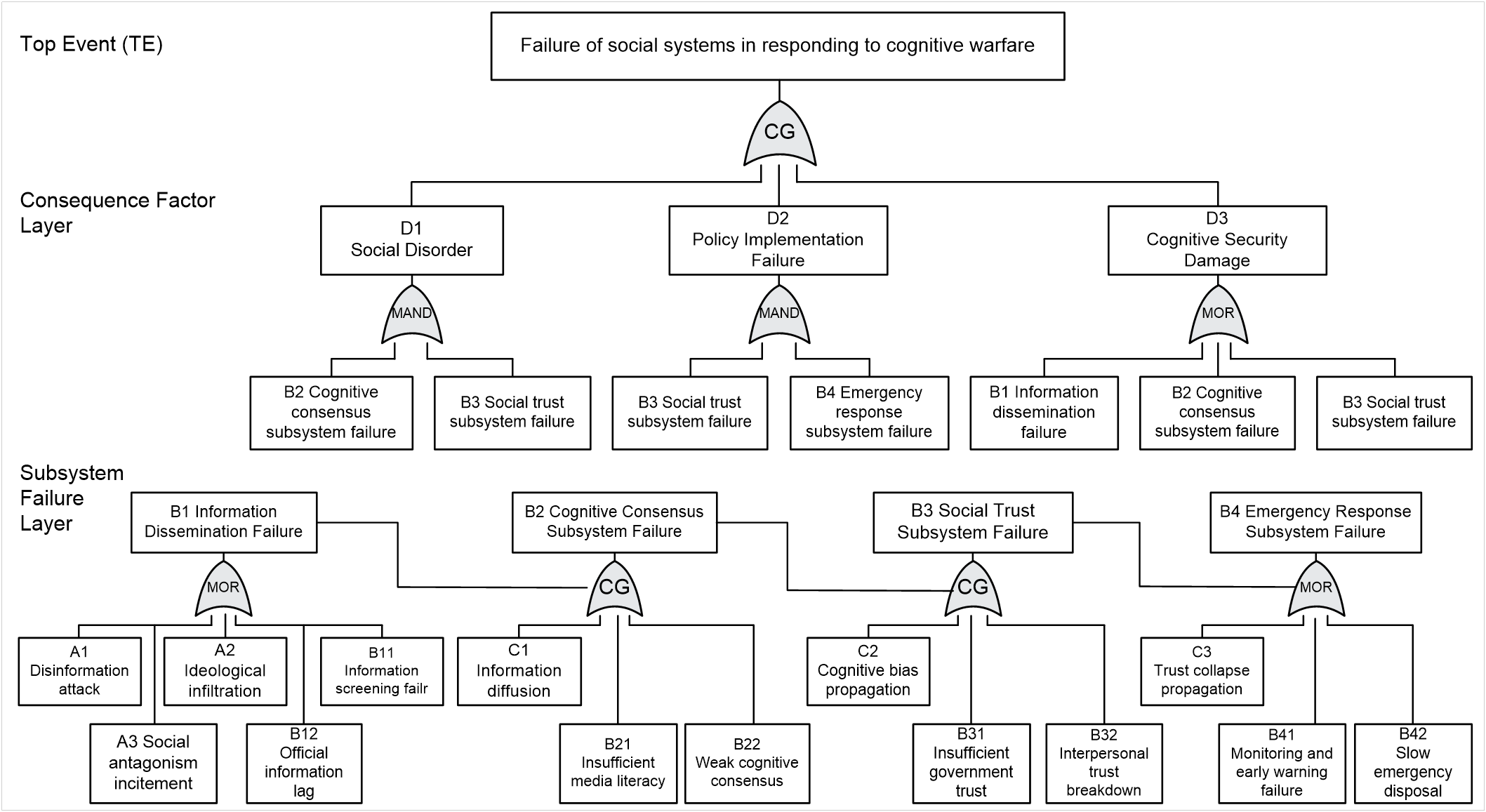
As an emerging non-traditional security threat, cognitive warfare undermines social systems by manipulating information dissemination, distorting cognitive consensus, and eroding social trust. The reliability of social systems against cognitive warfare reflects their ability to maintain core functions, resist cognitive infiltration, and restore social order. To quantitatively evaluate this reliability, this paper proposes a hybrid approach integrating the Extended Fault Tree (EFT) and Multi-Valued Decision Diagram (MDD). First, key failure paths and interdependencies are identified, including cascading failures among four core subsystems: information dissemination, cognitive consensus, social trust, and emergency response. Second, EFT models the logical relationships among cognitive attack sources, propagation nodes, and failure consequences, while multi-state nodes and cascade gates characterize graded failures and cascading effects. MDD is then employed to efficiently solve the complex logical model derived from EFT, balancing analytical accuracy and computational efficiency. An empirical case study of cognitive warfare response during a sudden public event verifies the effectiveness and applicability of the proposed approach. The results demonstrate that the hybrid approach provides quantitative decision support for optimizing social cognitive defense systems and offers a methodological reference for national cognitive security governance.
Graphical Abstract
Keywords
Data Availability Statement
Funding
Conflicts of Interest
AI Use Statement
Ethical Approval and Consent to Participate
References
- Green, S. (2008). Cognitive Warfare (M.S. thesis). Joint Military Intelligence College, Washington, DC, USA. https://theaugeanstables.com/wp-content/uploads/2009/10/Stuart-Green-LTC-USN-Cognitive-Warfare.pdf
[Google Scholar] - Danyk, Y., & Briggs, C. M. (2023). Modern cognitive operations and hybrid warfare. Journal of Strategic Security, 16(1), 35-50.
[CrossRef] [Google Scholar] - Tversky, A., & Kahneman, D. (1974). Judgment under Uncertainty: Heuristics and Biases: Biases in judgments reveal some heuristics of thinking under uncertainty. science, 185(4157), 1124-1131.
[CrossRef] [Google Scholar] - Nickerson, R. S. (1998). Confirmation bias: A ubiquitous phenomenon in many guises. Review of general psychology, 2(2), 175-220.
[CrossRef] [Google Scholar] - Vosoughi, S., Roy, D., & Aral, S. (2018). The spread of true and false news online. Science, 359(6380), 1146-1151.
[CrossRef] [Google Scholar] - Claverie, B., & du Cluzel, F. (2022). The Cognitive Warfare Concept. NATO-ACT Innovation Hub. https://innovationhub-act.org/wp-content/uploads/2023/12/CW-article-Claverie-du-Cluzel-final_0.pdf
[Google Scholar] - Shrestha, A., Xing, L., & Dai, Y. (2009). Decision diagram based methods and complexity analysis for multi-state systems. IEEE Transactions on Reliability, 59(1), 145-161.
[CrossRef] [Google Scholar] - Mo, Y., Xing, L., & Amari, S. V. (2014). A multiple-valued decision diagram based method for efficient reliability analysis of non-repairable phased-mission systems. IEEE Transactions on Reliability, 63(1), 320-330.
[CrossRef] [Google Scholar] - Flaxman, S., Goel, S., & Rao, J. M. (2016). Filter bubbles, echo chambers, and online news consumption. Public opinion quarterly, 80(S1), 298-320.
[CrossRef] [Google Scholar] - Xing, L., & Dai, Y. S. (2008). A new decision-diagram-based method for efficient analysis on multistate systems. IEEE Transactions on Dependable and Secure Computing, 6(3), 161-174.
[CrossRef] [Google Scholar] - Shu, K., Sliva, A., Wang, S., Tang, J., & Liu, H. (2017). Fake news detection on social media: A data mining perspective. ACM SIGKDD explorations newsletter, 19(1), 22-36.
[CrossRef] [Google Scholar] - Wang, H., Lu, X., Du, Y., Zhang, C., Sadiq, R., & Deng, Y. (2017). Fault tree analysis based on TOPSIS and triangular fuzzy number. International journal of system assurance engineering and management, 8(Suppl 4), 2064-2070.
[CrossRef] [Google Scholar] - Rao, K. D., Gopika, V., Rao, V. S., Kushwaha, H. S., Verma, A. K., & Srividya, A. (2009). Dynamic fault tree analysis using Monte Carlo simulation in probabilistic safety assessment. Reliability Engineering & System Safety, 94(4), 872-883.
[CrossRef] [Google Scholar] - Xing, L. (2020). Cascading failures in Internet of Things: Review and perspectives on reliability and resilience. IEEE Internet of Things Journal, 8(1), 44-64.
[CrossRef] [Google Scholar] - Wilson, C., Grizzle, A., Tuazon, R., Akyempong, K., & Cheung, C. K. (2011). Media and Information Literacy Curriculum for Teachers. UNESCO. https://www.unesco.org/en/articles/media-and-information-literacy-curriculum-teachers
[Google Scholar] - Rauzy, A. (1993). New algorithms for fault trees analysis. Reliability Engineering & System Safety, 40(3), 203-211.
[CrossRef] [Google Scholar] - Xing, L. (2005). Reliability modeling and analysis of complex hierarchical systems. International Journal of Reliability, Quality and Safety Engineering, 12(06), 477-492.
[CrossRef] [Google Scholar] - Mo, Y., Xing, L., Lin, Y. K., & Guo, W. (2018). Efficient analysis of repairable computing systems subject to scheduled checkpointing. IEEE Transactions on Dependable and Secure Computing, 18(1), 1-14.
[CrossRef] [Google Scholar] - Mo, Y., & Xing, L. (2021). Efficient analysis of resource availability for cloud computing systems to reduce SLA violations. IEEE Transactions on Dependable and Secure Computing, 19(6), 3699-3710.
[CrossRef] [Google Scholar] - Xing, L., & Amari, S. V. (2015). Binary decision diagrams and extensions for system reliability analysis. John Wiley & Sons.
[CrossRef] [Google Scholar]
Cite This Article
TY  - JOUR
AU  - Mo, Yuchang
AU  - Miao, Chunyu
AU  - Chen, Guangxuan
AU  - Gai, Tiantian
AU  - Wu, Wen
AU  - Gong, Yuhuan
PY  - 2026
DA  - 2026/10/01
TI  - Reliability Evaluation of Social Systems Against Cognitive Warfare: A Hybrid Approach Based on Extended Fault Tree and Multi-Valued Decision Diagram
JO  - ICCK Transactions on Systems Safety and Reliability
T2  - ICCK Transactions on Systems Safety and Reliability
JF  - ICCK Transactions on Systems Safety and Reliability
VL  - 2
IS  - 4
SP  - 220
EP  - 234
DO  - 10.62762/TSSR.2026.783316
UR  - https://www.icck.org/article/abs/TSSR.2026.783316
KW  - social system
KW  - cognitive warfare
KW  - reliability analysis
KW  - extended fault tree (EFT)
KW  - multi-valued decision diagram (MDD)
KW  - cascading failure
AB  - As an emerging non-traditional security threat, cognitive warfare undermines social systems by manipulating information dissemination, distorting cognitive consensus, and eroding social trust. The reliability of social systems against cognitive warfare reflects their ability to maintain core functions, resist cognitive infiltration, and restore social order. To quantitatively evaluate this reliability, this paper proposes a hybrid approach integrating the Extended Fault Tree (EFT) and Multi-Valued Decision Diagram (MDD). First, key failure paths and interdependencies are identified, including cascading failures among four core subsystems: information dissemination, cognitive consensus, social trust, and emergency response. Second, EFT models the logical relationships among cognitive attack sources, propagation nodes, and failure consequences, while multi-state nodes and cascade gates characterize graded failures and cascading effects. MDD is then employed to efficiently solve the complex logical model derived from EFT, balancing analytical accuracy and computational efficiency. An empirical case study of cognitive warfare response during a sudden public event verifies the effectiveness and applicability of the proposed approach. The results demonstrate that the hybrid approach provides quantitative decision support for optimizing social cognitive defense systems and offers a methodological reference for national cognitive security governance.
SN  - 3069-1087
PB  - Institute of Central Computation and Knowledge
LA  - English
ER  -
@article{Mo2026Reliabilit,
  author = {Yuchang Mo and Chunyu Miao and Guangxuan Chen and Tiantian Gai and Wen Wu and Yuhuan Gong},
  title = {Reliability Evaluation of Social Systems Against Cognitive Warfare: A Hybrid Approach Based on Extended Fault Tree and Multi-Valued Decision Diagram},
  journal = {ICCK Transactions on Systems Safety and Reliability},
  year = {2026},
  volume = {2},
  number = {4},
  pages = {220-234},
  doi = {10.62762/TSSR.2026.783316},
  url = {https://www.icck.org/article/abs/TSSR.2026.783316},
  abstract = {As an emerging non-traditional security threat, cognitive warfare undermines social systems by manipulating information dissemination, distorting cognitive consensus, and eroding social trust. The reliability of social systems against cognitive warfare reflects their ability to maintain core functions, resist cognitive infiltration, and restore social order. To quantitatively evaluate this reliability, this paper proposes a hybrid approach integrating the Extended Fault Tree (EFT) and Multi-Valued Decision Diagram (MDD). First, key failure paths and interdependencies are identified, including cascading failures among four core subsystems: information dissemination, cognitive consensus, social trust, and emergency response. Second, EFT models the logical relationships among cognitive attack sources, propagation nodes, and failure consequences, while multi-state nodes and cascade gates characterize graded failures and cascading effects. MDD is then employed to efficiently solve the complex logical model derived from EFT, balancing analytical accuracy and computational efficiency. An empirical case study of cognitive warfare response during a sudden public event verifies the effectiveness and applicability of the proposed approach. The results demonstrate that the hybrid approach provides quantitative decision support for optimizing social cognitive defense systems and offers a methodological reference for national cognitive security governance.},
  keywords = {social system, cognitive warfare, reliability analysis, extended fault tree (EFT), multi-valued decision diagram (MDD), cascading failure},
  issn = {3069-1087},
  publisher = {Institute of Central Computation and Knowledge}
}
Article Metrics
Publisher's Note
ICCK stays neutral with regard to jurisdictional claims in published maps and institutional affiliations.
Rights and Permissions


Portico
