

Multi-Task Machine Learning for Prenatal Risk Stratification: Integrating Biomarkers, Maternal Age, and Ultrasound Measurements to Predict the Risk of Down Syndrome, Trisomy 18, Trisomy 13, and Neural Tube Defects


Article Information
Abstract
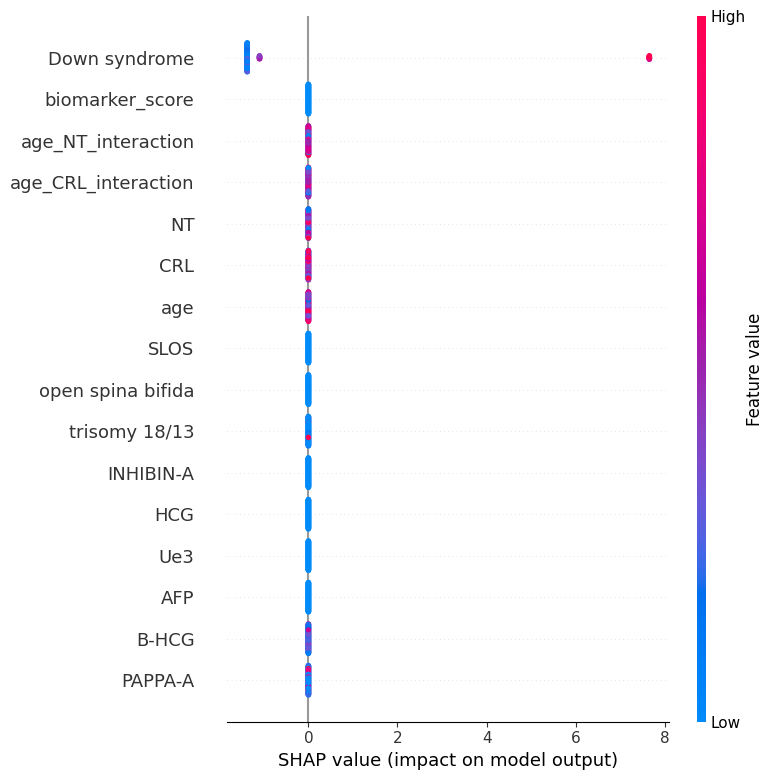
This study developed a machine learning model for early risk stratification of Down syndrome by integrating maternal serum biomarkers and ultrasound measurements. A retrospective multicentre dataset was used, including maternal age, AFP, HCG, INHIBIN-A, and ultrasound parameters (NT, CRL). After imputing missing data and engineering features (e.g., Age_NT_interaction), a Gradient Boosting Machine (GBM) was trained and evaluated using AUROC, precision, recall, and F1-score. The model achieved high performance (AUROC: 0.9921; precision: 1.00; F1-score: 0.91; accuracy: 0.97). SHAP analysis identified key interactions—particularly Age_NT, Age_HCG, and Age_PAPP-A—as major contributors. High maternal age combined with elevated HCG or low PAPP-A was linked to increased risk, aligning with clinical knowledge. The model offers a highly accurate and interpretable approach for Down syndrome risk prediction, supporting personalized, data-driven prenatal care. Prospective validation and clinical integration are recommended.
Graphical Abstract
Keywords
Data Availability Statement
Funding
Conflicts of Interest
Ethical Approval and Consent to Participate
References
- Abedalthagafi, M., Bawazeer, S., Fawaz, R. I., Heritage, A. M., Alajaji, N. M., & Faqeih, E. (2023). Non-invasive prenatal testing: a revolutionary journey in prenatal testing. Frontiers in Medicine, 10, 1265090.
[CrossRef] [Google Scholar] - Aboughalia, H., Bastawrous, S., Revzin, M. V., Delaney, S. S., Katz, D. S., & Moshiri, M. (2020). Imaging findings in association with altered maternal alpha-fetoprotein levels during pregnancy. Abdominal Radiology, 45, 3239–3257.
[Google Scholar] - Aprigio, J., de Castro, C. M., Lima, M. A. C., Ribeiro, M. G., Orioli, I. M., & Amorim, M. R. (2023). Mothers of children with Down syndrome: A clinical and epidemiological study. Journal of Community Genetics, 14(2), 189-195.
[CrossRef] [Google Scholar] - Chaemsaithong, P., Sahota, D. S., & Poon, L. C. (2022). First trimester preeclampsia screening and prediction. American journal of obstetrics and gynecology, 226(2), S1071-S1097.
[CrossRef] [Google Scholar] - Colnet, B., Josse, J., Varoquaux, G., & Scornet, E. (2023). Risk ratio, odds ratio, risk difference... Which causal measure is easier to generalize? ArXiv Preprint ArXiv:2303.16008.
[CrossRef] [Google Scholar] - de Souza Lima, B., Sanches, A. P. V., Ferreira, M. S., de Oliveira, J. L., Cleal, J. K., & Ignacio-Souza, L. (2024). Maternal-placental axis and its impact on fetal outcomes, metabolism, and development. Biochimica et Biophysica Acta (BBA)-Molecular Basis of Disease, 1870(1), 166855.
[CrossRef] [Google Scholar] - Demir, S., & Sahin, E. K. (2023). An investigation of feature selection methods for soil liquefaction prediction based on tree-based ensemble algorithms using AdaBoost, gradient boosting, and XGBoost. Neural Computing and Applications, 35(4), 3173-3190.
[CrossRef] [Google Scholar] - Esbensen, A. J., Schworer, E. K., & Hartley, S. L. (2024). Down syndrome. Intellectual and Developmental Disabilities: A Dynamic Systems Approach, 279-302.
[CrossRef] [Google Scholar] - Asselman, A., Khaldi, M., & Aammou, S. (2023). Enhancing the prediction of student performance based on the machine learning XGBoost algorithm. Interactive Learning Environments, 31(6), 3360-3379.
[CrossRef] [Google Scholar] - Keilty, B., Jackson, M. A., & Smith, J. (2024). Families’ experiences with supports after receiving a prenatal diagnosis of down syndrome. Early Childhood Research Quarterly, 66, 1-10.
[CrossRef] [Google Scholar] - Leung, C., Su, L., Simões-e-Silva, A. C., Arocha, L. S., de Paiva, K. M., & Haas, P. (2023). Risk for severe illness and death among pediatric patients with down syndrome hospitalized for COVID-19, Brazil. Emerging Infectious Diseases, 29(1), 26.
[CrossRef] [Google Scholar] - Poynard, T., Halfon, P., Castera, L., Charlotte, F., Le Bail, B., Munteanu, M., ... & Bourlière, M. (2007). Variability of the area under the receiver operating characteristic curves in the diagnostic evaluation of liver fibrosis markers: impact of biopsy length and fragmentation. Alimentary Pharmacology & Therapeutics, 25(6), 733–739.
[Google Scholar] - Rose, N. C., Kaimal, A. J., Dugoff, L., Norton, M. E., & American College of Obstetricians and Gynecologists. (2020). Screening for fetal chromosomal abnormalities: ACOG practice bulletin, number 226. Obstetrics & Gynecology, 136(4), e48–e69.
[Google Scholar] - Cabello-Solorzano, K., Ortigosa de Araujo, I., Peña, M., Correia, L., & J. Tallón-Ballesteros, A. (2023, August). The impact of data normalization on the accuracy of machine learning algorithms: a comparative analysis. In International conference on soft computing models in industrial and environmental applications (pp. 344-353). Cham: Springer Nature Switzerland.
[CrossRef] [Google Scholar] - Sarker, M. (2024). Revolutionizing healthcare: the role of machine learning in the health sector. Journal of Artificial Intelligence General science (JAIGS) ISSN: 3006-4023, 2(1), 36-61.
[CrossRef] [Google Scholar] - Zhang, Y., Zheng, Y., Wang, D., Gu, X., Zyphur, M. J., Xiao, L., ... & Deng, Y. (2025). Shedding Light on the Black Box: Integrating Prediction Models and Explainability Using Explainable Machine Learning. Organizational Research Methods, 10944281251323248.
[CrossRef] [Google Scholar] - Sadegh-Zadeh, S. A., Nazari, M. J., Aljamaeen, M., Yazdani, F. S., Mousavi, S. Y., & Vahabi, Z. (2024). Predictive models for Alzheimer's disease diagnosis and MCI identification: The use of cognitive scores and artificial intelligence algorithms. NPG Neurologie-Psychiatrie-Gériatrie, 24(142), 194-211.
[CrossRef] [Google Scholar] - Javaid, M., Haleem, A., Singh, R. P., Suman, R., & Rab, S. (2022). Significance of machine learning in healthcare: Features, pillars and applications. International Journal of Intelligent Networks, 3, 58-73.
[CrossRef] [Google Scholar] - Sadegh-Zadeh, S. A., Sakha, H., Movahedi, S., Harandi, A. F., Ghaffari, S., Javanshir, E., ... & Hajizadeh, R. (2023). Advancing prognostic precision in pulmonary embolism: a clinical and laboratory-based artificial intelligence approach for enhanced early mortality risk stratification. Computers in Biology and Medicine, 167, 107696.
[CrossRef] [Google Scholar] - Sadegh-Zadeh, S. A., Soleimani Mamalo, A., Kavianpour, K., Atashbar, H., Heidari, E., Hajizadeh, R., ... & Gargari, S. S. (2024). Artificial intelligence approaches for tinnitus diagnosis: leveraging high-frequency audiometry data for enhanced clinical predictions. Frontiers in Artificial Intelligence, 7, 1381455.
[CrossRef] [Google Scholar] - Steffensen, E. H., Pedersen, L. H., Lou, S., Vogel, I., Danish Fetal Medicine Study Group, & Danish Cytogenetic Central Registry Study Group. (2023). Is the first‐trimester combined screening result associated with the phenotype of Down syndrome? A population‐based cohort study. Prenatal Diagnosis, 43(1), 51-61.
[CrossRef] [Google Scholar] - Valentini, D., Di Camillo, C., Mirante, N., Vallogini, G., Olivini, N., Baban, A., ... & Villani, A. (2021). Medical conditions of children and young people with Down syndrome. Journal of Intellectual Disability Research, 65(2), 199-209.
[CrossRef] [Google Scholar] - Wang, Q., Ma, Y., Zhao, K., & Tian, Y. (2022). A comprehensive survey of loss functions in machine learning. Annals of Data Science, 9(2), 187-212.
[CrossRef] [Google Scholar] - Yang, Y., & Xu, Z. (2020). Rethinking the value of labels for improving class-imbalanced learning. Advances in Neural Information Processing Systems, 33, 19290–19301.
[CrossRef] [Google Scholar] - Zhang, J., Ma, X., Zhang, J., Sun, D., Zhou, X., Mi, C., & Wen, H. (2023). Insights into geospatial heterogeneity of landslide susceptibility based on the SHAP-XGBoost model. Journal of environmental management, 332, 117357.
[CrossRef] [Google Scholar]
Cite This Article
TY  - JOUR
AU  - Sadegh-Zadeh, Seyed-Ali
AU  - Mamalo, Alireza Soleimani
AU  - Saadat, Shayan
AU  - Gargari, Sahar Sayyadi
AU  - Barati, Mohammad Amin
AU  - Mehranfar, Sahar
AU  - Naderi, Zahra
PY  - 2025
DA  - 2025/07/06
TI  - Multi-Task Machine Learning for Prenatal Risk Stratification: Integrating Biomarkers, Maternal Age, and Ultrasound Measurements to Predict the Risk of Down Syndrome, Trisomy 18, Trisomy 13, and Neural Tube Defects
JO  - Frontiers in Biomedical Signal Processing
T2  - Frontiers in Biomedical Signal Processing
JF  - Frontiers in Biomedical Signal Processing
VL  - 1
IS  - 1
SP  - 24
EP  - 36
DO  - 10.62762/FBSP.2025.954863
UR  - https://www.icck.org/article/abs/FBSP.2025.954863
KW  - down syndrome
KW  - machine learning
KW  - prenatal screening
KW  - SHAP analysis
KW  - maternal biomarkers
AB  - This study developed a machine learning model for early risk stratification of Down syndrome by integrating maternal serum biomarkers and ultrasound measurements. A retrospective multicentre dataset was used, including maternal age, AFP, HCG, INHIBIN-A, and ultrasound parameters (NT, CRL). After imputing missing data and engineering features (e.g., Age_NT_interaction), a Gradient Boosting Machine (GBM) was trained and evaluated using AUROC, precision, recall, and F1-score. The model achieved high performance (AUROC: 0.9921; precision: 1.00; F1-score: 0.91; accuracy: 0.97). SHAP analysis identified key interactions—particularly Age_NT, Age_HCG, and Age_PAPP-A—as major contributors. High maternal age combined with elevated HCG or low PAPP-A was linked to increased risk, aligning with clinical knowledge. The model offers a highly accurate and interpretable approach for Down syndrome risk prediction, supporting personalized, data-driven prenatal care. Prospective validation and clinical integration are recommended.
SN  - 3071-2912
PB  - Institute of Central Computation and Knowledge
LA  - English
ER  -
@article{SadeghZadeh2025MultiTask,
  author = {Seyed-Ali Sadegh-Zadeh and Alireza Soleimani Mamalo and Shayan Saadat and Sahar Sayyadi Gargari and Mohammad Amin Barati and Sahar Mehranfar and Zahra Naderi},
  title = {Multi-Task Machine Learning for Prenatal Risk Stratification: Integrating Biomarkers, Maternal Age, and Ultrasound Measurements to Predict the Risk of Down Syndrome, Trisomy 18, Trisomy 13, and Neural Tube Defects},
  journal = {Frontiers in Biomedical Signal Processing},
  year = {2025},
  volume = {1},
  number = {1},
  pages = {24-36},
  doi = {10.62762/FBSP.2025.954863},
  url = {https://www.icck.org/article/abs/FBSP.2025.954863},
  abstract = {This study developed a machine learning model for early risk stratification of Down syndrome by integrating maternal serum biomarkers and ultrasound measurements. A retrospective multicentre dataset was used, including maternal age, AFP, HCG, INHIBIN-A, and ultrasound parameters (NT, CRL). After imputing missing data and engineering features (e.g., Age\_NT\_interaction), a Gradient Boosting Machine (GBM) was trained and evaluated using AUROC, precision, recall, and F1-score. The model achieved high performance (AUROC: 0.9921; precision: 1.00; F1-score: 0.91; accuracy: 0.97). SHAP analysis identified key interactions—particularly Age\_NT, Age\_HCG, and Age\_PAPP-A—as major contributors. High maternal age combined with elevated HCG or low PAPP-A was linked to increased risk, aligning with clinical knowledge. The model offers a highly accurate and interpretable approach for Down syndrome risk prediction, supporting personalized, data-driven prenatal care. Prospective validation and clinical integration are recommended.},
  keywords = {down syndrome, machine learning, prenatal screening, SHAP analysis, maternal biomarkers},
  issn = {3071-2912},
  publisher = {Institute of Central Computation and Knowledge}
}
Article Metrics
Publisher's Note
ICCK stays neutral with regard to jurisdictional claims in published maps and institutional affiliations.
Rights and Permissions
 Copyright © 2025 by the Author(s). Published by Institute of Central Computation and Knowledge. This article is an open access article distributed under the terms and conditions of the Creative Commons Attribution (CC BY) license (https://creativecommons.org/licenses/by/4.0/), which permits use, sharing, adaptation, distribution and reproduction in any medium or format, as long as you give appropriate credit to the original author(s) and the source, provide a link to the Creative Commons licence, and indicate if changes were made.


Portico
