

Dielectric and Ferroelectric Properties of Ba$_{0.85}$Ca$_{0.15}$Ti$_{0.9}$Zr$_{0.1}$O$_3$–Sr$_{0.7}$Bi$_{0.2}$TiO$_3$ Solid Solution


Article Information
Abstract
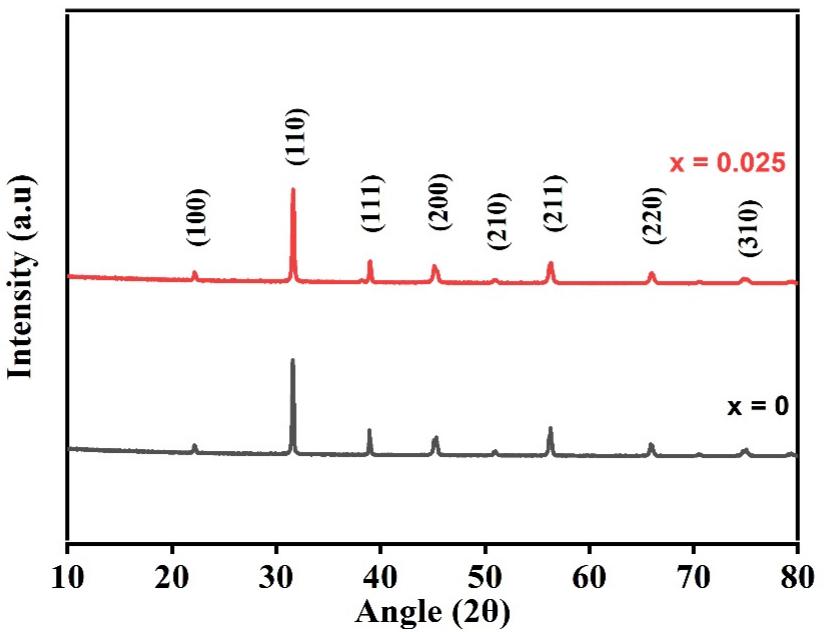
In this work, \((1-x)\text{Ba}_{0.85}\text{Ca}_{0.15}\text{Ti}_{0.9}\text{Zr}_{0.1}\text{O}_{3} - x\text{Sr}_{0.7}\text{Bi}_{0.2}\text{TiO}_{3}\) (BCZT–SBT) ceramics with \( x = 0 \) and \( x = 0.025 \) were prepared through the conventional solid-state route. The samples were calcined at \(1200\,^{\circ}\text{C}\) for \(6\,\text{h}\), then re-milled, pressed into pellets, and sintered at \(1325\,^{\circ}\text{C}\) for \(6\,\text{h}\). XRD patterns indicate the formation of a cubic perovskite structure. A small decrease in lattice parameter is observed upon introducing SBT (\(a\) decreases from \(4.0176\,\text{Å}\) to \(4.0149\,\text{Å}\)), accompanied by a slight reduction in unit-cell volume (\(64.85\,\text{Å}^3\) to \(64.72\,\text{Å}^3\)). \(\varepsilon_r\) increases strongly with \( x = 0.025 \): at \(1\,\text{MHz}\), \(\varepsilon_r\) rises from 1057 (\( x = 0 \)) to 2175 (\( x = 0.025 \)), while \(\tan\delta\) remains low (0.034–0.037). Ferroelectric measurements at \(30\,\text{kV/cm}\) show an increase in maximum polarization from \(11.06\,\mu\text{C/cm}^2\) (\( x = 0 \)) to \(23.5\,\mu\text{C/cm}^2\) (\( x = 0.025 \)), with the coercive field decreasing from \(6.9\,\text{kV/cm}\) to \(5.1\,\text{kV/cm}\).
Graphical Abstract
Keywords
Data Availability Statement
Funding
Conflicts of Interest
AI Use Statement
Ethical Approval and Consent to Participate
References
- Zhou, Z., Tang, H., & Sodano, H. A. (2014). Scalable synthesis of morphotropic phase boundary lead zirconium titanate nanowires for energy harvesting. Advanced Materials (Deerfield Beach, Fla.), 26(45), 7547-7554.
[CrossRef] [Google Scholar] - Koruza, J., Bell, A. J., Frömling, T., Webber, K. G., Wang, K., & Rödel, J. (2018). Requirements for the transfer of lead-free piezoceramics into application. Journal of Materiomics, 4(1), 13-26.
[CrossRef] [Google Scholar] - Panda, P. K., & Sahoo, B. (2015). PZT to lead free piezo ceramics: a review. Ferroelectrics, 474(1), 128-143.
[CrossRef] [Google Scholar] - Rödel, J., Jo, W., Seifert, K. T., Anton, E. M., Granzow, T., & Damjanovic, D. (2009). Perspective on the development of lead‐free piezoceramics. Journal of the American Ceramic Society, 92(6), 1153-1177.
[CrossRef] [Google Scholar] - Hanani, Z., Mezzane, D., Amjoud, M. B., Gagou, Y., Hoummada, K., Perrin, C., ... & Rožič, B. (2020). Structural, dielectric, and ferroelectric properties of lead-free BCZT ceramics elaborated by low-temperature hydrothermal processing. Journal of Materials Science: Materials in Electronics, 31(13), 10096-10104.
[CrossRef] [Google Scholar] - Liu, W., & Ren, X. (2009). Large piezoelectric effect in Pb-free ceramics. Physical Review Letters, 103(25), 257602.
[CrossRef] [Google Scholar] - Wu, J., Xiao, D., Wu, B., Wu, W., Zhu, J., Yang, Z., & Wang, J. (2012). Sintering temperature-induced electrical properties of (Ba\(_{0.90}\)Ca\(_{0.10}\))(Ti\(_{0.85}\)Zr\(_{0.15}\))O\(_3\) lead-free ceramics. Materials Research Bulletin, 47(5), 1281-1284.
[CrossRef] [Google Scholar] - Wang, Z., et al. (2016). Synthesis, structure, dielectric, piezoelectric, and energy storage performance of (Ba\(_{0.85}\)Ca\(_{0.15}\))(Ti\(_{0.9}\)Zr\(_{0.1}\))O\(_3\) ceramics prepared by different methods. Journal of Materials Science: Materials in Electronics, 27(5), 5047-5058.
[CrossRef] [Google Scholar] - Praveen, J. P., Karthik, T., James, A. R., Chandrakala, E., Asthana, S., & Das, D. (2015). Effect of poling process on piezoelectric properties of sol–gel derived BZT–BCT ceramics. Journal of the European Ceramic Society, 35(6), 1785-1798.
[CrossRef] [Google Scholar] - Rafiq, M. A., Rafiq, M. N., & Saravanan, K. V. (2015). Dielectric and impedance spectroscopic studies of lead-free barium‐calcium‐zirconium‐titanium oxide ceramics. Ceramics International, 41(9), 11436-11444.
[CrossRef] [Google Scholar] - Wu, J., Xiao, D., Wu, W., Chen, Q., Zhu, J., Yang, Z., & Wang, J. (2011). Role of room-temperature phase transition in the electrical properties of (Ba, Ca)(Ti, Zr)O$_3$ ceramics. Scripta Materialia, 65(9), 771-774.
[CrossRef] [Google Scholar] - Zhao, P., Tang, B., Si, F., Yang, C., Li, H., & Zhang, S. (2020). Novel Ca doped Sr$_{0.7$Bi$_{0.2$TiO$_3$ lead-free relaxor ferroelectrics with high energy density and efficiency. Journal of the European Ceramic Society, 40(5), 1938-1946.
[CrossRef] [Google Scholar] - Sakurai, M., Kanehara, K., Takeda, H., Tsurumi, T., & Hoshina, T. (2016). Wideband dielectric spectroscopy of (Sr0. 7Bi0. 2) TiO3 ceramics and its microscopic mechanism of polarization. Journal of the Ceramic Society of Japan, 124(6), 664-667.
[CrossRef] [Google Scholar] - Zhang, G. F., Cao, M., Hao, H., & Liu, H. (2013). Energy storage characteristics in Sr$_{(1-1.5x)$Bi$_x$TiO$_3$ ceramics. Ferroelectrics, 447(1), 86-94.
[CrossRef] [Google Scholar] - Shannon, R. T., & Prewitt, C. T. (1969). Effective ionic radii in oxides and fluorides. Structural Science, 25(5), 925-946.
[CrossRef] [Google Scholar] - Shi, C., Yan, F., Ge, G., Wei, Y., Zhai, J., & Yao, W. (2021). Significantly enhanced energy storage performances and power density in (1-x)BCZT-xSBT lead-free ceramics via synergistic optimization strategy. Chemical Engineering Journal, 426, 130800.
[CrossRef] [Google Scholar] - Zhao, P., Fang, Z., Zhang, X., Chen, J., Shen, Y., Zhang, X., ... & Tang, B. (2021). Aliovalent doping engineering for A-and B-sites with multiple regulatory mechanisms: a strategy to improve energy storage properties of Sr0. 7Bi0. 2TiO3-based lead-free relaxor ferroelectric ceramics. ACS applied materials & interfaces, 13(21), 24833-24855.
[CrossRef] [Google Scholar]
Cite This Article
TY  - JOUR
AU  - Shah, Kainat
AU  - Ali, Asif
PY  - 2026
DA  - 2026/03/28
TI  - Dielectric and Ferroelectric Properties of Ba$_{0.85}$Ca$_{0.15}$Ti$_{0.9}$Zr$_{0.1}$O$_3$–Sr$_{0.7}$Bi$_{0.2}$TiO$_3$ Solid Solution
JO  - Journal of Advanced Electronic Materials
T2  - Journal of Advanced Electronic Materials
JF  - Journal of Advanced Electronic Materials
VL  - 2
IS  - 1
SP  - 20
EP  - 24
DO  - 10.62762/JAEM.2026.678918
UR  - https://www.icck.org/article/abs/JAEM.2026.678918
KW  - BCZT
KW  - SBT
KW  - dielectric properties
KW  - ferroelectric properties
AB  - In this work, \((1-x)\text{Ba}_{0.85}\text{Ca}_{0.15}\text{Ti}_{0.9}\text{Zr}_{0.1}\text{O}_{3} - x\text{Sr}_{0.7}\text{Bi}_{0.2}\text{TiO}_{3}\) (BCZT–SBT) ceramics with \( x = 0 \) and \( x = 0.025 \) were prepared through the conventional solid-state route. The samples were calcined at \(1200\,^{\circ}\text{C}\) for \(6\,\text{h}\), then re-milled, pressed into pellets, and sintered at \(1325\,^{\circ}\text{C}\) for \(6\,\text{h}\). XRD patterns indicate the formation of a cubic perovskite structure. A small decrease in lattice parameter is observed upon introducing SBT (\(a\) decreases from \(4.0176\,\text{Å}\) to \(4.0149\,\text{Å}\)), accompanied by a slight reduction in unit-cell volume (\(64.85\,\text{Å}^3\) to \(64.72\,\text{Å}^3\)). \(\varepsilon_r\) increases strongly with \( x = 0.025 \): at \(1\,\text{MHz}\), \(\varepsilon_r\) rises from 1057 (\( x = 0 \)) to 2175 (\( x = 0.025 \)), while \(\tan\delta\) remains low (0.034–0.037). Ferroelectric measurements at \(30\,\text{kV/cm}\) show an increase in maximum polarization from \(11.06\,\mu\text{C/cm}^2\) (\( x = 0 \)) to \(23.5\,\mu\text{C/cm}^2\) (\( x = 0.025 \)), with the coercive field decreasing from \(6.9\,\text{kV/cm}\) to \(5.1\,\text{kV/cm}\).
SN  - 3070-5649
PB  - Institute of Central Computation and Knowledge
LA  - English
ER  -
@article{Shah2026Dielectric,
  author = {Kainat Shah and Asif Ali},
  title = {Dielectric and Ferroelectric Properties of Ba\$\_{0.85}\$Ca\$\_{0.15}\$Ti\$\_{0.9}\$Zr\$\_{0.1}\$O\$\_3\$–Sr\$\_{0.7}\$Bi\$\_{0.2}\$TiO\$\_3\$ Solid Solution},
  journal = {Journal of Advanced Electronic Materials},
  year = {2026},
  volume = {2},
  number = {1},
  pages = {20-24},
  doi = {10.62762/JAEM.2026.678918},
  url = {https://www.icck.org/article/abs/JAEM.2026.678918},
  abstract = {In this work, \((1-x)\text{Ba}\_{0.85}\text{Ca}\_{0.15}\text{Ti}\_{0.9}\text{Zr}\_{0.1}\text{O}\_{3} - x\text{Sr}\_{0.7}\text{Bi}\_{0.2}\text{TiO}\_{3}\) (BCZT–SBT) ceramics with \( x = 0 \) and \( x = 0.025 \) were prepared through the conventional solid-state route. The samples were calcined at \(1200\,^{\circ}\text{C}\) for \(6\,\text{h}\), then re-milled, pressed into pellets, and sintered at \(1325\,^{\circ}\text{C}\) for \(6\,\text{h}\). XRD patterns indicate the formation of a cubic perovskite structure. A small decrease in lattice parameter is observed upon introducing SBT (\(a\) decreases from \(4.0176\,\text{Å}\) to \(4.0149\,\text{Å}\)), accompanied by a slight reduction in unit-cell volume (\(64.85\,\text{Å}^3\) to \(64.72\,\text{Å}^3\)). \(\varepsilon\_r\) increases strongly with \( x = 0.025 \): at \(1\,\text{MHz}\), \(\varepsilon\_r\) rises from 1057 (\( x = 0 \)) to 2175 (\( x = 0.025 \)), while \(\tan\delta\) remains low (0.034–0.037). Ferroelectric measurements at \(30\,\text{kV/cm}\) show an increase in maximum polarization from \(11.06\,\mu\text{C/cm}^2\) (\( x = 0 \)) to \(23.5\,\mu\text{C/cm}^2\) (\( x = 0.025 \)), with the coercive field decreasing from \(6.9\,\text{kV/cm}\) to \(5.1\,\text{kV/cm}\).},
  keywords = {BCZT, SBT, dielectric properties, ferroelectric properties},
  issn = {3070-5649},
  publisher = {Institute of Central Computation and Knowledge}
}
Article Metrics
Publisher's Note
ICCK stays neutral with regard to jurisdictional claims in published maps and institutional affiliations.
Rights and Permissions
 Copyright © 2026 by the Author(s). Published by Institute of Central Computation and Knowledge. This article is an open access article distributed under the terms and conditions of the Creative Commons Attribution (CC BY) license (https://creativecommons.org/licenses/by/4.0/), which permits use, sharing, adaptation, distribution and reproduction in any medium or format, as long as you give appropriate credit to the original author(s) and the source, provide a link to the Creative Commons licence, and indicate if changes were made.


Portico
