

Cellulose Beyond Substrates: Emerging Functional Roles in Sustainable Advanced Electronics



Article Information
Abstract
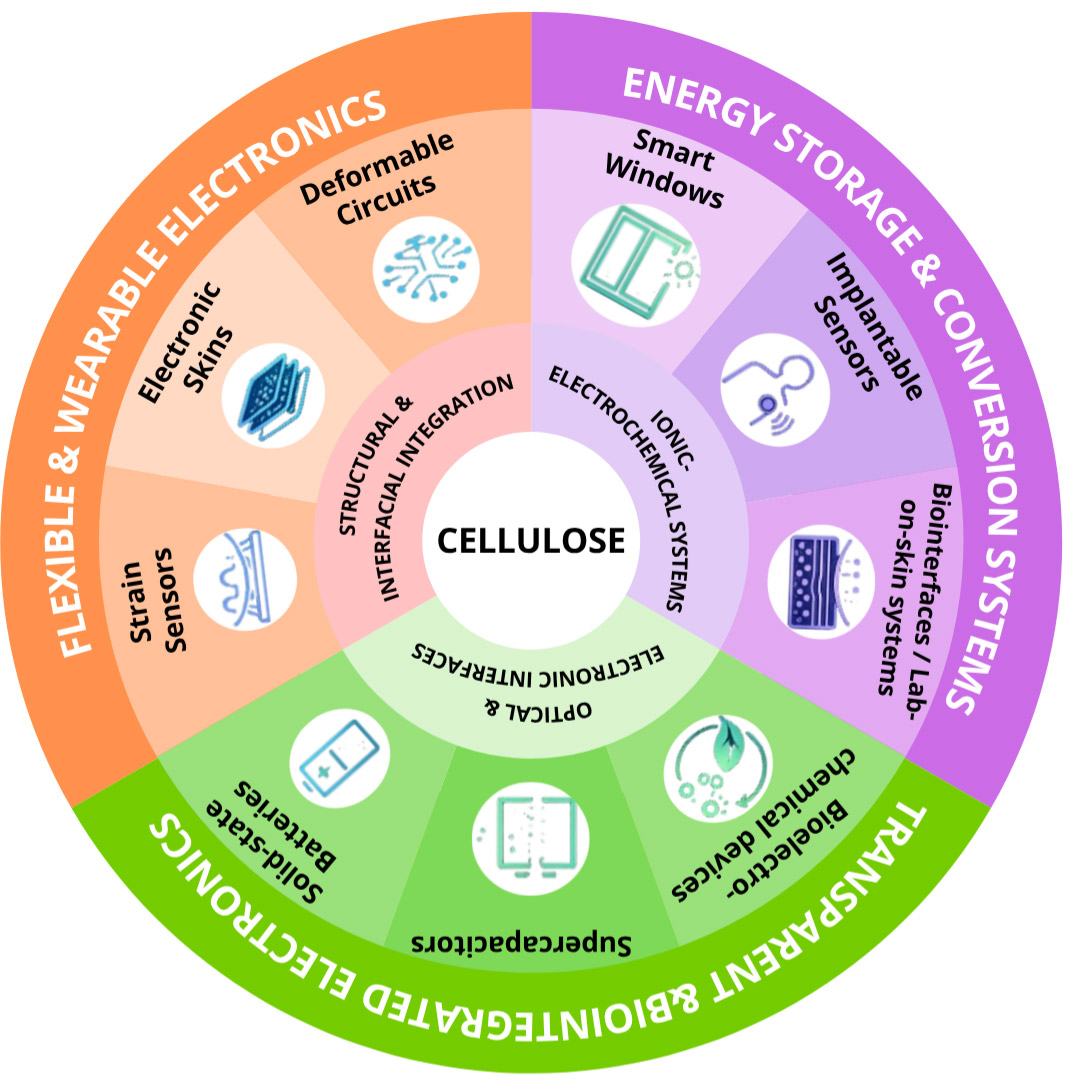
Cellulose, the most abundant natural polymer, is emerging as a versatile biomaterial platform for sustainable advanced electronics beyond its conventional role as a passive substrate. Its hierarchical fibrillar architecture and hydroxyl-rich chemistry enable unique combinations of mechanical compliance, interfacial reactivity, ionic transport, and optical transparency. This perspective highlights cellulose as a multifunctional system spanning structural and interfacial integration, ionic-electrochemical behavior, and optoelectronic interfaces, which together underpin its growing relevance in flexible, energy, and transparent electronic technologies. However, intrinsic coupling between hydration sensitivity, conductivity limitations, and structural stability defines key design trade-offs that must be addressed for practical implementation. Future progress will rely on transforming these inherent characteristics into tunable design parameters through hierarchical structuring and sustainable hybridization strategies, enabling cellulose-based architectures for next-generation environmentally adaptive electronics.
Graphical Abstract
Keywords
Data Availability Statement
Funding
Conflicts of Interest
AI Use Statement
Ethical Approval and Consent to Participate
References
- Klemm, D., Heublein, B., Fink, H. P., & Bohn, A. (2005). Cellulose: fascinating biopolymer and sustainable raw material. Angewandte chemie international edition, 44(22), 3358-3393.
[CrossRef] [Google Scholar] - Klemm, D., Kramer, F., Moritz, S., Lindström, T., Ankerfors, M., Gray, D., & Dorris, A. (2011). Nanocelluloses: a new family of nature‐based materials. Angewandte Chemie International Edition, 50(24), 5438-5466.
[CrossRef] [Google Scholar] - Dufresne, A. (2013). Nanocellulose: a new ageless bionanomaterial. Materials today, 16(6), 220-227.
[CrossRef] [Google Scholar] - Cosgrove, D. J. (2005). Growth of the plant cell wall. Nature reviews molecular cell biology, 6(11), 850-861.
[CrossRef] [Google Scholar] - Nishiyama, Y., Langan, P., & Chanzy, H. (2002). Crystal structure and hydrogen-bonding system in cellulose I$\beta$ from synchrotron X-ray and neutron fiber diffraction. Journal of the American Chemical Society, 124(31), 9074-9082.
[CrossRef] [Google Scholar] - Isogai, A., Saito, T., & Fukuzumi, H. (2011). TEMPO-oxidized cellulose nanofibers. Nanoscale, 3(1), 71-85.
[CrossRef] [Google Scholar] - Antony Jose, S., Cowan, N., Davidson, M., Godina, G., Smith, I., Xin, J., & Menezes, P. L. (2025). A comprehensive review on cellulose nanofibers, nanomaterials, and composites: manufacturing, properties, and applications. Nanomaterials, 15(5), 356.
[CrossRef] [Google Scholar] - Luo, R., Xie, X., Xiao, X. R., Zhang, N., Yang, J. H., & Wang, Y. (2026). Cellulose-Based Biobased Dielectrics for Energy Storage: Manufacturing and Performance Optimization Strategies. Biomacromolecules.
[CrossRef] [Google Scholar] - Pan, R., Cheng, Y., Pei, Y., Liu, J., Tian, W., Jiang, Y., ... & Zheng, X. (2023). Cellulose materials with high light transmittance and high haze: a review. Cellulose, 30(8), 4813-4826.
[CrossRef] [Google Scholar] - Luo, Q., Shen, H., Zhou, G., & Xu, X. (2023). A mini-review on the dielectric properties of cellulose and nanocellulose-based materials as electronic components. Carbohydrate Polymers, 303, 120449.
[CrossRef] [Google Scholar] - Wang, D. C., Lei, S. N., Zhong, S., Xiao, X., & Guo, Q. H. (2023). Cellulose-based conductive materials for energy and sensing applications. Polymers, 15(20), 4159.
[CrossRef] [Google Scholar] - Zhao, D., Zhu, Y., Cheng, W., Chen, W., Wu, Y., & Yu, H. (2021). Cellulose‐based flexible functional materials for emerging intelligent electronics. Advanced materials, 33(28), 2000619.
[CrossRef] [Google Scholar]
Cite This Article
TY  - JOUR
AU  - Jothiprakash, Gitanjali
AU  - Huat, Bernard Saw Lip
AU  - Sundaram, Senthilarasu
AU  - Sun, Dongyang
PY  - 2026
DA  - 2026/06/25
TI  - Cellulose Beyond Substrates: Emerging Functional Roles in Sustainable Advanced Electronics
JO  - Journal of Advanced Electronic Materials
T2  - Journal of Advanced Electronic Materials
JF  - Journal of Advanced Electronic Materials
VL  - 2
IS  - 2
SP  - 58
EP  - 63
DO  - 10.62762/JAEM.2026.198129
UR  - https://www.icck.org/article/abs/JAEM.2026.198129
KW  - cellulose
KW  - bioelectronics
KW  - energy storage
KW  - electrospinning
KW  - sustainable electronics
KW  - wearable technologies
AB  - Cellulose, the most abundant natural polymer, is emerging as a versatile biomaterial platform for sustainable advanced electronics beyond its conventional role as a passive substrate. Its hierarchical fibrillar architecture and hydroxyl-rich chemistry enable unique combinations of mechanical compliance, interfacial reactivity, ionic transport, and optical transparency. This perspective highlights cellulose as a multifunctional system spanning structural and interfacial integration, ionic-electrochemical behavior, and optoelectronic interfaces, which together underpin its growing relevance in flexible, energy, and transparent electronic technologies. However, intrinsic coupling between hydration sensitivity, conductivity limitations, and structural stability defines key design trade-offs that must be addressed for practical implementation. Future progress will rely on transforming these inherent characteristics into tunable design parameters through hierarchical structuring and sustainable hybridization strategies, enabling cellulose-based architectures for next-generation environmentally adaptive electronics.
SN  - 3070-5649
PB  - Institute of Central Computation and Knowledge
LA  - English
ER  -
@article{Jothiprakash2026Cellulose,
  author = {Gitanjali Jothiprakash and Bernard Saw Lip Huat and Senthilarasu Sundaram and Dongyang Sun},
  title = {Cellulose Beyond Substrates: Emerging Functional Roles in Sustainable Advanced Electronics},
  journal = {Journal of Advanced Electronic Materials},
  year = {2026},
  volume = {2},
  number = {2},
  pages = {58-63},
  doi = {10.62762/JAEM.2026.198129},
  url = {https://www.icck.org/article/abs/JAEM.2026.198129},
  abstract = {Cellulose, the most abundant natural polymer, is emerging as a versatile biomaterial platform for sustainable advanced electronics beyond its conventional role as a passive substrate. Its hierarchical fibrillar architecture and hydroxyl-rich chemistry enable unique combinations of mechanical compliance, interfacial reactivity, ionic transport, and optical transparency. This perspective highlights cellulose as a multifunctional system spanning structural and interfacial integration, ionic-electrochemical behavior, and optoelectronic interfaces, which together underpin its growing relevance in flexible, energy, and transparent electronic technologies. However, intrinsic coupling between hydration sensitivity, conductivity limitations, and structural stability defines key design trade-offs that must be addressed for practical implementation. Future progress will rely on transforming these inherent characteristics into tunable design parameters through hierarchical structuring and sustainable hybridization strategies, enabling cellulose-based architectures for next-generation environmentally adaptive electronics.},
  keywords = {cellulose, bioelectronics, energy storage, electrospinning, sustainable electronics, wearable technologies},
  issn = {3070-5649},
  publisher = {Institute of Central Computation and Knowledge}
}
Article Metrics
Publisher's Note
ICCK stays neutral with regard to jurisdictional claims in published maps and institutional affiliations.
Rights and Permissions
 Copyright © 2026 by the Author(s). Published by Institute of Central Computation and Knowledge. This article is an open access article distributed under the terms and conditions of the Creative Commons Attribution (CC BY) license (https://creativecommons.org/licenses/by/4.0/), which permits use, sharing, adaptation, distribution and reproduction in any medium or format, as long as you give appropriate credit to the original author(s) and the source, provide a link to the Creative Commons licence, and indicate if changes were made.


Portico
