

Sustainable Nanocellulose-PEO Composites Reinforced with Functional Nanofillers in High-Performance Dielectric Nanocomposites for Green Flexible Electronics





Article Information
Abstract
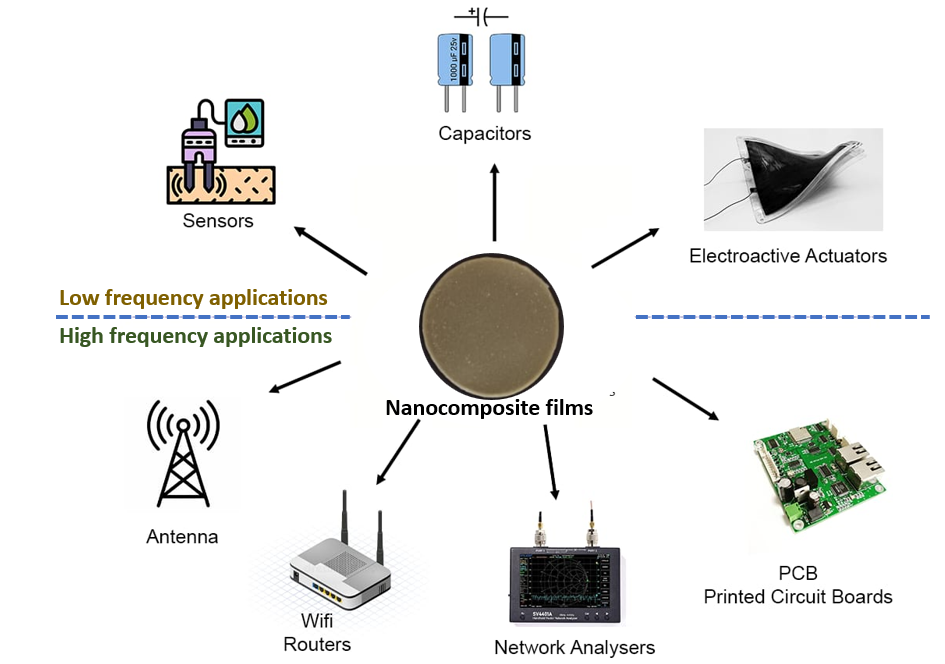
The growing demand for sustainable materials in green flexible electronics calls for alternatives to petroleum-derived polymers, which are non-biodegradable, resource-intensive, and environmentally harmful. This study presents the fabrication of bio-composite films using water hyacinth derived cellulose nanofibrils (CNF), blended with polyethylene oxide (PEO) and reinforced by functional nanofillers such as barium titanate (BTO), silver nanowires (SNP), and carbon nanotubes (CNT). The nanocomposite films (NCF) were produced by solution casting and systematically characterized for morphological, dielectric, mechanical, thermal, and chemical properties. Scanning electron microscopy analysis revealed well-dispersed CNF (-30 nm diameter) uniformly embedded within a CNF/PEO matrix and nanofillers (0.5–2%). Dielectric testing showed that BTO significantly enhanced permittivity (>200), making it promising for capacitor and antenna applications, although dielectric loss increased at higher nanofiller loadings. SNP-reinforced NCF exhibited moderate permittivity (50–90) but higher dielectric loss (0.15–0.32), supporting multifunctional applications requiring both dielectric and conductivity. CNT reinforced with NCF provided a balanced performance, with stable permittivity, relative low dielectric loss (< 0.015) and superior mechanical flexibility. Mechanical testing confirmed that BTO increased stiffness and tensile strength (1.5–2%), SNP enhanced strength but reduced ductility up to 1.5%, and CNT offered reinforcement at 1.5% with preserved elongation (up to 6%). FTIR spectra indicated strong interfacial interactions between nanofillers and CNF-PEO matrix. Thermal analysis revealed that CNT disrupted the crystalline structure of the matrix, lowering melting and crystallization temperatures, whereas BTO and SNP had negligible thermal effects. This study demonstrates a sustainable pathway to valorize an invasive species into a biodegradable, high-performance NCF for sustainable electronics, signifying a pathway toward flexible antenna, sensors, and energy storage materials.
Graphical Abstract
Keywords
Data Availability Statement
Funding
Conflicts of Interest
Ethical Approval and Consent to Participate
References
- Dulal, M., Modha, H. R. M., Liu, J., Islam, M. R., Carr, C., Hasan, T., ... & Karim, N. (2025). Sustainable, Wearable, and Eco‐Friendly Electronic Textiles. Energy & Environmental Materials, 8(3), e12854.
[CrossRef] [Google Scholar] - Moshood, T. D., Nawanir, G., Mahmud, F., Mohamad, F., Ahmad, M. H., & AbdulGhani, A. (2022). Sustainability of biodegradable plastics: New problem or solution to solve the global plastic pollution?. Current Research in Green and Sustainable Chemistry, 5, 100273.
[CrossRef] [Google Scholar] - Thomas, B., Raj, M. C., B, A. K., Joy, J., Moores, A., Drisko, G. L., & Sanchez, C. (2018). Nanocellulose, a versatile green platform: from biosources to materials and their applications. Chemical Reviews, 118(24), 11575-11625.
[CrossRef] [Google Scholar] - Ibanez Labiano, I., Arslan, D., Ozden Yenigun, E., Asadi, A., Cebeci, H., & Alomainy, A. (2021). Screen printing carbon nanotubes textiles antennas for smart wearables. Sensors, 21(14), 4934.
[CrossRef] [Google Scholar] - Packiam, K. K., Murugesan, B., Kaliyannan Sundaramoorthy, P. M., Srinivasan, H., & Dhanasekaran, K. (2022). Extraction, purification and characterization of nanocrystalline cellulose from Eichhornia crassipes (Mart.) solms: a common aquatic weed water hyacinth. Journal of Natural Fibers, 19(14), 7424-7435.
[CrossRef] [Google Scholar] - Ghamari, M., Sun, D., Dai, Y., See, C. H., Yu, H., Edirisinghe, M., & Sundaram, S. (2024). Valorization of diverse waste-derived nanocellulose for multifaceted applications: A review. International Journal of Biological Macromolecules, 280, 136130.
[CrossRef] [Google Scholar] - Vijayakumary, P., Manisha, R. B., Meenakshi, P., Parimala, D. R., Subramanian, P., Sriramajayam, S., \ldots & Ramesh, D. (2024). Conversion of sugarcane bagasse into cellulose, carboxymethyl cellulose, and polymer membrane electrolyte and their characterization. Plant Science Today, 11, 5874.
[CrossRef] [Google Scholar] - Chaiwarit, T., Chanabodeechalermrung, B., Kantrong, N., Chittasupho, C., & Jantrawut, P. (2022). Fabrication and evaluation of water hyacinth cellulose-composited hydrogel containing quercetin for topical antibacterial applications. Gels, 8(12), 767.
[CrossRef] [Google Scholar] - Pantamanatsopa, P., Ariyawiriyanan, W., & Ekgasit, S. (2023). Production of cellulose nanocrystals suspension with high yields from water hyacinth. Journal of Natural Fibers, 20(1), 2134266.
[CrossRef] [Google Scholar] - Nandi, S., Kerur, S. S., & Dhanalakshmi, S. (2024). Electrical and dielectric properties of polymer-metal hybrid nanocomposites-A short review. Diffusion Foundations and Materials Applications, 35, 1-13.
[CrossRef] [Google Scholar] - Farzin, M. A., Naghib, S. M., & Rabiee, N. (2024). Advancements in bio-inspired self-powered wireless sensors: Materials, mechanisms, and biomedical applications. ACS Biomaterials Science & Engineering, 10(3), 1262-1301.
[CrossRef] [Google Scholar] - AL-Oqla, F. M. (2020). Biocomposites in advanced biomedical and electronic systems applications. In Composites in biomedical applications (pp. 49-70). CRC Press.
[CrossRef] [Google Scholar] - Asrofi, M., Abral, H., Kasim, A., Pratoto, A., Mahardika, M., Park, J. W., & Kim, H. J. (2018). Isolation of nanocellulose from water hyacinth fiber (WHF) produced via digester-sonication and its characterization. Fibers and Polymers, 19(8), 1618-1625.
[CrossRef] [Google Scholar] - Uyor, U. O., Popoola, A. P. I., & Popoola, O. M. (2023). Flexible dielectric polymer nanocomposites with improved thermal energy management for energy-power applications. Frontiers in Energy Research, 11, 1114512.
[CrossRef] [Google Scholar] - Sun, D., Onyianta, A. J., O'Rourke, D., Perrin, G., Popescu, C. M., Saw, L. H., \ldots & Dorris, M. (2020). A process for deriving high quality cellulose nanofibrils from water hyacinth invasive species. Cellulose, 27(7), 3727-3740.
[CrossRef] [Google Scholar] - Krupka, J., Clarke, R. N., Rochard, O. C., & Gregory, A. P. (2000, May). Split post dielectric resonator technique for precise measurements of laminar dielectric specimens-measurement uncertainties. In 13th International Conference on Microwaves, Radar and Wireless Communications. MIKON-2000. Conference Proceedings (Vol. 1, pp. 305-308). IEEE.
[CrossRef] [Google Scholar] - Yaw, K. C. (2012). Measurement of dielectric material properties. Application Note. Rohde & Schwarz, 1-35.
[Google Scholar] - Sehaqui, H., Zhou, Q., & Berglund, L. A. (2011). High-porosity aerogels of high specific surface area prepared from nanofibrillated cellulose (NFC). Composites Science and Technology, 71(13), 1593-1599.
[CrossRef] [Google Scholar] - Dang, Z. M., Yuan, J. K., Zha, J. W., Zhou, T., Li, S. T., & Hu, G. H. (2012). Fundamentals, processes and applications of high-permittivity polymer–matrix composites. Progress in Materials Science, 57(4), 660-723.
[CrossRef] [Google Scholar] - Moon, R. J., Martini, A., Nairn, J., Simonsen, J., & Youngblood, J. (2011). Cellulose nanomaterials review: structure, properties and nanocomposites. Chemical Society Reviews, 40(7), 3941-3994.
[CrossRef] [Google Scholar] - Yang, L., Qiu, J., Ji, H., Zhu, K., & Wang, J. (2014). Enhanced dielectric and ferroelectric properties induced by TiO2@ MWCNTs nanoparticles in flexible poly (vinylidene fluoride) composites. Composites Part A: Applied Science and Manufacturing, 65, 125-134.
[CrossRef] [Google Scholar] - Khosroshahi, F. H., Kordi, F., & Tohidian, M. (2025). Preparation of cross-linked sponge with piezoelectric properties based on low density polyethylene/poly (ethylene-co-vinyl acetate) and barium titanate: Relationship between mechanical properties, and cell structure with piezoelectric coefficients. Polymers for Advanced Technologies, 36(2), e70084.
[CrossRef] [Google Scholar] - Mabrouki, A. E., Messaoudi, O., Dhahri, A., Azhary, A., Mansouri, M., & Alfhaid, L. (2025). Investigation of the frequency-dependent dielectric properties of the as-prepared LaNiO3/Co3O4 nanocomposites. ACS Omega, 10(22), 22701-22710.
[CrossRef] [Google Scholar] - Durai, S. V., & Kumar, E. (2020). Frequency-dependent impedance, modulus and dielectric studies of polyaniline/manganese dioxide nanocomposites. Journal of Ovonic Research, 16(3), 173-180.
[Google Scholar] - Sayin, G., Kurnaz, S., Tokeşer, E. A., Seydioğlu, T., & Öztürk, Ö. (2025). Frequency-dependent dielectric and impedance properties of TPU-graphene nanocomposites. Sensors and Actuators A: Physical, 116938.
[CrossRef] [Google Scholar] - Chen, Y., Carmichael, R. S., & Carmichael, T. B. (2019). Patterned, flexible, and stretchable silver nanowire/polymer composite films as transparent conductive electrodes. ACS Applied Materials & Interfaces, 11(34), 31210-31219.
[CrossRef] [Google Scholar] - Zeraati, A. S., Arjmand, M., & Sundararaj, U. (2017). Silver nanowire/MnO2 nanowire hybrid polymer nanocomposites: materials with high dielectric permittivity and low dielectric loss. ACS Applied Materials & Interfaces, 9(16), 14328-14336.
[CrossRef] [Google Scholar] - Zhou, Y., Bayram, Y., Du, F., Dai, L., & Volakis, J. L. (2010). Polymer-carbon nanotube sheets for conformal load bearing antennas. IEEE Transactions on Antennas and Propagation, 58(7), 2169-2175.
[CrossRef] [Google Scholar] - Liu, J., He, X., Wang, F., Zhou, X., & Li, G. (2021). Dielectric and mechanical properties of polycaprolactone/nano-barium titanate piezoelectric composites. Plastics, Rubber and Composites, 50(6), 299-306.
[CrossRef] [Google Scholar] - Turcanu, G., Stoica, I., Albu, R. M., Varganici, C. D., Avadanei, M. I., Barzic, A. I., \ldots & Buscaglia, M. T. (2025). Design of polysaccharide-based nanocomposites for eco-friendly flexible electronics. Polymers, 17(12), 1612.
[CrossRef] [Google Scholar] - Das Lala, S., Deoghare, A. B., & Chatterjee, S. (2018). Effect of reinforcements on polymer matrix bio-composites–an overview. Science and Engineering of Composite Materials, 25(6), 1039-1058.
[CrossRef] [Google Scholar] - Sha, Z., Cheng, X., Islam, M. S., Sangkarat, P., Chang, W., Brown, S. A., \ldots & Wang, C. H. (2023). Synergistically enhancing the electrical conductivity of carbon fibre reinforced polymers by vertical graphene and silver nanowires. Composites Part A: Applied Science and Manufacturing, 168, 107463.
[CrossRef] [Google Scholar] - Lee, I., Lee, J., Ko, S. H., & Kim, T. S. (2013). Reinforcing Ag nanoparticle thin films with very long Ag nanowires. Nanotechnology, 24(41), 415704.
[CrossRef] [Google Scholar] - Wang, X., & Wu, P. (2018). Fluorinated carbon nanotube/nanofibrillated cellulose composite film with enhanced toughness, superior thermal conductivity, and electrical insulation. ACS Applied Materials & Interfaces, 10(40), 34311-34321.
[CrossRef] [Google Scholar] - Sadasivuni, K. K., Saha, P., Adhikari, J., Deshmukh, K., Ahamed, M. B., & Cabibihan, J. J. (2020). Recent advances in mechanical properties of biopolymer composites: a review. Polymer Composites, 41(1), 32-59.
[CrossRef] [Google Scholar] - Azeez, S., & Shenbagaraman, R. (2025). Fourier transform infrared spectroscopy in characterization of bionanocomposites. In Characterization Techniques in Bionanocomposites (pp. 209-227). Woodhead Publishing.
[CrossRef] [Google Scholar] - Atta, M. R., Algethami, N., Farea, M. O., Alsulami, Q. A., & Rajeh, A. (2022). Enhancing the structural, thermal, and dielectric properties of the polymer nanocomposites based on polymer blend and barium titanate nanoparticles for application in energy storage. International Journal of Energy Research, 46(6), 8020-8029.
[CrossRef] [Google Scholar] - Sadeghi, E., Taghavi, R., Hasanzadeh, A., & Rostamnia, S. (2024). Bactericidal behavior of silver nanoparticle decorated nano-sized magnetic hydroxyapatite. Nanoscale Advances, 6(24), 6166-6172.
[CrossRef] [Google Scholar] - El Idrissi El Hassani, C., Daoudi, H., El Achaby, M., & Kassab, Z. (2023). Biomedical applications of chitosan-based nanostructured composite materials. In Chitosan Nanocomposites: Bionanomechanical Applications (pp. 81-107). Springer Nature Singapore.
[CrossRef] [Google Scholar] - Shah, S. A., Ali, H., Inayat, M. I., E. Mahmoud, E., Al Garalleh, H., & Ahmad, B. (2024). Effect of carbon nanotubes and zinc oxide on electrical and mechanical properties of polyvinyl alcohol matrix composite by electrospinning method. Scientific Reports, 14(1), 28107.
[CrossRef] [Google Scholar] - Sahoo, N. G., Cheng, H. K. F., Li, L., Chan, S. H., Judeh, Z., & Zhao, J. (2009). Specific functionalization of carbon nanotubes for advanced polymer nanocomposites. Advanced Functional Materials, 19(24), 3962-3971.
[CrossRef] [Google Scholar] - Jin, F. L., & Park, S. J. (2011). A review of the preparation and properties of carbon nanotubes-reinforced polymer composites. Carbon Letters, 12(2), 57-69.
[CrossRef] [Google Scholar]
Cite This Article
TY  - JOUR
AU  - Jothiprakash, Gitanjali
AU  - Sun, Dongyang
AU  - Adonteng, Peter
AU  - See, Chan Hwang
AU  - Lasseuguette, Elsa
AU  - Lu, Zhilun
AU  - Desikan, Ramesh
AU  - Karthikeyan, Subburamu
AU  - Sundaram, Senthilarasu
PY  - 2025
DA  - 2025/11/29
TI  - Sustainable Nanocellulose-PEO Composites Reinforced with Functional Nanofillers in High-Performance Dielectric Nanocomposites for Green Flexible Electronics
JO  - Journal of Advanced Electronic Materials
T2  - Journal of Advanced Electronic Materials
JF  - Journal of Advanced Electronic Materials
VL  - 1
IS  - 1
SP  - 5
EP  - 16
DO  - 10.62762/JAEM.2025.761770
UR  - https://www.icck.org/article/abs/JAEM.2025.761770
KW  - cellulose
KW  - nanofibrils
KW  - nanocomposite films
KW  - sustainable materials
KW  - water hyacinth
AB  - The growing demand for sustainable materials in green flexible electronics calls for alternatives to petroleum-derived polymers, which are non-biodegradable, resource-intensive, and environmentally harmful. This study presents the fabrication of bio-composite films using water hyacinth derived cellulose nanofibrils (CNF), blended with polyethylene oxide (PEO) and reinforced by functional nanofillers such as barium titanate (BTO), silver nanowires (SNP), and carbon nanotubes (CNT). The nanocomposite films (NCF) were produced by solution casting and systematically characterized for morphological, dielectric, mechanical, thermal, and chemical properties. Scanning electron microscopy analysis revealed well-dispersed CNF (-30 nm diameter) uniformly embedded within a CNF/PEO matrix and nanofillers (0.5–2%). Dielectric testing showed that BTO significantly enhanced permittivity (>200), making it promising for capacitor and antenna applications, although dielectric loss increased at higher nanofiller loadings. SNP-reinforced NCF exhibited moderate permittivity (50–90) but higher dielectric loss (0.15–0.32), supporting multifunctional applications requiring both dielectric and conductivity. CNT reinforced with NCF provided a balanced performance, with stable permittivity, relative low dielectric loss (< 0.015) and superior mechanical flexibility. Mechanical testing confirmed that BTO increased stiffness and tensile strength (1.5–2%), SNP enhanced strength but reduced ductility up to 1.5%, and CNT offered reinforcement at 1.5% with preserved elongation (up to 6%). FTIR spectra indicated strong interfacial interactions between nanofillers and CNF-PEO matrix. Thermal analysis revealed that CNT disrupted the crystalline structure of the matrix, lowering melting and crystallization temperatures, whereas BTO and SNP had negligible thermal effects. This study demonstrates a sustainable pathway to valorize an invasive species into a biodegradable, high-performance NCF for sustainable electronics, signifying a pathway toward flexible antenna, sensors, and energy storage materials.
SN  - 3070-5649
PB  - Institute of Central Computation and Knowledge
LA  - English
ER  -
@article{Jothiprakash2025Sustainabl,
  author = {Gitanjali Jothiprakash and Dongyang Sun and Peter Adonteng and Chan Hwang See and Elsa Lasseuguette and Zhilun Lu and Ramesh Desikan and Subburamu Karthikeyan and Senthilarasu Sundaram},
  title = {Sustainable Nanocellulose-PEO Composites Reinforced with Functional Nanofillers in High-Performance Dielectric Nanocomposites for Green Flexible Electronics},
  journal = {Journal of Advanced Electronic Materials},
  year = {2025},
  volume = {1},
  number = {1},
  pages = {5-16},
  doi = {10.62762/JAEM.2025.761770},
  url = {https://www.icck.org/article/abs/JAEM.2025.761770},
  abstract = {The growing demand for sustainable materials in green flexible electronics calls for alternatives to petroleum-derived polymers, which are non-biodegradable, resource-intensive, and environmentally harmful. This study presents the fabrication of bio-composite films using water hyacinth derived cellulose nanofibrils (CNF), blended with polyethylene oxide (PEO) and reinforced by functional nanofillers such as barium titanate (BTO), silver nanowires (SNP), and carbon nanotubes (CNT). The nanocomposite films (NCF) were produced by solution casting and systematically characterized for morphological, dielectric, mechanical, thermal, and chemical properties. Scanning electron microscopy analysis revealed well-dispersed CNF (-30 nm diameter) uniformly embedded within a CNF/PEO matrix and nanofillers (0.5–2\%). Dielectric testing showed that BTO significantly enhanced permittivity (>200), making it promising for capacitor and antenna applications, although dielectric loss increased at higher nanofiller loadings. SNP-reinforced NCF exhibited moderate permittivity (50–90) but higher dielectric loss (0.15–0.32), supporting multifunctional applications requiring both dielectric and conductivity. CNT reinforced with NCF provided a balanced performance, with stable permittivity, relative low dielectric loss (< 0.015) and superior mechanical flexibility. Mechanical testing confirmed that BTO increased stiffness and tensile strength (1.5–2\%), SNP enhanced strength but reduced ductility up to 1.5\%, and CNT offered reinforcement at 1.5\% with preserved elongation (up to 6\%). FTIR spectra indicated strong interfacial interactions between nanofillers and CNF-PEO matrix. Thermal analysis revealed that CNT disrupted the crystalline structure of the matrix, lowering melting and crystallization temperatures, whereas BTO and SNP had negligible thermal effects. This study demonstrates a sustainable pathway to valorize an invasive species into a biodegradable, high-performance NCF for sustainable electronics, signifying a pathway toward flexible antenna, sensors, and energy storage materials.},
  keywords = {cellulose, nanofibrils, nanocomposite films, sustainable materials, water hyacinth},
  issn = {3070-5649},
  publisher = {Institute of Central Computation and Knowledge}
}
Article Metrics
Publisher's Note
ICCK stays neutral with regard to jurisdictional claims in published maps and institutional affiliations.
Rights and Permissions
 Copyright © 2025 by the Author(s). Published by Institute of Central Computation and Knowledge. This article is an open access article distributed under the terms and conditions of the Creative Commons Attribution (CC BY) license (https://creativecommons.org/licenses/by/4.0/), which permits use, sharing, adaptation, distribution and reproduction in any medium or format, as long as you give appropriate credit to the original author(s) and the source, provide a link to the Creative Commons licence, and indicate if changes were made.


Portico
