

Ionic Conduction in Cold-Sintered Metakaolin Ceramics


Article Information
Abstract
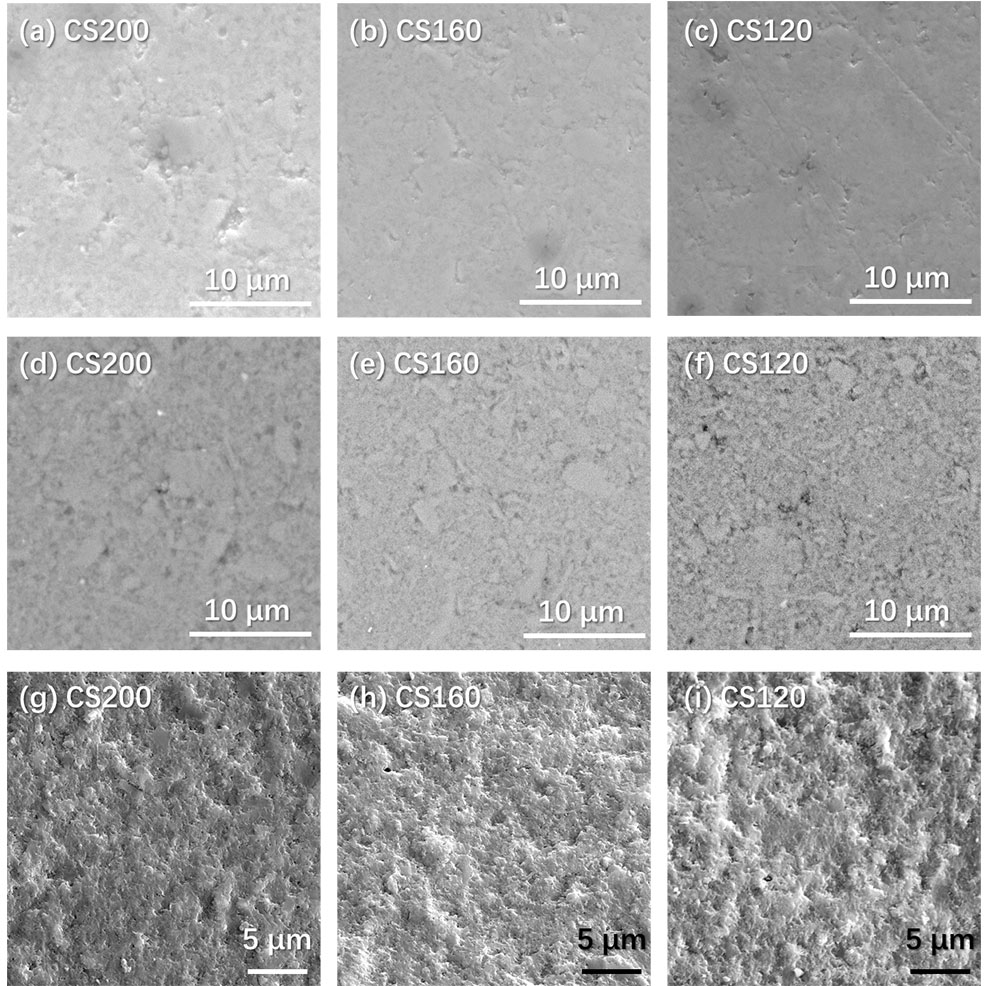
The influence of process conditions and post-annealing treatments on the ionic transport properties of metakaolin (MK) ceramics prepared by the cold sintering process (CSP) were investigated. Within the temperature range of 120–200 °C, CSP temperature has little influence on densification and microstructure. Impedance spectroscopy revealed that all as-sintered ceramics exhibited significant ionic conduction, with bulk conductivity of approximately 0.001 S/cm at 600 °C. The associated activation energies are confined to a narrow range of 0.63–0.65 eV. In contrast, post-annealing significantly alters the electrical microstructure, giving rise to an additional grain boundary response. After annealing at 1100 °C, the bulk ionic conductivity increased. This increase is likely attributed to the space charge effect due to the coexistence of crystalline and amorphous regions.
Graphical Abstract
Keywords
Data Availability Statement
Funding
Conflicts of Interest
AI Use Statement
Ethical Approval and Consent to Participate
References
- Janek, J., & Zeier, W. G. (2016). A solid future for battery development. Nature energy, 1(9), 1-4.
[CrossRef] [Google Scholar] - Bachman, J. C., Muy, S., Grimaud, A., Chang, H. H., Pour, N., Lux, S. F., ... & Shao-Horn, Y. (2016). Inorganic solid-state electrolytes for lithium batteries: mechanisms and properties governing ion conduction. Chemical reviews, 116(1), 140-162.
[CrossRef] [Google Scholar] - Jiang, T., Liu, Z., Tian, X., Wu, J., & Wang, L. (2024). Review on the impact of metakaolin-based geopolymer's reaction chemistry, nanostructure and factors on its properties. Construction and Building Materials, 412, 134760.
[CrossRef] [Google Scholar] - Souquet, J. L. (1981). Ionic transport in amorphous solid electrolytes. Annual Review of Materials Science, 11(1), 211-231.
[CrossRef] [Google Scholar] - Nascimento, M. L. F., Rodrigues, A. C. M., & Souquet, J. L. (2010). Microscopic and thermodynamic interpretations of experimental data on ionic conductivity in lithium silicate glasses. Physics and Chemistry of Glasses-European Journal of Glass Science and Technology Part B, 51(1), 69-77.
[Google Scholar] - Guo, J., Berbano, S. S., Guo, H., Baker, A. L., Lanagan, M. T., & Randall, C. A. (2016). Cold sintering process of composites: bridging the processing temperature gap of ceramic and polymer materials. Advanced Functional Materials, 26(39), 7115-7121.
[CrossRef] [Google Scholar] - Guo, J., Floyd, R., Lowum, S., Maria, J. P., Herisson de Beauvoir, T., Seo, J. H., & Randall, C. A. (2019). Cold sintering: progress, challenges, and future opportunities. Annual Review of Materials Research, 49(1), 275-295.
[CrossRef] [Google Scholar] - Guo, J., Baker, A. L., Guo, H., Lanagan, M., & Randall, C. A. (2017). Cold sintering process: a new era for ceramic packaging and microwave device development. Journal of the American Ceramic Society, 100(2), 669-677.
[CrossRef] [Google Scholar] - Maria, J. P., Kang, X., Floyd, R. D., Dickey, E. C., Guo, H., Guo, J., ... & Randall, C. A. (2017). Cold sintering: Current status and prospects. Journal of Materials Research, 32(17), 3205-3218.
[CrossRef] [Google Scholar] - Guo, H., Guo, J., Baker, A., & Randall, C. A. (2016). Hydrothermal-assisted cold sintering process: a new guidance for low-temperature ceramic sintering. ACS applied materials & interfaces, 8(32), 20909-20915.
[CrossRef] [Google Scholar] - Guo, H., Baker, A., Guo, J., & Randall, C. A. (2016). Cold sintering process: a novel technique for low‐temperature ceramic processing of ferroelectrics. Journal of the American Ceramic Society, 99(11), 3489-3507.
[CrossRef] [Google Scholar] - Zubairi, H., Hussain, F., Sheikh, S., Shaikh, A. A., Wang, D., & Reaney, I. M. (2023). Comparative study of cold assisted and conventional sintering of (1-2x) K0. 5Na0. 5NbO3-xBaTiO3-xBiFeO3 multiferroic ceramics. Materials Science and Engineering: B, 296, 116632.
[CrossRef] [Google Scholar] - Ndayishimiye, A., Sengul, M. Y., Sada, T., Dursun, S., Bang, S. H., Grady, Z. A., ... & Randall, C. A. (2020). Roadmap for densification in cold sintering: Chemical pathways. Open Ceramics, 2, 100019.
[CrossRef] [Google Scholar] - Funahashi, S., Guo, J., Guo, H., Wang, K., Baker, A. L., Shiratsuyu, K., & Randall, C. A. (2017). Demonstration of the cold sintering process study for the densification and grain growth of ZnO ceramics. Journal of the American Ceramic Society, 100(2), 546-553.
[CrossRef] [Google Scholar] - Tsuji, K., Ndayishimiye, A., Lowum, S., Floyd, R., Wang, K., Wetherington, M., ... & Randall, C. A. (2020). Single step densification of high permittivity BaTiO3 ceramics at 300 ºC. Journal of the European Ceramic Society, 40(4), 1280-1284.
[CrossRef] [Google Scholar] - Wang, D., Li, L., Jiang, J., Lu, Z., Wang, G., Song, K., ... & Reaney, I. M. (2021). Cold sintering of microwave dielectric ceramics and devices. Journal of Materials Research, 36(2), 333-349.
[CrossRef] [Google Scholar] - Zaengle, T. H., Ndayishimiye, A., Tsuji, K., Fan, Z., Bang, S. H., Perini, J., ... & Randall, C. A. (2020). Single‐step densification of nanocrystalline CeO2 by the cold sintering process. Journal of the American Ceramic Society, 103(5), 2979-2985.
[CrossRef] [Google Scholar] - Zhao, X., Guo, J., Wang, K., Herisson De Beauvoir, T., Li, B., & Randall, C. A. (2018). Introducing a ZnO–PTFE (polymer) nanocomposite varistor via the cold sintering process. Advanced Engineering Materials, 20(7), 1700902.
[CrossRef] [Google Scholar] - Seo, J. H., Guo, J., Guo, H., Verlinde, K., Heidary, D. S. B., Rajagopalan, R., & Randall, C. A. (2017). Cold sintering of a Li-ion cathode: LiFePO4-composite with high volumetric capacity. Ceramics International, 43(17), 15370-15374.
[CrossRef] [Google Scholar] - Li, L., Andrews, J., Mitchell, R., Button, D., Sinclair, D. C., & Reaney, I. M. (2023). Aqueous cold sintering of Li-based compounds. ACS Applied Materials & Interfaces, 15(16), 20228-20239.
[CrossRef] [Google Scholar] - Liu, B., Li, L., Song, K. X., Mao, M. M., Lu, Z., Wang, G., ... & Reaney, I. M. (2021). Enhancement of densification and microwave dielectric properties in LiF ceramics via a cold sintering and post-annealing process. Journal of the European Ceramic Society, 41(2), 1726-1729.
[CrossRef] [Google Scholar] - Seo, J. H., Verlinde, K., Rajagopalan, R., Gomez, E. D., Mallouk, T. E., & Randall, C. A. (2019). Cold sintering process for fabrication of a high volumetric capacity Li4Ti5O12 anode. Materials Science and Engineering: B, 250, 114435.
[CrossRef] [Google Scholar] - Li, L., Yang, F., Liu, C., Chen, Z., Ge, J., & Hou, Z. (2025). Cold Sintering of Metakaolin: a One-Step Densification Process of Amorphous Aluminosilicate. Ceramics International, 51(24), 43311–43318.
[CrossRef] [Google Scholar] - Liang, C. C. (1973). Conduction characteristics of the lithium iodide‐aluminum oxide solid electrolytes. Journal of the Electrochemical Society, 120(10), 1289-1292.
[CrossRef] [Google Scholar] - Maier, J. (1995). Ionic conduction in space charge regions. Progress in solid state chemistry, 23(3), 171-263.
[CrossRef] [Google Scholar] - Maier, J. (1984). Surface Induced Defects in the Space Charge Region and the Enhancement of Ionic Conductivity in Two‐Phase Systems. physica status solidi (b), 123(1), K89-K91.
[CrossRef] [Google Scholar] - Maier, J. (1985). Space charge regions in solid two-phase systems and their conduction contribution—I. Conductance enhancement in the system ionic conductor-‘inert’phase and application on AgC1: Al2O3 and AgC1: SiO2. Journal of Physics and Chemistry of Solids, 46(3), 309-320.
[CrossRef] [Google Scholar]
Cite This Article
TY  - JOUR
AU  - Li, Linhao
AU  - Zhang, Yinyin
AU  - Xu, Zibo
AU  - Li, Bofeng
PY  - 2026
DA  - 2026/05/10
TI  - Ionic Conduction in Cold-Sintered Metakaolin Ceramics
JO  - Journal of Advanced Electronic Materials
T2  - Journal of Advanced Electronic Materials
JF  - Journal of Advanced Electronic Materials
VL  - 2
IS  - 2
SP  - 44
EP  - 50
DO  - 10.62762/JAEM.2026.769607
UR  - https://www.icck.org/article/abs/JAEM.2026.769607
KW  - cold sintering process
KW  - metakaolin
KW  - ionic conductivity
KW  - impedance spectroscopy
KW  - space charge effect
AB  - The influence of process conditions and post-annealing treatments on the ionic transport properties of metakaolin (MK) ceramics prepared by the cold sintering process (CSP) were investigated. Within the temperature range of 120–200 °C, CSP temperature has little influence on densification and microstructure. Impedance spectroscopy revealed that all as-sintered ceramics exhibited significant ionic conduction, with bulk conductivity of approximately 0.001 S/cm at 600 °C. The associated activation energies are confined to a narrow range of 0.63–0.65 eV. In contrast, post-annealing significantly alters the electrical microstructure, giving rise to an additional grain boundary response. After annealing at 1100 °C, the bulk ionic conductivity increased. This increase is likely attributed to the space charge effect due to the coexistence of crystalline and amorphous regions.
SN  - 3070-5649
PB  - Institute of Central Computation and Knowledge
LA  - English
ER  -
@article{Li2026Ionic,
  author = {Linhao Li and Yinyin Zhang and Zibo Xu and Bofeng Li},
  title = {Ionic Conduction in Cold-Sintered Metakaolin Ceramics},
  journal = {Journal of Advanced Electronic Materials},
  year = {2026},
  volume = {2},
  number = {2},
  pages = {44-50},
  doi = {10.62762/JAEM.2026.769607},
  url = {https://www.icck.org/article/abs/JAEM.2026.769607},
  abstract = {The influence of process conditions and post-annealing treatments on the ionic transport properties of metakaolin (MK) ceramics prepared by the cold sintering process (CSP) were investigated. Within the temperature range of 120–200 °C, CSP temperature has little influence on densification and microstructure. Impedance spectroscopy revealed that all as-sintered ceramics exhibited significant ionic conduction, with bulk conductivity of approximately 0.001 S/cm at 600 °C. The associated activation energies are confined to a narrow range of 0.63–0.65 eV. In contrast, post-annealing significantly alters the electrical microstructure, giving rise to an additional grain boundary response. After annealing at 1100 °C, the bulk ionic conductivity increased. This increase is likely attributed to the space charge effect due to the coexistence of crystalline and amorphous regions.},
  keywords = {cold sintering process, metakaolin, ionic conductivity, impedance spectroscopy, space charge effect},
  issn = {3070-5649},
  publisher = {Institute of Central Computation and Knowledge}
}
Article Metrics
Publisher's Note
ICCK stays neutral with regard to jurisdictional claims in published maps and institutional affiliations.
Rights and Permissions
 Copyright © 2026 by the Author(s). Published by Institute of Central Computation and Knowledge. This article is an open access article distributed under the terms and conditions of the Creative Commons Attribution (CC BY) license (https://creativecommons.org/licenses/by/4.0/), which permits use, sharing, adaptation, distribution and reproduction in any medium or format, as long as you give appropriate credit to the original author(s) and the source, provide a link to the Creative Commons licence, and indicate if changes were made.


Portico
