Boosting Viewer Experience with Emotion-Driven Video Analysis: A BERT-based Framework for Social Media Content



Article Information
Abstract
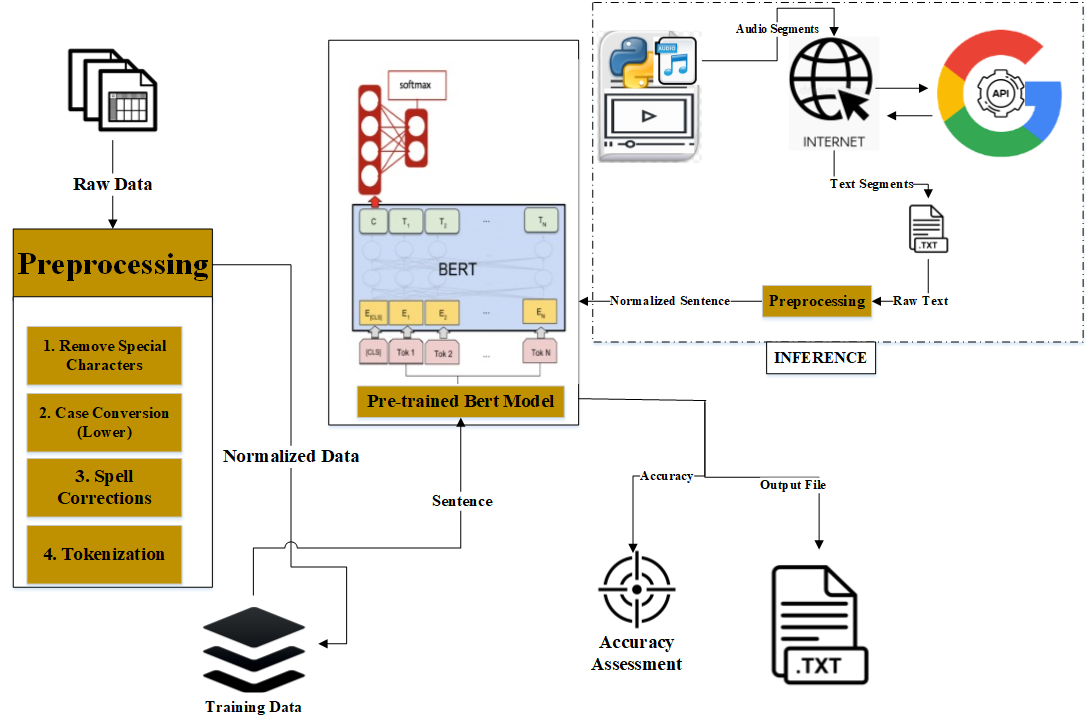
Social media has significantly transformed the digital landscape by enabling an unprecedented expansion of content, further accelerated by the COVID-19 pandemic, which increased the demand for online classes, virtual meetings, and recorded conferences. While major technology companies have previously employed sentiment analysis and opinion mining to gauge user feedback, this study proposes a novel framework for emotion-based video content analysis. The proposed method extracts audio from social media videos and applies Speech-to-Text (STT) conversion. The extracted text is then processed using a pre-trained BERT model, leveraging its fine-tuned capabilities and 110 million parameters to enhance emotion recognition. To improve inference, we modify the initial embedding layers of BERT to refine emotional analysis for unseen video content, ensuring better alignment with viewers' emotional responses. Experimental results demonstrate that the pre-trained BERT model outperforms traditional deep learning and machine learning approaches, achieving 83% accuracy and an F1 score of 83. Comparatively, CNN and LSTM models achieved 74% and 73% accuracy, respectively, while SVM resulted in 72% accuracy. The proposed framework offers a more refined emotional analysis, potentially improving user engagement by making content more relatable and emotionally intuitive for viewers.
Graphical Abstract
Keywords
Data Availability Statement
Funding
Conflicts of Interest
Ethical Approval and Consent to Participate
References
- Pokhrel, S., & Chhetri, R. (2021). A Literature Review on Impact of COVID-19 Pandemic on Teaching and Learning. Higher Education for the Future, 8(1), 133-141.
[CrossRef] [Google Scholar] - Wilson, T., Wiebe, J., & Hoffmann, P. (2009). Articles: Recognizing Contextual Polarity: An Exploration of Features for Phrase-Level Sentiment Analysis. Computational Linguistics, 35, 399-433.
[CrossRef] [Google Scholar] - Palacios-Ceña, D., Fernández-de-Las-Peñas, C., Florencio, L. L., de-la-Llave-Rincón, A. I., & Palacios-Ceña, M. (2021). Emotional experience and feelings during first COVID-19 outbreak perceived by physical therapists: A qualitative study in Madrid, Spain. International Journal of Environmental Research and Public Health, 18(1), 127.
[CrossRef] [Google Scholar] - Silvia, P. J. (2009). Looking past pleasure: Anger, confusion, disgust, pride, surprise, and other unusual aesthetic emotions. Psychology of Aesthetics, Creativity, and the Arts, 3(1), 48-51. https://psycnet.apa.org/doi/10.1037/a0014632
[Google Scholar] - Han, P., Chen, H., Rasool, A., Jiang, Q., & Yang, M. (2025). MFB: A Generalized Multimodal Fusion Approach for Bitcoin Price Prediction Using Time-Lagged Sentiment and Indicator Features. Expert Systems with Applications, 261, 125515.
[CrossRef] [Google Scholar] - Lee, J., Jatowt, A., & Kim, K.-S. (2021). Discovering underlying sensations of human emotions based on social media. Journal of the Association for Information Science and Technology, 72(4), 417-432.
[CrossRef] [Google Scholar] - Kumar, A., Cambria, E., & Trueman, T. E. (2021, December). Transformer-based bidirectional encoder representations for emotion detection from text. In 2021 IEEE Symposium Series on Computational Intelligence (SSCI) (pp. 1-6). IEEE.
[CrossRef] [Google Scholar] - Barken, R. (2013). Review of Emotions Matter: A Relational Approach to Emotions. Symbolic Interaction, 36(1), 104-106.
[CrossRef] [Google Scholar] - Rasool, A., Jiang, Q., Qu, Q., Kamyab, M., & Huang, M. (2022). HSMC: Hybrid Sentiment Method for Correlation to Analyze COVID-19 Tweets (pp. 991-999).
[CrossRef] [Google Scholar] - Landmann, H. (2021). The Bright and Dark Side of Eudaimonic Emotions: A Conceptual Framework. Media and Communication, 9(2), 191-201.
[CrossRef] [Google Scholar] - Illendula, A., & Sheth, A. (2019). Multimodal Emotion Classification. In Companion Proceedings of The 2019 World Wide Web Conference (pp. 439-449). ACM.
[CrossRef] [Google Scholar] - Saud, M., Mashud, M., & Ida, R. (2020). Usage of social media during the pandemic: Seeking support and awareness about COVID-19 through social media platforms. Journal of Public Affairs, 20(4), e02417.
[CrossRef] [Google Scholar] - Rasool, A., Shahzad, M. I., Aslam, H., & Chan, V. (2024). Emotion-Aware Response Generation Using Affect-Enriched Embeddings with LLMs. arXiv preprint arXiv:2410.01306.
[CrossRef] [Google Scholar] - Xu, G., Li, W., & Liu, J. (2020). A social emotion classification approach using multi-model fusion. Future Generation Computer Systems, 102, 347-356.
[CrossRef] [Google Scholar] - Păvăloaia, V.-D., Teodor, E.-M., Fotache, D., & Danileţ, M. (2019). Opinion Mining on Social Media Data: Sentiment Analysis of User Preferences. Sustainability, 11(16), 4459.
[CrossRef] [Google Scholar] - Han, P., Hong, J., Rasool, A., Chen, H., Pan, Y., & Jiang, Q. (2022, December). A hybrid recommendation model for social network services using twitter data. In International Conference on Web Services (pp. 122-129). Cham: Springer Nature Switzerland.
[CrossRef] [Google Scholar] - Ziyada, M., & Shamoi, P. (2024, November). Video Popularity in Social Media: Impact of Emotions, Raw Features and Viewer Comments. In 2024 Joint 13th International Conference on Soft Computing and Intelligent Systems and 25th International Symposium on Advanced Intelligent Systems (SCIS&ISIS) (pp. 1-7). IEEE.
[CrossRef] [Google Scholar] - Heule, R., Bause, J., Pusterla, O., & Scheffler, K. (2020). Multi-parametric artificial neural network fitting of phase-cycled balanced steady-state free precession data. Magnetic Resonance in Medicine, 84(6), 2981-2993.
[CrossRef] [Google Scholar] - Min, B., Ross, H., Sulem, E., Veyseh, A. P. B., Nguyen, T. H., Sainz, O., ... & Roth, D. (2023). Recent advances in natural language processing via large pre-trained language models: A survey. ACM Computing Surveys, 56(2), 1-40.
[CrossRef] [Google Scholar] - Feng, B., Cheng, F., Liu, Y., Chang, X., Wang, X., & Jin, D. (2024). Community Detection on Social Networks With Sentimental Interaction. International Journal of Semantic Web and Information Systems, 20(1), 1-23.
[CrossRef] [Google Scholar]
Cited By (5)
-
Feng Shen, Jia Kuang, You Hu, Shiting Chen. An enhanced risk-aware multi-task learning framework with dual-source sentiment and multi-scale decomposition for robust stock ranking forecasting.
Expert Systems with Applications, 2026 , 323 .
[CrossRef] -
Yifan Fan, Bowei Zou, Yuhan Chen, Yu Hong. CBT: Corrective boosting training approach for multi-choice commonsense question answering.
Expert Systems with Applications, 2026 , 305 .
[CrossRef] -
Madhav Gupta, Mitali Balki, Sairaj Patki, Jayaraman K. Valadi. Detecting depression: employing word-embeddings and sentence transformers.
Journal of Computational Social Science, 2026 , 9 (2).
[CrossRef] -
Wei Li, Guangying Lv, Yunling He. Dual-Path Short Text Classification with Data Optimization.
Applied Sciences, 2025 , 15 (20).
[CrossRef] -
Esra Karadeniz Köse, Ali Karcı. Social Trusty Algorithm: A New Algorithm for Computing the Trust Score Between All Entities in Social Networks Based on Linear Algebra.
Applied Sciences, 2025 , 15 (17).
[CrossRef]
Cite This Article
TY  - JOUR
AU  - Akbar, Zubair
AU  - Ghani, Muhammad Usman
AU  - Aziz, Umair
PY  - 2025
DA  - 2025/04/16
TI  - Boosting Viewer Experience with Emotion-Driven Video Analysis: A BERT-based Framework for Social Media Content
JO  - Journal of Artificial Intelligence in Bioinformatics
T2  - Journal of Artificial Intelligence in Bioinformatics
JF  - Journal of Artificial Intelligence in Bioinformatics
VL  - 1
IS  - 1
SP  - 3
EP  - 11
DO  - 10.62762/JAIB.2025.954751
UR  - https://www.icck.org/article/abs/JAIB.2025.954751
KW  - motions classification
KW  - Pre-Trained BERT model
KW  - social media
KW  - video data
KW  - emotions analysis
AB  - Social media has significantly transformed the digital landscape by enabling an unprecedented expansion of content, further accelerated by the COVID-19 pandemic, which increased the demand for online classes, virtual meetings, and recorded conferences. While major technology companies have previously employed sentiment analysis and opinion mining to gauge user feedback, this study proposes a novel framework for emotion-based video content analysis. The proposed method extracts audio from social media videos and applies Speech-to-Text (STT) conversion. The extracted text is then processed using a pre-trained BERT model, leveraging its fine-tuned capabilities and 110 million parameters to enhance emotion recognition. To improve inference, we modify the initial embedding layers of BERT to refine emotional analysis for unseen video content, ensuring better alignment with viewers' emotional responses. Experimental results demonstrate that the pre-trained BERT model outperforms traditional deep learning and machine learning approaches, achieving 83% accuracy and an F1 score of 83. Comparatively, CNN and LSTM models achieved 74% and 73% accuracy, respectively, while SVM resulted in 72% accuracy. The proposed framework offers a more refined emotional analysis, potentially improving user engagement by making content more relatable and emotionally intuitive for viewers.
SN  - 3068-7535
PB  - Institute of Central Computation and Knowledge
LA  - English
ER  -
@article{Akbar2025Boosting,
  author = {Zubair Akbar and Muhammad Usman Ghani and Umair Aziz},
  title = {Boosting Viewer Experience with Emotion-Driven Video Analysis: A BERT-based Framework for Social Media Content},
  journal = {Journal of Artificial Intelligence in Bioinformatics},
  year = {2025},
  volume = {1},
  number = {1},
  pages = {3-11},
  doi = {10.62762/JAIB.2025.954751},
  url = {https://www.icck.org/article/abs/JAIB.2025.954751},
  abstract = {Social media has significantly transformed the digital landscape by enabling an unprecedented expansion of content, further accelerated by the COVID-19 pandemic, which increased the demand for online classes, virtual meetings, and recorded conferences. While major technology companies have previously employed sentiment analysis and opinion mining to gauge user feedback, this study proposes a novel framework for emotion-based video content analysis. The proposed method extracts audio from social media videos and applies Speech-to-Text (STT) conversion. The extracted text is then processed using a pre-trained BERT model, leveraging its fine-tuned capabilities and 110 million parameters to enhance emotion recognition. To improve inference, we modify the initial embedding layers of BERT to refine emotional analysis for unseen video content, ensuring better alignment with viewers' emotional responses. Experimental results demonstrate that the pre-trained BERT model outperforms traditional deep learning and machine learning approaches, achieving 83\% accuracy and an F1 score of 83. Comparatively, CNN and LSTM models achieved 74\% and 73\% accuracy, respectively, while SVM resulted in 72\% accuracy. The proposed framework offers a more refined emotional analysis, potentially improving user engagement by making content more relatable and emotionally intuitive for viewers.},
  keywords = {motions classification, Pre-Trained BERT model, social media, video data, emotions analysis},
  issn = {3068-7535},
  publisher = {Institute of Central Computation and Knowledge}
}
Article Metrics
Publisher's Note
ICCK stays neutral with regard to jurisdictional claims in published maps and institutional affiliations.
Rights and Permissions
 Copyright © 2025 by the Author(s). Published by Institute of Central Computation and Knowledge. This article is an open access article distributed under the terms and conditions of the Creative Commons Attribution (CC BY) license (https://creativecommons.org/licenses/by/4.0/), which permits use, sharing, adaptation, distribution and reproduction in any medium or format, as long as you give appropriate credit to the original author(s) and the source, provide a link to the Creative Commons licence, and indicate if changes were made.


Portico