

RetinoNet: An Efficient MobileNetV3-Based Model for Diabetic Retinopathy Detection Using Multi-Scale Feature Fusion




Article Information
Abstract
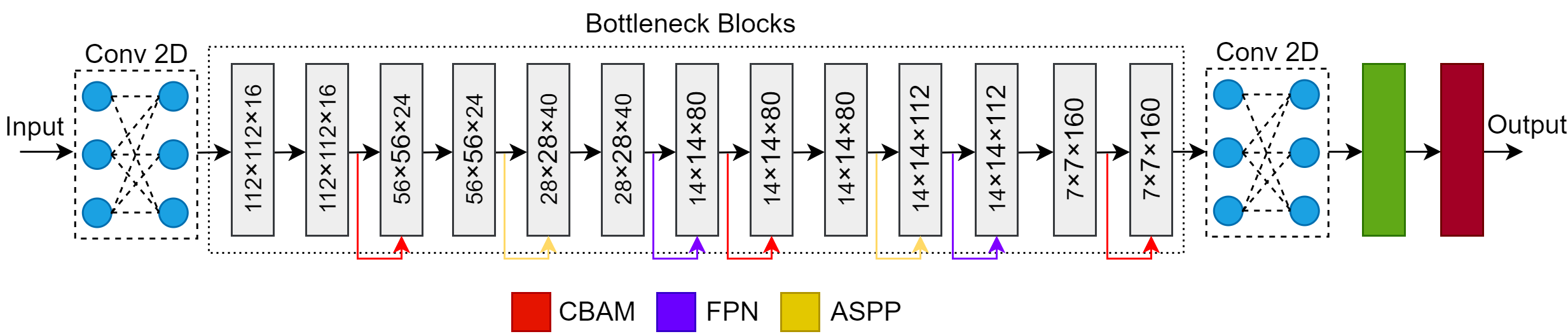
Diabetic retinopathy (DR) is a leading cause of blindness globally, requiring timely detection and classification to prevent vision loss. Deep learning techniques offer significant potential for automating DR detection by analyzing retinal fundus images with high precision. This paper proposes a RetinoNet model that consists of MobileNetV3, Convolutional Block Attention Module (CBAM), Atrous Spatial Pyramid Pooling (ASPP), and Feature Pyramid Network (FPN). MobileNetV3 provides a lightweight and efficient foundation for feature extraction, while CBAM emphasizes critical spatial and channel information, enabling the detection of subtle retinal abnormalities. ASPP captures multi-scale contextual information through atrous convolutions, improving the model's ability to identify lesions of varying sizes and shapes. FPN combines hierarchical features from multiple network levels, ensuring both fine-grained details and high-level semantics are leveraged for accurate classification. The model was trained on the APTOS dataset. Evaluation metrics such as accuracy, precision, recall, and F1 score demonstrate the effectiveness of the proposed model in achieving state-of-the-art performance for DR detection and classification across five severity levels. This approach addresses computational challenges and improves generalization, making it suitable for both clinical and remote healthcare applications.
Graphical Abstract
Keywords
Data Availability Statement
Funding
Conflicts of Interest
Ethical Approval and Consent to Participate
References
- Cushley, L. N., Csincsik, L., Virgili, G., Curran, K., Silvestri, G., Galway, N., & Peto, T. (2024). The NaviSight study: Investigating how diabetic retinopathy and retinitis pigmentosa affect navigating the built environment. Disabilities, 4(3), 507-524.
[CrossRef] [Google Scholar] - Cross, N., van Steen, C., Zegaoui, Y., Satherley, A., & Angelillo, L. (2022). Retinitis pigmentosa: burden of disease and current unmet needs. Clinical Ophthalmology, 1993-2010.
[CrossRef] [Google Scholar] - Khalifa, M., & Albadawy, M. (2024). Artificial intelligence for diabetes: Enhancing prevention, diagnosis, and effective management. Computer methods and programs in biomedicine update, 5, 100141.
[CrossRef] [Google Scholar] - Rana, M., & Bhushan, M. (2023). Machine learning and deep learning approach for medical image analysis: diagnosis to detection. Multimedia Tools and Applications, 82(17), 26731-26769.
[CrossRef] [Google Scholar] - Latif, J., Xiao, C., Imran, A., & Tu, S. (2019, January). Medical imaging using machine learning and deep learning algorithms: a review. In 2019 2nd International conference on computing, mathematics and engineering technologies (iCoMET) (pp. 1-5). IEEE.
[CrossRef] [Google Scholar] - Dastgir, A., Wang, B., Saeed, M. U., Sheng, J., & Saleem, S. (2025). MAFMv3: An automated multi-scale attention-based feature fusion MobileNetv3 for spine lesion classification. Image and Vision Computing, 155, 105440.
[CrossRef] [Google Scholar] - Grauslund, J. (2022). Diabetic retinopathy screening in the emerging era of artificial intelligence. Diabetologia, 65(9), 1415-1423.
[CrossRef] [Google Scholar] - Guefrachi, S., Echtioui, A., & Hamam, H. (2025). Diabetic retinopathy detection using deep learning multistage training method. Arabian Journal for Science and Engineering, 50(2), 1079-1096.
[CrossRef] [Google Scholar] - Kurup, G., Jothi, J. A. A., & Kanadath, A. (2021). Diabetic retinopathy detection and classification using pretrained inception-v3. In 2021 International Conference on Smart Generation Computing, Communication and Networking (SMART GENCON) (pp. 1–6). IEEE.
[CrossRef] [Google Scholar] - Bodapati, J. D., Shaik, N. S., & Naralasetti, V. (2021). Deep convolution feature aggregation: An application to diabetic retinopathy severity level prediction. Signal, Image and Video Processing, 15, 923–930.
[CrossRef] [Google Scholar] - Mohanty, C., Mahapatra, S., Acharya, B., Kokkoras, F., Gerogiannis, V. C., Karamitsos, I., & Kanavos, A. (2023). Using deep learning architectures for detection and classification of diabetic retinopathy. Sensors, 23(12), 5726.
[CrossRef] [Google Scholar] - Nahiduzzaman, M., Islam, M. R., Goni, M. O. F., Anower, M. S., Ahsan, M., Haider, J., & Kowalski, M. (2023). Diabetic retinopathy identification using parallel convolutional neural network based feature extractor and ELM classifier. Expert Systems with Applications, 217, 119557.
[CrossRef] [Google Scholar] - Sacchini, F., Mancin, S., Cangelosi, G., Palomares, S. M., Caggianelli, G., Gravante, F., & Petrelli, F. (2025). The role of artificial intelligence in diabetic retinopathy screening in type 1 diabetes: A systematic review. Journal of Diabetes and its Complications, 109139.
[CrossRef] [Google Scholar] - Khalighi, S., Reddy, K., Midya, A., Pandav, K. B., Madabhushi, A., & Abedalthagafi, M. (2024). Artificial intelligence in neuro-oncology: advances and challenges in brain tumor diagnosis, prognosis, and precision treatment. NPJ precision oncology, 8(1), 80.
[CrossRef] [Google Scholar] - Xiao, S., Zhou, Y., Wu, Q., Wang, X., Hu, Y., Pan, Q., ... & Pan, D. (2022). Prevalence of cardiovascular diseases in relation to total bone mineral density and prevalent fractures: a population-based cross-sectional study. Nutrition, Metabolism and Cardiovascular Diseases, 32(1), 134-141.
[CrossRef] [Google Scholar] - Sandler, M., Howard, A., Zhu, M., Zhmoginov, A., & Chen, L. C. (2018, June). MobileNetV2: Inverted Residuals and Linear Bottlenecks. In 2018 IEEE/CVF Conference on Computer Vision and Pattern Recognition (pp. 4510-4520). IEEE.
[CrossRef] [Google Scholar] - Kadam, K., Ahirrao, S., Kotecha, K., & Sahu, S. (2021). Detection and localization of multiple image splicing using MobileNet V1. IEEE Access, 9, 162499–162519.
[CrossRef] [Google Scholar] - Lian, X., Pang, Y., Han, J., & Pan, J. (2021). Cascaded hierarchical atrous spatial pyramid pooling module for semantic segmentation. Pattern Recognition, 110, 107622.
[CrossRef] [Google Scholar] - Diabetic retinopathy detection. (n.d.). Kaggle: Your Machine Learning and Data Science Community. Retrieved from \url{https://www.kaggle.com/competitions/diabetic-retinopathy-detection
[Google Scholar] - Gangwar, A. K., & Ravi, V. (2020). Diabetic retinopathy detection using transfer learning and deep learning. In Evolution in Computational Intelligence: Frontiers in Intelligent Computing: Theory and Applications (FICTA 2020), Volume 1 (pp. 679-689). Singapore: Springer Singapore.
[CrossRef] [Google Scholar] - Maqsood, Z., & Gupta, M. K. (2022). Automatic detection of diabetic retinopathy on the edge. In Cyber Security, Privacy and Networking: Proceedings of ICSPN 2021 (pp. 129-139). Singapore: Springer Nature Singapore.
[CrossRef] [Google Scholar] - Thomas, N. M., & Albert Jerome, S. (2021). Grading and classification of retinal images for detecting diabetic retinopathy using convolutional neural network. In International Conference on Advances in Electrical and Computer Technologies (pp. 607–614). Springer.
[CrossRef] [Google Scholar] - Ali, G., Dastgir, A., Iqbal, M. W., Anwar, M., & Faheem, M. (2023). A hybrid convolutional neural network model for automatic diabetic retinopathy classification from fundus images. IEEE Journal of Translational Engineering in Health and Medicine, 11, 341–350.
[CrossRef] [Google Scholar]
Cite This Article
TY  - JOUR
AU  - Saeed, Muhammad Usman
AU  - Dastgir, Aqsa
AU  - Ghani, Muhammad Ahmad Nawaz Ul
AU  - Manzoor, Arslan
PY  - 2025
DA  - 2025/10/25
TI  - RetinoNet: An Efficient MobileNetV3-Based Model for Diabetic Retinopathy Detection Using Multi-Scale Feature Fusion
JO  - Journal of Artificial Intelligence in Bioinformatics
T2  - Journal of Artificial Intelligence in Bioinformatics
JF  - Journal of Artificial Intelligence in Bioinformatics
VL  - 1
IS  - 2
SP  - 58
EP  - 68
DO  - 10.62762/JAIB.2025.322062
UR  - https://www.icck.org/article/abs/JAIB.2025.322062
KW  - diabetic retinopathy
KW  - feature fusion
KW  - bio-informatics
KW  - multi-scale
AB  - Diabetic retinopathy (DR) is a leading cause of blindness globally, requiring timely detection and classification to prevent vision loss. Deep learning techniques offer significant potential for automating DR detection by analyzing retinal fundus images with high precision. This paper proposes a RetinoNet model that consists of MobileNetV3, Convolutional Block Attention Module (CBAM), Atrous Spatial Pyramid Pooling (ASPP), and Feature Pyramid Network (FPN). MobileNetV3 provides a lightweight and efficient foundation for feature extraction, while CBAM emphasizes critical spatial and channel information, enabling the detection of subtle retinal abnormalities. ASPP captures multi-scale contextual information through atrous convolutions, improving the model's ability to identify lesions of varying sizes and shapes. FPN combines hierarchical features from multiple network levels, ensuring both fine-grained details and high-level semantics are leveraged for accurate classification. The model was trained on the APTOS dataset. Evaluation metrics such as accuracy, precision, recall, and F1 score demonstrate the effectiveness of the proposed model in achieving state-of-the-art performance for DR detection and classification across five severity levels. This approach addresses computational challenges and improves generalization, making it suitable for both clinical and remote healthcare applications.
SN  - 3068-7535
PB  - Institute of Central Computation and Knowledge
LA  - English
ER  -
@article{Saeed2025RetinoNet,
  author = {Muhammad Usman Saeed and Aqsa Dastgir and Muhammad Ahmad Nawaz Ul Ghani and Arslan Manzoor},
  title = {RetinoNet: An Efficient MobileNetV3-Based Model for Diabetic Retinopathy Detection Using Multi-Scale Feature Fusion},
  journal = {Journal of Artificial Intelligence in Bioinformatics},
  year = {2025},
  volume = {1},
  number = {2},
  pages = {58-68},
  doi = {10.62762/JAIB.2025.322062},
  url = {https://www.icck.org/article/abs/JAIB.2025.322062},
  abstract = {Diabetic retinopathy (DR) is a leading cause of blindness globally, requiring timely detection and classification to prevent vision loss. Deep learning techniques offer significant potential for automating DR detection by analyzing retinal fundus images with high precision. This paper proposes a RetinoNet model that consists of MobileNetV3, Convolutional Block Attention Module (CBAM), Atrous Spatial Pyramid Pooling (ASPP), and Feature Pyramid Network (FPN). MobileNetV3 provides a lightweight and efficient foundation for feature extraction, while CBAM emphasizes critical spatial and channel information, enabling the detection of subtle retinal abnormalities. ASPP captures multi-scale contextual information through atrous convolutions, improving the model's ability to identify lesions of varying sizes and shapes. FPN combines hierarchical features from multiple network levels, ensuring both fine-grained details and high-level semantics are leveraged for accurate classification. The model was trained on the APTOS dataset. Evaluation metrics such as accuracy, precision, recall, and F1 score demonstrate the effectiveness of the proposed model in achieving state-of-the-art performance for DR detection and classification across five severity levels. This approach addresses computational challenges and improves generalization, making it suitable for both clinical and remote healthcare applications.},
  keywords = {diabetic retinopathy, feature fusion, bio-informatics, multi-scale},
  issn = {3068-7535},
  publisher = {Institute of Central Computation and Knowledge}
}
Article Metrics
Publisher's Note
ICCK stays neutral with regard to jurisdictional claims in published maps and institutional affiliations.
Rights and Permissions
 Copyright © 2025 by the Author(s). Published by Institute of Central Computation and Knowledge. This article is an open access article distributed under the terms and conditions of the Creative Commons Attribution (CC BY) license (https://creativecommons.org/licenses/by/4.0/), which permits use, sharing, adaptation, distribution and reproduction in any medium or format, as long as you give appropriate credit to the original author(s) and the source, provide a link to the Creative Commons licence, and indicate if changes were made.


Portico
