

Role of Social Factors in the Adoption of AI-Driven Personalized Healthcare



Article Information
Abstract
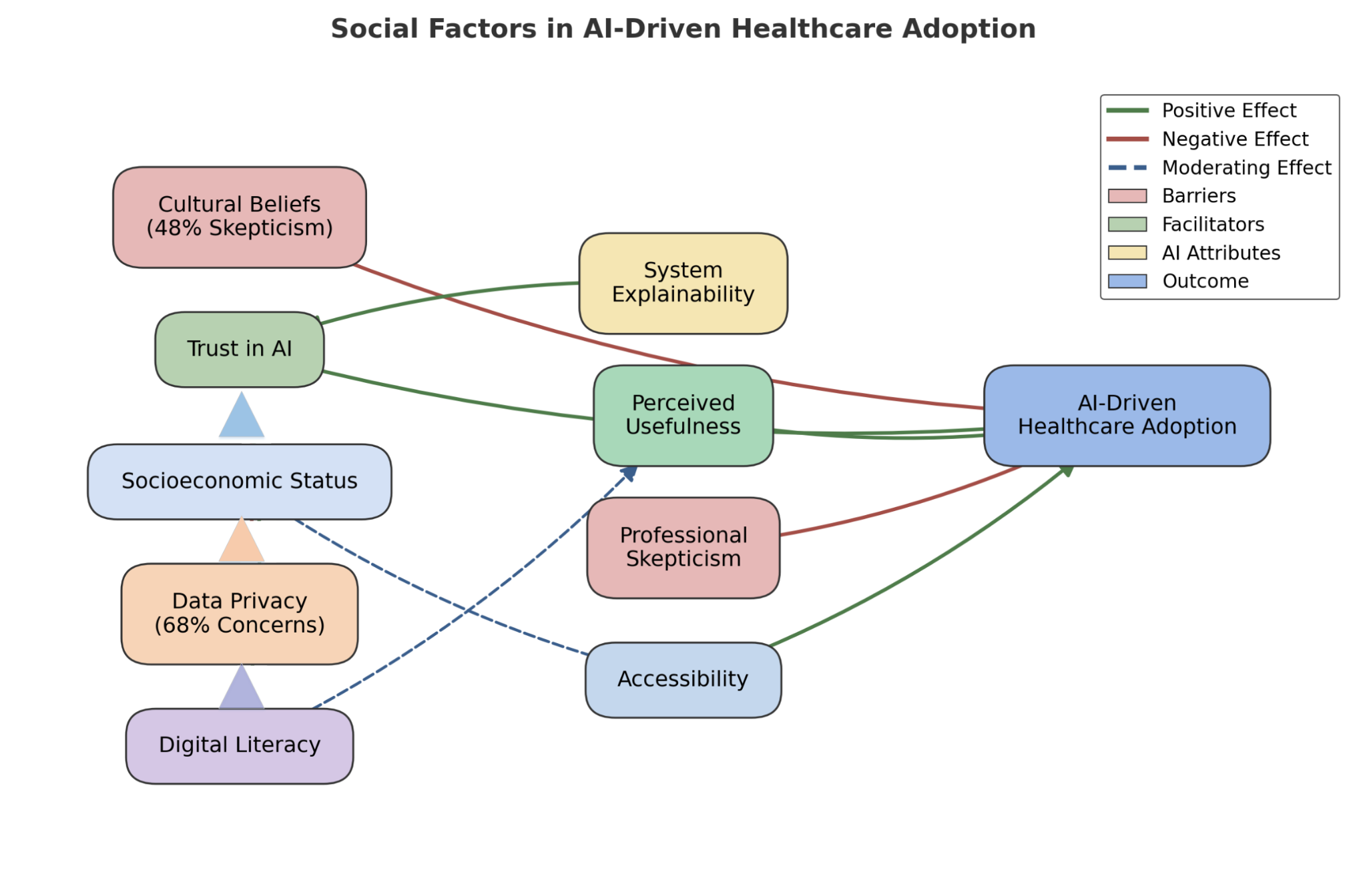
Artificial intelligence (AI) is transforming personalized medicine through its potential. However, implementing AI-driven healthcare solutions remains inconsistent because of certain social factors, i.e., cultural beliefs, trust issues, and major accessibility elements. This study focuses on the key social determinants involved in the acceptance and implementation of AI-driven medicine, with a prime focus on hurdles such as algorithmic bias, transparency issues, and public skepticism. A quantitative approach was employed in the research, and survey data were collected among healthcare professionals, policymakers, and patients. Statistical analyses were performed, including chi-square tests and multiple regression modeling. It examined relationships between social factors and AI adoption rates. The findings presented that familiarity with AI positively influences its acceptance However, the concerns about non-transparent algorithms and cultural resistance continue to hinder its adoption. Nearly 48% of respondents exhibited low attitudes toward AI-driven healthcare. On the other hand, 68% showed concerns about data security. Furthermore, socioeconomic disparities impact accessibility to a great extent, with lower-income groups reporting limited exposure to AI-powered medical solutions. The study also identified transparency as both a facilitator and a barrier, with clinicians hesitant to rely on AI systems due to the lack of explainability. Addressing all these barriers through targeted education, trust-building initiatives, and ethical oversight can increase the equitable integration of AI-driven personalized medicine in diverse settings of healthcare settings.
Graphical Abstract
Keywords
Data Availability Statement
Funding
Conflicts of Interest
Ethical Approval and Consent to Participate
References
- Topol, E. (2019). Deep medicine: how artificial intelligence can make healthcare human again. Hachette UK.
[Google Scholar] - Jiang, F., Jiang, Y., Zhi, H., Dong, Y., Li, H., Ma, S., ... & Wang, Y. (2017). Artificial intelligence in healthcare: past, present and future. Stroke and vascular neurology, 2(4).
[CrossRef] [Google Scholar] - Laï, M. C., Brian, M., & Mamzer, M. F. (2020). Perceptions of artificial intelligence in healthcare: findings from a qualitative survey study among actors in France. Journal of translational medicine, 18, 1-13.
[CrossRef] [Google Scholar] - Adithyan, N., Chowdhury, R. R., Padmavathy, L., Peter, R. M., & Anantharaman, V. V. (2024). Perception of the Adoption of Artificial Intelligence in Healthcare Practices Among Healthcare Professionals in a Tertiary Care Hospital: A Cross-Sectional Study. Cureus, 16(9), e69910.
[CrossRef] [Google Scholar] - Hassan, M., Kushniruk, A., & Borycki, E. (2024). Barriers to and facilitators of artificial intelligence adoption in health care: scoping review. JMIR Human Factors, 11, e48633.
[CrossRef] [Google Scholar] - Davenport, T., & Kalakota, R. (2019). The potential for artificial intelligence in healthcare. Future healthcare journal, 6(2), 94-98.
[CrossRef] [Google Scholar] - Taddeo, M., & Floridi, L. (2018). How AI can be a force for good. Science, 361(6404), 751-752.
[CrossRef] [Google Scholar] - Mittelstadt, B. D., Allo, P., Taddeo, M., Wachter, S., & Floridi, L. (2016). The ethics of algorithms: Mapping the debate. Big Data & Society, 3(2), 2053951716679679.
[CrossRef] [Google Scholar] - Amann, J., Blasimme, A., Vayena, E., Frey, D., Madai, V. I., & Precise4Q Consortium. (2020). Explainability for artificial intelligence in healthcare: a multidisciplinary perspective. BMC medical informatics and decision making, 20, 1-9.
[CrossRef] [Google Scholar] - Shameer, K., Johnson, K. W., Glicksberg, B. S., Dudley, J. T., & Sengupta, P. P. (2018). Machine learning in cardiovascular medicine: are we there yet?. Heart, 104(14), 1156-1164.
[CrossRef] [Google Scholar] - Obermeyer, Z., Powers, B., Vogeli, C., & Mullainathan, S. (2019). Dissecting racial bias in an algorithm used to manage the health of populations. Science, 366(6464), 447-453.
[CrossRef] [Google Scholar] - Chen, I. Y., Joshi, S., & Ghassemi, M. (2020). Treating health disparities with artificial intelligence. Nature medicine, 26(1), 16-17.
[CrossRef] [Google Scholar] - Brynjolfsson, E., & McAfee, A. (2014). The second machine age: Work, progress, and prosperity in a time of brilliant technologies. WW Norton & company.
[Google Scholar] - Venkatesh, V., Morris, M. G., Davis, G. B., & Davis, F. D. (2003). User acceptance of information technology: Toward a unified view. MIS quarterly, 425-478.
[CrossRef] [Google Scholar] - Beets, B., Newman, T. P., Howell, E. L., Bao, L., & Yang, S. (2023). Surveying public perceptions of artificial intelligence in health care in the United States: systematic review. Journal of Medical Internet Research, 25, e40337.
[CrossRef] [Google Scholar] - Gerke, S., Minssen, T., & Cohen, G. (2020). Ethical and legal challenges of artificial intelligence-driven healthcare. In Artificial intelligence in healthcare (pp. 295-336). Academic Press.
[CrossRef] [Google Scholar] - Adadi, A., & Berrada, M. (2018). Peeking inside the black box A survey on explainable artificial intelligence (XAI). IEEE Access, 6, 52138–52160.
[CrossRef] [Google Scholar] - Ribeiro, M. T., Singh, S., & Guestrin, C. (2016, August). `` Why should i trust you?'' Explaining the predictions of any classifier. In Proceedings of the 22nd ACM SIGKDD international conference on knowledge discovery and data mining (pp. 1135-1144).
[CrossRef] [Google Scholar] - Chen, I., Johansson, F. D., & Sontag, D. (2018). Why is my classifier discriminatory?. Advances in neural information processing systems, 31.
[CrossRef] [Google Scholar] - McMahan, B., Moore, E., Ramage, D., Hampson, S., & y Arcas, B. A. (2017, April). Communication-efficient learning of deep networks from decentralized data. In Artificial intelligence and statistics (pp. 1273-1282). PMLR.
[Google Scholar] - Rajkomar, A., Dean, J., & Kohane, I. (2019). Machine learning in medicine. New England Journal of Medicine, 380(14), 1347-1358.
[CrossRef] [Google Scholar] - Rajkomar, A., Hardt, M., Howell, M. D., Corrado, G., & Chin, M. H. (2018). Ensuring fairness in machine learning to advance health equity. Annals of internal medicine, 169(12), 866-872.
[CrossRef] [Google Scholar] - Dhagarra, D., Goswami, M., & Kumar, G. (2020). Impact of trust and privacy concerns on technology acceptance in healthcare: an Indian perspective. International journal of medical informatics, 141, 104164.
[CrossRef] [Google Scholar] - Floridi, L., Cowls, J., Beltrametti, M., Chatila, R., Chazerand, P., Dignum, V., ... & Vayena, E. (2018). AI4People—an ethical framework for a good AI society: opportunities, risks, principles, and recommendations. Minds and machines, 28, 689-707.
[CrossRef] [Google Scholar] - Creswell, J. W., & Creswell, J. D. (2017). Research design: Qualitative, quantitative, and mixed methods approaches. Sage publications.
[Google Scholar] - Algorithmic transparency recording standard - guidance for public sector bodies. (2023, January 5). GOV.UK. Retrieved from https://www.gov.uk/government/publications/guidance-for-organisations-using-the-algorithmic-transparency-recording-standard/algorithmic-transparency-recording-standard-guidance-for-public-sector-bodies
[Google Scholar]
Cite This Article
TY  - JOUR
AU  - Nadeem, Maryam
AU  - Aslam, Fiza
AU  - Rehman, Muhammad Aftab Ur
AU  - Aslam, Saba
PY  - 2025
DA  - 2025/06/29
TI  - Role of Social Factors in the Adoption of AI-Driven Personalized Healthcare
JO  - Journal of Artificial Intelligence in Bioinformatics
T2  - Journal of Artificial Intelligence in Bioinformatics
JF  - Journal of Artificial Intelligence in Bioinformatics
VL  - 1
IS  - 1
SP  - 30
EP  - 40
DO  - 10.62762/JAIB.2025.345522
UR  - https://www.icck.org/article/abs/JAIB.2025.345522
KW  - personalized medicine
KW  - AI adoption factors
KW  - healthcare
KW  - trust AI
AB  - Artificial intelligence (AI) is transforming personalized medicine through its potential. However, implementing AI-driven healthcare solutions remains inconsistent because of certain social factors, i.e., cultural beliefs, trust issues, and major accessibility elements. This study focuses on the key social determinants involved in the acceptance and implementation of AI-driven medicine, with a prime focus on hurdles such as algorithmic bias, transparency issues, and public skepticism. A quantitative approach was employed in the research, and survey data were collected among healthcare professionals, policymakers, and patients. Statistical analyses were performed, including chi-square tests and multiple regression modeling. It examined relationships between social factors and AI adoption rates. The findings presented that familiarity with AI positively influences its acceptance However, the concerns about non-transparent algorithms and cultural resistance continue to hinder its adoption. Nearly 48% of respondents exhibited low attitudes toward AI-driven healthcare. On the other hand, 68% showed concerns about data security. Furthermore, socioeconomic disparities impact accessibility to a great extent, with lower-income groups reporting limited exposure to AI-powered medical solutions. The study also identified transparency as both a facilitator and a barrier, with clinicians hesitant to rely on AI systems due to the lack of explainability. Addressing all these barriers through targeted education, trust-building initiatives, and ethical oversight can increase the equitable integration of AI-driven personalized medicine in diverse settings of healthcare settings.
SN  - 3068-7535
PB  - Institute of Central Computation and Knowledge
LA  - English
ER  -
@article{Nadeem2025Role,
  author = {Maryam Nadeem and Fiza Aslam and Muhammad Aftab Ur Rehman and Saba Aslam},
  title = {Role of Social Factors in the Adoption of AI-Driven Personalized Healthcare},
  journal = {Journal of Artificial Intelligence in Bioinformatics},
  year = {2025},
  volume = {1},
  number = {1},
  pages = {30-40},
  doi = {10.62762/JAIB.2025.345522},
  url = {https://www.icck.org/article/abs/JAIB.2025.345522},
  abstract = {Artificial intelligence (AI) is transforming personalized medicine through its potential. However, implementing AI-driven healthcare solutions remains inconsistent because of certain social factors, i.e., cultural beliefs, trust issues, and major accessibility elements. This study focuses on the key social determinants involved in the acceptance and implementation of AI-driven medicine, with a prime focus on hurdles such as algorithmic bias, transparency issues, and public skepticism. A quantitative approach was employed in the research, and survey data were collected among healthcare professionals, policymakers, and patients. Statistical analyses were performed, including chi-square tests and multiple regression modeling. It examined relationships between social factors and AI adoption rates. The findings presented that familiarity with AI positively influences its acceptance However, the concerns about non-transparent algorithms and cultural resistance continue to hinder its adoption. Nearly 48\% of respondents exhibited low attitudes toward AI-driven healthcare. On the other hand, 68\% showed concerns about data security. Furthermore, socioeconomic disparities impact accessibility to a great extent, with lower-income groups reporting limited exposure to AI-powered medical solutions. The study also identified transparency as both a facilitator and a barrier, with clinicians hesitant to rely on AI systems due to the lack of explainability. Addressing all these barriers through targeted education, trust-building initiatives, and ethical oversight can increase the equitable integration of AI-driven personalized medicine in diverse settings of healthcare settings.},
  keywords = {personalized medicine, AI adoption factors, healthcare, trust AI},
  issn = {3068-7535},
  publisher = {Institute of Central Computation and Knowledge}
}
Article Metrics
Publisher's Note
ICCK stays neutral with regard to jurisdictional claims in published maps and institutional affiliations.
Rights and Permissions
 Copyright © 2025 by the Author(s). Published by Institute of Central Computation and Knowledge. This article is an open access article distributed under the terms and conditions of the Creative Commons Attribution (CC BY) license (https://creativecommons.org/licenses/by/4.0/), which permits use, sharing, adaptation, distribution and reproduction in any medium or format, as long as you give appropriate credit to the original author(s) and the source, provide a link to the Creative Commons licence, and indicate if changes were made.


Portico
