

Cross-Frequency Graph-Transformer Networks for Subject-Independent EEG Classification of Neurodegenerative Disorders


Article Information
Abstract
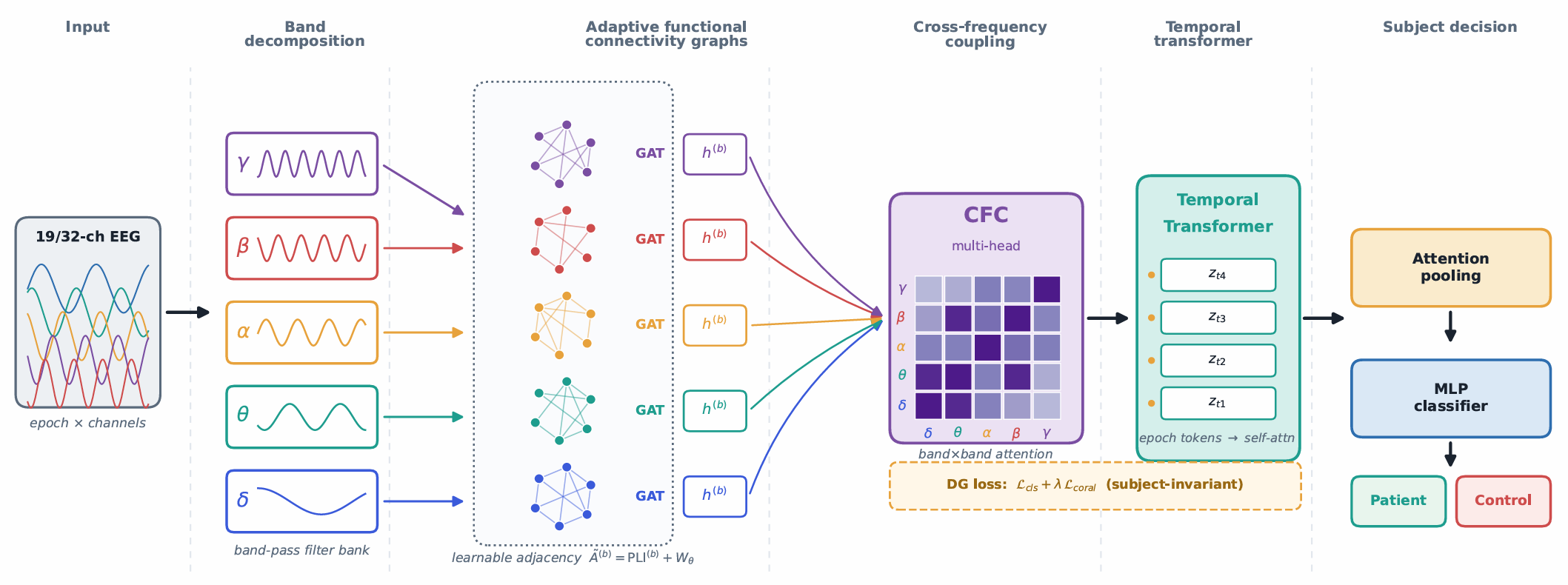
Resting-state EEG offers a low-cost, non-invasive biomarker for Alzheimer's and Parkinson's diseases, yet most deep learning models fail to generalize to new patients due to subject-dependent evaluation protocols, isolated frequency-band processing, and the neglect of cross-frequency interactions. We propose CFGT-Net, a Cross-Frequency Graph-Transformer Network. For each EEG epoch, five canonical bands are processed by a graph attention encoder on a learnable phase-lag index adjacency to produce spatial embeddings. A cross-frequency coupling (CFC) attention models band interactions, a temporal transformer tracks their evolution across epochs, and a correlation-alignment loss enforces subject-invariant representations. Evaluated under leave-one-subject-out on two public datasets, CFGT-Net achieves 88.6% accuracy (0.931 AUC) for AD and 85.3% accuracy (0.902 AUC) for PD, outperforming prior methods including DICE-Net. Ablations confirm the adaptive graph, CFC module, and temporal transformer each contribute gains, while learned connectivity highlights fronto-parietal links consistent with known disease patterns. Limitations include small cohorts and residual per-subject variance under LOSO. Modeling adaptive connectivity with cross-frequency coupling improves subject-independent EEG screening and yields interpretable connectivity maps for clinical inspection.
Graphical Abstract
Keywords
Data Availability Statement
Funding
Conflicts of Interest
AI Use Statement
Ethical Approval and Consent to Participate
References
- Nichols, E., Steinmetz, J. D., Vollset, S. E., Fukutaki, K., Chalek, J., Abd-Allah, F., ... & Liu, X. (2022). Estimation of the global prevalence of dementia in 2019 and forecasted prevalence in 2050: an analysis for the Global Burden of Disease Study 2019. The Lancet Public Health, 7(2), e105-e125.
[CrossRef] [Google Scholar] - Livingston, G., Huntley, J., Sommerlad, A., Ames, D., Ballard, C., Banerjee, S., ... & Mukadam, N. (2020). Dementia prevention, intervention, and care: 2020 report of the Lancet Commission. The lancet, 396(10248), 413-446.
[CrossRef] [Google Scholar] - Zhu, J., Cui, Y., Zhang, J., Yan, R., Su, D., Zhao, D., et al. (2024). Temporal trends in the prevalence of Parkinson's disease from 1980 to 2023: a systematic review and meta-analysis. The Lancet Healthy Longevity, 5(7), e464-e479.
[CrossRef] [Google Scholar] - Bi, J., Wang, F., Hu, F., Han, S., Wang, Y., Fu, Z., & Zhang, X. (2025). The EEG analysis and identification of Alzheimer's disease: a review. Frontiers in Aging Neuroscience, 17, 1686628.
[CrossRef] [Google Scholar] - Aviles, M., S\'anchez-Reyes, L. M., \'Alvarez-Alvarado, J. M., & Rodr\'iguez-Res\'endiz, J. (2024). Machine and deep learning trends in EEG-based detection and diagnosis of Alzheimer's disease: a systematic review. Eng, 5(3), 1464-1484.
[CrossRef] [Google Scholar] - Bunterngchit, C., Jamroen, C., Aslam, S., Rasool, A., & Samuel, O. W. (2026). Attention-guided electroencephalography fusion with fractal and nonlinear dynamics decodes early Alzheimer's biomarkers. Computers and Electrical Engineering, 133, 111076.
[CrossRef] [Google Scholar] - Hodnik, T., Roytman, S., Bohnen, N. I., & Marusic, U. (2024). Beta-gamma phase-amplitude coupling as a non-invasive biomarker for Parkinson's disease: insights from electroencephalography studies. Life, 14(3), 391.
[CrossRef] [Google Scholar] - Vafaei, E., & Hosseini, M. (2025). Transformers in EEG analysis: a review of architectures and applications in motor imagery, seizure, and emotion classification. Sensors, 25(5), 1293.
[CrossRef] [Google Scholar] - Craik, A., He, Y., & Contreras-Vidal, J. L. (2019). Deep learning for electroencephalogram (EEG) classification tasks: a review. Journal of neural engineering, 16(3), 031001.
[CrossRef] [Google Scholar] - Roy, Y., Banville, H., Albuquerque, I., Gramfort, A., Falk, T. H., & Faubert, J. (2019). Deep learning-based electroencephalography analysis: a systematic review. Journal of neural engineering, 16(5), 051001.
[CrossRef] [Google Scholar] - Aslam, S., Hussain, M., Ru, T., & Wu, H. (2025). Cross-subject and cross-session continual adaptation of EEG signals using temporal context encoding. In Proceedings of the 2025 10th International Conference on Frontiers of Signal Processing (ICFSP) (pp. 69-73). Paris, France.
[CrossRef] [Google Scholar] - Song, Y., Zheng, Q., Liu, B., & Gao, X. (2023). EEG Conformer: convolutional transformer for EEG decoding and visualization. IEEE Transactions on Neural Systems and Rehabilitation Engineering, 31, 710-719.
[CrossRef] [Google Scholar] - Aslam, S., Hussain, M., Li, X., Li, H., & Wu, H. (2026). HAMD-Net: a biologically informed hybrid attention model for EEG classification of multiple neurological disorders. Biomedical Signal Processing and Control, 120, 110049.
[CrossRef] [Google Scholar] - Miltiadous, A., Gionanidis, E., Tzimourta, K. D., Giannakeas, N., & Tzallas, A. T. (2023). DICE-net: a novel convolution-transformer architecture for Alzheimer detection in EEG signals. IEEE Access, 11, 71840-71858.
[CrossRef] [Google Scholar] - Chen, Y., Wang, H., Zhang, D., Zhang, L., & Tao, L. (2023). Multi-feature fusion learning for Alzheimer's disease prediction using EEG signals in resting state. Frontiers in Neuroscience, 17, 1272834.
[CrossRef] [Google Scholar] - Khan, W., Khan, M. S., Qasem, S. N., Ghaban, W., Saeed, F., Hanif, M., & Ahmad, J. (2025). An explainable and efficient deep learning framework for EEG-based diagnosis of Alzheimer's disease and frontotemporal dementia. Frontiers in Medicine, 12, 1590201.
[CrossRef] [Google Scholar] - Bunterngchit, C., Baniata, L. H., Albayati, H., Baniata, M. H., Alharbi, K., Alshammari, F. H., & Kang, S. (2025). A hybrid convolutional-transformer approach for accurate EEG-based Parkinson's disease detection. Bioengineering, 12(6), 583.
[CrossRef] [Google Scholar] - Klepl, D., He, F., Wu, M., Blackburn, D. J., & Sarrigiannis, P. (2022). EEG-based graph neural network classification of Alzheimer's disease: an empirical evaluation of functional connectivity methods. IEEE Transactions on Neural Systems and Rehabilitation Engineering, 30, 2651-2660.
[CrossRef] [Google Scholar] - Shan, X., Cao, J., Huo, S., Chen, L., Sarrigiannis, P. G., & Zhao, Y. (2022). Spatial-temporal graph convolutional network for Alzheimer classification based on brain functional connectivity imaging of electroencephalogram. Human Brain Mapping, 43(17), 5194-5209.
[CrossRef] [Google Scholar] - Xu, Q., An, L., Yang, H., & Hong, K.-S. (2025). A multi-graph convolutional network method for Alzheimer's disease diagnosis based on multi-frequency EEG data with dual-mode connectivity. Frontiers in Neuroscience, 19, 1555657.
[CrossRef] [Google Scholar] - Klepl, D., He, F., Wu, M., Blackburn, D. J., & Sarrigiannis, P. G. (2023). Adaptive gated graph convolutional network for explainable diagnosis of Alzheimer's disease using EEG data. IEEE Transactions on Neural Systems and Rehabilitation Engineering, 31, 3978-3987.
[CrossRef] [Google Scholar] - Wang, J., Fang, Y., Wang, X., Yang, H., Yu, X., & Wang, H. (2017). Enhanced gamma activity and cross-frequency interaction of resting-state electroencephalographic oscillations in patients with Alzheimer’s disease. Frontiers in aging neuroscience, 9, 243.
[CrossRef] [Google Scholar] - Brookshire, G., Kasper, J., Blauch, N. M., Wu, Y. C., Glatt, R., Merrill, D. A., et al. (2024). Data leakage in deep learning studies of translational EEG. Frontiers in Neuroscience, 18, 1373515.
[CrossRef] [Google Scholar] - Kim, J.-H., Nam, H., Won, D., & Im, C.-H. (2025). Domain-generalized deep learning for improved subject-independent emotion recognition based on electroencephalography. Experimental Neurobiology, 34(3), 119-130.
[CrossRef] [Google Scholar] - Miltiadous, A., Tzimourta, K. D., Afrantou, T., et al. (2023). A dataset of scalp EEG recordings of Alzheimer's disease, frontotemporal dementia and healthy subjects from routine EEG. Data, 8(6), 95.
[CrossRef] [Google Scholar] - Rockhill, A. P., Jackson, N., George, J., Aron, A., & Swann, N. C. (2021). UC San Diego resting state EEG data from patients with Parkinson's disease (ds002778). OpenNeuro.
[CrossRef] [Google Scholar] - Lawhern, V. J., Solon, A. J., Waytowich, N. R., Gordon, S. M., Hung, C. P., & Lance, B. J. (2018). EEGNet: a compact convolutional neural network for EEG-based brain-computer interfaces. Journal of Neural Engineering, 15(5), 056013.
[CrossRef] [Google Scholar] - Oh, S. L., Hagiwara, Y., Raghavendra, U., et al. (2020). A deep learning approach for Parkinson's disease diagnosis from EEG signals. Neural Computing and Applications, 32, 10927-10933.
[CrossRef] [Google Scholar]
Cite This Article
TY  - JOUR
AU  - Rehman, H. M. Abdul
AU  - Li, Xiaoli
AU  - Bunterngchit, Chayut
PY  - 2026
DA  - 2026/07/13
TI  - Cross-Frequency Graph-Transformer Networks for Subject-Independent EEG Classification of Neurodegenerative Disorders
JO  - Journal of Artificial Intelligence in Bioinformatics
T2  - Journal of Artificial Intelligence in Bioinformatics
JF  - Journal of Artificial Intelligence in Bioinformatics
VL  - 2
IS  - 2
SP  - 22
EP  - 30
DO  - 10.62762/JAIB.2026.815471
UR  - https://www.icck.org/article/abs/JAIB.2026.815471
KW  - electroencephalography
KW  - neurodegenerative disorders
KW  - graph neural networks
KW  - cross-frequency coupling
KW  - transformers
KW  - subject-independent classification
AB  - Resting-state EEG offers a low-cost, non-invasive biomarker for Alzheimer's and Parkinson's diseases, yet most deep learning models fail to generalize to new patients due to subject-dependent evaluation protocols, isolated frequency-band processing, and the neglect of cross-frequency interactions. We propose CFGT-Net, a Cross-Frequency Graph-Transformer Network. For each EEG epoch, five canonical bands are processed by a graph attention encoder on a learnable phase-lag index adjacency to produce spatial embeddings. A cross-frequency coupling (CFC) attention models band interactions, a temporal transformer tracks their evolution across epochs, and a correlation-alignment loss enforces subject-invariant representations. Evaluated under leave-one-subject-out on two public datasets, CFGT-Net achieves 88.6% accuracy (0.931 AUC) for AD and 85.3% accuracy (0.902 AUC) for PD, outperforming prior methods including DICE-Net. Ablations confirm the adaptive graph, CFC module, and temporal transformer each contribute gains, while learned connectivity highlights fronto-parietal links consistent with known disease patterns. Limitations include small cohorts and residual per-subject variance under LOSO. Modeling adaptive connectivity with cross-frequency coupling improves subject-independent EEG screening and yields interpretable connectivity maps for clinical inspection.
SN  - 3068-7535
PB  - Institute of Central Computation and Knowledge
LA  - English
ER  -
@article{Rehman2026CrossFrequ,
  author = {H. M. Abdul Rehman and Xiaoli Li and Chayut Bunterngchit},
  title = {Cross-Frequency Graph-Transformer Networks for Subject-Independent EEG Classification of Neurodegenerative Disorders},
  journal = {Journal of Artificial Intelligence in Bioinformatics},
  year = {2026},
  volume = {2},
  number = {2},
  pages = {22-30},
  doi = {10.62762/JAIB.2026.815471},
  url = {https://www.icck.org/article/abs/JAIB.2026.815471},
  abstract = {Resting-state EEG offers a low-cost, non-invasive biomarker for Alzheimer's and Parkinson's diseases, yet most deep learning models fail to generalize to new patients due to subject-dependent evaluation protocols, isolated frequency-band processing, and the neglect of cross-frequency interactions. We propose CFGT-Net, a Cross-Frequency Graph-Transformer Network. For each EEG epoch, five canonical bands are processed by a graph attention encoder on a learnable phase-lag index adjacency to produce spatial embeddings. A cross-frequency coupling (CFC) attention models band interactions, a temporal transformer tracks their evolution across epochs, and a correlation-alignment loss enforces subject-invariant representations. Evaluated under leave-one-subject-out on two public datasets, CFGT-Net achieves 88.6\% accuracy (0.931 AUC) for AD and 85.3\% accuracy (0.902 AUC) for PD, outperforming prior methods including DICE-Net. Ablations confirm the adaptive graph, CFC module, and temporal transformer each contribute gains, while learned connectivity highlights fronto-parietal links consistent with known disease patterns. Limitations include small cohorts and residual per-subject variance under LOSO. Modeling adaptive connectivity with cross-frequency coupling improves subject-independent EEG screening and yields interpretable connectivity maps for clinical inspection.},
  keywords = {electroencephalography, neurodegenerative disorders, graph neural networks, cross-frequency coupling, transformers, subject-independent classification},
  issn = {3068-7535},
  publisher = {Institute of Central Computation and Knowledge}
}
Article Metrics
Publisher's Note
ICCK stays neutral with regard to jurisdictional claims in published maps and institutional affiliations.
Rights and Permissions
 Copyright © 2026 by the Author(s). Published by Institute of Central Computation and Knowledge. This article is an open access article distributed under the terms and conditions of the Creative Commons Attribution (CC BY) license (https://creativecommons.org/licenses/by/4.0/), which permits use, sharing, adaptation, distribution and reproduction in any medium or format, as long as you give appropriate credit to the original author(s) and the source, provide a link to the Creative Commons licence, and indicate if changes were made.


Portico
