

Bio-Inspired Machine Learning for Enhanced EMG Signal Analysis




Article Information
Abstract
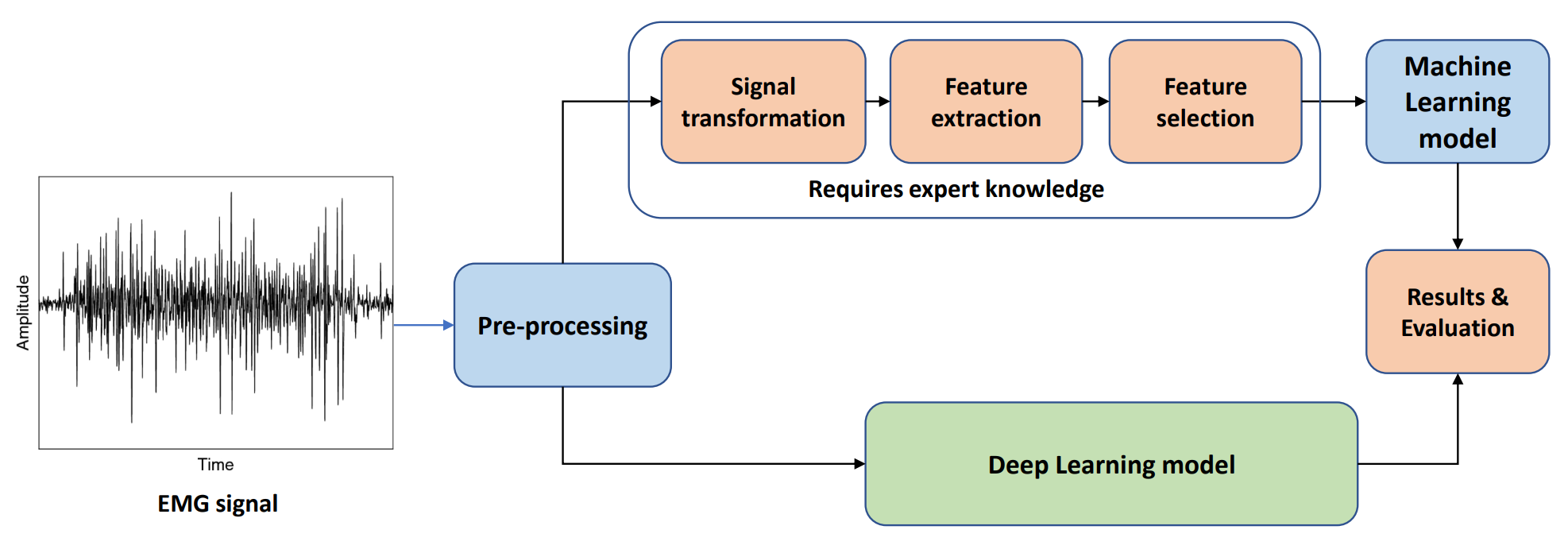
Electromyography (EMG) signals provide critical insights into neuromuscular function, yet their analysis remains challenging due to inherent noise, inter-subject variability, and non-stationary characteristics. Bio-inspired artificial intelligence (AI) models, drawing computational principles from biological neural systems, offer promising solutions to these challenges. This mini-review synthesizes recent advances in bio-inspired AI approaches for EMG signal processing, including spiking neural networks, hierarchical deep learning, attention mechanisms, and neuromorphic computing. We evaluate state-of-the-art methods, comparing their performance across key metrics including classification accuracy, computational efficiency, and real-world applicability. Our analysis reveals that hybrid architectures combining convolutional neural networks with transformer-based attention mechanisms achieve superior performance while maintaining computational efficiency. We identify emerging trends in multimodal integration, self-supervised learning, and edge computing implementations. This paper provides researchers and practitioners with a comprehensive framework for selecting appropriate bio-inspired AI methods for specific EMG applications in prosthetics, clinical diagnosis, rehabilitation, and human-computer interaction.
Graphical Abstract
Keywords
Data Availability Statement
Funding
Conflicts of Interest
Ethical Approval and Consent to Participate
References
- Merletti, R., & Farina, D. (Eds.). (2016). Surface electromyography: physiology, engineering, and applications. John Wiley & Sons.
[Google Scholar] - Phinyomark, A., Phukpattaranont, P., & Limsakul, C. (2012). Feature reduction and selection for EMG signal classification. Expert systems with applications, 39(8), 7420-7431.
[CrossRef] [Google Scholar] - Sid'El Moctar, S. M., Rida, I., & Boudaoud, S. (2024). Comprehensive review of feature extraction techniques for semg signal classification: From handcrafted features to deep learning approaches. IRBM, 45(6), 100866.
[CrossRef] [Google Scholar] - Wang, Z., Huang, W., Qi, Z., & Yin, S. (2024). MS-CLSTM: Myoelectric Manipulator Gesture Recognition Based on Multi-Scale Feature Fusion CNN-LSTM Network. Biomimetics, 9(12), 784.
[CrossRef] [Google Scholar] - Côté-Allard, U., Fall, C. L., Drouin, A., Campeau-Lecours, A., Gosselin, C., Glette, K., ... & Gosselin, B. (2019). Deep learning for electromyographic hand gesture signal classification using transfer learning. IEEE transactions on neural systems and rehabilitation engineering, 27(4), 760-771.
[CrossRef] [Google Scholar] - Liu, Y., Li, X., Yang, L., Bian, G., & Yu, H. (2023). A CNN-transformer hybrid recognition approach for sEMG-based dynamic gesture prediction. IEEE Transactions on Instrumentation and Measurement, 72, 1–16.
[CrossRef] [Google Scholar] - Wei, W., Wong, Y., Du, Y., Hu, Y., Kankanhalli, M., & Geng, W. (2019). A multi-stream convolutional neural network for sEMG-based gesture recognition in muscle-computer interface. Pattern Recognition Letters, 119, 131–138.
[CrossRef] [Google Scholar] - Nunes, J. D., Carvalho, M., Carneiro, D., & Cardoso, J. S. (2022). Spiking neural networks: A survey. IEEE Access, 10, 60738–60764.
[CrossRef] [Google Scholar] - Serre, T. (2019). Deep learning: The good, the bad, and the ugly. Annual Review of Vision Science, 5(1), 399–426.
[CrossRef] [Google Scholar] - Song, S., Dong, A., Yu, J., Han, Y., & Zhou, Y. (2023). A multichannel CNN-GRU hybrid architecture for sEMG gesture recognition. In Proceedings of the 2023 IEEE International Conference on Bioinformatics and Biomedicine (BIBM) (pp. 4132–4139). IEEE.
[CrossRef] [Google Scholar] - Bai, S., Kolter, J. Z., & Koltun, V. (2018). An empirical evaluation of generic convolutional and recurrent networks for sequence modeling. arXiv preprint arXiv:1803.01271.
[Google Scholar] - Chen, C., Guo, W., Ma, C., Yang, Y., Wang, Z., & Lin, C. (2021). sEMG-based continuous estimation of finger kinematics via large-scale temporal convolutional network. Applied Sciences, 11(10), 4678.
[CrossRef] [Google Scholar] - Montazerin, M., Rahimian, E., Naderkhani, F., Atashzar, S. F., Yanushkevich, S., & Mohammadi, A. (2023). Transformer-based hand gesture recognition from instantaneous to fused neural decomposition of high-density EMG signals. Scientific Reports, 13(1), 11000.
[CrossRef] [Google Scholar] - Lin, C., Wang, Y., & Dai, M. (2024). Robust gesture recognition based on attention-deep fast convolutional neural network and surface electromyographic signals. Frontiers in Neuroscience, 18, 1306047.
[CrossRef] [Google Scholar] - Sun, A., Chen, X., Xu, M., Zhang, X., & Chen, X. (2023). Feasibility study on the application of a spiking neural network in myoelectric control systems. Frontiers in Neuroscience, 17, 1174760.
[CrossRef] [Google Scholar] - Neftci, E. O., Mostafa, H., & Zenke, F. (2019). Surrogate gradient learning in spiking neural networks: Bringing the power of gradient-based optimization to spiking neural networks. IEEE Signal Processing Magazine, 36(6), 51–63.
[CrossRef] [Google Scholar] - Donati, E., Payvand, M., Risi, N., Krause, R., & Indiveri, G. (2019). Discrimination of EMG signals using a neuromorphic implementation of a spiking neural network. IEEE transactions on biomedical circuits and systems, 13(5), 795-803.
[CrossRef] [Google Scholar] - Sid'El Moctar, S. M., Diab, A., Rida, I., Kinugawa, K., & Boudaoud, S. (2023, June). Active aging prediction from muscle electrical activity using HD-sEMG signals and machine learning. In 2023 ieee 36th international symposium on computer-based medical systems (cbms) (pp. 734-737). IEEE.
[CrossRef] [Google Scholar] - Vijayvargiya, A., Kumar, R., & Sharma, P. (2023). PC-GNN: Pearson correlation-based graph neural network for recognition of human lower limb activity using sEMG signal. IEEE Transactions on Human-Machine Systems, 53(6), 945–954.
[CrossRef] [Google Scholar] - Zhang, H., Sid’El Moctar, S. M., Boudaoud, S., & Rida, I. (2026). A comprehensive review of sEMG-IMU sensor fusion for upper limb movements pattern recognition. Information Fusion, 125, 103422.
[CrossRef] [Google Scholar] - Wang, W., Liu, Y., Song, F., Lu, J., Qu, J., Guo, J., & Huang, J. (2025). CGMV-EGR: A multimodal fusion framework for electromyographic gesture recognition. Pattern Recognition, 162, 111387.
[CrossRef] [Google Scholar] - Duan, S., Wu, L., Liu, A., & Chen, X. (2023). Alignment-enhanced interactive fusion model for complete and incomplete multimodal hand gesture recognition. IEEE Transactions on Neural Systems and Rehabilitation Engineering, 31, 4661–4671.
[CrossRef] [Google Scholar] - Tam, S., Raghu, S. T. P., Buteau, É., Scheme, E., Boukadoum, M., Campeau-Lecours, A., & Gosselin, B. (2024). Towards Robust and Interpretable EMG-based Hand Gesture Recognition using Deep Metric Meta Learning. arXiv preprint arXiv:2404.15360.
[Google Scholar] - Lai, Z., Kang, X., Wang, H., Zhang, X., Zhang, W., & Wang, F. (2022, October). Contrastive domain adaptation: A self-supervised learning framework for sEMG-based gesture recognition. In 2022 IEEE International Joint Conference on Biometrics (IJCB) (pp. 1-7). IEEE.
[CrossRef] [Google Scholar] - Sid'El Moctar, S. M., Zhang, H., Rida, I., Kinugawa, K., & Boudaoud, S. (2025). Gender recognition with aging using HD-sEMG signals. Multimedia Tools and Applications.
[Google Scholar]
Cite This Article
TY  - JOUR
AU  - Moctar, Sidi Mohamed Sid'El
PY  - 2025
DA  - 2025/12/24
TI  - Bio-Inspired Machine Learning for Enhanced EMG Signal Analysis
JO  - Journal of Artificial Intelligence in Bioinformatics
T2  - Journal of Artificial Intelligence in Bioinformatics
JF  - Journal of Artificial Intelligence in Bioinformatics
VL  - 1
IS  - 2
SP  - 79
EP  - 84
DO  - 10.62762/JAIB.2025.677230
UR  - https://www.icck.org/article/abs/JAIB.2025.677230
KW  - electromyography
KW  - bio-inspired AI
KW  - deep learning
KW  - signal processing
AB  - Electromyography (EMG) signals provide critical insights into neuromuscular function, yet their analysis remains challenging due to inherent noise, inter-subject variability, and non-stationary characteristics. Bio-inspired artificial intelligence (AI) models, drawing computational principles from biological neural systems, offer promising solutions to these challenges. This mini-review synthesizes recent advances in bio-inspired AI approaches for EMG signal processing, including spiking neural networks, hierarchical deep learning, attention mechanisms, and neuromorphic computing. We evaluate state-of-the-art methods, comparing their performance across key metrics including classification accuracy, computational efficiency, and real-world applicability. Our analysis reveals that hybrid architectures combining convolutional neural networks with transformer-based attention mechanisms achieve superior performance while maintaining computational efficiency. We identify emerging trends in multimodal integration, self-supervised learning, and edge computing implementations. This paper provides researchers and practitioners with a comprehensive framework for selecting appropriate bio-inspired AI methods for specific EMG applications in prosthetics, clinical diagnosis, rehabilitation, and human-computer interaction.
SN  - 3068-7535
PB  - Institute of Central Computation and Knowledge
LA  - English
ER  -
@article{Moctar2025BioInspire,
  author = {Sidi Mohamed Sid'El Moctar},
  title = {Bio-Inspired Machine Learning for Enhanced EMG Signal Analysis},
  journal = {Journal of Artificial Intelligence in Bioinformatics},
  year = {2025},
  volume = {1},
  number = {2},
  pages = {79-84},
  doi = {10.62762/JAIB.2025.677230},
  url = {https://www.icck.org/article/abs/JAIB.2025.677230},
  abstract = {Electromyography (EMG) signals provide critical insights into neuromuscular function, yet their analysis remains challenging due to inherent noise, inter-subject variability, and non-stationary characteristics. Bio-inspired artificial intelligence (AI) models, drawing computational principles from biological neural systems, offer promising solutions to these challenges. This mini-review synthesizes recent advances in bio-inspired AI approaches for EMG signal processing, including spiking neural networks, hierarchical deep learning, attention mechanisms, and neuromorphic computing. We evaluate state-of-the-art methods, comparing their performance across key metrics including classification accuracy, computational efficiency, and real-world applicability. Our analysis reveals that hybrid architectures combining convolutional neural networks with transformer-based attention mechanisms achieve superior performance while maintaining computational efficiency. We identify emerging trends in multimodal integration, self-supervised learning, and edge computing implementations. This paper provides researchers and practitioners with a comprehensive framework for selecting appropriate bio-inspired AI methods for specific EMG applications in prosthetics, clinical diagnosis, rehabilitation, and human-computer interaction.},
  keywords = {electromyography, bio-inspired AI, deep learning, signal processing},
  issn = {3068-7535},
  publisher = {Institute of Central Computation and Knowledge}
}
Article Metrics
Publisher's Note
ICCK stays neutral with regard to jurisdictional claims in published maps and institutional affiliations.
Rights and Permissions
 Copyright © 2025 by the Author(s). Published by Institute of Central Computation and Knowledge. This article is an open access article distributed under the terms and conditions of the Creative Commons Attribution (CC BY) license (https://creativecommons.org/licenses/by/4.0/), which permits use, sharing, adaptation, distribution and reproduction in any medium or format, as long as you give appropriate credit to the original author(s) and the source, provide a link to the Creative Commons licence, and indicate if changes were made.


Portico
