


Retrial Queues: Scaling Limits


Article Information
Abstract
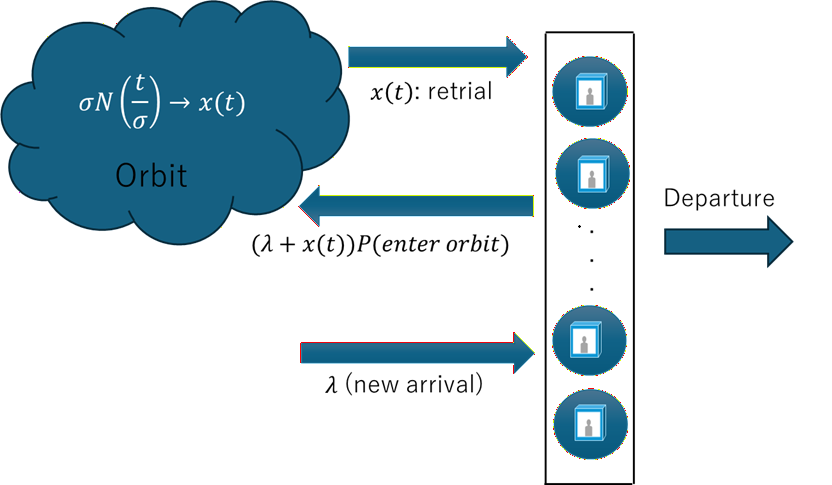
Retrial queues arise in various applications such as call centers, services, and computer networks. The study of retrial queues is an important research branch of Queueing Theory. Retrial queues are characterized by the feature that customers who cannot receive service upon arrival do not queue but retry to enter the server after some random time. This makes the analysis of retrial queues more difficult than that of corresponding models without retrials. While the latter can be considered the limit of the former as the retrial time tends to infinity, some scaling limits are needed to obtain a scaled version of the number of retrial customers as the retrial time tends to zero, because the number of retrial customers explodes under this limiting regime. In this paper, a brief survey is provided on the major scaling limits of these models, and open problems are discussed. These limits can be used as approximations of complex systems with retrials.
Graphical Abstract
Keywords
Data Availability Statement
Funding
Conflicts of Interest
AI Use Statement
Ethical Approval and Consent to Participate
References
- Falin, G. I. and Templeton, J.G.C. (1997). Retrial Queues (First ed.). Chapman & Hall, London. https://books.google.com/books?hl=zh-CN&lr=&id=OsKoEAAAQBAJ&oi=fnd&pg=PR9&ots=h7b4U_DApG&sig=IBtE-ICC_nFb-ybEZPEJWVH48qw#v=onepage&q&f=false
[Google Scholar] - Moiseev, A., Nazarov, A., & Paul, S. (2020). Asymptotic diffusion analysis of multi-server retrial queue with hyper-exponential service. Mathematics, 8(4), 531.
[CrossRef] [Google Scholar] - Atar, R., & Lev-Ari, A. (2018). Optimizing buffer size for the retrial queue: two state space collapse results in heavy traffic. Queueing Systems, 90(3), 225-255.
[CrossRef] [Google Scholar] - Mandelbaum, A., Massey, W. A., Reiman, M. I., Stolyar, A., & Rider, B. (2002). Queue lengths and waiting times for multiserver queues with abandonment and retrials. Telecommunication Systems, 21(2), 149-171.
[CrossRef] [Google Scholar] - Nazarov, A., Phung-Duc, T., & Izmailova, Y. (2020, September). Multidimensional central limit theorem of the multiclass M/M/1/1 retrial queue. In International Conference on Distributed Computer and Communication Networks (pp. 298-310). Cham: Springer International Publishing.
[CrossRef] [Google Scholar] - Nazarov, A. A., & Fedorova, E. A. (2025). Method of the Marginal Asymptotic-Diffusion Analysis for Multiclass Retrial Queue Mn/GIn. AUTOMATION AND REMOTE CONTROL, 86(3), 235-248.
[Google Scholar]
Cite This Article
TY  - JOUR
AU  - Phung-Duc, Tuan
PY  - 2026
DA  - 2026/04/30
TI  - Retrial Queues: Scaling Limits
JO  - Journal of Systems Scalability
T2  - Journal of Systems Scalability
JF  - Journal of Systems Scalability
VL  - 1
IS  - 2
SP  - 39
EP  - 42
DO  - 10.62762/JSS.2025.500072
UR  - https://www.icck.org/article/abs/JSS.2025.500072
KW  - scaling limits
KW  - fluid limit
KW  - diffusion limit
KW  - heavy traffic
KW  - retrial queues
KW  - networks
AB  - Retrial queues arise in various applications such as call centers, services, and computer networks. The study of retrial queues is an important research branch of Queueing Theory. Retrial queues are characterized by the feature that customers who cannot receive service upon arrival do not queue but retry to enter the server after some random time. This makes the analysis of retrial queues more difficult than that of corresponding models without retrials. While the latter can be considered the limit of the former as the retrial time tends to infinity, some scaling limits are needed to obtain a scaled version of the number of retrial customers as the retrial time tends to zero, because the number of retrial customers explodes under this limiting regime. In this paper, a brief survey is provided on the major scaling limits of these models, and open problems are discussed. These limits can be used as approximations of complex systems with retrials.
SN  - 3142-7855
PB  - Institute of Central Computation and Knowledge
LA  - English
ER  -
@article{PhungDuc2026Retrial,
  author = {Tuan Phung-Duc},
  title = {Retrial Queues: Scaling Limits},
  journal = {Journal of Systems Scalability},
  year = {2026},
  volume = {1},
  number = {2},
  pages = {39-42},
  doi = {10.62762/JSS.2025.500072},
  url = {https://www.icck.org/article/abs/JSS.2025.500072},
  abstract = {Retrial queues arise in various applications such as call centers, services, and computer networks. The study of retrial queues is an important research branch of Queueing Theory. Retrial queues are characterized by the feature that customers who cannot receive service upon arrival do not queue but retry to enter the server after some random time. This makes the analysis of retrial queues more difficult than that of corresponding models without retrials. While the latter can be considered the limit of the former as the retrial time tends to infinity, some scaling limits are needed to obtain a scaled version of the number of retrial customers as the retrial time tends to zero, because the number of retrial customers explodes under this limiting regime. In this paper, a brief survey is provided on the major scaling limits of these models, and open problems are discussed. These limits can be used as approximations of complex systems with retrials.},
  keywords = {scaling limits, fluid limit, diffusion limit, heavy traffic, retrial queues, networks},
  issn = {3142-7855},
  publisher = {Institute of Central Computation and Knowledge}
}
Article Metrics
Publisher's Note
ICCK stays neutral with regard to jurisdictional claims in published maps and institutional affiliations.
Rights and Permissions
 Copyright © 2026 by the Author(s). Published by Institute of Central Computation and Knowledge. This article is an open access article distributed under the terms and conditions of the Creative Commons Attribution (CC BY) license (https://creativecommons.org/licenses/by/4.0/), which permits use, sharing, adaptation, distribution and reproduction in any medium or format, as long as you give appropriate credit to the original author(s) and the source, provide a link to the Creative Commons licence, and indicate if changes were made.

