


Physiological and Morphological Divergence between Wild Olive (Olea ferruginea) and Grafted Commercial Cultivars: Implications for Drought Resilience and Ecosystem Services in Pakistan


Article Information
Abstract
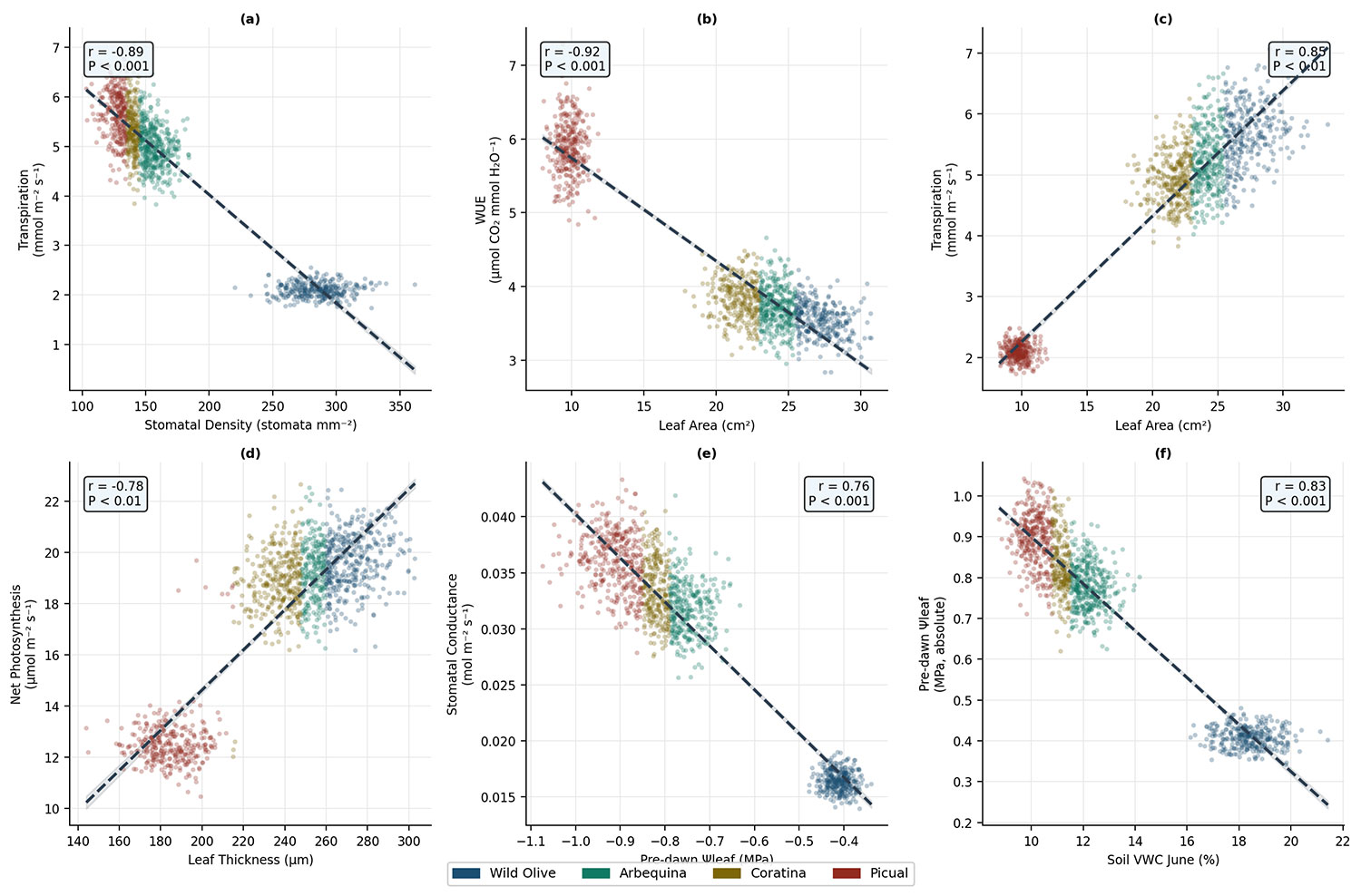
Pakistan's `50 Million Olive Tree Tsunami' targets ~10 million acres of olive expansion by grafting commercial cultivars onto wild Olea ferruginea rootstocks, but physiological/ecological impacts are unknown. This 2023--2025 field study sampled 450 trees across three Balochistan sites (wild: \( n = 150 \); Arbequina, Coratina, Picual: \( n = 100 \) each) with \( n = 1{,}240 \) leaf measurements. Wild leaves were 56--63% smaller (\( 9.8 \) vs. \( 22.4 \)--\( 26.8 \, \text{cm}^2 \); \( P < 0.001 \); \( \eta^2 = 0.926 \)), but had 83--118% higher stomatal density (\( 285 \) vs. \( 131 \)--\( 156 \, \text{mm}^{-2} \); \( \eta^2 = 0.934 \)) and 36--40% smaller stomata. This strategy reduced transpiration 56--64% (\( 2.1 \) vs. \( 4.8 \)--\( 5.8 \, \text{mmol H}_2\text{O·m}^{-2}\text{·s}^{-1} \)) and improved WUE 51--69% (\( 5.9 \) vs. \( 3.5 \)--\( 3.9 \, \mu\text{mol CO}_2\,\text{mmol}^{-1}\,\text{H}_2\text{O} \); \( \eta^2 = 0.918 \)); leaf area explained 85% of WUE variance (\( r = -0.92 \), \( P < 0.001 \)). Pressure-bomb data showed wild olives had less negative \( \Psi_{pd} \) (\( -0.41 \) vs. \( -0.76 \) to \( -0.91 \, \text{MPa} \); \( \eta^2 = 0.959 \)) and midday \( \Psi_{leaf} \) (\( -1.48 \) vs. \( -2.34 \) to \( -2.78 \, \text{MPa} \)), with TDR soil VWC 52--72% higher under wild canopies in August. Rainfed projections indicate grafted systems exhaust soil moisture 18--22 days earlier than wild stands. Wild ecosystems supported 2.6× greater bird richness (87 vs. 34; Mayfield nesting: \( 68.4 \pm 3.1% \) vs. \( 24.7 \pm 4.2% \)) and better livestock retention (94% vs. 68%; mortality: 2% vs. 10%). ANOVA confirmed significant effects for all 12 variables (\( P < 0.001 \); \( \eta^2 = 0.207 \)--\( 0.983 \)). Grafting decouples below-ground adaptation from above-ground demand, urging integrated conservation with sustainable irrigation.
Graphical Abstract
Keywords
Data Availability Statement
Funding
Conflicts of Interest
AI Use Statement
Ethical Approval and Consent to Participate
References
- Nasrullah, K., Fayaz, A., Kishwar, A., & Shahid, S. (2015). Composition, structure and regeneration dynamics of Olea ferruginea Royle forests from Hindukush range of Pakistan. Journal of Mountain Science, 12(3), 647-658.
[CrossRef] [Google Scholar] - Ali, S., Mueed, A., Jahangir, M., Sammi, S., Zakki, S. A., Amin, A., ... & Zheng, H. (2024). Evolution of olive farming, industry, and usage in Pakistan: A comprehensive review. Journal of Agriculture and Food Research, 16, 101091.
[CrossRef] [Google Scholar] - Anwar, P., Bendini, A., Gulfraz, M., Qureshi, R., Valli, E., Di Lecce, G., ... & Toschi, T. G. (2013). Characterization of olive oils obtained from wild olive trees (Olea ferruginea Royle) in Pakistan. Food research international, 54(2), 1965-1971.
[CrossRef] [Google Scholar] - Bacelar, E. A., Santos, D. L., Moutinho-Pereira, J. M., Lopes, J. I., Gonçalves, B. C., Ferreira, T. C., & Correia, C. M. (2007). Physiological behaviour, oxidative damage and antioxidative protection of olive trees grown under different irrigation regimes. Plant and soil, 292(1), 1-12.
[CrossRef] [Google Scholar] - Bergmann, D. C., & Sack, F. D. (2007). Stomatal development. Annu. Rev. Plant Biol., 58, 163-181.
[CrossRef] [Google Scholar] - Bertolino, L. T., Caine, R. S., & Gray, J. E. (2019). Impact of stomatal density and morphology on water-use efficiency in a changing world. Frontiers in plant science, 10, 225.
[CrossRef] [Google Scholar] - Blum, A. (2005). Drought resistance, water-use efficiency, and yield potential—are they compatible, dissonant, or mutually exclusive?. Australian journal of agricultural research, 56(11), 1159-1168.
[CrossRef] [Google Scholar] - Bonarota, M. S., Toups, H. S., Bristow, S. T., Santos, P., Jackson, L. E., Cramer, G. R., & Barrios-Masias, F. H. (2024). Drought response and recovery mechanisms of grapevine rootstocks grafted to a common Vitis vinifera scion. Plant Stress, 11, 100346.
[CrossRef] [Google Scholar] - Chaves, M. M., Flexas, J., & Pinheiro, C. (2009). Photosynthesis under drought and salt stress: regulation mechanisms from whole plant to cell. Annals of botany, 103(4), 551-560.
[CrossRef] [Google Scholar] - Chaves, M. M., Maroco, J. P., & Pereira, J. S. (2003). Understanding plant responses to drought—from genes to the whole plant. Functional plant biology, 30(3), 239-264.
[CrossRef] [Google Scholar] - Condon, A. G., Richards, R. A., Rebetzke, G. J., & Farquhar, G. D. (2004). Breeding for high water-use efficiency. Journal of experimental botany, 55(407), 2447-2460.
[CrossRef] [Google Scholar] - Dickison, W. C. (2000). Integrative plant anatomy (2nd ed.). Elsevier.
[CrossRef] [Google Scholar] - Fernández, J. E., Diaz-Espejo, A., Infante, J. M., Durán, P., Palomo, M. J., Chamorro, V., ... & Villagarcía, L. (2006). Water relations and gas exchange in olive trees under regulated deficit irrigation and partial rootzone drying. Plant and Soil, 284(1), 273-291.
[CrossRef] [Google Scholar] - Yan, W., Zhong, Y., & Shangguan, Z. (2016). A meta-analysis of leaf gas exchange and water status responses to drought. Scientific Reports, 6(1), 20917.
[CrossRef] [Google Scholar] - Chartzoulakis, K., Patakas, A., & Bosabalidis, A. M. (1999). Changes in water relations, photosynthesis and leaf anatomy induced by intermittent drought in two olive cultivars. Environmental and experimental botany, 42(2), 113-120.
[CrossRef] [Google Scholar] - Hetherington, A. M., & Woodward, F. I. (2003). The role of stomata in sensing and driving environmental change. Nature, 424(6951), 901-908.
[CrossRef] [Google Scholar] - IPCC. (2023). Climate Change 2023: Synthesis Report. Contribution of Working Groups I, II and III to the Sixth Assessment Report of the Intergovernmental Panel on Climate Change. IPCC, Geneva, Switzerland.
[CrossRef] [Google Scholar] - Niu, M., Sun, S., Nawaz, M. A., Sun, J., Cao, H., Lu, J., ... & Bie, Z. (2019). Grafting cucumber onto pumpkin induced early stomatal closure by increasing ABA sensitivity under salinity conditions. Frontiers in Plant Science, 10, 1290.
[CrossRef] [Google Scholar] - Johnson, D. H. (1979). Estimating nest success: the Mayfield method and an alternative. The auk, 96(4), 651-661.
[CrossRef] [Google Scholar] - Ullah, A., Ansari, L., Khan, K. D., Bano, W., Aslam, S., Minallah, N., ... & Bibi, Y. (2025). Status of Wild Olive in Murree, Kahuta and Kotli Sattian National Park. Journal of Asian Development Studies, 14(2), 1622-1641.
[CrossRef] [Google Scholar] - Lawson, T., & Blatt, M. R. (2014). Stomatal size, speed, and responsiveness impact on photosynthesis and water use efficiency. Plant physiology, 164(4), 1556-1570.
[CrossRef] [Google Scholar] - El Said, S. H., Abd Allatif, A. M., & Abdel-Fattah, A. A. (2024). Response of grafted olive (Olea europaea L. Cv. Coratina) to water deficit conditions. Basrah Journal of Agricultural Sciences, 37(1), 134-148.
[CrossRef] [Google Scholar] - Morgado, R., Santana, J., Porto, M., Sánchez-Oliver, J. S., Reino, L., Herrera, J. M., ... & Moreira, F. (2020). A Mediterranean silent spring? The effects of olive farming intensification on breeding bird communities. Agriculture, Ecosystems & Environment, 288, 106694.
[CrossRef] [Google Scholar] - Nteve, G. M., Kostas, S., Polidoros, A. N., Madesis, P., & Nianiou-Obeidat, I. (2024). Adaptation mechanisms of olive tree under drought stress: The potential of modern omics approaches. Agriculture, 14(4), 579.
[CrossRef] [Google Scholar] - Passioura, J. (2007). The drought environment: physical, biological and agricultural perspectives. Journal of experimental botany, 58(2), 113-117.
[CrossRef] [Google Scholar] - R Core Team. (2023). R: A Language and Environment for Statistical Computing. The R Foundation. Retrieved from https://www.r-project.org/
[Google Scholar] - Parri, S., Romi, M., Hoshika, Y., Giovannelli, A., Dias, M. C., Piritore, F. C., ... & Cantini, C. (2023). Morpho-physiological responses of three italian olive tree (Olea europaea L.) cultivars to drought stress. Horticulturae, 9(7), 830.
[CrossRef] [Google Scholar] - Scholander, P. F., Bradstreet, E. D., Hemmingsen, E. A., & Hammel, H. T. (1965). Sap Pressure in Vascular Plants: Negative hydrostatic pressure can be measured in plants. Science, 148(3668), 339-346.
[CrossRef] [Google Scholar] - Tadić, J., Dumičić, G., Veršić Bratinčević, M., Vitko, S., & Radić Brkanac, S. (2021). Physiological and biochemical response of wild olive (Olea europaea Subsp. europaea var. sylvestris) to salinity. Frontiers in plant science, 12, 712005.
[CrossRef] [Google Scholar] - Tscharntke, T., Clough, Y., Wanger, T. C., Jackson, L., Motzke, I., Perfecto, I., ... & Whitbread, A. (2012). Global food security, biodiversity conservation and the future of agricultural intensification. Biological conservation, 151(1), 53-59.
[CrossRef] [Google Scholar] - Razouk, R., Hssaini, L., Alghoum, M., Adiba, A., & Hamdani, A. (2022). Phenotyping olive cultivars for drought tolerance using leaf macro-characteristics. Horticulturae, 8(10), 939.
[CrossRef] [Google Scholar] - Yang, L., Xia, L., Zeng, Y., Han, Q., & Zhang, S. (2022). Grafting enhances plants drought resistance: Current understanding, mechanisms, and future perspectives. Frontiers in Plant Science, 13, 1015317.
[CrossRef] [Google Scholar]
Cite This Article
TY  - JOUR
AU  - Haleem, Abdul
AU  - Gul, Hamza
AU  - Rahman, Sajjad Ur
AU  - Wahab, Atta Ul
PY  - 2026
DA  - 2026/07/05
TI  - Physiological and Morphological Divergence between Wild Olive (Olea ferruginea) and Grafted Commercial Cultivars: Implications for Drought Resilience and Ecosystem Services in Pakistan
JO  - Plant Innovation Journal
T2  - Plant Innovation Journal
JF  - Plant Innovation Journal
VL  - 1
IS  - 2
SP  - 72
EP  - 87
DO  - 10.62762/PIJ.2026.658461
UR  - https://www.icck.org/article/abs/PIJ.2026.658461
KW  - Olea ferruginea
KW  - drought tolerance
KW  - water-use efficiency
KW  - stomatal morphology
KW  - leaf water potential
KW  - soil moisture
KW  - ecosystem services
KW  - grafting physiology
KW  - climate resilience
KW  - Pakistan
KW  - agroforestry
AB  - Pakistan's `50 Million Olive Tree Tsunami' targets ~10 million acres of olive expansion by grafting commercial cultivars onto wild Olea ferruginea rootstocks, but physiological/ecological impacts are unknown. This 2023--2025 field study sampled 450 trees across three Balochistan sites (wild: \( n = 150 \); Arbequina, Coratina, Picual: \( n = 100 \) each) with \( n = 1{,}240 \) leaf measurements. Wild leaves were 56--63% smaller (\( 9.8 \) vs. \( 22.4 \)--\( 26.8 \, \text{cm}^2 \); \( P < 0.001 \); \( \eta^2 = 0.926 \)), but had 83--118% higher stomatal density (\( 285 \) vs. \( 131 \)--\( 156 \, \text{mm}^{-2} \); \( \eta^2 = 0.934 \)) and 36--40% smaller stomata. This strategy reduced transpiration 56--64% (\( 2.1 \) vs. \( 4.8 \)--\( 5.8 \, \text{mmol H}_2\text{O·m}^{-2}\text{·s}^{-1} \)) and improved WUE 51--69% (\( 5.9 \) vs. \( 3.5 \)--\( 3.9 \, \mu\text{mol CO}_2\,\text{mmol}^{-1}\,\text{H}_2\text{O} \); \( \eta^2 = 0.918 \)); leaf area explained 85% of WUE variance (\( r = -0.92 \), \( P < 0.001 \)). Pressure-bomb data showed wild olives had less negative \( \Psi_{pd} \) (\( -0.41 \) vs. \( -0.76 \) to \( -0.91 \, \text{MPa} \); \( \eta^2 = 0.959 \)) and midday \( \Psi_{leaf} \) (\( -1.48 \) vs. \( -2.34 \) to \( -2.78 \, \text{MPa} \)), with TDR soil VWC 52--72% higher under wild canopies in August. Rainfed projections indicate grafted systems exhaust soil moisture 18--22 days earlier than wild stands. Wild ecosystems supported 2.6× greater bird richness (87 vs. 34; Mayfield nesting: \( 68.4 \pm 3.1% \) vs. \( 24.7 \pm 4.2% \)) and better livestock retention (94% vs. 68%; mortality: 2% vs. 10%). ANOVA confirmed significant effects for all 12 variables (\( P < 0.001 \); \( \eta^2 = 0.207 \)--\( 0.983 \)). Grafting decouples below-ground adaptation from above-ground demand, urging integrated conservation with sustainable irrigation.
SN  - 3142-7596
PB  - Institute of Central Computation and Knowledge
LA  - English
ER  -
@article{Haleem2026Physiologi,
  author = {Abdul Haleem and Hamza Gul and Sajjad Ur Rahman and Atta Ul Wahab},
  title = {Physiological and Morphological Divergence between Wild Olive (Olea ferruginea) and Grafted Commercial Cultivars: Implications for Drought Resilience and Ecosystem Services in Pakistan},
  journal = {Plant Innovation Journal},
  year = {2026},
  volume = {1},
  number = {2},
  pages = {72-87},
  doi = {10.62762/PIJ.2026.658461},
  url = {https://www.icck.org/article/abs/PIJ.2026.658461},
  abstract = {Pakistan's `50 Million Olive Tree Tsunami' targets ~10 million acres of olive expansion by grafting commercial cultivars onto wild Olea ferruginea rootstocks, but physiological/ecological impacts are unknown. This 2023--2025 field study sampled 450 trees across three Balochistan sites (wild: \( n = 150 \); Arbequina, Coratina, Picual: \( n = 100 \) each) with \( n = 1{,}240 \) leaf measurements. Wild leaves were 56--63\% smaller (\( 9.8 \) vs. \( 22.4 \)--\( 26.8 \, \text{cm}^2 \); \( P < 0.001 \); \( \eta^2 = 0.926 \)), but had 83--118\% higher stomatal density (\( 285 \) vs. \( 131 \)--\( 156 \, \text{mm}^{-2} \); \( \eta^2 = 0.934 \)) and 36--40\% smaller stomata. This strategy reduced transpiration 56--64\% (\( 2.1 \) vs. \( 4.8 \)--\( 5.8 \, \text{mmol H}\_2\text{O·m}^{-2}\text{·s}^{-1} \)) and improved WUE 51--69\% (\( 5.9 \) vs. \( 3.5 \)--\( 3.9 \, \mu\text{mol CO}\_2\,\text{mmol}^{-1}\,\text{H}\_2\text{O} \); \( \eta^2 = 0.918 \)); leaf area explained 85\% of WUE variance (\( r = -0.92 \), \( P < 0.001 \)). Pressure-bomb data showed wild olives had less negative \( \Psi\_{pd} \) (\( -0.41 \) vs. \( -0.76 \) to \( -0.91 \, \text{MPa} \); \( \eta^2 = 0.959 \)) and midday \( \Psi\_{leaf} \) (\( -1.48 \) vs. \( -2.34 \) to \( -2.78 \, \text{MPa} \)), with TDR soil VWC 52--72\% higher under wild canopies in August. Rainfed projections indicate grafted systems exhaust soil moisture 18--22 days earlier than wild stands. Wild ecosystems supported 2.6× greater bird richness (87 vs. 34; Mayfield nesting: \( 68.4 \pm 3.1\% \) vs. \( 24.7 \pm 4.2\% \)) and better livestock retention (94\% vs. 68\%; mortality: 2\% vs. 10\%). ANOVA confirmed significant effects for all 12 variables (\( P < 0.001 \); \( \eta^2 = 0.207 \)--\( 0.983 \)). Grafting decouples below-ground adaptation from above-ground demand, urging integrated conservation with sustainable irrigation.},
  keywords = {Olea ferruginea, drought tolerance, water-use efficiency, stomatal morphology, leaf water potential, soil moisture, ecosystem services, grafting physiology, climate resilience, Pakistan, agroforestry},
  issn = {3142-7596},
  publisher = {Institute of Central Computation and Knowledge}
}
Article Metrics
Publisher's Note
ICCK stays neutral with regard to jurisdictional claims in published maps and institutional affiliations.
Rights and Permissions
 Copyright © 2026 by the Author(s). Published by Institute of Central Computation and Knowledge. This article is an open access article distributed under the terms and conditions of the Creative Commons Attribution (CC BY) license (https://creativecommons.org/licenses/by/4.0/), which permits use, sharing, adaptation, distribution and reproduction in any medium or format, as long as you give appropriate credit to the original author(s) and the source, provide a link to the Creative Commons licence, and indicate if changes were made.

