


Melatonin-Mediated Activation of the MKK5–MPK3/6 Cascade: A Molecular Framework for Integrated Drought Stress Tolerance in Plants



Article Information
Abstract
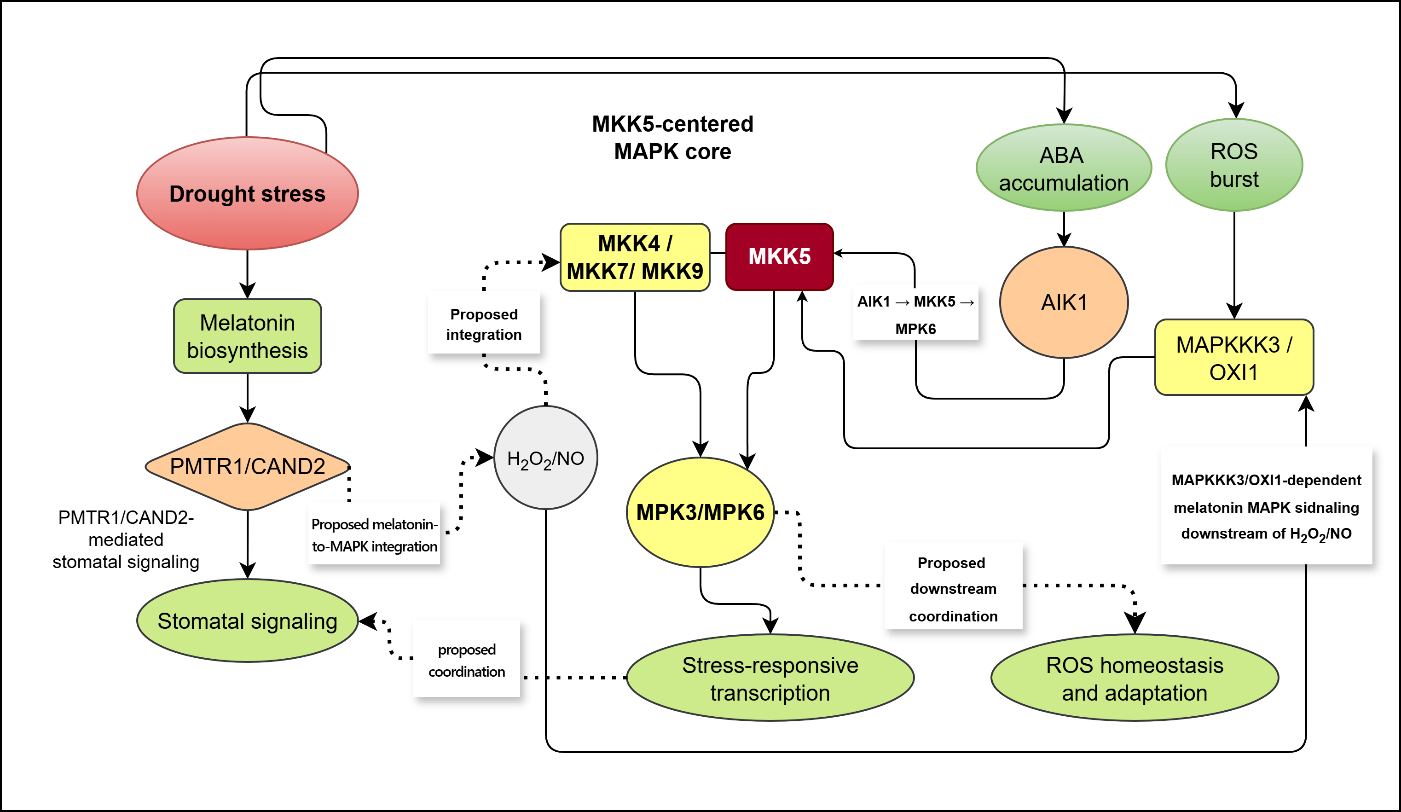
Drought stress is one of the most devastating abiotic stresses threatening global food security. Melatonin (N-acetyl-5-methoxytryptamine) and Mitogen-Activated Protein Kinase Kinase 5 (MKK5) are independently recognized as central regulators of plant stress adaptation; however, the molecular intersection of their signaling axes remains poorly characterized. This review proposes and examines a coherent molecular framework wherein melatonin, perceived via the phytomelatonin receptor PMTR1/CAND2, may converge on MKK5-containing MPK3/6 signaling modules as part of a broader MKK4/5/7/9 MAPK response network to orchestrate an integrated drought stress response. Key convergence points include the ABA-AIK1-MKK5-MPK6 module, reactive oxygen species (ROS) homeostasis, cooperative stomatal regulation, and the shared transcriptional targeting of WRKY and DREB factors. Understanding this melatonin–MKK5 axis opens new avenues for engineering drought-resilient crops in the context of accelerating climate change.
Graphical Abstract
Keywords
Data Availability Statement
Funding
Conflicts of Interest
AI Use Statement
Ethical Approval and Consent to Participate
References
- Luo, C. K., Min, W. F., Akhtar, M., Lu, X. P., Bai, X. R., Zhang, Y. X., ... & Chen, X. H. (2022). Melatonin Enhances Drought Tolerance in Rice Seedlings by Modulating Antioxidant Systems, Osmoregulation, and Corresponding Gene Expression. International Journal of Molecular Sciences, 23(20), 12075.
[CrossRef] [Google Scholar] - Lee, H. Y., & Back, K. (2016). Mitogen-activated protein kinase pathways are required for melatonin-mediated defense responses in plants. Journal of Pineal Research, 60(3), 327–335.
[CrossRef] [Google Scholar] - Movahedi, A., Hwarari, D., Dzinyela, R., Ni, S. Y., & Yang, L. M. (2025). A close-up of regulatory networks and signaling pathways of MKK5 in biotic and abiotic stresses. Critical Reviews in Biotechnology, 45(2), 473–490.
[CrossRef] [Google Scholar] - Li, K., Yang, F. B., Zhang, G. Z., Song, S. F., Li, Y., Ren, D. T., ... & Xiong, L. M. (2017). AIK1, A Mitogen-Activated Protein Kinase, Modulates Abscisic Acid Responses through the MKK5-MPK6 Kinase Cascade. Plant Physiology, 173(2), 1391–1408.
[CrossRef] [Google Scholar] - Back, K., Tan, D. X., & Reiter, R. J. (2016). Melatonin biosynthesis in plants: multiple pathways catalyze tryptophan to melatonin in the cytoplasm or chloroplasts. Journal of Pineal Research, 61(4), 426–437.
[CrossRef] [Google Scholar] - Dzinyela, R., Hwarari, D., Opoku, K. N., Yang, L., & Movahedi, A. (2024). Enhancing drought stress tolerance in horticultural plants through melatonin-mediated phytohormonal crosstalk. Plant Cell Reports, 43(11), 272.
[CrossRef] [Google Scholar] - Li, C., Tan, D. X., Liang, D., Chang, C., Jia, D. F., & Ma, F. W. (2015). Melatonin mediates the regulation of ABA metabolism, free-radical scavenging, and stomatal behaviour in two Malus species under drought stress. Journal of Experimental Botany, 66(3), 669–680.
[CrossRef] [Google Scholar] - Wei, J., Li, D. X., Zhang, J. R., Shan, C., Rengel, Z., Song, Z. B., & Chen, Q. (2018). Phytomelatonin receptor PMTR1-mediated signaling regulates stomatal closure in Arabidopsis thaliana. Journal of Pineal Research, 65(2), e12500.
[CrossRef] [Google Scholar] - Lee, H. Y., & Back, K. (2017). Melatonin is required for H$_2$O$_2$- and NO-mediated defense signaling through MAPKKK3 and OXI1 in Arabidopsis thaliana. Journal of Pineal Research, 62(2), e12379.
[CrossRef] [Google Scholar] - Wang, L. F., Li, T. T., Zhang, Y., Guo, J. X., Lu, K. K., & Liu, W. C. (2021). CAND2/PMTR1 Is Required for Melatonin-Conferred Osmotic Stress Tolerance in Arabidopsis. International Journal of Molecular Sciences, 22(8), 4014.
[CrossRef] [Google Scholar] - Wang, L. F., Lu, K. K., Li, T. T., Zhang, Y., Guo, J. X., Song, R. F., & Liu, W. C. (2022). Maize PHYTOMELATONIN RECEPTOR1 functions in plant tolerance to osmotic and drought stress. Journal of Experimental Botany, 73(17), 5961–5973.
[CrossRef] [Google Scholar] - Ahn, H. R., Kim, Y. J., Lim, Y. J., Duan, S. C., Eom, S. H., & Jung, K. H. (2021). Key Genes in the Melatonin Biosynthesis Pathway with Circadian Rhythm Are Associated with Various Abiotic Stresses. Plants, 10(1), 129.
[CrossRef] [Google Scholar]
Cite This Article
TY  - JOUR
AU  - Movahedi, Ali
AU  - Yang, Liming
PY  - 2026
DA  - 2026/04/05
TI  - Melatonin-Mediated Activation of the MKK5–MPK3/6 Cascade: A Molecular Framework for Integrated Drought Stress Tolerance in Plants
JO  - Plant Innovation Journal
T2  - Plant Innovation Journal
JF  - Plant Innovation Journal
VL  - 1
IS  - 1
SP  - 50
EP  - 57
DO  - 10.62762/PIJ.2026.832797
UR  - https://www.icck.org/article/abs/PIJ.2026.832797
KW  - melatonin
KW  - MKK5
KW  - MAPK cascade
KW  - PMTR1/CAND2
KW  - drought stress
AB  - Drought stress is one of the most devastating abiotic stresses threatening global food security. Melatonin (N-acetyl-5-methoxytryptamine) and Mitogen-Activated Protein Kinase Kinase 5 (MKK5) are independently recognized as central regulators of plant stress adaptation; however, the molecular intersection of their signaling axes remains poorly characterized. This review proposes and examines a coherent molecular framework wherein melatonin, perceived via the phytomelatonin receptor PMTR1/CAND2, may converge on MKK5-containing MPK3/6 signaling modules as part of a broader MKK4/5/7/9 MAPK response network to orchestrate an integrated drought stress response. Key convergence points include the ABA-AIK1-MKK5-MPK6 module, reactive oxygen species (ROS) homeostasis, cooperative stomatal regulation, and the shared transcriptional targeting of WRKY and DREB factors. Understanding this melatonin–MKK5 axis opens new avenues for engineering drought-resilient crops in the context of accelerating climate change.
SN  - 3142-7596
PB  - Institute of Central Computation and Knowledge
LA  - English
ER  -
@article{Movahedi2026MelatoninM,
  author = {Ali Movahedi and Liming Yang},
  title = {Melatonin-Mediated Activation of the MKK5–MPK3/6 Cascade: A Molecular Framework for Integrated Drought Stress Tolerance in Plants},
  journal = {Plant Innovation Journal},
  year = {2026},
  volume = {1},
  number = {1},
  pages = {50-57},
  doi = {10.62762/PIJ.2026.832797},
  url = {https://www.icck.org/article/abs/PIJ.2026.832797},
  abstract = {Drought stress is one of the most devastating abiotic stresses threatening global food security. Melatonin (N-acetyl-5-methoxytryptamine) and Mitogen-Activated Protein Kinase Kinase 5 (MKK5) are independently recognized as central regulators of plant stress adaptation; however, the molecular intersection of their signaling axes remains poorly characterized. This review proposes and examines a coherent molecular framework wherein melatonin, perceived via the phytomelatonin receptor PMTR1/CAND2, may converge on MKK5-containing MPK3/6 signaling modules as part of a broader MKK4/5/7/9 MAPK response network to orchestrate an integrated drought stress response. Key convergence points include the ABA-AIK1-MKK5-MPK6 module, reactive oxygen species (ROS) homeostasis, cooperative stomatal regulation, and the shared transcriptional targeting of WRKY and DREB factors. Understanding this melatonin–MKK5 axis opens new avenues for engineering drought-resilient crops in the context of accelerating climate change.},
  keywords = {melatonin, MKK5, MAPK cascade, PMTR1/CAND2, drought stress},
  issn = {3142-7596},
  publisher = {Institute of Central Computation and Knowledge}
}
Article Metrics
Publisher's Note
ICCK stays neutral with regard to jurisdictional claims in published maps and institutional affiliations.
Rights and Permissions
 Copyright © 2026 by the Author(s). Published by Institute of Central Computation and Knowledge. This article is an open access article distributed under the terms and conditions of the Creative Commons Attribution (CC BY) license (https://creativecommons.org/licenses/by/4.0/), which permits use, sharing, adaptation, distribution and reproduction in any medium or format, as long as you give appropriate credit to the original author(s) and the source, provide a link to the Creative Commons licence, and indicate if changes were made.

