Investigating the Adsorption Properties of Soil Additive Mixtures Using Microstructural Characterization Techniques for Liner Applications





Article Information
Abstract
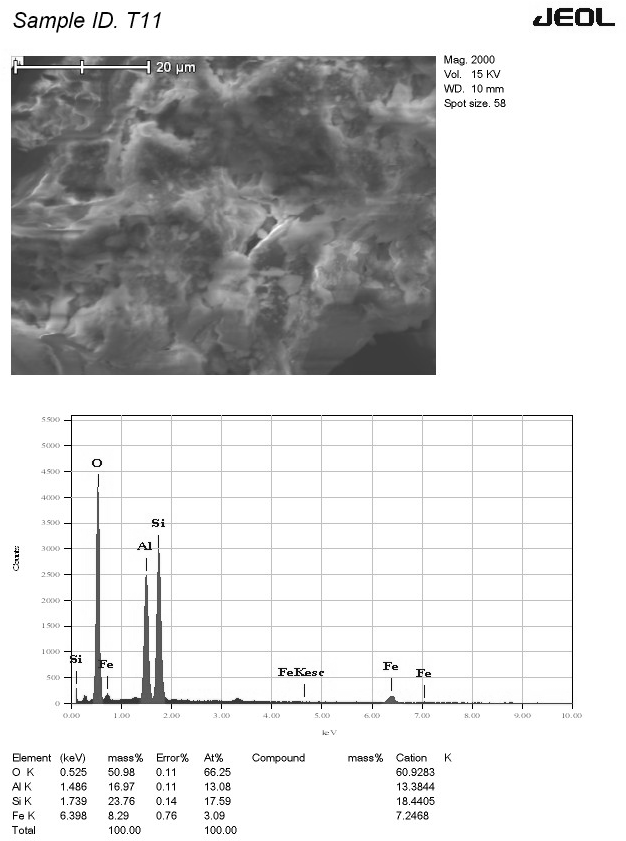
This study evaluated the potential of readily available Indian soils, red soil (Bengaluru) and black cotton soil (Belgaum), as sustainable and cost-effective alternatives to synthetic landfill liners for heavy metal containment. Utilizing Scanning Electron Microscopy (SEM) and Energy-Dispersive Spectroscopy (EDS), we characterized the soil's microstructural properties and elemental composition to assess their adsorption capabilities. To enhance metal capture, soils were amended with lime, cement, and fly ash. Batch leaching experiments, simulating landfill conditions with copper and chromium contamination, quantified adsorption efficiency. Microscopic analysis of leached samples using SEM and EDS corroborated macroscopic findings, revealing key adsorption mechanisms such as particle aggregation and the formation of binding compounds. Black cotton soil, particularly when amended, exhibited superior adsorption, likely due to its higher organic matter content. This integrated approach, linking microscopic observations to macroscopic performance, demonstrates the viability of these local soils, especially with additives, for effective and sustainable landfill liner applications.
Graphical Abstract
Keywords
Data Availability Statement
Funding
Conflicts of Interest
Ethical Approval and Consent to Participate
References
- Mgangira, M. B. (2008). Paige-Green. Scanning electron microscopy (SEM) internal technical report no. CSIR/BE/IE/IR/2006/0017/B. CSIR. Pretoria South Africa, 2006.
[Google Scholar] - Yang, H., Huang, K., Zhang, K., Weng, Q., Zhang, H., & Wang, F. (2021). Predicting heavy metal adsorption on soil with machine learning and mapping global distribution of soil adsorption capacities. Environmental Science & Technology, 55(20), 14316-14328.
[CrossRef] [Google Scholar] - Muralidhar, G., Satish Babu, C. L., & Shetty, S. (2012). Integrity of the interface between denture base and soft liner: A scanning electron microscopic study. The Journal of Indian Prosthodontic Society, 12, 72-77.
[CrossRef] [Google Scholar] - Qian, S. H. E. N., Qiongyao, Y. A. N. G., & Bailin, R. E. N. (2024). Adsorption and desorption characteristics of cd, Cu and Pb in different soil aggregates through soil profile under single and ternary systems. Pedosphere.
[CrossRef] [Google Scholar] - Wierzchos, J., Garcia-Gonzalez, M. T., & Ascaso, C. (1995). Advantages of application of the backscattered electron scanning images in the determination of soil structure and soil constituents. International Agrophysics, 9(1).
[CrossRef] [Google Scholar] - Wilkinson, A., Haque, A., & Kodikara, J. (2010a). Stabilisation of clayey soils with industrial by-products: Part A. Proceedings of the Institution of Civil Engineers - Ground Improvement, 163(3), 149-163.
[CrossRef] [Google Scholar] - Wilkinson, A., Haque, A., & Kodikara, J. (2010b). Stabilisation of clayey soils with industrial by-products: Part B. Proceedings of the Institution of Civil Engineers - Ground Improvement, 163(3), 165-172.
[CrossRef] [Google Scholar] - Moghal, A., Reddy, S. K., Mohammed, M. A. S., Al-Shamrani, M. A., & Zahid, W. (2017). Sorptive response of chromium (Cr) and mercury (Hg) from aqueous solutions using chemically modified soils. Journal of Testing and Evaluation, 45(1), 105-119.
[CrossRef] [Google Scholar] - Moghal, A. A. B., Mohammed, S. A. S., Almajed, A., & Al-Shamrani, M. A. (2020). Desorption of heavy metals from lime-stabilized arid-soils using different extractants. International Journal of Civil Engineering, 18(4), 449-461.
[CrossRef] [Google Scholar]
Cite This Article
TY  - JOUR
AU  - Mohammed, Syed Abu Sayeed
AU  - Moghal, Arif Ali Baig
PY  - 2025
DA  - 2025/04/11
TI  - Investigating the Adsorption Properties of Soil Additive Mixtures Using Microstructural Characterization Techniques for Liner Applications
JO  - Sustainable Intelligent Infrastructure
T2  - Sustainable Intelligent Infrastructure
JF  - Sustainable Intelligent Infrastructure
VL  - 1
IS  - 1
SP  - 19
EP  - 28
DO  - 10.62762/SII.2025.498283
UR  - https://www.icck.org/article/abs/SII.2025.498283
KW  - landfill liners
KW  - metal adsorption
KW  - microscopic analysis
KW  - soil additives
KW  - leaching tests
AB  - This study evaluated the potential of readily available Indian soils, red soil (Bengaluru) and black cotton soil (Belgaum), as sustainable and cost-effective alternatives to synthetic landfill liners for heavy metal containment. Utilizing Scanning Electron Microscopy (SEM) and Energy-Dispersive Spectroscopy (EDS), we characterized the soil's microstructural properties and elemental composition to assess their adsorption capabilities. To enhance metal capture, soils were amended with lime, cement, and fly ash. Batch leaching experiments, simulating landfill conditions with copper and chromium contamination, quantified adsorption efficiency. Microscopic analysis of leached samples using SEM and EDS corroborated macroscopic findings, revealing key adsorption mechanisms such as particle aggregation and the formation of binding compounds. Black cotton soil, particularly when amended, exhibited superior adsorption, likely due to its higher organic matter content. This integrated approach, linking microscopic observations to macroscopic performance, demonstrates the viability of these local soils, especially with additives, for effective and sustainable landfill liner applications.
SN  - 3067-8137
PB  - Institute of Central Computation and Knowledge
LA  - English
ER  -
@article{Mohammed2025Investigat,
  author = {Syed Abu Sayeed Mohammed and Arif Ali Baig Moghal},
  title = {Investigating the Adsorption Properties of Soil Additive Mixtures Using Microstructural Characterization Techniques for Liner Applications},
  journal = {Sustainable Intelligent Infrastructure},
  year = {2025},
  volume = {1},
  number = {1},
  pages = {19-28},
  doi = {10.62762/SII.2025.498283},
  url = {https://www.icck.org/article/abs/SII.2025.498283},
  abstract = {This study evaluated the potential of readily available Indian soils, red soil (Bengaluru) and black cotton soil (Belgaum), as sustainable and cost-effective alternatives to synthetic landfill liners for heavy metal containment. Utilizing Scanning Electron Microscopy (SEM) and Energy-Dispersive Spectroscopy (EDS), we characterized the soil's microstructural properties and elemental composition to assess their adsorption capabilities. To enhance metal capture, soils were amended with lime, cement, and fly ash. Batch leaching experiments, simulating landfill conditions with copper and chromium contamination, quantified adsorption efficiency. Microscopic analysis of leached samples using SEM and EDS corroborated macroscopic findings, revealing key adsorption mechanisms such as particle aggregation and the formation of binding compounds. Black cotton soil, particularly when amended, exhibited superior adsorption, likely due to its higher organic matter content. This integrated approach, linking microscopic observations to macroscopic performance, demonstrates the viability of these local soils, especially with additives, for effective and sustainable landfill liner applications.},
  keywords = {landfill liners, metal adsorption, microscopic analysis, soil additives, leaching tests},
  issn = {3067-8137},
  publisher = {Institute of Central Computation and Knowledge}
}
Article Metrics
Publisher's Note
ICCK stays neutral with regard to jurisdictional claims in published maps and institutional affiliations.
Rights and Permissions
 Copyright © 2025 by the Author(s). Published by Institute of Central Computation and Knowledge. This article is an open access article distributed under the terms and conditions of the Creative Commons Attribution (CC BY) license (https://creativecommons.org/licenses/by/4.0/), which permits use, sharing, adaptation, distribution and reproduction in any medium or format, as long as you give appropriate credit to the original author(s) and the source, provide a link to the Creative Commons licence, and indicate if changes were made.


Portico