

Advanced Machine Learning and Optimization for Erodibility Prediction of Treated Unsaturated Lateritic Soil




Article Information
Abstract
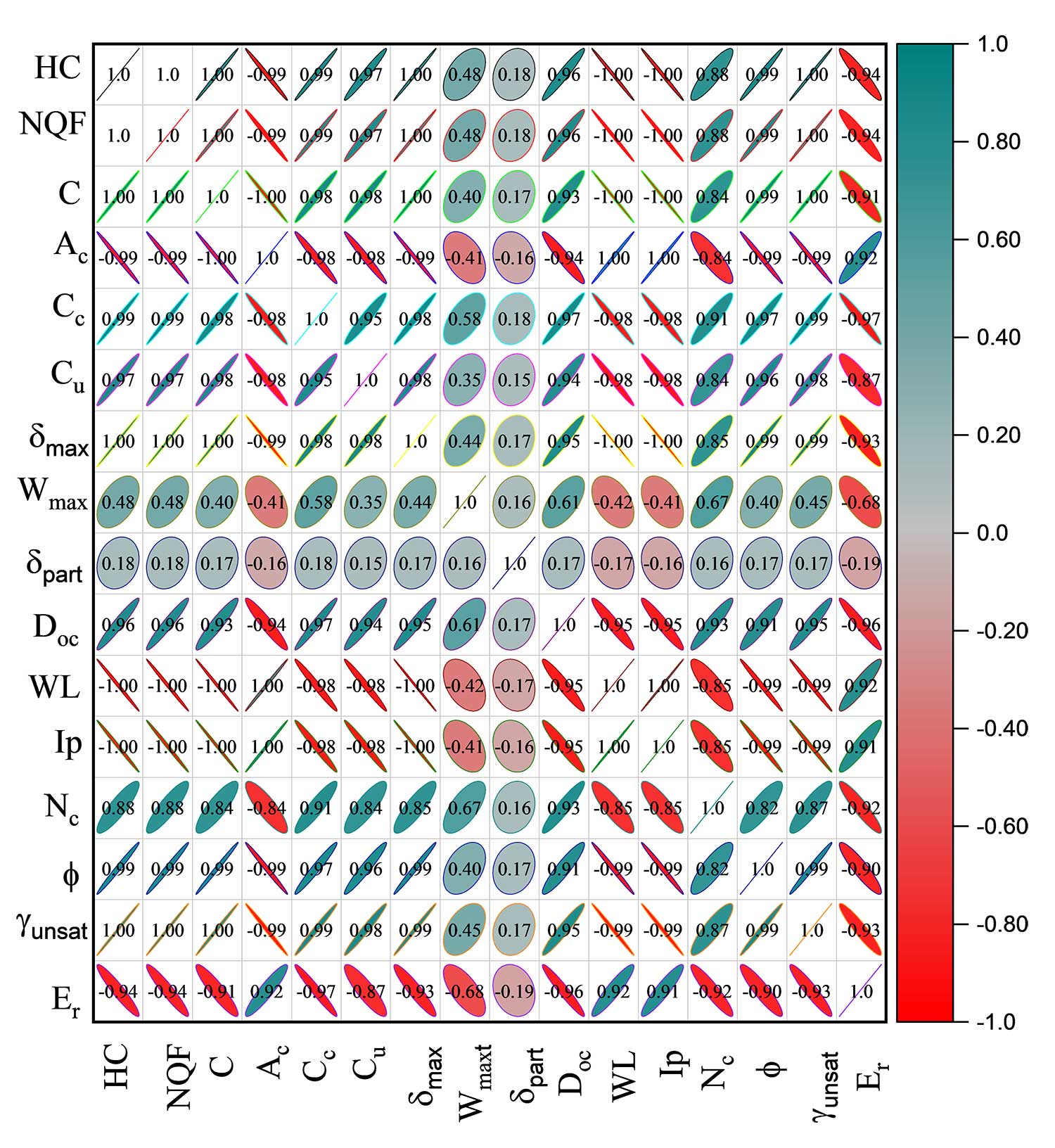
This research pioneers the application of a diverse set of advanced machine learning and optimization methods, to predict the erodibility of lateritic soil treated with cement and nanostructured quarry fines, providing a groundbreaking, data-driven approach that enhances traditional erosion analysis techniques. Traditional experimental methods for erosion analysis are often complex and resource-intensive; therefore, this research focuses on developing predictive models using Python. To build the machine learning and optimization models, 121 data points were collected from existing literature. The dataset includes erodibility measurements of unsaturated lateritic soil treated with local cement and enhanced with nanostructured quarry fines. The study employs Artificial Neural Networks (ANN), Random Forest (RF), Support Vector Machine (SVM), XGBoost, CatBoost, and Particle Swarm Optimization (PSO) to predict soil erodibility. The data was divided into training (70%), testing (15%), and validation (15%) sets for model development and evaluation. Model performance was assessed using statistical metrics such as $R^2$, M.A.E., M.S.E., R.M.S.E., and M.A.P.E. The results indicated an $R^2$ value are almost equal to 1 in training, testing, and validation phases, and the M.A.P.E. values are below 3% for the CatBoost, RF, XGB, SVM, and ANN models across all three phases: training, testing, and validation. The CatBoost, RF, XGB, SVM, and ANN models are most accurate in predicting the erodibility. Finally, relative importance showed that maximum unit weight and hydrated cement are the most influencing parameter in predicting the erodibility.
Graphical Abstract
Keywords
Data Availability Statement
Funding
Conflicts of Interest
Ethical Approval and Consent to Participate
References
- Baghbani, A., Choudhury, T., Costa, S., & Reiner, J. (2022). Application of artificial intelligence in geotechnical engineering: A state-of-the-art review. Earth-Science Reviews, 228, 103991.
[CrossRef] [Google Scholar] - Yaghoubi, E., Yaghoubi, E., Khamees, A., & Vakili, A. H. (2024). A systematic review and meta-analysis of artificial neural network, machine learning, deep learning, and ensemble learning approaches in field of geotechnical engineering. Neural Computing and Applications, 36(21), 12655-12699.
[CrossRef] [Google Scholar] - Onyelowe, K. C., Shakeri, J., Amini-Khoshalann, H., Salahudeen, A. B., Arinze, E. E., & Ugwu, H. U. (2021). Application of ANFIS hybrids to predict coefficients of curvature and uniformity of treated unsaturated lateritic soil for sustainable earthworks. Cleaner Materials, 1, 100005.
[CrossRef] [Google Scholar] - Moges, G., McDonnell, K., Delele, M. A., Ali, A. N., & Fanta, S. W. (2023). Development and comparative analysis of ANN and SVR-based models with conventional regression models for predicting spray drift. Environmental Science and Pollution Research, 30(8), 21927-21944.
[CrossRef] [Google Scholar] - Kurnaz, T. F., Dagdeviren, U., Yildiz, M., & Ozkan, O. (2016). Prediction of compressibility parameters of the soils using artificial neural network. SpringerPlus, 5(1), 1801.
[CrossRef] [Google Scholar] - Le, H. A., Nguyen, T. A., Nguyen, D. D., & Prakash, I. (2020). Prediction of soil unconfined compressive strength using Artificial Neural Network Model. Vietnam Journal of Earth Sciences, 42, 15342.
[CrossRef] [Google Scholar] - Kouchami-Sardoo, I., Shirani, H., Esfandiarpour-Boroujeni, I., Besalatpour, A. A., & Hajabbasi, M. A. (2020). Prediction of soil wind erodibility using a hybrid Genetic algorithm–Artificial neural network method. Catena, 187, 104315.
[CrossRef] [Google Scholar] - Taghizadeh-Mehrjardi, R., Emadi, M., Cherati, A., Heung, B., Mosavi, A., & Scholten, T. (2021). Bio-inspired hybridization of artificial neural networks: An application for mapping the spatial distribution of soil texture fractions. Remote Sensing, 13(5), 1025.
[CrossRef] [Google Scholar] - Alavi, A. H., Gandomi, A. H., & Mollahasani, A. (2012). A genetic programming-based approach for the performance characteristics assessment of stabilized soil. In Variants of evolutionary algorithms for real-world applications (pp. 343-376). Berlin, Heidelberg: Springer Berlin Heidelberg.
[CrossRef] [Google Scholar] - Firoozi, A. A., Firoozi, A. A., Aati, K., Khan, A. H., & Vambol, V. (2025). Integrating the Fourth Industrial Revolution into Geotechnical Engineering: Transformations, Challenges, and Future Directions. Ecological Questions, 36(1), 1-41.
[CrossRef] [Google Scholar] - Abdul Wahab, N., A Rashid, A. S., Roshan, M. J., Horpibulsuk, S., & Razali, R. (2025). Climate Change Impact on Unsaturated Cement-Stabilized Laterite Soil Using Suction-Controlled Testing. Geotechnical and Geological Engineering, 43(1), 11.
[CrossRef] [Google Scholar] - Sharma, A., & Sharma, A. (2024). Strength prediction of construction demolition waste and pine needle fibre stabilized soil using artificial neural network. Multiscale and Multidisciplinary Modeling, Experiments and Design, 7(3), 1975-1991.
[CrossRef] [Google Scholar] - Fattahi, H., Ghaedi, H., Malekmahmoodi, F., & Armaghani, D. J. (2024). Optimizing pile bearing capacity prediction: Insights from dynamic testing and smart algorithms in geotechnical engineering. Measurement, 230, 114563.
[CrossRef] [Google Scholar] - Bertalot, D., Rattley, M. J., Burbury, D., Abyaneh, S., Mclean, R., & Francis, M. (2023, September). Performance assessment of driveability predictions for different pile geometries and soil conditions. In SUT Offshore Site Investigation and Geotechnics (pp. SUT-OSIG). SUT.
[CrossRef] [Google Scholar] - Albusoda, B. S. (2024). Skirted foundation, performance, mechanism, and limitations: A review study. Journal of Engineering, 30(10), 102-121.
[CrossRef] [Google Scholar] - Abdulrasool, A. S., Abbas, S. A., & Abdulrahman, S. M. (2021). Improving Bearing Capacity by Skirted Foundation: A Review Study. Iraqi Journal of Civil Engineering, 15(1), 66-71.
[CrossRef] [Google Scholar] - Shahani, N. M., Ullah, B., Shah, K. S., Hassan, F. U., Ali, R., Elkotb, M. A., ... & Tag-Eldin, E. M. (2022). Predicting angle of internal friction and cohesion of rocks based on machine learning algorithms. Mathematics, 10(20), 3875.
[CrossRef] [Google Scholar] - Rehman, M. A., Abd Rahman, N., Ibrahim, A. N. H., Kamal, N. A., & Ahmad, A. (2024). Estimation of soil erodibility in Peninsular Malaysia: A case study using multiple linear regression and artificial neural networks. Heliyon, 10(7).
[CrossRef] [Google Scholar] - Tadayon, A., Eslami, A., & Fakharian, K. (2024). Geotechnical behavior of conical and skirted foundations through experimental and numerical assessment. Transportation Infrastructure Geotechnology, 11(4), 2501-2522.
[CrossRef] [Google Scholar] - Nawaz, M. N., Nawaz, M. M., Awan, T. A., Jaffar, S. T. A., Jafri, T. H., Oh, T. M., ... & Azab, M. (2023). A sustainable approach for estimating soft ground soil stiffness modulus using artificial intelligence. Environmental Earth Sciences, 82(23), 579.
[CrossRef] [Google Scholar] - Kazemi, F., Shafighfard, T., & Yoo, D. Y. (2024). Data-driven modeling of mechanical properties of fiber-reinforced concrete: a critical review. Archives of Computational Methods in Engineering, 31(4), 2049-2078.
[CrossRef] [Google Scholar] - Awolusi, T. F., Finbarrs-Ezema, B. C., Chukwudulue, I. M., & Azab, M. (2024). Application of artificial intelligence (AI) in civil engineering. In New Advances in Soft Computing in Civil Engineering: AI-Based Optimization and Prediction (pp. 15-46). Cham: Springer Nature Switzerland.
[CrossRef] [Google Scholar] - Demir, S., & Sahin, E. K. (2023). Predicting occurrence of liquefaction-induced lateral spreading using gradient boosting algorithms integrated with particle swarm optimization: PSO-XGBoost, PSO-LightGBM, and PSO-CatBoost. Acta Geotechnica, 18(6), 3403-3419.
[CrossRef] [Google Scholar] - Khodadadi, N., Roghani, H., De Caso, F., El-kenawy, E. S. M., Yesha, Y., & Nanni, A. (2024). Data-driven PSO-CatBoost machine learning model to predict the compressive strength of CFRP-confined circular concrete specimens. Thin-walled structures, 198, 111763.
[CrossRef] [Google Scholar] - LeCun, Y., Bengio, Y., & Hinton, G. (2015). Deep learning. nature, 521(7553), 436-444.
[CrossRef] [Google Scholar] - Ghaboussi, J. (2010). Advances in neural networks in computational mechanics and engineering. In Advances of soft computing in engineering (pp. 191-236). Vienna: Springer Vienna.
[CrossRef] [Google Scholar] - Zhang, A., Lipton, Z. C., Li, M., & Smola, A. J. (2023). Dive into deep learning. Cambridge University Press.
[Google Scholar] - Breiman, L. (2001). Random forests. Machine learning, 45(1), 5-32.
[CrossRef] [Google Scholar] - Cutler, A., Cutler, D. R., & Stevens, J. R. (2012). Random forests. In Ensemble machine learning (pp. 157-175). Springer, New York, NY.
[CrossRef] [Google Scholar] - Zhang, W., Wu, C., Li, Y., Wang, L., & Samui, P. (2021). Assessment of pile drivability using random forest regression and multivariate adaptive regression splines. Georisk: Assessment and Management of Risk for Engineered Systems and Geohazards, 15(1), 27-40.
[CrossRef] [Google Scholar] - Chen, T., & Guestrin, C. (2016, August). Xgboost: A scalable tree boosting system. In Proceedings of the 22nd acm sigkdd international conference on knowledge discovery and data mining (pp. 785-794).
[CrossRef] [Google Scholar] - Breiman, L., Friedman, J., Olshen, R. A., & Stone, C. J. (2017). Classification and regression trees. Chapman and Hall/CRC.
[CrossRef] [Google Scholar] - Wang, L., Wu, C., Tang, L., Zhang, W., Lacasse, S., Liu, H., & Gao, L. (2020). Efficient reliability analysis of earth dam slope stability using extreme gradient boosting method. Acta Geotechnica, 15(11), 3135-3150.
[CrossRef] [Google Scholar] - Zhang, W. G., Li, H. R., Wu, C. Z., Li, Y. Q., Liu, Z. Q., & Liu, H. L. (2021). Soft computing approach for prediction of surface settlement induced by earth pressure balance shield tunneling. Underground Space, 6(4), 353-363.
[CrossRef] [Google Scholar] - Zhang, W., Zhang, R., Wu, C., Goh, A. T. C., Lacasse, S., Liu, Z., & Liu, H. (2020). State-of-the-art review of soft computing applications in underground excavations. Geoscience Frontiers, 11(4), 1095-1106.
[CrossRef] [Google Scholar] - Zhang, W., Li, Y., Wu, C., Li, H., Goh, A. T. C., & Liu, H. (2022). Prediction of lining response for twin tunnels constructed in anisotropic clay using machine learning techniques. Underground space, 7(1), 122-133.
[CrossRef] [Google Scholar] - Boser, B. E. (1992). Proceedings of the 5th annual ACM workshop on computational learning theory. (No Title), 144.
[Google Scholar] - Vapnik, V. (2013). The nature of statistical learning theory. Springer science & business media.
[Google Scholar] - Cortes, C., & Vapnik, V. (1995). Support-vector networks. Machine learning, 20(3), 273-297.
[CrossRef] [Google Scholar] - Navia-Vázquez, A., Gutierrez-Gonzalez, D., Parrado-Hernández, E., & Navarro-Abellan, J. J. (2024). Distributed support vector machines. IEEE Transactions on Neural Networks, 17(4), 1091-1097.
[CrossRef] [Google Scholar] - Nagaraju, T. V., Bahrami, A., Prasad, C. D., Mantena, S., Biswal, M., & Islam, M. R. (2023). Predicting California bearing ratio of lateritic soils using hybrid machine learning technique. Buildings, 13(1), 255.
[CrossRef] [Google Scholar] - Freund, Y., Schapire, R., & Abe, N. (1999). A short introduction to boosting. Journal-Japanese Society For Artificial Intelligence, 14(771-780), 1612.
[Google Scholar] - Catani, F., Lagomarsino, D., Segoni, S., & Tofani, V. (2013). Landslide susceptibility estimation by random forests technique: sensitivity and scaling issues. Natural Hazards and Earth System Sciences, 13(11), 2815-2831.
[CrossRef] [Google Scholar] - Kennedy, J., & Eberhart, R. (1995, November). Particle swarm optimization. In Proceedings of ICNN'95-international conference on neural networks (Vol. 4, pp. 1942-1948). IEEE.
[CrossRef] [Google Scholar] - Hossain, M. S., & El-Shafie, A. (2014). Evolutionary techniques versus swarm intelligences: application in reservoir release optimization. Neural Computing and Applications, 24(7), 1583-1594.
[CrossRef] [Google Scholar] - Reynolds, C. W. (1987, August). Flocks, herds and schools: A distributed behavioral model. In Proceedings of the 14th annual conference on Computer graphics and interactive techniques (pp. 25-34).
[CrossRef] [Google Scholar] - Engelbrecht, A. P. (2007). Computational intelligence: an introduction (Vol. 2). Hoboken, NJ, USA: John Wiley & Sons.
[CrossRef] [Google Scholar] - Ebid, A. E., Deifalla, A. F., & Onyelowe, K. C. (2023, December). Data utilization and partitioning for machine learning applications in civil engineering. In International conference on advanced technologies for humanity (pp. 87-100). Cham: Springer Nature Switzerland.
[CrossRef] [Google Scholar]
Cite This Article
TY  - JOUR
AU  - Gnananandarao, Tammineni
AU  - Muktinutalapati, Jayatheja
AU  - Maralapalle, Vedprakash
AU  - Kumar, B. A. V. Ram
AU  - Ajay, CH.
PY  - 2025
DA  - 2025/09/24
TI  - Advanced Machine Learning and Optimization for Erodibility Prediction of Treated Unsaturated Lateritic Soil
JO  - Sustainable Intelligent Infrastructure
T2  - Sustainable Intelligent Infrastructure
JF  - Sustainable Intelligent Infrastructure
VL  - 1
IS  - 2
SP  - 93
EP  - 107
DO  - 10.62762/SII.2025.839324
UR  - https://www.icck.org/article/abs/SII.2025.839324
KW  - unsaturated lateritic soil
KW  - ANN
KW  - RF
KW  - SVR
KW  - XGBoost
KW  - CatBoost
KW  - PSO
KW  - relative importance
AB  - This research pioneers the application of a diverse set of advanced machine learning and optimization methods, to predict the erodibility of lateritic soil treated with cement and nanostructured quarry fines, providing a groundbreaking, data-driven approach that enhances traditional erosion analysis techniques. Traditional experimental methods for erosion analysis are often complex and resource-intensive; therefore, this research focuses on developing predictive models using Python. To build the machine learning and optimization models, 121 data points were collected from existing literature. The dataset includes erodibility measurements of unsaturated lateritic soil treated with local cement and enhanced with nanostructured quarry fines. The study employs Artificial Neural Networks (ANN), Random Forest (RF), Support Vector Machine (SVM), XGBoost, CatBoost, and Particle Swarm Optimization (PSO) to predict soil erodibility. The data was divided into training (70%), testing (15%), and validation (15%) sets for model development and evaluation. Model performance was assessed using statistical metrics such as $R^2$, M.A.E., M.S.E., R.M.S.E., and M.A.P.E. The results indicated an $R^2$ value are almost equal to 1 in training, testing, and validation phases, and the M.A.P.E. values are below 3% for the CatBoost, RF, XGB, SVM, and ANN models across all three phases: training, testing, and validation. The CatBoost, RF, XGB, SVM, and ANN models are most accurate in predicting the erodibility. Finally, relative importance showed that maximum unit weight and hydrated cement are the most influencing parameter in predicting the erodibility.
SN  - 3067-8137
PB  - Institute of Central Computation and Knowledge
LA  - English
ER  -
@article{Gnananandarao2025Advanced,
  author = {Tammineni Gnananandarao and Jayatheja Muktinutalapati and Vedprakash Maralapalle and B. A. V. Ram Kumar and CH. Ajay},
  title = {Advanced Machine Learning and Optimization for Erodibility Prediction of Treated Unsaturated Lateritic Soil},
  journal = {Sustainable Intelligent Infrastructure},
  year = {2025},
  volume = {1},
  number = {2},
  pages = {93-107},
  doi = {10.62762/SII.2025.839324},
  url = {https://www.icck.org/article/abs/SII.2025.839324},
  abstract = {This research pioneers the application of a diverse set of advanced machine learning and optimization methods, to predict the erodibility of lateritic soil treated with cement and nanostructured quarry fines, providing a groundbreaking, data-driven approach that enhances traditional erosion analysis techniques. Traditional experimental methods for erosion analysis are often complex and resource-intensive; therefore, this research focuses on developing predictive models using Python. To build the machine learning and optimization models, 121 data points were collected from existing literature. The dataset includes erodibility measurements of unsaturated lateritic soil treated with local cement and enhanced with nanostructured quarry fines. The study employs Artificial Neural Networks (ANN), Random Forest (RF), Support Vector Machine (SVM), XGBoost, CatBoost, and Particle Swarm Optimization (PSO) to predict soil erodibility. The data was divided into training (70\%), testing (15\%), and validation (15\%) sets for model development and evaluation. Model performance was assessed using statistical metrics such as \$R^2\$, M.A.E., M.S.E., R.M.S.E., and M.A.P.E. The results indicated an \$R^2\$ value are almost equal to 1 in training, testing, and validation phases, and the M.A.P.E. values are below 3\% for the CatBoost, RF, XGB, SVM, and ANN models across all three phases: training, testing, and validation. The CatBoost, RF, XGB, SVM, and ANN models are most accurate in predicting the erodibility. Finally, relative importance showed that maximum unit weight and hydrated cement are the most influencing parameter in predicting the erodibility.},
  keywords = {unsaturated lateritic soil, ANN, RF, SVR, XGBoost, CatBoost, PSO, relative importance},
  issn = {3067-8137},
  publisher = {Institute of Central Computation and Knowledge}
}
Article Metrics
Publisher's Note
ICCK stays neutral with regard to jurisdictional claims in published maps and institutional affiliations.
Rights and Permissions
 Copyright © 2025 by the Author(s). Published by Institute of Central Computation and Knowledge. This article is an open access article distributed under the terms and conditions of the Creative Commons Attribution (CC BY) license (https://creativecommons.org/licenses/by/4.0/), which permits use, sharing, adaptation, distribution and reproduction in any medium or format, as long as you give appropriate credit to the original author(s) and the source, provide a link to the Creative Commons licence, and indicate if changes were made.


Portico
