

Machine Learning Prediction of the Improvement of Black Cotton Soil by Partial Displacement with Quarry Dust and Fly Ash for Sustainable Road Construction





Article Information
Abstract
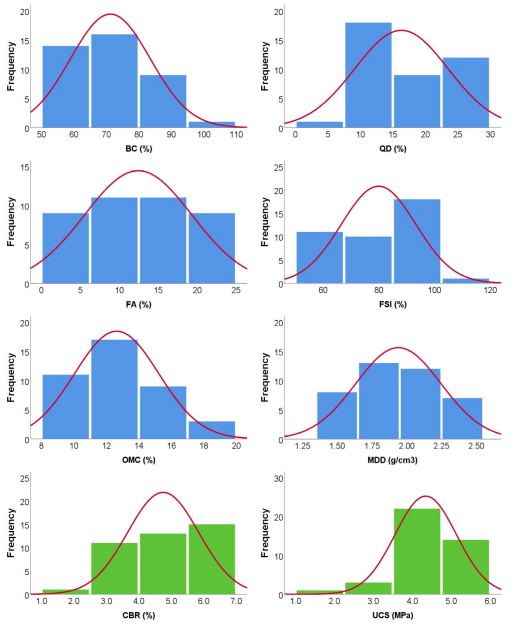
In this research paper, advanced artificial intelligence (AI) techniques have been applied in predicting the mechanical properties of black cotton soil (BCS) treated by the method of partial displacement of the soil. The materials of the displacement operation were fly ash (FA) and quarry dust (QD), which are both solid wastes derived from coal combustion in power plants and quarrying of stones for the production of aggregates. Previous activities show that BCS has never been treated by displacement of the soil sample but by the addition of these cementitious materials as wt % of the dry soil. The advanced AI techniques were the ANN, GP and the EPR, which executed forty data entries collected from experimental samples of the treated BCS. At the end of the modelling exercise, it was observed that the ANN with the performance indices of SSE 0.8, MAE 0.1, MSE 0.02, RMSE 0.141 and R2 0.983 for the CBR and SSE 0.9, MAE 0.11, MSE 0.023, RMSE 0.151, and R2 0.960 for the UCS outperformed all the other AI techniques. Also, the ANN outperformed other machine learning techniques applied in previous works. In conclusion, the models proposed in this research can be applied in the design and monitoring of pavement foundations constructed with treated BCS.
Graphical Abstract
Keywords
Data Availability Statement
Funding
Conflicts of Interest
Ethical Approval and Consent to Participate
References
- Rajashekar, D., & Manyamkonda, K. (2022). Study on utilization of stone dust for stabilization of black cotton soil. International Journal of Innovations in Engineering Research and Technology, 8(07), 206-211.
[CrossRef] [Google Scholar] - Johari, A., & Rawat, S. (2014). Soil Stabilization using Plastic Bags and Jute Bags and Controlling Heave Behaviour of Black Cotton Soil. http://www.ir.juit.ac.in:8080/jspui/handle/123456789/8011
[Google Scholar] - Saida, N. A., George, A. D., & Mohamad, H. M. (2023). A review on experimental investigations and geotechnical characteristic of peat soil stabilization. International Journal of Advanced Research in Engineering Innovation, 5(1), 1-19.
[Google Scholar] - Salini, U., Parayil, A., Diya, B., & Dev, L. (2023). Use of fly ash and quarry waste for the production of the controlled low strength material. Construction and Building Materials, 392, 131924.
[CrossRef] [Google Scholar] - Ebrahimi, M., Eslami, A., Hajirasouliha, I., Ramezanpour, M., & Pilakoutas, K. (2023). Effect of ceramic waste powder as a binder replacement on the properties of cement-and lime-based mortars. Construction and Building Materials, 379, 131146.
[CrossRef] [Google Scholar] - Randhawa, K. S., Chauhan, R., & Kumar, R. (2022). An investigation on the effect of lime addition on UCS of Indian black cotton soil. Materials Today: Proceedings, 50, 797-803.
[CrossRef] [Google Scholar] - Navagire, O. P., Sharma, S. K., & Rambabu, D. (2022). Stabilization of black cotton soil with coal bottom ash. Materials Today: Proceedings, 52, 979-985.
[CrossRef] [Google Scholar] - Al Adili, A., Azzam, R., Spagnoli, G., & Schrader, J. (2012). Strength of soil reinforced with fiber materials (Papyrus). Soil Mechanics and Foundation Engineering, 48(6), 241-247.
[CrossRef] [Google Scholar] - Horpibulsuk, S., Chinkullijniwat, A., & Shen, S. L. (2013). Engineering properties of recycled calcium carbide residue stabilized clay as fill and pavement materials. Construction and Building Materials, 46, 203-210.
[CrossRef] [Google Scholar] - Nadgouda, K. A., & Hegde, R. A. (2010, December). The effect of lime stabilization on properties of black cotton soil. In Indian geotechnical conference (pp. 511-514).
[Google Scholar] - Pappu, A., Saxena, M., & Asolekar, S. R. (2007). Solid wastes generation in India and their recycling potential in building materials. Building and environment, 42(6), 2311-2320.
[CrossRef] [Google Scholar] - Hudyma, N., Avar, B. B., Karakouzian, M., Sharma, S., & Hardcastle, J. H. (2002). Control of expansive soils by mixing with sand: A laboratory study. In Proceedings of the 37th Symposium on Engineering Geology and Geotechnical Engineering: Idaho State University Press, Pocatello, ID (pp. 71-78).
[Google Scholar] - Krishnappa, S. (2017). Stabilization of black cotton soil by admixtures. Int J Adv Res Sci Eng, 6(8), 1145-62.
[Google Scholar] - Noolu, V., Mudavath, H., Pillai, R. J., & Yantrapalli, S. K. (2019). Permanent deformation behaviour of black cotton soil treated with calcium carbide residue. Construction and Building Materials, 223, 441-449.
[CrossRef] [Google Scholar] - Mokhtari, M., & Dehghani, M. (2012). Swell-shrink behavior of expansive soils, damage and control. Electronic Journal of Geotechnical Engineering, 17, 2673-2682.
[Google Scholar] - Oza, J. B., & Gundaliya, P. J. (2013). Study of black cotton soil characteristics with cement waste dust and lime. Procedia Engineering, 51, 110-118.
[CrossRef] [Google Scholar] - Dalal, S. P., Patel, R., & Dalal, P. D. (2017). Effect on engineering properties of black cotton soil treated with agricultural and industrial waste. Materials Today: Proceedings, 4(9), 9640-9644.
[CrossRef] [Google Scholar] - Etim, R. K., Eberemu, A. O., & Osinubi, K. J. (2017). Stabilization of black cotton soil with lime and iron ore tailings admixture. Transportation Geotechnics, 10, 85-95.
[CrossRef] [Google Scholar] - Amadi, A. A., & Osu, A. S. (2018). Effect of curing time on strength development in black cotton soil–Quarry fines composite stabilized with cement kiln dust (CKD). Journal of King Saud University-Engineering Sciences, 30(4), 305-312.
[CrossRef] [Google Scholar] - Ikeagwuani, C. C., & Nwonu, D. C. (2019). Emerging trends in expansive soil stabilisation: A review. Journal of rock mechanics and geotechnical engineering, 11(2), 423-440.
[CrossRef] [Google Scholar] - Vijayakumar, R., Govindhasamy, K., & Kumar, K. S. (2024). The Combined Effect of Pond Ash with Borrowed Soil Materials Along with Milling Waste for Flexible Pavement Sub-Grade Crater Foiling and Strength Characteristic Enhancement. Ecological Engineering & Environmental Technology, 25. http://dx.doi.org/10.12912/27197050/186181
[Google Scholar] - Gautam, P. K., Kalla, P., Jethoo, A. S., Agrawal, R., & Singh, H. (2018). Sustainable use of waste in flexible pavement: A review. Construction and Building Materials, 180, 239-253.
[CrossRef] [Google Scholar] - Lavigne, J. (2025). Industrial residuals in land reclamation: enhancing soil recovery and ecological function in disturbed glacial soils (Doctoral dissertation).
[Google Scholar] - Edil, T. B. (2013). Characterization of recycled materials for sustainable construction. Proc. 18th ICSMGE.
[Google Scholar] - Sen, T., & Mishra, U. (2010). Usage of industrial waste products in villageroad construction. International Journal of Environmental Science and Development, 1(2), 122.
[Google Scholar] - Zhou, R., Wang, B. T., Han, S. Y., Wang, D. Y., & Zhang, F. H. (2024). Mechanisms of crack development and strength deterioration in compacted expansive soils under controlled wetting-drying conditions. Engineering Failure Analysis, 159, 108133.
[CrossRef] [Google Scholar] - Tanyıldızı, M., Uz, V. E., & Gökalp, İ. (2023). Utilization of waste materials in the stabilization of expansive pavement subgrade: An extensive review. Construction and Building Materials, 398, 132435.
[CrossRef] [Google Scholar] - Puppala, A. J., & Musenda, C. (2000). Effects of fiber reinforcement on strength and volume change in expansive soils. Transportation Research Record, 1736(1), 134-140.
[CrossRef] [Google Scholar] - Jain, P. K. (2024). Enhancing the properties of swelling soils with lime, fly ash, and expanded polystyrene-A review. Heliyon, 10(12).
[CrossRef] [Google Scholar] - Nalbantoğlu, Z. (2004). Effectiveness of class C fly ash as an expansive soil stabilizer. Construction and Building Materials, 18(6), 377-381.
[CrossRef] [Google Scholar] - Zha, F., Liu, S., Du, Y., & Cui, K. (2008). Behavior of expansive soils stabilized with fly ash. Natural hazards, 47, 509-523.
[CrossRef] [Google Scholar] - Cokca, E. (2001). Use of class c fly ashes for the stabilizationof an expansive soil. Journal of Geotechnical and geoenvironmental engineering, 127(7), 568-573.
[CrossRef] [Google Scholar] - Phani Kumar, B. R., & Sharma, R. S. (2004). Effect of fly ash on engineering properties of expansive soils. Journal of Geotechnical and Geoenvironmental Engineering, 130(7), 764-767.
[CrossRef] [Google Scholar] - Li, M., Fang, C., Kawasaki, S., & Achal, V. (2018). Fly ash incorporated with biocement to improve strength of expansive soil. Scientific reports, 8(1), 2565.
[CrossRef] [Google Scholar] - Bhadra, C., Sarkar, D., Rang, S., Das, S., Banerjee, S., Das, A. K., & Pal, S. (2023, December). Comparing Efficiency of Stabilisation of Black Cotton Soil Mixed with Fly Ash Using Plastic, Bentonite, and Bio-cement. In International Conference on Sustainable Advanced Technologies for Environmental Management (pp. 513-528). Cham: Springer Nature Switzerland.
[CrossRef] [Google Scholar] - Zhou, S. Q., Zhou, D. W., Zhang, Y. F., & Wang, W. J. (2019). Study on Physical‐Mechanical Properties and Microstructure of Expansive Soil Stabilized with Fly Ash and Lime. Advances in Civil Engineering, 2019(1), 4693757.
[CrossRef] [Google Scholar] - Ahmad, S., Ghazi, M. S. A., Syed, M., & Al-Osta, M. A. (2024). Utilization of fly ash with and without secondary additives for stabilizing expansive soils: A review. Results in Engineering, 102079.
[CrossRef] [Google Scholar] - Sharma, N. K., Swain, S. K., & Sahoo, U. C. (2012). Stabilization of a clayey soil with fly ash and lime: a micro level investigation. Geotechnical and geological engineering, 30, 1197-1205.
[CrossRef] [Google Scholar] - Kumar, P. G., & Harika, S. (2021). Stabilization of expansive subgrade soil by using fly ash. Materials Today: Proceedings, 45, 6558-6562.
[CrossRef] [Google Scholar] - Phummiphan, I., Horpibulsuk, S., Sukmak, P., Chinkulkijniwat, A., Arulrajah, A., & Shen, S. L. (2016). Stabilisation of marginal lateritic soil using high calcium fly ash-based geopolymer. Road Materials and Pavement Design, 17(4), 877-891.
[CrossRef] [Google Scholar] - Brooks, R. M. (2009). Soil stabilization with flyash and rice husk ash.
[Google Scholar] - Renjith, R., Robert, D., Setunge, S., Costa, S., & Mohajerani, A. (2021). Optimization of fly ash based soil stabilization using secondary admixtures for sustainable road construction. Journal of Cleaner Production, 294, 126264.
[CrossRef] [Google Scholar] - Sridharan, A., Soosan, T. G., Jose, B. T., & Abraham, B. M. (2006). Shear strength studies on soil-quarry dust mixtures. Geotechnical & Geological Engineering, 24, 1163-1179.
[CrossRef] [Google Scholar] - Sabat, A. K. (2012). A study on some geotechnical properties of lime stabilised expansive soil–quarry dust mixes. International Journal of emerging trends in engineering and development, 1(2), 42-49.
[Google Scholar] - Sabat, A. K., & Bose, B. (2013). Improvement in geotechnical properties of an expansive soil using fly ash-quarry dust mixes. Electronic Journal of Geotechnical Engineering, 18, 3487-3500.
[Google Scholar] - Chansoria, A., Yadav, R. K., Chansoria, A., & Yadav, R. (2016). Effect of quarry dust on engineering properties of black cotton soil. Int. J. Innov. Res. Sci. Technol, 2(11), 715-718.
[Google Scholar] - Yarkhan, M., Aasim, M. A. U., Fahed, S. M., & Ahmed, M. I. Stabilization of Expansive Soil By Using Lime and Quarry Dust.
[Google Scholar] - Sudhakar, S., Duraisekaran, E., Dilli Vignesh, G., & Kanna, G. D. (2021). Performance evaluation of quarry dust treated expansive clay for road foundations. Iranian Journal of Science and Technology, Transactions of Civil Engineering, 45(4), 2637-2649.
[CrossRef] [Google Scholar] - Rasheed, A. A. (2023). Improving prediction efficiency by revolutionary machine learning models. Materials today: proceedings, 81, 577-583.
[CrossRef] [Google Scholar] - Pierro, C., & Capitelli, F. (2004, May). Inorganic phosphates investigation by support vector machine. In International Conference on Computational Science and Its Applications (pp. 338-349). Berlin, Heidelberg: Springer Berlin Heidelberg. 540-24709-8_36
[CrossRef] [Google Scholar] - Banzhaf, W. (2015). Artificial intelligence: Genetic programming.
[Google Scholar] - Manan, A., Pu, Z., Ahmad, J., & Umar, M. (2025). Multi-targeted strength properties of recycled aggregate concrete through a machine learning approach. Engineering Computations, 42(1), 388-430.
[CrossRef] [Google Scholar] - Manan, A., Pu, Z., Weiyi, C., Ahmad, J., Alattyih, W., Umar, M., & Almujibah, H. (2024). Machine learning prediction of recycled concrete powder with experimental validation and life cycle assessment study. Case Studies in Construction Materials, 21, e04053.
[CrossRef] [Google Scholar] - Kumar, A., & Sodhi, S. S. (2022, November). Some modified activation functions of hyperbolic tangent (TanH) activation function for artificial neural networks. In International Conference on Innovations in Data Analytics (pp. 369-392). Singapore: Springer Nature Singapore.
[CrossRef] [Google Scholar] - Manan, A., Zhang, P., Ahmad, S., & Ahmad, J. (2024). Optimizing Hybrid Fibre-Reinforced Polymer Bars Design: A Machine Learning Approach. Journal of Polymer Materials, 41(1).
[CrossRef] [Google Scholar]
Cite This Article
TY  - JOUR
AU  - Onyelowe, Fortune K. C.
AU  - Manan, Aneel
AU  - Khan, Amir
AU  - Hanandeh, Shadi
AU  - Ebid, Ahmed M.
AU  - Ulloa, Nestor
PY  - 2025
DA  - 2025/05/31
TI  - Machine Learning Prediction of the Improvement of Black Cotton Soil by Partial Displacement with Quarry Dust and Fly Ash for Sustainable Road Construction
JO  - Sustainable Intelligent Infrastructure
T2  - Sustainable Intelligent Infrastructure
JF  - Sustainable Intelligent Infrastructure
VL  - 1
IS  - 2
SP  - 52
EP  - 66
DO  - 10.62762/SII.2025.901022
UR  - https://www.icck.org/article/abs/SII.2025.901022
KW  - black cotton soil
KW  - quarry dust
KW  - fly ash
KW  - road construction
KW  - CBR
KW  - UCS
AB  - In this research paper, advanced artificial intelligence (AI) techniques have been applied in predicting the mechanical properties of black cotton soil (BCS) treated by the method of partial displacement of the soil. The materials of the displacement operation were fly ash (FA) and quarry dust (QD), which are both solid wastes derived from coal combustion in power plants and quarrying of stones for the production of aggregates. Previous activities show that BCS has never been treated by displacement of the soil sample but by the addition of these cementitious materials as wt % of the dry soil. The advanced AI techniques were the ANN, GP and the EPR, which executed forty data entries collected from experimental samples of the treated BCS. At the end of the modelling exercise, it was observed that the ANN with the performance indices of SSE 0.8, MAE 0.1, MSE 0.02, RMSE 0.141 and R2 0.983 for the CBR and SSE 0.9, MAE 0.11, MSE 0.023, RMSE 0.151, and R2 0.960 for the UCS outperformed all the other AI techniques. Also, the ANN outperformed other machine learning techniques applied in previous works. In conclusion, the models proposed in this research can be applied in the design and monitoring of pavement foundations constructed with treated BCS.
SN  - 3067-8137
PB  - Institute of Central Computation and Knowledge
LA  - English
ER  -
@article{Onyelowe2025Machine,
  author = {Fortune K. C. Onyelowe and Aneel Manan and Amir Khan and Shadi Hanandeh and Ahmed M. Ebid and Nestor Ulloa},
  title = {Machine Learning Prediction of the Improvement of Black Cotton Soil by Partial Displacement with Quarry Dust and Fly Ash for Sustainable Road Construction},
  journal = {Sustainable Intelligent Infrastructure},
  year = {2025},
  volume = {1},
  number = {2},
  pages = {52-66},
  doi = {10.62762/SII.2025.901022},
  url = {https://www.icck.org/article/abs/SII.2025.901022},
  abstract = {In this research paper, advanced artificial intelligence (AI) techniques have been applied in predicting the mechanical properties of black cotton soil (BCS) treated by the method of partial displacement of the soil. The materials of the displacement operation were fly ash (FA) and quarry dust (QD), which are both solid wastes derived from coal combustion in power plants and quarrying of stones for the production of aggregates. Previous activities show that BCS has never been treated by displacement of the soil sample but by the addition of these cementitious materials as wt \% of the dry soil. The advanced AI techniques were the ANN, GP and the EPR, which executed forty data entries collected from experimental samples of the treated BCS. At the end of the modelling exercise, it was observed that the ANN with the performance indices of SSE 0.8, MAE 0.1, MSE 0.02, RMSE 0.141 and R2 0.983 for the CBR and SSE 0.9, MAE 0.11, MSE 0.023, RMSE 0.151, and R2 0.960 for the UCS outperformed all the other AI techniques. Also, the ANN outperformed other machine learning techniques applied in previous works. In conclusion, the models proposed in this research can be applied in the design and monitoring of pavement foundations constructed with treated BCS.},
  keywords = {black cotton soil, quarry dust, fly ash, road construction, CBR, UCS},
  issn = {3067-8137},
  publisher = {Institute of Central Computation and Knowledge}
}
Article Metrics
Publisher's Note
ICCK stays neutral with regard to jurisdictional claims in published maps and institutional affiliations.
Rights and Permissions
 Copyright © 2025 by the Author(s). Published by Institute of Central Computation and Knowledge. This article is an open access article distributed under the terms and conditions of the Creative Commons Attribution (CC BY) license (https://creativecommons.org/licenses/by/4.0/), which permits use, sharing, adaptation, distribution and reproduction in any medium or format, as long as you give appropriate credit to the original author(s) and the source, provide a link to the Creative Commons licence, and indicate if changes were made.


Portico
