Carbon Footprint Analysis on Alternate Disposal Strategies for Personal Protective Equipment Waste






Article Information
Abstract
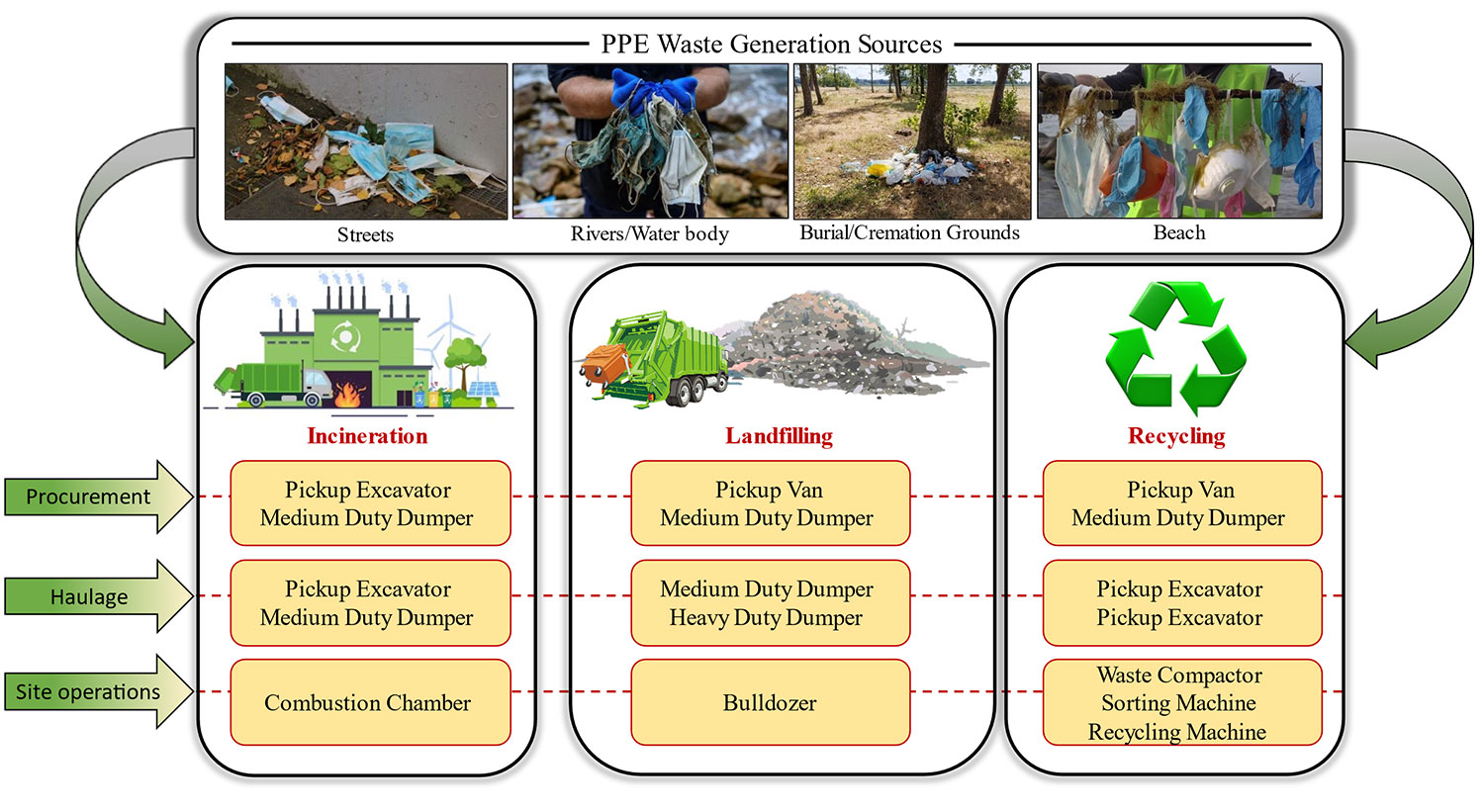
The use of personal protective equipment (PPE) has gained universal acceptance as a critical measure for safeguarding individuals against hazardous environments, including exposure to infectious agents and harmful substances. The increased use of PPE across various industries has resulted in a significant rise in its consumption. Primarily, the steady surge in global COVID cases has caused a sudden rise in demand for PPE. However, the indiscreet and irrational disposal method can potentially augment the impending climate change problem. In the prevailing situation, there is a need to assess their current mode of disposal in terms of carbon emissions. The present study aims to perform carbon footprint analysis (CFA) on landfilling, incineration, and recycling methods of disposal for two scenarios (1 and 100 million PPE). The results indicate that the application of the recycling option could contribute to a situation with conceivably positive emissions with net savings in emissions of approximately 0.159 million kg CO2e/million PPE. In contrast, it shows that the emissions associated with incineration are substantially higher than the other two methods with emissions of more than 0.78 million kg CO2e/million PPE. Additionally, transportation factors such as haulage distance and vehicle type significantly influence overall emissions. For scenario II, emissions from recycling and landfilling increase by 383% and 390%, respectively, compared to a 100% increase for incineration. Based on the net emissions, the order of preference for the three disposal methods is recycling > landfilling > incineration, which is consistent for both scenarios. However, for the hypothetical infinite periods, the emissions from landfilling can potentially rise by more than ten times compared to a surveyable period of 30 years. These findings highlight the need for sustainable PPE waste management to reduce environmental impact.
Graphical Abstract
Keywords
Data Availability Statement
Funding
Conflicts of Interest
Ethical Approval and Consent to Participate
References
- Del Rio, C., & Malani, P. N. (2020). COVID-19—new insights on a rapidly changing epidemic. Jama, 323(14), 1339-1340.
[CrossRef] [Google Scholar] - Ashfaq, M., Lal, M. H., Moghal, A. A. B., & Murthy, V. R. (2020). Carbon footprint analysis of coal gangue in geotechnical engineering applications. Indian Geotechnical Journal, 50(4), 646–654.
[CrossRef] [Google Scholar] - Astrup, T., Fruergaard, T., & Christensen, T. H. (2009). Recycling of plastic: Accounting of greenhouse gases and global warming contributions. Waste Management & Research, 27(8), 763–772.
[CrossRef] [Google Scholar] - Kim, J., Chung, Y., Jo, H. J., Lee, N., Kim, M. S., Woo, S. H., Park, S., Kim, J. W., Kim, H. M., & Han, M. (2020). Identification of coronavirus isolated from a patient in Korea with COVID-19. Osong Public Health and Research Perspectives, 11(1), 3-7.
[CrossRef] [Google Scholar] - Chen, Y., & Lo, S. (2016). Evaluation of greenhouse gas emissions for several municipal solid waste management strategies. Journal of Cleaner Production, 113, 606–612.
[CrossRef] [Google Scholar] - Cook, T. M. (2020). Personal protective equipment during the coronavirus disease (COVID) 2019 pandemic – a narrative review. Anaesthesia, 75(7), 920–927.
[CrossRef] [Google Scholar] - ISO 14044:2006. (2022). Environmental management — Life cycle assessment — Requirements and guidelines. Retrieved from https://www.iso.org/cms/render/live/en/sites/isoorg/contents/data/standard/03/84/38498.html
[Google Scholar] - Eriksson, O., & Finnveden, G. (2009). Plastic waste as a fuel—CO2-neutral or not? Energy & Environmental Science, 2(9), 907–914.
[CrossRef] [Google Scholar] - Finnveden, G., Albertsson, A., Berendson, J., Eriksson, E., Höglund, L. O., Karlsson, S., & Sundqvist, J. (1995). Solid waste treatment within the framework of life-cycle assessment. Journal of Cleaner Production, 3(4), 189-199.
[CrossRef] [Google Scholar] - Herron, J., Hay-David, A., Gilliam, A., & Brennan, P. (2020). Personal protective equipment and Covid 19- a risk to healthcare staff? British Journal of Oral and Maxillofacial Surgery, 58(5), 500-502.
[CrossRef] [Google Scholar] - Hong, J., Zhan, S., Yu, Z., Hong, J., & Qi, C. (2018). Life-cycle environmental and economic assessment of medical waste treatment. Journal of Cleaner Production, 174, 65–73.
[CrossRef] [Google Scholar] - Kalina, M., & Tilley, E. (2020). “This is our next problem”: Cleaning up from the COVID-19 response. Waste Management, 108, 202–205.
[CrossRef] [Google Scholar] - Brems, A., Baeyens, J., & Dewil, R. (2012). Recycling and recovery of post-consumer plastic solid waste in a European context. Thermal Science, 16(3), 669-685.
[CrossRef] [Google Scholar] - Lea, W. R. (1996). Plastic incineration versus recycling: A comparison of energy and landfill cost savings. Journal of Hazardous Materials, 47(1), 295–302.
[CrossRef] [Google Scholar] - Lee, C. C., & Huffman, G. L. (1996). Medical waste management/incineration. Journal of Hazardous Materials, 48(1), 1–30.
[CrossRef] [Google Scholar] - Liu, H., You, J., Lu, C., & Chen, Y. (2015). Evaluating health-care waste treatment technologies using a hybrid multi-criteria decision making model. Renewable and Sustainable Energy Reviews, 41, 932-942.
[CrossRef] [Google Scholar] - Livingston, E., Desai, A., & Berkwits, M. (2020). Sourcing personal protective equipment during the COVID-19 pandemic. JAMA, 323(19), 1912.
[CrossRef] [Google Scholar] - Mahase, E. (2020). Coronavirus: COVID-19 has killed more people than SARS and MERS combined, despite lower case fatality rate. BMJ, m641.
[CrossRef] [Google Scholar] - Moberg, Å., Finnveden, G., Johansson, J., & Lind, P. (2005). Life cycle assessment of energy from solid waste—part 2: Landfilling compared to other treatment methods. Journal of Cleaner Production, 13(3), 231–240.
[CrossRef] [Google Scholar] - Mohammad, N., Moghal, A. A., Rasheed, R. M., & Almajed, A. (2022). Critical review on the efficacy of electrokinetic techniques in geotechnical and geoenvironmental applications. Arabian Journal of Geosciences, 15(8), 781.
[CrossRef] [Google Scholar] - Nuruddin, M., & Moghal, A. A. (2024). State-of-the-art review on the geotechnical and geoenvironmental feasibility of select biochars. Indian Geotechnical Journal, 54(3), 1073-1094.
[CrossRef] [Google Scholar] - Hu, Q. R., Shen, X. Y., Qian, X. M., Huang, G. Y., & Yuan, M. Q. (2023). The personal protective equipment (PPE) based on individual combat: A systematic review and trend analysis. Defence Technology, 28, 195-221.
[CrossRef] [Google Scholar] - Perugini, F., Mastellone, M. L., & Arena, U. (2005). A life cycle assessment of mechanical and feedstock recycling options for management of plastic packaging wastes. Environmental Progress, 24(2), 137–154.
[CrossRef] [Google Scholar] - Rabl, A., Spadaro, J. V., & Zoughaib, A. (2008). Environmental impacts and costs of solid waste: A comparison of landfill and incineration. Waste Management & Research: The Journal for a Sustainable Circular Economy, 26(2), 147-162.
[CrossRef] [Google Scholar] - Ragaert, K., Delva, L., & Van Geem, K. (2017). Mechanical and chemical recycling of solid plastic waste. Waste Management, 69, 24–58.
[CrossRef] [Google Scholar] - Requirements and technical specifications of personal protective equipment (PPE) for the novel coronavirus (2019-ncov) in healthcare settings—PAHO/WHO | Pan American Health Organization. (n.d.). Retrieved April 21, 2021, Retrieved from https://www.paho.org/en/documents/requirements-and-technical-specifications-personal-protective-equipment-ppe-novel
[Google Scholar] - Sharma, H. B., Vanapalli, K. R., Cheela, V. S., Ranjan, V. P., Jaglan, A. K., Dubey, B., Goel, S., & Bhattacharya, J. (2020). Challenges, opportunities, and innovations for effective solid waste management during and post COVID-19 pandemic. Resources, Conservation and Recycling, 162, 105052.
[CrossRef] [Google Scholar] - Shillaber, C. M., Mitchell, J. K., & Dove, J. E. (2016). Energy and carbon assessment of ground improvement works. II: Working model and example. Journal of Geotechnical and Geoenvironmental Engineering, 142(3), 04015084.
[CrossRef] [Google Scholar] - Soares, S. R., Finotti, A. R., da Silva, V. P., & Alvarenga, R. A. F. (2013). Applications of life cycle assessment and cost analysis in health care waste management. Waste Management, 33(1), 175–183.
[CrossRef] [Google Scholar] - Tyskeng, S., & Finnveden, G. (2010). Comparing energy use and environmental impacts of recycling and waste incineration. Journal of Environmental Engineering, 136(8), 744–748.
[CrossRef] [Google Scholar] - Zheng, J., & Suh, S. (2019). Strategies to reduce the global carbon footprint of plastics. Nature climate change, 9(5), 374-378.
[CrossRef] [Google Scholar]
Cite This Article
TY  - JOUR
AU  - Ashfaq, Mohammed
AU  - Nuruddin, Mohammad
AU  - Moghal, Arif Ali Baig
AU  - Almajed, Abdullah
PY  - 2025
DA  - 2025/04/14
TI  - Carbon Footprint Analysis on Alternate Disposal Strategies for Personal Protective Equipment Waste
JO  - Sustainable Intelligent Infrastructure
T2  - Sustainable Intelligent Infrastructure
JF  - Sustainable Intelligent Infrastructure
VL  - 1
IS  - 1
SP  - 29
EP  - 38
DO  - 10.62762/SII.2025.512875
UR  - https://www.icck.org/article/abs/SII.2025.512875
KW  - personal protective equipment
KW  - carbon footprint analysis
KW  - incineration
KW  - landfilling
KW  - recycling
AB  - The use of personal protective equipment (PPE) has gained universal acceptance as a critical measure for safeguarding individuals against hazardous environments, including exposure to infectious agents and harmful substances. The increased use of PPE across various industries has resulted in a significant rise in its consumption. Primarily, the steady surge in global COVID cases has caused a sudden rise in demand for PPE. However, the indiscreet and irrational disposal method can potentially augment the impending climate change problem. In the prevailing situation, there is a need to assess their current mode of disposal in terms of carbon emissions. The present study aims to perform carbon footprint analysis (CFA) on landfilling, incineration, and recycling methods of disposal for two scenarios (1 and 100 million PPE). The results indicate that the application of the recycling option could contribute to a situation with conceivably positive emissions with net savings in emissions of approximately 0.159 million kg CO2e/million PPE. In contrast, it shows that the emissions associated with incineration are substantially higher than the other two methods with emissions of more than 0.78 million kg CO2e/million PPE. Additionally, transportation factors such as haulage distance and vehicle type significantly influence overall emissions. For scenario II, emissions from recycling and landfilling increase by 383% and 390%, respectively, compared to a 100% increase for incineration. Based on the net emissions, the order of preference for the three disposal methods is recycling > landfilling > incineration, which is consistent for both scenarios. However, for the hypothetical infinite periods, the emissions from landfilling can potentially rise by more than ten times compared to a surveyable period of 30 years. These findings highlight the need for sustainable PPE waste management to reduce environmental impact.
SN  - 3067-8137
PB  - Institute of Central Computation and Knowledge
LA  - English
ER  -
@article{Ashfaq2025Carbon,
  author = {Mohammed Ashfaq and Mohammad Nuruddin and Arif Ali Baig Moghal and Abdullah Almajed},
  title = {Carbon Footprint Analysis on Alternate Disposal Strategies for Personal Protective Equipment Waste},
  journal = {Sustainable Intelligent Infrastructure},
  year = {2025},
  volume = {1},
  number = {1},
  pages = {29-38},
  doi = {10.62762/SII.2025.512875},
  url = {https://www.icck.org/article/abs/SII.2025.512875},
  abstract = {The use of personal protective equipment (PPE) has gained universal acceptance as a critical measure for safeguarding individuals against hazardous environments, including exposure to infectious agents and harmful substances. The increased use of PPE across various industries has resulted in a significant rise in its consumption. Primarily, the steady surge in global COVID cases has caused a sudden rise in demand for PPE. However, the indiscreet and irrational disposal method can potentially augment the impending climate change problem. In the prevailing situation, there is a need to assess their current mode of disposal in terms of carbon emissions. The present study aims to perform carbon footprint analysis (CFA) on landfilling, incineration, and recycling methods of disposal for two scenarios (1 and 100 million PPE). The results indicate that the application of the recycling option could contribute to a situation with conceivably positive emissions with net savings in emissions of approximately 0.159 million kg CO2e/million PPE. In contrast, it shows that the emissions associated with incineration are substantially higher than the other two methods with emissions of more than 0.78 million kg CO2e/million PPE. Additionally, transportation factors such as haulage distance and vehicle type significantly influence overall emissions. For scenario II, emissions from recycling and landfilling increase by 383\% and 390\%, respectively, compared to a 100\% increase for incineration. Based on the net emissions, the order of preference for the three disposal methods is recycling > landfilling > incineration, which is consistent for both scenarios. However, for the hypothetical infinite periods, the emissions from landfilling can potentially rise by more than ten times compared to a surveyable period of 30 years. These findings highlight the need for sustainable PPE waste management to reduce environmental impact.},
  keywords = {personal protective equipment, carbon footprint analysis, incineration, landfilling, recycling},
  issn = {3067-8137},
  publisher = {Institute of Central Computation and Knowledge}
}
Article Metrics
Publisher's Note
ICCK stays neutral with regard to jurisdictional claims in published maps and institutional affiliations.
Rights and Permissions
 Copyright © 2025 by the Author(s). Published by Institute of Central Computation and Knowledge. This article is an open access article distributed under the terms and conditions of the Creative Commons Attribution (CC BY) license (https://creativecommons.org/licenses/by/4.0/), which permits use, sharing, adaptation, distribution and reproduction in any medium or format, as long as you give appropriate credit to the original author(s) and the source, provide a link to the Creative Commons licence, and indicate if changes were made.


Portico