
Journal of Plant Electrobiology

Publishing Model:
ISSN:
ISSN: 3071-6268
Journal of Plant Electrobiology (JPE) is a peer-reviewed international journal dedicated to advancing the transformative intersection of electronics, bioenergetics, biophysics, and plant science.
DOI Prefix: 10.62762/JPE

Journal Metrics

-
Impact Factor
-
CiteScore

Recent Articles

Free Access | Review Article | 31 March 2026 | Cited: Crossref logo  1
Electrobiological Signatures as Early Indicators of Plant Stress and Adaptation
Journal of Plant Electrobiology | Volume 1, Issue 1: 58-73, 2026 | DOI: 10.62762/JPE.2026.146822
Abstract
Plants, being sessile, must constantly monitor and respond to environmental fluctuations and stressors. Among the diverse signalling modalities (chemical, hydraulic, hormonal), electrical signals stand out for their rapid propagation and capacity to serve as early warning cues. In this review, we examine the concept of electrobiological signatures—distinctive patterns of electrical activity in plants as potential early indicators of stress and adaptation. This review first discusses the fundamental mechanisms such as ion fluxes, membrane transporters, coupling with calcium dynamics, reactive oxygen species (ROS), and cross-talk with hormonal networks. Next, it explores how these signatures... More >

Graphical Abstract
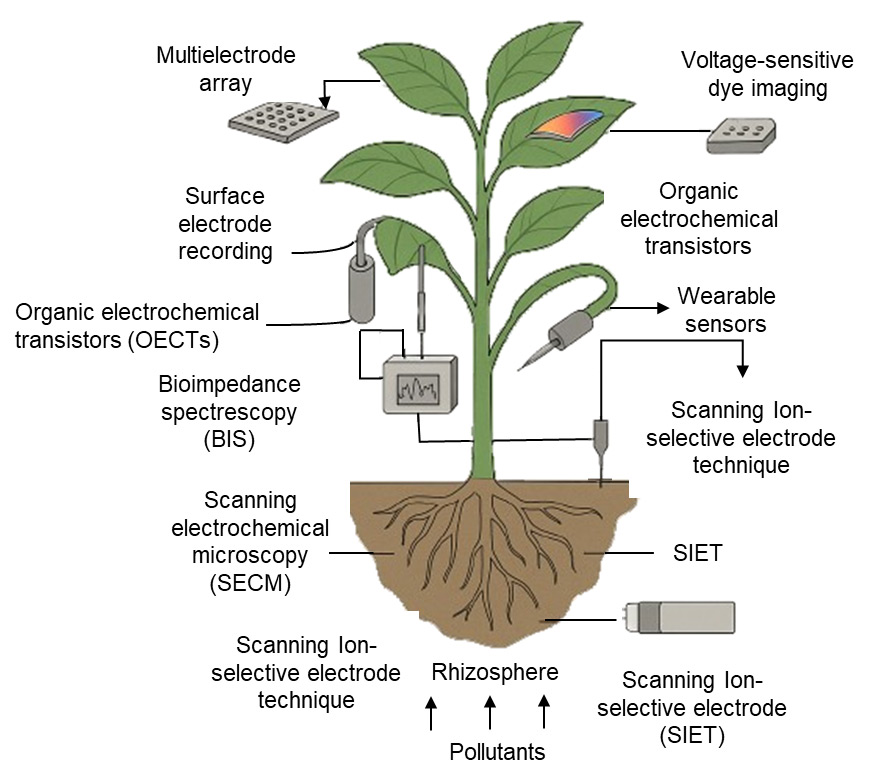
Electrobiological Signatures as Early Indicators of Plant Stress and Adaptation
Free Access | Research Article | 30 March 2026
Intracellular Water Dynamic Traits in Detached Leaves of Two Brassicaceae Plant Species under Saturated and Non-saturated Water Conditions
Journal of Plant Electrobiology | Volume 1, Issue 1: 42-57, 2026 | DOI: 10.62762/JPE.2025.989558
Abstract
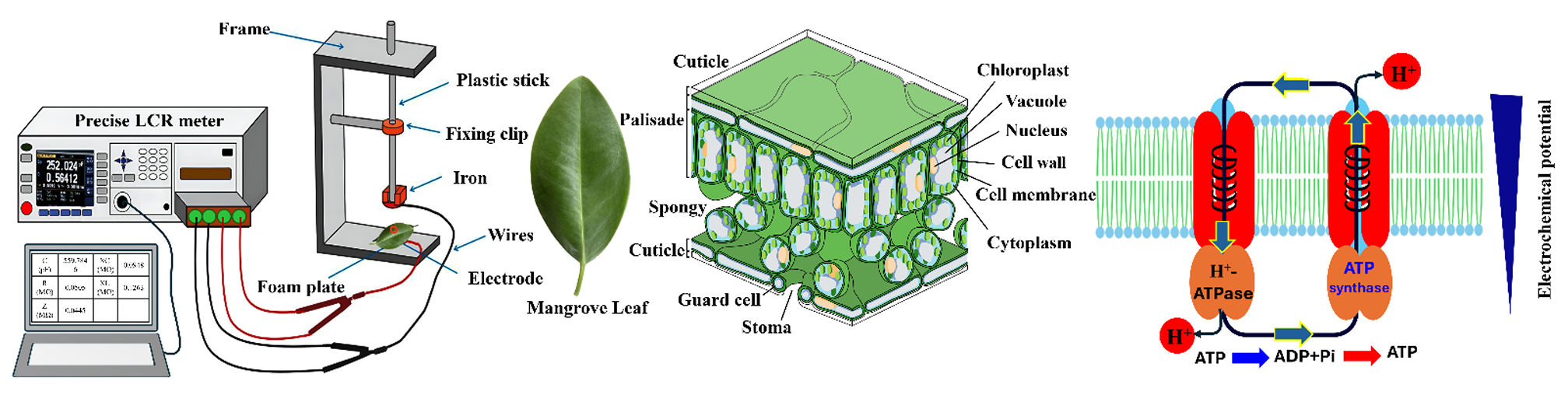
Investigating the intracellular water dynamics within leaves will clarify plant responses to different water conditions and provide a theoretical basis for enhancing water-use efficiency. Detached leaves of Chinese flowering cabbage (Brassica campestris L. ssp. chinensis var. utilis Tsen et Lee) and broccoli (Brassica oleracea L. var. italica Plenck) were used as experimental materials in this study. Electrophysiological parameters of the leaves under saturated and non-saturated conditions were measured, and the intracellular water, nutrient, and energy related indices were calculated according to Nernst equation. The acceleration (a) reflecting the change rate of water transport rate in cel... More >

Graphical Abstract
Intracellular Water Dynamic Traits in Detached Leaves of Two Brassicaceae Plant Species under Saturated and Non-saturated Water Conditions
Free Access | Research Article | 11 March 2026
Effect of High-voltage Electrostatic Field on Potassium and Phosphate Uptake by Cucumber Plants
Journal of Plant Electrobiology | Volume 1, Issue 1: 32-41, 2026 | DOI: 10.62762/JPE.2025.597638
Abstract
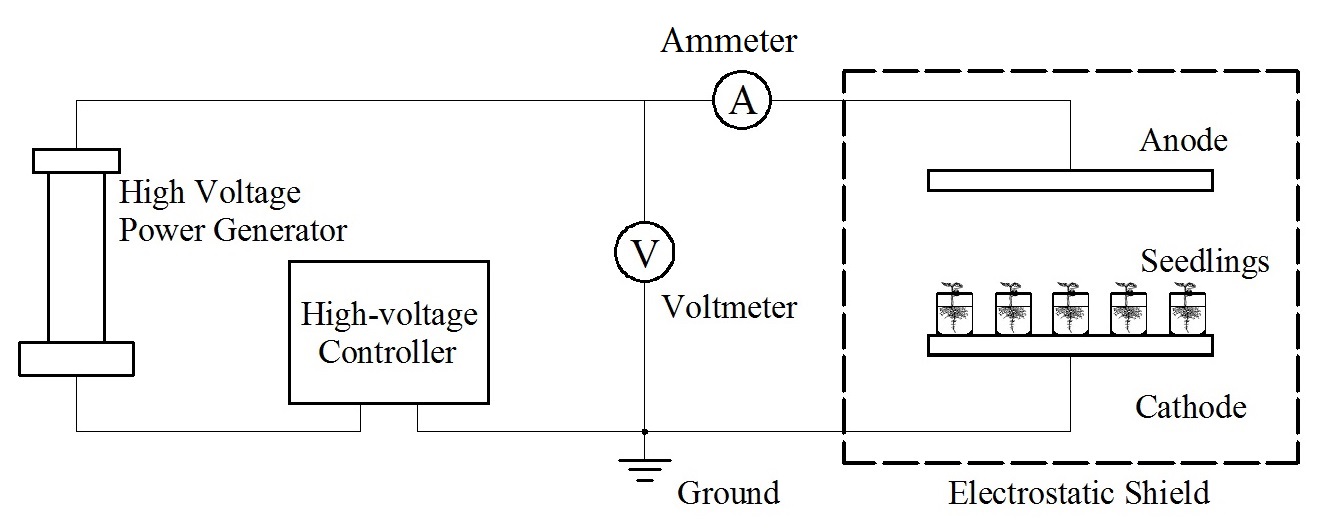
An individual plant cell functions as a complex dynamic circuit, composed of resistor, capacitor, and inductor networks created by cellular structures and macromolecules. Furthermore, high-voltage electrostatic fields (HVEF) alter its electrical properties and initiate metabolic changes. This study aimed to examine the impact of HVEF on the kinetic properties of potassium (K$^+$) and phosphate (H$_2$PO$_4^-$) absorption by Cucumis sativus L. seedlings, and further probed the regulatory mechanisms by constructing a cell membrane potential model. Experimental findings revealed that HVEF substantially altered the maximum uptake rate ($I_{max}$), half-saturation constant ($K_m$), and minimum cr... More >

Graphical Abstract
Effect of High-voltage Electrostatic Field on Potassium and Phosphate Uptake by Cucumber Plants
Free Access | Research Article | 12 February 2026
Salt Adaptation in Aegiceras Corniculatum: Electrophysiology, Gene Expression, and Energy Trade-Offs
Journal of Plant Electrobiology | Volume 1, Issue 1: 7-31, 2026 | DOI: 10.62762/JPE.2025.184208
Abstract
The integration of physical and chemical processes underpins life. Plant cells function as bioelectrical units, storing and converting energy through capacitive, inductive, and resistive properties. This study elucidates the electrophysiological and molecular mechanisms governing salt transport and energy allocation in Aegiceras corniculatum leaves under combined salinity-waterlogging stress (T1: 0.1 M NaCl + 2 h; T2: 0.2 M NaCl + 4 h; T3: 0.4 M NaCl + 6 h). Results demonstrate that leaf intracellular water-salt transport dynamics, coupled with salt-transport gene expression, coordinately regulate active/passive transport, vacuolar compartmentalization, cytoplasmic Na+ levels, and excretion.... More >

Graphical Abstract
Salt Adaptation in Aegiceras Corniculatum: Electrophysiology, Gene Expression, and Energy Trade-Offs
Open Access | Editorial | 21 September 2025 | Cited: Scopus 1
Inaugural Editorial for the Journal of Plant Electrobiology
Journal of Plant Electrobiology | Volume 1, Issue 1: 1-6, 2026 | DOI: 10.62762/JPE.2025.322792
Abstract
This editorial defines the core mission, academic orientation, and six interrelated thematic pillars of Journal of Plant Electrobiology (JPE), which is a peer-reviewed international journal dedicated to advancing the interdisciplinary fusion of electronics, bioenergetics, biophysics, and plant science. JPE aims to showcase innovative researches that leverage electronic principles and technologies to address fundamental and applied questions in plant biology, foster cross-disciplinary collaboration, and accelerate the translation of plant electrobiology breakthroughs into solutions for sustainable agriculture, plant stress resilience, and environmental stewardship. Against the backdrop of rap... More >

Journal Statistics

38
Authors
5
Countries / Regions
13
Articles
1
Scopus Citations
7.7% Cited
2025
Published Since
16,096
Article Views
3,932
Article Downloads
Journal of Plant Electrobiology
eISSN: 3071-6268
Crossref
Crossref
Member of Crossref
Visit Crossref →