


ICCK

Dr Chukwunonso D. Okpala

Department of Agricultural and Bioresources Engineering, Nnamdi Azikiwe University, Awka 420001, Nigeria, NG

ORCID
Section 01

Academic Profile

No academic profile information available at the moment.

Section 02

ICCK Publications

Export all 3 BibTeX RIS
Open Access | Research Article | 05 October 2026
Neuro-Predictive Modelling and Thermo-Energetic Optimization of Convective Drying Kinetics and Mass Transfer Dynamics in Black Bean (Akidi) Seeds
Agricultural Science and Food Processing | Volume 3, Issue 4: 124-141, 2026 | DOI: 10.62762/ASFP.2026.204903
Abstract
Convective drying extends the storage life of legume seeds, but its nonlinear kinetics and energy demand are difficult to predict with conventional models. This study developed and validated an artificial neural network (ANN) to predict the drying kinetics, drying time and energy consumption of black bean (\textit{Vigna unguiculata}) seeds during convective drying at 45-65~\degC, and to identify optimal drying conditions. Fresh seeds had an initial moisture content of 18.84% (wet basis), above the 12-14% safe storage limit. A 2-10-10-3 feedforward network (Levenberg-Marquardt training) used drying time and temperature as inputs and moisture ratio (MR), drying rate (DR) and energy consumption... More >

Graphical Abstract
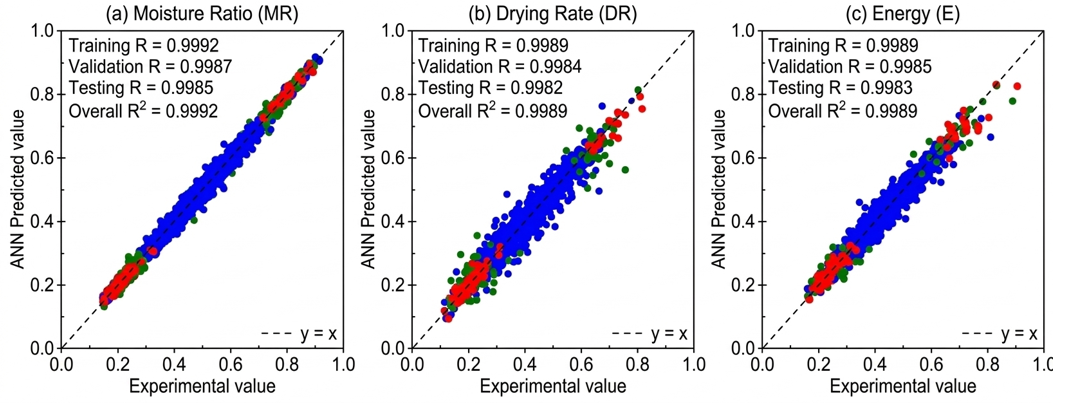
Neuro-Predictive Modelling and Thermo-Energetic Optimization of Convective Drying Kinetics and Mass Transfer Dynamics in Black Bean (Akidi) Seeds
Open Access | Research Article | 15 June 2026
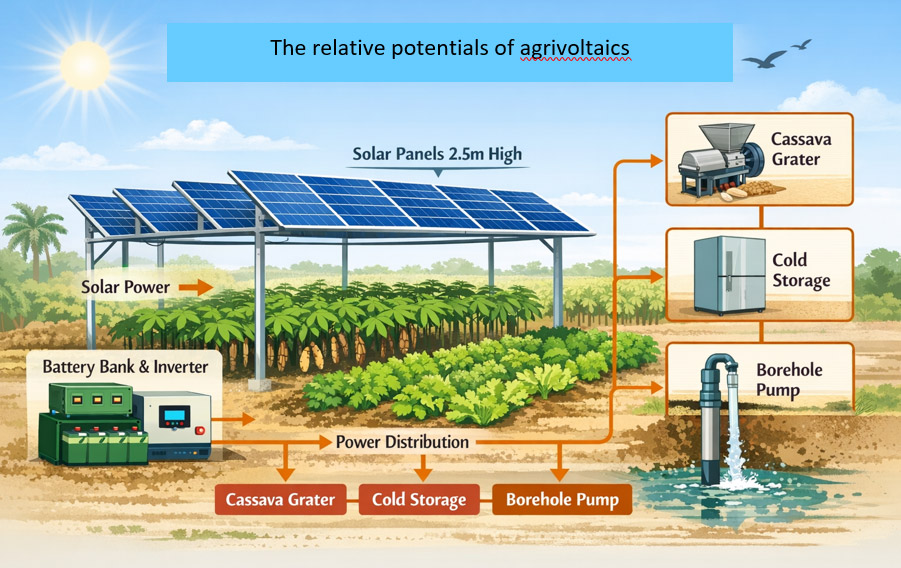
Agrivoltaics Potentials for Food Processing and Water Supply in Rural Electrification-deficient Areas: A Case Study of Anambra Agricultural Zones, Nigeria
Agricultural Science and Food Processing | Volume 3, Issue 2: 95-119, 2026 | DOI: 10.62762/ASFP.2026.324107
Abstract
Reliable electricity remains a significant barrier to agricultural productivity in rural Nigeria. This case study investigated the potential of agrivoltaic systems, combining solar energy generation with crop production, to address food processing and water supply challenges in the Anambra State Agricultural Zones. Drawing on the Technology Acceptance Model (TAM), a cross-sectional survey was administered to 845 respondents, of whom 840 returned valid questionnaires, food processors, and water facility operators across 16 communities using probability-proportional-to-size sampling (design effect = 2.0). Descriptive statistics and ordinal logistic regression were used to assess perceptions an... More >

Graphical Abstract
Agrivoltaics Potentials for Food Processing and Water Supply in Rural Electrification-deficient Areas: A Case Study of Anambra Agricultural Zones, Nigeria
Open Access | Research Article | 10 May 2026 | Cited: Crossref logo  1 , Scopus 1
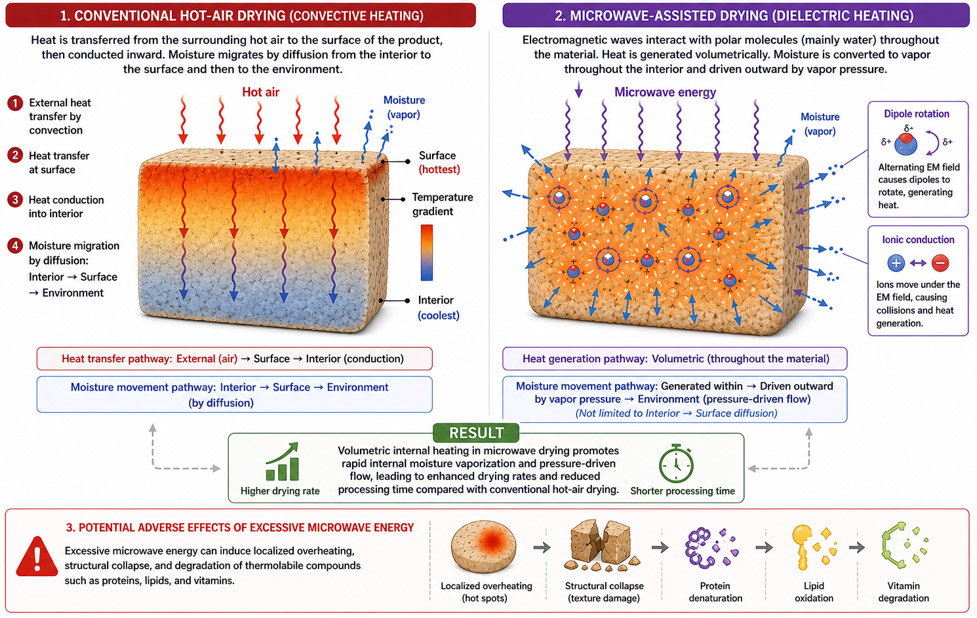
Response Surface Methodology Study of the Synergistic Effects of Soaking Pretreatment and Microwave Power on the Proximate Composition of Tiger nut (Cyperus esculentus L.)
Agricultural Science and Food Processing | Volume 3, Issue 2: 73-94, 2026 | DOI: 10.62762/ASFP.2026.613613
Abstract
Despite its nutritional potential, Tiger nut remains under-utilized. This study examined the interactive effects of soaking time (24–72\,h) and microwave power (100–280\,W) on its proximate composition using response surface methodology. Commercial tubers (14.33% moisture) were rehydrated to 38.6–46.8% moisture via soaking and then microwave-dried at 2.45\,GHz. Proximate composition was determined by AOAC methods. Ash, fat and carbohydrate followed linear models (\(p<0.0001\)); fiber followed a two-factor interaction model (\(p<0.0001\)); protein showed quadratic behavior (\(p=0.0006\)). Multi-response optimization identified 48\,h soaking and 190\,W power as optimal (desirability=0.87... More >

Graphical Abstract
Response Surface Methodology Study of the Synergistic Effects of Soaking Pretreatment and Microwave Power on the Proximate Composition of Tiger nut (Cyperus esculentus L.)