

Neuro-Predictive Modelling and Thermo-Energetic Optimization of Convective Drying Kinetics and Mass Transfer Dynamics in Black Bean (Akidi) Seeds





Article Information
Abstract
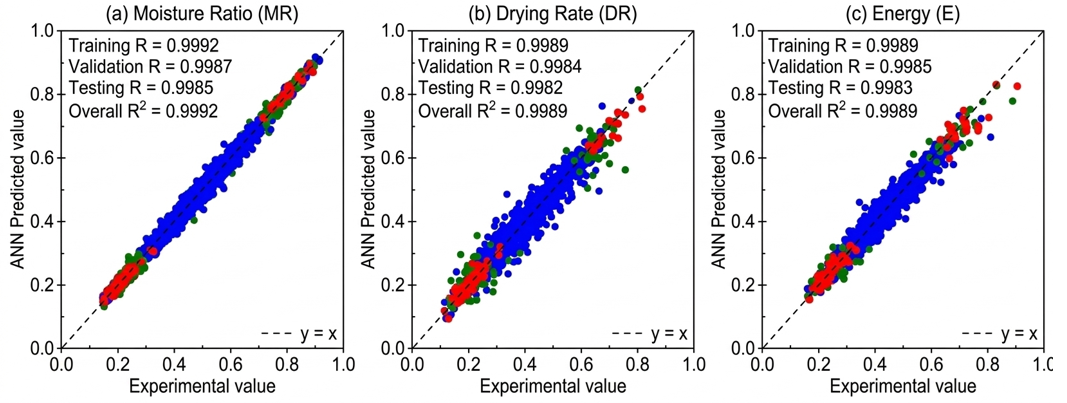
Convective drying extends the storage life of legume seeds, but its nonlinear kinetics and energy demand are difficult to predict with conventional models. This study developed and validated an artificial neural network (ANN) to predict the drying kinetics, drying time and energy consumption of black bean (\textit{Vigna unguiculata}) seeds during convective drying at 45-65~\degC, and to identify optimal drying conditions. Fresh seeds had an initial moisture content of 18.84% (wet basis), above the 12-14% safe storage limit. A 2-10-10-3 feedforward network (Levenberg-Marquardt training) used drying time and temperature as inputs and moisture ratio (MR), drying rate (DR) and energy consumption (E) as outputs. Increasing the temperature from 45 to 65~\degC{} reduced the drying time from 1100 to 800~min (27.3%), while the effective moisture diffusivity increased from $2.84\times10^{-10}$ to $6.15\times10^{-10}$~m$^{2}$\,s$^{-1}$, with an activation energy of 34.70~kJ\,mol$^{-1}$. On a dry matter basis, protein (25.92-22.92%) and fat (2.26-1.85%) decreased, whereas ash, fibre and carbohydrate increased with temperature. The ANN achieved overall $R^{2}$ of 0.9988-0.9992 and RMSE of 0.0141-0.0190, with maximum prediction errors of 0.61% for MR and 0.40% for DR. ANN-based optimization identified 65~\degC{} as the optimum within the investigated range, reducing the predicted drying time by 25.8% and energy consumption by 27.3% relative to 45~\degC. The model provides a decision-support tool for energy-efficient drying of black bean seeds.
Graphical Abstract
Keywords
Data Availability Statement
Funding
Conflicts of Interest
AI Use Statement
Ethical Approval and Consent to Participate
References
- Boukar, O., Belko, N., Chamarthi, S., Togola, A., Batieno, J., Owusu, E., Haruna, M., Diallo, S., Umar, M. L., Olufajo, O., & Fatokun, C. (2019). Cowpea (Vigna unguiculata): Genetics, genomics and breeding. Plant Breeding, 138(4), 415-424.
[CrossRef] [Google Scholar] - Gonçalves, A., Goufo, P., Barros, A., Domínguez‐Perles, R., Trindade, H., Rosa, E. A., ... & Rodrigues, M. (2016). Cowpea (Vigna unguiculata L. Walp), a renewed multipurpose crop for a more sustainable agri-food system: Nutritional advantages and constraints. Journal of the Science of Food and Agriculture, 96(9), 2941-2951.
[CrossRef] [Google Scholar] - Duraipandian, M., Poorani, K. E., Abirami, H., & Anusha, M. B. (2022). Vigna unguiculata (L.) Walp: A strategic crop for nutritional security, well-being and environmental protection. Legumes Research: Volume 2. IntechOpen.
[CrossRef] [Google Scholar] - Martín-Cabrejas, M. Á. (Ed.). (2019). Legumes: Nutritional quality, processing and potential health benefits. Royal Society of Chemistry.
[CrossRef] [Google Scholar] - Affognon, H., Mutungi, C., Sanginga, P., & Borgemeister, C. (2015). Unpacking postharvest losses in Sub-Saharan Africa: A meta-analysis. World Development, 66, 49-68.
[CrossRef] [Google Scholar] - Anyene, C. C. C., Nwajinka, C. O., Okpala, C. D., Nwakuba, N. R., & Amaefule, D. O. (2026). Interactive effects of soaking duration and drying temperature on the drying kinetics and proximate composition of tiger nuts (Cyperus esculentus L.). European Food Research and Technology, 252(3), Article 98.
[CrossRef] [Google Scholar] - Doymaz, İ. (2005). Drying behaviour of green beans. Journal of food Engineering, 69(2), 161-165.
[CrossRef] [Google Scholar] - Mandizvo, T., & Odindo, A. O. (2019). Seed coat structural and imbibitional characteristics of dark and light coloured Bambara groundnut (Vigna subterranea L.) landraces. Heliyon, 5(2), e01249.
[CrossRef] [Google Scholar] - Kılıç, E. E., & Çınar, İ. (2019). Convective hot airdrying characteristics of selected vegetables. International Advanced Researches and Engineering Journal, 3(1), 7-13. https://dergipark.org.tr/en/pub/iarej/article/449564
[Google Scholar] - Keskes, S., Hanini, S., Hentabli, M., & Laidi, M. (2020). Artificial intelligence and mathematical modelling of the drying kinetics of pharmaceutical powders. Kemija u industriji, 69(3-4), 137-152.
[CrossRef] [Google Scholar] - Subramanyam, R., & Narayanan, M. (2023). Artificial neural network modeling for drying kinetics of paddy using a cabinet tray dryer. Chemical Industry & Chemical Engineering Quarterly, 29(2), 87-98.
[CrossRef] [Google Scholar] - Muñoz-Zavala, A. E., Macías-Díaz, J. E., Alba-Cuéllar, D., & Guerrero-Díaz-de-León, J. A. (2024). A literature review on some trends in artificial neural networks for modeling and simulation with time series. Algorithms, 17(2), 76.
[CrossRef] [Google Scholar] - Basheer, I. A., & Hajmeer, M. (2000). Artificial neural networks: Fundamentals, computing, design, and application. Journal of Microbiological Methods, 43(1), 3-31.
[CrossRef] [Google Scholar] - Zaras, A., Passalis, N., & Tefas, A. (2022). Neural networks and backpropagation. In Deep learning for robot perception and cognition (pp. 17-34). Academic Press.
[CrossRef] [Google Scholar] - Rumelhart, D. E., Hinton, G. E., & Williams, R. J. (1986). Learning representations by back-propagating errors. nature, 323(6088), 533-536.
[CrossRef] [Google Scholar] - Topal, M. E., Şahin, B., & Vela, S. (2024). Artificial neural network modeling techniques for drying kinetics of citrus medica fruit during the freeze-drying process. Processes, 12(7), 1362.
[CrossRef] [Google Scholar] - Lu, S., Wang, S., & Wei, Q. (2025). Application of artificial neural networks in agricultural product drying. Frontiers of Agricultural Science and Engineering, 12(4), 779-792.
[CrossRef] [Google Scholar] - Khaledifard, G., Taki, M., Dastjerdi, R. M., & Behbahani, B. A. (2025). Integrating drying kinetics, quality attributes and machine learning for red pepper drying in a greenhouse solar dryer. Scientific Reports, 16(1), 1899.
[CrossRef] [Google Scholar] - Thibault, B., Zeynoddin, M., Bonakdari, H., Ratti, C., & Khalloufi, S. (2025). Effect of model selection approach obtained by machine learning tools on predicting the volume reduction of plant-based dehydrated foods. Journal of Food Engineering, 391, 112415.
[CrossRef] [Google Scholar] - Prakash Maran, J., Sivakumar, V., Thirugnanasambandham, K., & Sridhar, R. (2013). Artificial neural network and response surface methodology modeling in mass transfer parameters predictions during osmotic dehydration of Carica papaya L. Alexandria Engineering Journal, 52(3), 507-516.
[CrossRef] [Google Scholar] - Demir, H., Demir, H., Lončar, B., Pezo, L., Brandić, I., Voća, N., & Yilmaz, F. (2023). Optimization of caper drying using response surface methodology and artificial neural networks for energy efficiency characteristics. Energies, 16(4), 1687.
[CrossRef] [Google Scholar] - Šovljanski, O., Lončar, B., Pezo, L., Saveljić, A., Tomić, A., Brunet, S., ... & Travičić, V. (2023). Unlocking the Potential of the ANN Optimization in Sweet Potato Varieties Drying Processes. Foods, 13(1), 134.
[CrossRef] [Google Scholar] - Chasiotis, V. K., Tzempelikos, D. A., Filios, A. E., & Moustris, K. P. (2020). Artificial neural network modelling of moisture content evolution for convective drying of cylindrical quince slices. Computers and Electronics in Agriculture, 172, 105074.
[CrossRef] [Google Scholar] - Francik, S., Łapczyńska-Kordon, B., Hajos, M., Basista, G., Zawiślak, A., & Francik, R. (2024). Modeling the Drying Process of Onion Slices Using Artificial Neural Networks. Energies, 17(13), 3199.
[CrossRef] [Google Scholar] - Movagharnejad, K., & Nikzad, M. (2007). Modeling of tomato drying using artificial neural network. Computers and electronics in agriculture, 59(1-2), 78-85.
[CrossRef] [Google Scholar] - Kerdpiboon, S., Kerr, W. L., & Devahastin, S. (2006). Neural network prediction of physical property changes of dried carrot as a function of fractal dimension and moisture content. Food research international, 39(10), 1110-1118.
[CrossRef] [Google Scholar] - Erenturk, S., & Erenturk, K. (2007). Comparison of genetic algorithm and neural network approaches for the drying process of carrot. Journal of food engineering, 78(3), 905-912.
[CrossRef] [Google Scholar] - Selvi, K. Ç., Alkhaled, A. Y., & Yıldız, T. (2022). Application of artificial neural network for predicting the drying kinetics and chemical attributes of linden (Tilia platyphyllos Scop.) during the infrared drying process. Processes, 10(10), 2069.
[CrossRef] [Google Scholar] - Aghbashlo, M., Hosseinpour, S., & Mujumdar, A. S. (2015). Application of artificial neural networks (ANNs) in drying technology: a comprehensive review. Drying technology, 33(12), 1397-1462.
[CrossRef] [Google Scholar] - Bai, J. W., Xiao, H. W., Ma, H. L., & Zhou, C. S. (2018). Artificial neural network modeling of drying kinetics and color changes of ginkgo biloba seeds during microwave drying process. Journal of Food Quality, 2018(1), 3278595.
[CrossRef] [Google Scholar] - Matin, A., Brandić, I., Špelić, K., Tomić, I., Pavlović, A., Matin, B., ... & Galić, A. (2026). Experimental Modelling of Sunflower Seed Moisture Content During Controlled Drying Using Machine Learning Methods. Agriculture, 16(6), 695.
[CrossRef] [Google Scholar] - Morais, S. J. D. S., Devilla, I. A., Ferreira, D. A., & Teixeira, I. R. (2013). Mathematical modeling of the drying curves and diffusion coefficient of cowpea grains (Vigna unguiculata (L.) Walp.). Revista Ciência Agronômica, 44, 455-463.
[CrossRef] [Google Scholar] - AOAC International (2002). Official Methods of Analysis (17th ed.). AOAC International, Gaithersburg, MD, USA.
[Google Scholar] - Mohsenin, N. N. (1986). Physical Properties of Plant and Animal Materials (2nd ed.). Gordon and Breach Science Publishers, New York.
[Google Scholar] - Popescu, M., Iancu, P., Plesu, V., Bildea, C. S., & Manolache, F. A. (2023). Mathematical modeling of thin-layer drying kinetics of tomato peels: influence of drying temperature on the energy requirements and extracts quality. Foods, 12(20), 3883.
[CrossRef] [Google Scholar] - Horuz, E., Bozkurt, H., Karata\c{s, H., & Maskan, M. (2020). Microwave-conventional drying characteristics of red pepper: Drying modeling, temperature profile, diffusivity and activation energy. Journal of Agricultural Science and Technology, 22(2), 425-437. https://www.sid.ir/en/VEWSSID/J_pdf/84820200211.pdf
[Google Scholar] - Yalçın, İ. (2007). Physical properties of cowpea (Vigna sinensis L.) seed. Journal of Food Engineering, 79(1), 57-62.
[CrossRef] [Google Scholar] - Inyang, U. E., Alexander, J. A., & Chibuzo, N. P. (2021). Prediction of cocoyam drying parameters using artificial neural network. International Journal of Novel Research in Engineering and Science, 8(1), 4-13. https://www.researchgate.net/publication/356106369
[Google Scholar] - Haddad, J. S., Ikhries, I. I., Al-Shawabkeh, A. F., Al-Najdawi, N. A., & Alfaqs, F. A. (2026). Optimizing the moisture content of sesame seed drying process by enforcing neural network algorithms. Results in Engineering, 29, 108789.
[CrossRef] [Google Scholar] - Dhurve, P., Tarafdar, A., & Arora, V. K. (2021). Vibro‐fluidized bed drying of pumpkin seeds: Assessment of mathematical and artificial neural network models for drying kinetics. Journal of food quality, 2021(1), 7739732.
[CrossRef] [Google Scholar] - Huang, X., Cao, H., & Jia, B. (2023). Optimization of Levenberg Marquardt algorithm applied to nonlinear systems. Processes, 11(6), 1794.
[CrossRef] [Google Scholar] - Motevali, A., Minaei, S., & Khoshtagaza, M. H. (2011). Evaluation of energy consumption in different drying methods. Energy conversion and management, 52(2), 1192-1199.
[CrossRef] [Google Scholar] - Alibas, I., & Yilmaz, A. (2022). Microwave and convective drying kinetics and thermal properties of orange slices and effect of drying on some phytochemical parameters. Journal of Thermal Analysis and Calorimetry, 147(15), 8301-8321.
[CrossRef] [Google Scholar] - Wang, Y., Li, B., Xi, Y., Zheng, L., & Zi, W. (2026). Kinetic characteristics and energy efficiency analysis of microwave-dried fresh ginger: Impacts of key process parameters. LWT, 240, 118999.
[CrossRef] [Google Scholar] - Kusuma, H. S., Paradiba, H., Wahyuni, T. D., Amenaghawon, A. N., El Messaoudi, N., & Darmokoesoemo, H. (2025). Comparison of thin-layer drying models for microwave drying of peanuts at varying power levels. Food and Humanity, 5, 100754.
[CrossRef] [Google Scholar] - Srinivas, G., Radhika, G. B., & Praveen, B. V. S. (2025). Experimental study on the effect of microwave heating power on the drying behavior of onion slices. MethodsX, 15, 103479.
[CrossRef] [Google Scholar] - Zibokere, D. S., & Egbe, E. W. (2020). Estimating the drying kinetics of spiced Okpokuru (Oryctes rhinoceros) with the use of some of the thin layer models. Research Journal of Engineering and Environmental Sciences, 5(2), 563-574. http://rjees.com/download/?file=V05-N02-563-574.pdf
[Google Scholar] - Olusola Adetifa, B., Olumomi, E. A., Moses Samuel, T., & Abiola Babalola, A. (2024). Application of the physical properties of local cowpea varieties in the development of a multi-variety cowpea cleaner. Research in Agricultural Engineering, 70(2), 82-91.
[CrossRef] [Google Scholar] - Obi, O. F., & Offorha, L. C. (2015). Moisture-dependent physical properties of melon (Citrullus colocynthis lanatus) seed and kernel relevant in bulk handling. Cogent Food & Agriculture, 1(1), 1020743.
[CrossRef] [Google Scholar] - Dajbych, O., Kabutey, A., Mizera, Č., Sedláček, A., & Herak, D. (2026). Effect of Diffusion Path Lengths on Effective Moisture Diffusivity and Activation Energy of Red Delicious Apple Slices Under Convective Drying. Processes, 14(12), 2015.
[CrossRef] [Google Scholar] - Arulkumar, M., Pandian, N. K. S., Murugan, B., Nambi, V. E., Sivaranjani, S., Baskaran, D., ... & Pandiselvam, R. (2023). Drying kinetics, effective moisture diffusivity, and activation energy of osmotic pretreated hot‐air‐dried paneer cubes. Journal of Food Processing and Preservation, 2023(1), 7685192.
[CrossRef] [Google Scholar] - Sindhuja, V., Ramachandran, P. A., & Thorat, B. N. (2022). Understanding diffusional effects in drying. In Proceedings of IDS'2022 - 22nd International Drying Symposium. Worcester Polytechnic Institute.
[CrossRef] [Google Scholar] - Wen, Z., Lu, X., Wen, J., Wang, Z., & Chai, M. (2024). Physical seed dormancy in legumes: Molecular advances and perspectives. Plants, 13(11), 1473.
[CrossRef] [Google Scholar] - Zeng, X. S., Ruan, R. R., Fulcher, R. G., & Chen, P. (1996). Evaluation of soybean seedcoat cracking during drying: Part I. Using drying tests. Drying Technology, 14(7--8), 1575--1593.
[CrossRef] [Google Scholar] - Shevkani, K. (2023). Protein from land - legumes and pulses. In B. K. Tiwari & L. E. Healy (Eds.), Future Proteins: Sources, Processing, Applications and the Bioeconomy (pp. 35-68). Academic Press. https://katalog.bibliothek.kit.edu/bib/1405887
[Google Scholar] - Wei, L., Li, P., Liu, Y., & Xie, Y. (2026). Effects of drying methods, temperature, and initial moisture content on drying characteristics, nutritional quality, texture, and oxidative stability of peanuts. Foods, 15(7), 1248.
[CrossRef] [Google Scholar] - Wu, L., Chen, S., Li, Y., Xie, W., & Tang, B. (2024). Effect of heat pump drying temperature on moisture migration characteristics and quality of instant Tremella fuciformis. Current Research in Food Science, 9, 100825.
[CrossRef] [Google Scholar] - Okechukwu-Ezike, N., Munonye, J., & Esiegwu, A. (2020). Comparative evaluation of the proximate composition, anti-nutrients and functional properties of some underutilized pulses. Food Science and Quality Management, 95, 72-80.
[CrossRef] [Google Scholar] - Olife, I. C., Ayatse, J. O. I., Ega, R. A. I., & Anajekwu, B. A. (2024). Proximate composition and mineral contents of raw and cooked Vigna unguiculata L. and Phaseolus lunatus L. procured from an open market in South East, Nigeria. International Journal of Science, Engineering and Technology, 12(5), 1-8. https://www.ijset.in/wp-content/uploads/IJSET_V12_issue5_727.pdf
[Google Scholar] - Fernandez-Rosillo, F., Sánchez-Goycochea, N. A., Santa Cruz-López, C., Cabrejos-Barrios, E. M., Caucha-Iparraguirre, J., Garcia-Carrión, F., & Quiñones-Huatangari, L. (2026). Effect of Temperature on the Drying Kinetics of Caturra Coffee: Correlation with Hyperspectral Imaging and Sensory Quality. Foods, 15(8), 1284.
[CrossRef] [Google Scholar] - Singh, N. J., & Pandey, R. K. (2011). Neural network approaches for prediction of drying kinetics during drying of sweet potato. Agricultural Engineering International: CIGR Journal, 13(1). https://cigrjournal.org/index.php/Ejounral/article/view/1734
[Google Scholar] - Gupta, A., Das, B., Arslan, E., Das, M., Kosan, M., & Can, O. F. (2024). Artificial neural networks based computational and experimental evaluation of thermal and drying performance of partially covered PVT solar dryer. Process Safety and Environmental Protection, 183, 1170-1185.
[CrossRef] [Google Scholar] - Amadeu, L. T. S., Queiroz, A. J. D. M., Figueirêdo, R. M. F. D., Ferreira, J. P. D. L., Silva, W. P. D., Gomes, J. P., ... & Silva, H. A. (2022). Controlled germination of faba beans: Drying, thermodynamic properties and physical-chemical composition. Processes, 10(8), 1460.
[CrossRef] [Google Scholar] - Midilli, A., Kucuk, H., & Yapar, Z. (2002). A new model for single-layer drying. Drying Technology, 20(7), 1503-1513.
[CrossRef] [Google Scholar] - Olalusi, A. P., Omosebi, M. O., & Agbola, O. Y. (2019). Influence of drying methods on the drying characteristics and nutritional quality of fermented locust beans. International Journal of Environment, Agriculture and Biotechnology, 4(6), 1695-1703. https://dx.doi.org/10.22161/ijeab.46.10
[Google Scholar] - Abhon, A., & Egbe, E. W. (2024). Activation energy and effective moisture diffusivity determination on some agricultural biomaterials: A review. International Journal of Innovative Mathematics, Statistics & Energy Policies, 12(1), 33-42.
[Google Scholar] - Hii, C. L., Law, C. L., & Cloke, M. (2009). Modeling using a new thin layer drying model and product quality of cocoa. Journal of Food Engineering, 90(2), 191-198.
[CrossRef] [Google Scholar]
Cite This Article
TY  - JOUR
AU  - Anyene, Chinedu C. C.
AU  - Nwajinka, Charles O.
AU  - Okpala, Chukwunonso D.
AU  - Amaefule, Desmond O.
AU  - Anonye, Onyemauche F.
AU  - Nwakuba, Nnaemeka R.
PY  - 2026
DA  - 2026/10/05
TI  - Neuro-Predictive Modelling and Thermo-Energetic Optimization of Convective Drying Kinetics and Mass Transfer Dynamics in Black Bean (Akidi) Seeds
JO  - Agricultural Science and Food Processing
T2  - Agricultural Science and Food Processing
JF  - Agricultural Science and Food Processing
VL  - 3
IS  - 4
SP  - 124
EP  - 141
DO  - 10.62762/ASFP.2026.204903
UR  - https://www.icck.org/article/abs/ASFP.2026.204903
KW  - Artificial neural network
KW  - Vigna unguiculata
KW  - black bean
KW  - moisture diffusivity
KW  - drying kinetics
AB  - Convective drying extends the storage life of legume seeds, but its nonlinear kinetics and energy demand are difficult to predict with conventional models. This study developed and validated an artificial neural network (ANN) to predict the drying kinetics, drying time and energy consumption of black bean (\textit{Vigna unguiculata}) seeds during convective drying at 45-65~\degC, and to identify optimal drying conditions. Fresh seeds had an initial moisture content of 18.84% (wet basis), above the 12-14% safe storage limit. A 2-10-10-3 feedforward network (Levenberg-Marquardt training) used drying time and temperature as inputs and moisture ratio (MR), drying rate (DR) and energy consumption (E) as outputs. Increasing the temperature from 45 to 65~\degC{} reduced the drying time from 1100 to 800~min (27.3%), while the effective moisture diffusivity increased from $2.84\times10^{-10}$ to $6.15\times10^{-10}$~m$^{2}$\,s$^{-1}$, with an activation energy of 34.70~kJ\,mol$^{-1}$. On a dry matter basis, protein (25.92-22.92%) and fat (2.26-1.85%) decreased, whereas ash, fibre and carbohydrate increased with temperature. The ANN achieved overall $R^{2}$ of 0.9988-0.9992 and RMSE of 0.0141-0.0190, with maximum prediction errors of 0.61% for MR and 0.40% for DR. ANN-based optimization identified 65~\degC{} as the optimum within the investigated range, reducing the predicted drying time by 25.8% and energy consumption by 27.3% relative to 45~\degC. The model provides a decision-support tool for energy-efficient drying of black bean seeds.
SN  - 3066-1579
PB  - Institute of Central Computation and Knowledge
LA  - English
ER  -
@article{Anyene2026NeuroPredi,
  author = {Chinedu C. C. Anyene and Charles O. Nwajinka and Chukwunonso D. Okpala and Desmond O. Amaefule and Onyemauche F. Anonye and Nnaemeka R. Nwakuba},
  title = {Neuro-Predictive Modelling and Thermo-Energetic Optimization of Convective Drying Kinetics and Mass Transfer Dynamics in Black Bean (Akidi) Seeds},
  journal = {Agricultural Science and Food Processing},
  year = {2026},
  volume = {3},
  number = {4},
  pages = {124-141},
  doi = {10.62762/ASFP.2026.204903},
  url = {https://www.icck.org/article/abs/ASFP.2026.204903},
  abstract = {Convective drying extends the storage life of legume seeds, but its nonlinear kinetics and energy demand are difficult to predict with conventional models. This study developed and validated an artificial neural network (ANN) to predict the drying kinetics, drying time and energy consumption of black bean (\textit{Vigna unguiculata}) seeds during convective drying at 45-65~\degC, and to identify optimal drying conditions. Fresh seeds had an initial moisture content of 18.84\% (wet basis), above the 12-14\% safe storage limit. A 2-10-10-3 feedforward network (Levenberg-Marquardt training) used drying time and temperature as inputs and moisture ratio (MR), drying rate (DR) and energy consumption (E) as outputs. Increasing the temperature from 45 to 65~\degC{} reduced the drying time from 1100 to 800~min (27.3\%), while the effective moisture diffusivity increased from \$2.84\times10^{-10}\$ to \$6.15\times10^{-10}\$~m\$^{2}\$\,s\$^{-1}\$, with an activation energy of 34.70~kJ\,mol\$^{-1}\$. On a dry matter basis, protein (25.92-22.92\%) and fat (2.26-1.85\%) decreased, whereas ash, fibre and carbohydrate increased with temperature. The ANN achieved overall \$R^{2}\$ of 0.9988-0.9992 and RMSE of 0.0141-0.0190, with maximum prediction errors of 0.61\% for MR and 0.40\% for DR. ANN-based optimization identified 65~\degC{} as the optimum within the investigated range, reducing the predicted drying time by 25.8\% and energy consumption by 27.3\% relative to 45~\degC. The model provides a decision-support tool for energy-efficient drying of black bean seeds.},
  keywords = {Artificial neural network, Vigna unguiculata, black bean, moisture diffusivity, drying kinetics},
  issn = {3066-1579},
  publisher = {Institute of Central Computation and Knowledge}
}
Article Metrics
Publisher's Note
ICCK stays neutral with regard to jurisdictional claims in published maps and institutional affiliations.
Rights and Permissions
 Copyright © 2026 by the Author(s). Published by Institute of Central Computation and Knowledge. This article is an open access article distributed under the terms and conditions of the Creative Commons Attribution (CC BY) license (https://creativecommons.org/licenses/by/4.0/), which permits use, sharing, adaptation, distribution and reproduction in any medium or format, as long as you give appropriate credit to the original author(s) and the source, provide a link to the Creative Commons licence, and indicate if changes were made.


Portico
