ICCK

Sohail Rehman

Qurtuba university, Peshawar, Pakistan

Section 01

Academic Profile

I am Dr. Sohail Rehman, an Assistant Professor in the Department of Numerical and Physical Sciences at Qurtuba University, Peshawar, Pakistan. My research focuses on applied mathematical modeling and numerical simulations in fluid dynamics, with an emphasis on non-Newtonian fluids, nanofluids, and hemodynamics. I specialize in computational approaches to study heat and mass transfer in complex fluid systems

Section 02

Editorial Roles

This user currently does not serve as an editor for any ICCK journals.

Section 03

ICCK Publications

Open Access | Research Article | 16 April 2026
Optimized Irreversibilities and Quartic Autocatalysis Chemical Reaction in A Wedge Flow
ICCK Journal of Applied Mathematics | Volume 2, Issue 2: 137-152, 2026 | DOI: 10.62762/JAM.2025.513035
Abstract
Entropy optimization in the dissipative flow of a viscous liquid with a chemical species of quartic autocatalysis inside wedge geometry is investigated in this study by executing the revised Buongiorno model using numerical simulations. To demonstrate the feasibility of this approach, an illustration of the well-known model of laminar flow in the wedge domain of a planar surface is provided. The term for nanoparticles amalgamation in the heat equation is omitted, which accounts for additional involvement brought on by the migration of the nanoparticles in relation to the fluid. In addition, the energy released by autocatalysis processes is assumed to be insignificant. The studied nanofluid a... More >

Graphical Abstract
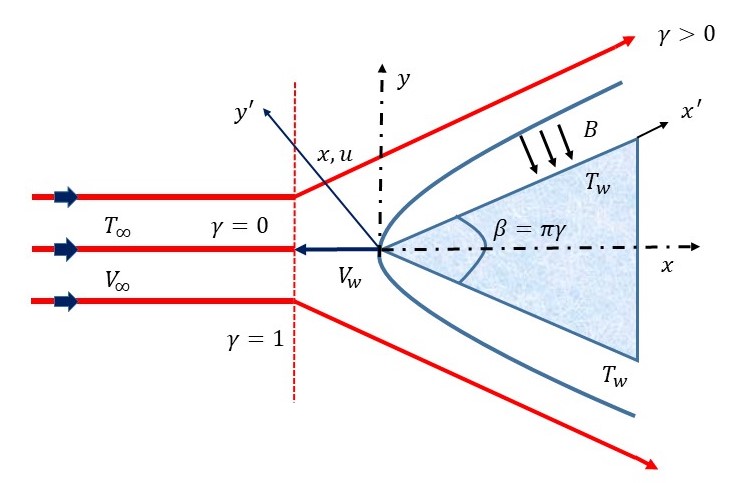
Optimized Irreversibilities and Quartic Autocatalysis Chemical Reaction in A Wedge Flow
Open Access | Research Article | 22 December 2025 | Cited: Crossref logo  5 , Scopus 4
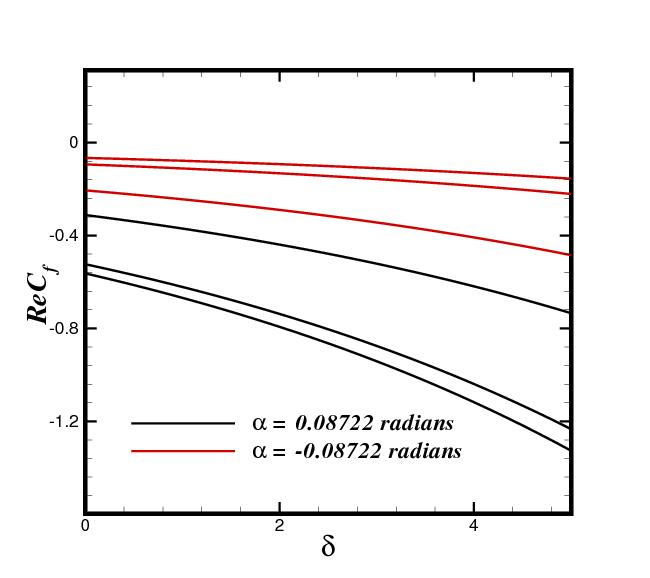
Thermal Cooling and System Irreversibilities of A Divergent/Convergent Channel with The Bioconvection Flow of Non-Newtonian Nanofluid
International Journal of Thermo-Fluid Systems and Sustainable Energy | Volume 1, Issue 2: 83-95, 2025 | DOI: 10.62762/IJTSSE.2025.318713
Abstract
The laminar bioconvection flow of a nanofluid in a convergent/divergent channel is computationally analyzed. The channel features impervious, adiabatic walls. A physics-based model couples the mass, momentum, and energy conservation equations. A thermal-hydraulic and entropy production analysis is performed using the first and second laws of thermodynamics to identify ideal parameters that maximize thermal performance while minimizing system irreversibility. Fluid flow, heat-mass transfer, motile microorganism density, and system entropy are investigated as functions of the channel angle. The governing equations are reduced via scaling and solved numerically using the Keller-Box method. Resu... More >

Graphical Abstract
Thermal Cooling and System Irreversibilities of A Divergent/Convergent Channel with The Bioconvection Flow of Non-Newtonian Nanofluid
Open Access | Research Article | 26 October 2025 | Cited: Crossref logo  7 , Scopus 7
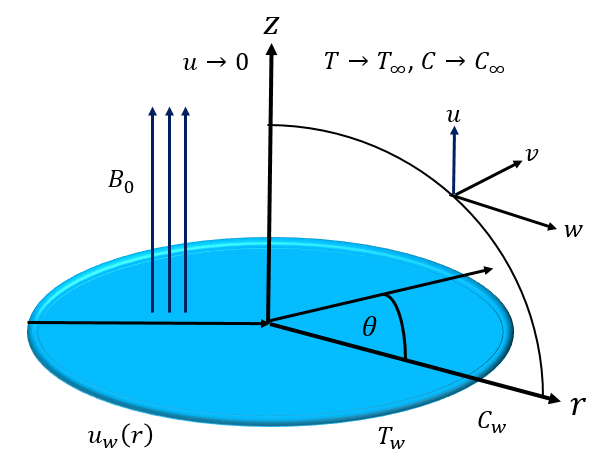
Magnetohydrodynamic Flow and Heat Transfer of Boger Tri-Hybrid Nanofluid over a Porous Disk with Cattaneo-Christov Heat Flux Theory Using Artificial Neural Network Framework
ICCK Journal of Applied Mathematics | Volume 1, Issue 3: 97-119, 2025 | DOI: 10.62762/JAM.2025.640044
Abstract
This study investigates the magnetohydrodynamic (MHD) flow of Boger tri-hybrid nanofluid (tri-HNF) through a stretching disk. A novel machine learning technique, specifically the Levenberg--Marquardt (LM) scheme under a backpropagated artificial neural network (ANN), is used to predict the flow dynamics with heat and mass transfer. The Cattaneo-Christov mass and heat fluxes model, permeable media, and viscous dissipation are considered. The well-known Brinkman-Hamilton and Crosser model is used to describe thermal conductivity and viscosity models. The computational solution to the current problem has been obtained using the Bvp4c approach, which is based on finite differences. In order to e... More >

Graphical Abstract
Magnetohydrodynamic Flow and Heat Transfer of Boger Tri-Hybrid Nanofluid over a Porous Disk with Cattaneo-Christov Heat Flux Theory Using Artificial Neural Network Framework