
Bifacial and Monofacial Photovoltaic Systems in Agrivoltaics: A Comparative Analysis of Performance, Microclimate Modulation, and Sustainability Implications





Article Information
Abstract
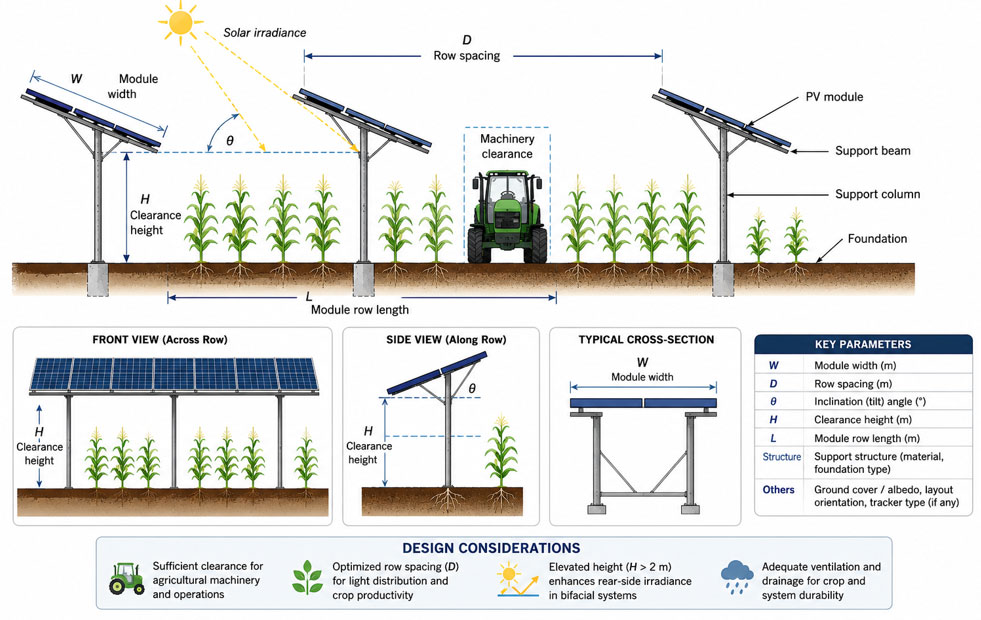
Agrivoltaic (APV) systems share land between photovoltaic (PV) generation and crop production, and the choice between monofacial and bifacial modules affects both outputs. This systematic review, following PRISMA guidelines, screened 1,247 records and retained 106 sources comparing the two module types in terms of energy performance, structural design, microclimate, crop response, economics, and sustainability. Bifacial glass-glass modules reach front-side efficiencies of 21.5-24.0% with bifaciality factors of 70-81%. Across heterogeneous studies, reported bifacial energy gains have a median of 14.2% (interquartile range 10-20%). Studies comparing both module types at the same mounting geometry report a lower gain (pooled 9.8%, 95% CI 7.2-12.4%), suggesting that part of the advantage credited to bifaciality comes from elevated mounting and wider row spacing. Reported total land equivalent ratios (LER) range from 1.18 to 2.05 for bifacial and from 1.35 to 1.64 for monofacial configurations; the ranges overlap, and the highest values reflect tracking or vertical layouts. Monofacial systems are cheaper to build (bifacial module premium about 3-7%, plus 5-15% in balance-of-system costs for elevated designs), whereas reported 4-19.6% reductions in levelised cost of energy (LCOE) for bifacial systems depend on albedo, site, and financing. Proposed spectral benefits of bifacial modules remain unmeasured in the field. Key gaps are $\pm$5-8% yield-prediction uncertainty, scarce durability data beyond 10-12 years, and confounding of module type with mounting geometry. An eight-criterion decision matrix is proposed for site-specific technology selection.
Graphical Abstract
Keywords
Data Availability Statement
Funding
Conflicts of Interest
AI Use Statement
Ethical Approval and Consent to Participate
References
- Maity, R., Hariram, N. P., Quazi, M. M., & Kumarasamy, S. (2025). Agrivoltaic systems for sustainability: An overview of emerging trends and practices. Solar Compass, 16, 100148.
[CrossRef] [Google Scholar] - Pandey, G., Lyden, S., Franklin, E., Millar, B., & Harrison, M. T. (2025). A systematic review of agrivoltaics: productivity, profitability, and environmental co-benefits. Sustainable Production and Consumption, 56, 13-36.
[CrossRef] [Google Scholar] - Ravi, S., Macknick, J., Lobell, D., Field, C., Ganesan, K., Jain, R., ... & Stoltenberg, B. (2016). Colocation opportunities for large solar infrastructures and agriculture in drylands. Applied Energy, 165, 383-392.
[CrossRef] [Google Scholar] - Feldman, D., Zuboy, J., Dummit, K., Heine, M., Grossman, S., & Narayanaswami, M. (2025). Spring 2025 solar industry update (NREL/PR-7A40-95135). National Renewable Energy Laboratory. https://www.osti.gov/servlets/purl/2583540{Link]
[Google Scholar] - Yakubu, R. O., Mensah, L. D., Quansah, D. A., & Adaramola, M. S. (2024). A systematic literature review of the bifacial photovoltaic module and its applications. The Journal of Engineering, 2024(8), e12421.
[CrossRef] [Google Scholar] - Belsky, A. A., Ngyen, V. T., Sheikhi, M. H., & Starshaia, V. V. (2025). Analysis of specifications of bifacial photovoltaic panels. Renewable and Sustainable Energy Reviews, 224, 116092.
[CrossRef] [Google Scholar] - Mahim, T. M., Rahim, A. A., & Rahman, M. M. (2024). Review of mono-and bifacial photovoltaic technologies: A comparative study. IEEE Journal of Photovoltaics, 14(3), 375-396.
[CrossRef] [Google Scholar] - Chunduri, S. K., & Schmela, M. (2018). Bifacial solar technology report 2018. TaiyangNews. https://taiyangnews.info/reports/bifacial-solar-technology-report-2018{Link]
[Google Scholar] - Du, H., Hao, G., Li, H., Xu, Q., & Ye, X. (2021). Analysis of annual bifacial gain in energy and annual energy yield of bifacial modules at low latitudes. International Journal of Green Energy, 18(15), 1632-1644.
[CrossRef] [Google Scholar] - IEA PVPS. (2021). Bifacial photovoltaic modules and systems: Experience and results from international research and pilot applications (Report IEA-PVPS T13-14:2021). International Energy Agency Photovoltaic Power Systems Programme. https://iea-pvps.org/wp-content/uploads/2021/04/IEA-PVPS-T13-14_2021-Bifacial-Photovoltaic-Modules-and-Systems-report.pdf{Link]
[Google Scholar] - Liang, T. S., Pravettoni, M., Deline, C., Stein, J. S., Kopecek, R., Singh, J. P., ... & Khoo, Y. S. (2019). A review of crystalline silicon bifacial photovoltaic performance characterisation and simulation. Energy & Environmental Science, 12(1), 116-148.
[CrossRef] [Google Scholar] - Toledo, C., & Scognamiglio, A. (2021). Agrivoltaic systems design and assessment: A critical review, and a descriptive model towards a sustainable landscape vision (three-dimensional agrivoltaic patterns). Sustainability, 13(12), 6871.
[CrossRef] [Google Scholar] - Trommsdorff, M., Kang, J., Reise, C., Schindele, S., Bopp, G., Ehmann, A., ... & Obergfell, T. (2021). Combining food and energy production: Design of an agrivoltaic system applied in arable and vegetable farming in Germany. Renewable and Sustainable Energy Reviews, 140, 110694.
[CrossRef] [Google Scholar] - Guerrero-Lemus, R., Vega, R., Kim, T., Kimm, A., & Shephard, L. E. (2016). Bifacial solar photovoltaics–A technology review. Renewable and sustainable energy reviews, 60, 1533-1549.
[CrossRef] [Google Scholar] - Alam, M., Gul, M. S., & Muneer, T. (2023). Performance analysis and comparison between bifacial and monofacial solar photovoltaic at various ground albedo conditions. Renewable Energy Focus, 44, 295-316.
[CrossRef] [Google Scholar] - Westerhof, J., Horst, L. M., Rikhof, A., Pal, S. S., Busko, D., Richards, B. S., & Saive, R. (2025). Impact of grass retroreflection on bifacial solar panel electricity yield in agrivoltaics. Journal of Photonics for Energy, 15(3), 032702.
[CrossRef] [Google Scholar] - Jamil, U., Rahman, M. M., & Pearce, J. M. (2025). Photosynthetically active radiation complexities in agrivoltaic policy mandates: insights from controlled environment yields under semitransparent photovoltaics. Journal of Cleaner Production, 523, 146392.
[CrossRef] [Google Scholar] - Prakash, V., Lunagaria, M. M., Trivedi, A. P., Upadhyaya, A., Kumar, R., Das, A., ... & Kumar, Y. (2023). Shading and PAR under different density agrivoltaic systems, their simulation and effect on wheat productivity. European Journal of Agronomy, 149, 126922.
[CrossRef] [Google Scholar] - Mouhib, E., Fernández-Solas, Á., Pérez-Higueras, P. J., Fernández-Ocaña, A. M., Micheli, L., Almonacid, F., & Fernández, E. F. (2024). Enhancing land use: Integrating bifacial PV and olive trees in agrivoltaic systems. Applied Energy, 359, 122660.
[CrossRef] [Google Scholar] - Meena, R., Pareek, A., & Gupta, R. (2024). A comprehensive review on interfacial delamination in photovoltaic modules. Renewable and Sustainable Energy Reviews, 189, 113944.
[CrossRef] [Google Scholar] - Weselek, A., Bauerle, A., Hartung, J., Zikeli, S., Lewandowski, I., & Högy, P. (2021). Agrivoltaic system impacts on microclimate and yield of different crops within an organic crop rotation in a temperate climate. Agronomy for Sustainable Development, 41(5), 59.
[CrossRef] [Google Scholar] - Valle, B., Simonneau, T., Sourd, F., Pechier, P., Hamard, P., Frisson, T., ... & Christophe, A. (2017). Increasing the total productivity of a land by combining mobile photovoltaic panels and food crops. Applied Energy, 206, 1495-1507.
[CrossRef] [Google Scholar] - Sinha, A., Sulas-Kern, D. B., Owen-Bellini, M., Spinella, L., Uličná, S., Ayala Pelaez, S., ... & Schelhas, L. T. (2021). Glass/glass photovoltaic module reliability and degradation: a review. Journal of Physics D: Applied Physics, 54(41), 413002.
[CrossRef] [Google Scholar] - Hsi, P. H., & Shieh, J. C. (2024). How credible is the 25-year photovoltaic (pv) performance warranty?—a techno-financial evaluation and implications for the sustainable development of the pv industry. Sustainability, 16(9), 3880.
[CrossRef] [Google Scholar] - Zhang, C., Shen, H., Sun, L., Yang, J., Wu, S., & Lu, Z. (2020). Bifacial p-type PERC solar cell with efficiency over 22\% using laser doped selective emitter. Energies, 13(6), 1388.
[CrossRef] [Google Scholar] - Song, H. J., Lee, D., Kim, C., & Na, J. H. (2024). Improved performance of bifacial photovoltaic modules with low-temperature processed textured rear reflector. Applied Sciences, 14(19), 8718.
[CrossRef] [Google Scholar] - Dupré, O., Vaillon, R., & Green, M. A. (2015). Physics of the temperature coefficients of solar cells. Solar energy materials and solar cells, 140, 92-100.
[CrossRef] [Google Scholar] - Wang, H., Cheng, X., & Yang, H. (2020). Temperature coefficients and operating temperature verification for passivated emitter and rear cell bifacial silicon solar module. IEEE Journal of Photovoltaics, 10(3), 729-739.
[CrossRef] [Google Scholar] - Badran, G., & Dhimish, M. (2024). Short term performance and degradation trends in bifacial versus monofacial PV systems: A U.K. case study. IEEE Journal of Photovoltaics, 14(5), 861-864.
[CrossRef] [Google Scholar] - Badran, G., & Dhimish, M. (2024). A comparative study of bifacial versus monofacial PV systems at the UK’s largest solar plant. Clean Energy, 8(4), 248-260.
[CrossRef] [Google Scholar] - Ramasamy, V., Feldman, D., Desai, J., & Margolis, R. (2021). U.S. solar photovoltaic system and energy storage cost benchmarks: Q1 2021 (NREL/TP-7A40-80694). National Renewable Energy Laboratory. https://docs.nlr.gov/docs/fy22osti/80694.pdf{Link]
[Google Scholar] - Willockx, B., Lavaert, C., & Cappelle, J. (2022). Geospatial assessment of elevated agrivoltaics on arable land in Europe to highlight the implications on design, land use and economic level. Energy Reports, 8, 8736-8751.
[CrossRef] [Google Scholar] - Lim, B. H., Tan, H. L., Tan, M. H., Qi, L., Zhang, Y., Chew, K. W., ... & Zhang, F. (2026). Long-term field evaluation of bifacial photovoltaic systems at a Tropical Site: Characteristics of bifacial gain, electricity yield, degradation, and techno-economic assessment. Energy Reports, 16, 109556.
[CrossRef] [Google Scholar] - Mirletz, B., Vimmerstedt, L., Avery, G., Sekar, A., Stright, D., Akindipe, D., ... & Hoffmann, J. (2024). Annual technology baseline: The 2024 electricity update (No. NREL/PR-7A40-89960). National Renewable Energy Laboratory (NREL), Golden, CO (United States). https://docs.nlr.gov/docs/fy24osti/89960.pdf{Link]
[Google Scholar] - Braga, D. S., Kazmerski, L. L., Cassini, D. A., Camatta, V., & Diniz, A. S. A. C. (2023). Performance of bifacial PV modules under different operating conditions in the State of Minas Gerais, Brazil. Renewable Energy and Environmental Sustainability, 8, 23.
[CrossRef] [Google Scholar] - Rodríguez-Gallegos, C. D., Liu, H., Gandhi, O., Singh, J. P., Krishnamurthy, V., Kumar, A., ... & Peters, I. M. (2020). Global techno-economic performance of bifacial and tracking photovoltaic systems. Joule, 4(7), 1514-1541.
[CrossRef] [Google Scholar] - Sun, X., Khan, M. R., Deline, C., & Alam, M. A. (2018). Optimization and performance of bifacial solar modules: A global perspective. Applied Energy, 212, 1601-1610.
[CrossRef] [Google Scholar] - Demir, H., Coşgun, A. E., Endiz, M. S., & Şenol, B. (2026). Maximizing energy generation in agrivoltaic systems: A study of bifacial and monofacial modules with consideration of module height and albedo impact. Energy Science & Engineering, 14(4), 1795-1807.
[CrossRef] [Google Scholar] - Arena, R., Aneli, S., Gagliano, A., & Tina, G. M. (2024). Optimal photovoltaic array layout of agrivoltaic systems based on vertical bifacial photovoltaic modules. Solar RRL, 8(1), 2300505.
[CrossRef] [Google Scholar] - Riaz, M. H., Imran, H., Younas, R., & Butt, N. Z. (2021). The optimization of vertical bifacial photovoltaic farms for efficient agrivoltaic systems. Solar Energy, 230, 1004-1012.
[CrossRef] [Google Scholar] - Yakubu, R. O., Mensah, L. D., Quansah, D. A., Adaramola, M. S., & Hammed, Y. (2022, November). Performance evaluation of bifacial solar PV modules under different climatic regions in Nigeria. In E3S Web of Conferences (Vol. 354, p. 02006). EDP Sciences.
[CrossRef] [Google Scholar] - Gu, W., Ma, T., Ahmed, S., Zhang, Y., & Peng, J. (2020). A comprehensive review and outlook of bifacial photovoltaic (bPV) technology. Energy Conversion and Management, 223, 113283.
[CrossRef] [Google Scholar] - Fraunhofer ISE. (2022). Agrivoltaics: Opportunities for agriculture and the energy transition. A guideline for Germany. Fraunhofer Institute for Solar Energy Systems ISE. https://www.ise.fraunhofer.de/content/dam/ise/en/documents/publications/studies/APV-Guideline.pdf{Link]
[Google Scholar] - Asa'a, S. N., Lu, S. M., Kaaya, I., Dupon, O., de Jong, R., van der Heide, A., ... & Daenen, M. (2025). Evaluating the influence of different agrivoltaic topologies on PV energy, crop yields and land productivity in a temperate climate. Renewable Energy, 252, 123528.
[CrossRef] [Google Scholar] - Ayadi, O., Shadid, R., Hamdan, M. A., Aburumman, Q., Bani Abdullah, A., Abdalla, M. E., ... & Sakhrieh, A. (2026). Comparative Experimental Performance Assessment of Tilted and Vertical Bifacial Photovoltaic Configurations for Agrivoltaic Applications. Sustainability, 18(2), 931.
[CrossRef] [Google Scholar] - Padilla, J., Toledo, C., & Abad, J. (2022). Enovoltaics: Symbiotic integration of photovoltaics in vineyards. Frontiers in Energy Research, 10, 1007383.
[CrossRef] [Google Scholar] - Katsikogiannis, O. A., Ziar, H., & Isabella, O. (2022). Integration of bifacial photovoltaics in agrivoltaic systems: A synergistic design approach. Applied Energy, 309, 118475.
[CrossRef] [Google Scholar] - Kopecek, R., & Libal, J. (2021). Bifacial photovoltaics 2021: Status, opportunities and challenges. Energies, 14(8), 2076.
[CrossRef] [Google Scholar] - Malgaroli, G., Matturro, F., Cagnetti, A., Vivino, A., Terzi, L., Ciocia, A., & Spertino, F. (2025). Quantification of yield gain from bifacial PV modules in multi-megawatt plants with sun-tracking systems. Solar, 5(4), 49.
[CrossRef] [Google Scholar] - Ghosh, A. (2023). Nexus between agriculture and photovoltaics (agrivoltaics, agriphotovoltaics) for sustainable development goal: A review. Solar Energy, 266, 112146.
[CrossRef] [Google Scholar] - Aly, A. M., & Whipple, J. (2021). Wind forces on ground-mounted photovoltaic solar systems: A comparative study. Applied Solar Energy, 57(5), 444-471.
[CrossRef] [Google Scholar] - Campana, P. E., Stridh, B., Amaducci, S., & Colauzzi, M. (2021). Optimisation of vertically mounted agrivoltaic systems. Journal of Cleaner Production, 325, 129091.
[CrossRef] [Google Scholar] - Weselek, A., Ehmann, A., Zikeli, S., Lewandowski, I., Schindele, S., & Högy, P. (2019). Agrophotovoltaic systems: Applications, challenges, and opportunities. A review. Agronomy for sustainable development, 39(4), 35.
[CrossRef] [Google Scholar] - Kim, J., Rabelo, M., Padi, S. P., Yousuf, H., Cho, E. C., & Yi, J. (2021). A review of the degradation of photovoltaic modules for life expectancy. Energies, 14(14), 4278.
[CrossRef] [Google Scholar] - Molto, C., Oh, J., Mahmood, F. I., Li, M., Hacke, P., Li, F., ... & Seigneur, H. (2023). Review of potential‐induced degradation in bifacial photovoltaic modules. Energy Technology, 11(4), 2200943.
[CrossRef] [Google Scholar] - Abubakar, S. I., See, C. H., Muhammad-Sukki, F., Sundaram, S., Abidin, M. I. Z., & Kamarudin, M. K. A. (2025). Model-Based Optimisation of a 10-kWp Agrivoltaic System with Semi-Transparent and Bi-Facial Panels for Enhanced Crop Yield, Energy Production and Land-Use Efficiency. IEEE Access, 13, 183755-183772.
[CrossRef] [Google Scholar] - Aroca-Delgado, R., Pérez-Alonso, J., Callejón-Ferre, Á. J., & Velázquez-Martí, B. (2018). Compatibility between crops and solar panels: An overview from shading systems. Sustainability, 10(3), 743.
[CrossRef] [Google Scholar] - Touil, S., Richa, A., Fizir, M., & Bingwa, B. (2021). Shading effect of photovoltaic panels on horticulture crops production: A mini review. Reviews in Environmental Science and Bio/Technology, 20(2), 281-296.
[CrossRef] [Google Scholar] - Riaz, M. H., Imran, H., Younas, R., Alam, M. A., & Butt, N. Z. (2021). Module technology for agrivoltaics: Vertical bifacial versus tilted monofacial farms. IEEE Journal of Photovoltaics, 11(2), 469-477.
[CrossRef] [Google Scholar] - Holalu, S. V., Reddy, S. K., & Finlayson, S. A. (2021). Low red light: far red light inhibits branching by promoting auxin signaling. Journal of Plant Growth Regulation, 40(5), 2028-2036.
[CrossRef] [Google Scholar] - Iglesias, M. J., Sellaro, R., Zurbriggen, M. D., & Casal, J. J. (2018). Multiple links between shade avoidance and auxin networks. Journal of Experimental Botany, 69(2), 213-228.
[CrossRef] [Google Scholar] - Li, X., Zhao, S., Lin, A., Yang, Y., Zhang, G., Xu, P., ... & Yang, Z. (2023). Effect of different ratios of red and blue light on maximum stomatal conductance and response rate of cucumber seedling leaves. Agronomy, 13(7), 1941.
[CrossRef] [Google Scholar] - Ren, M., Liu, S., Tang, C., Mao, G., Gai, P., Guo, X., ... & Tang, Q. (2023). Photomorphogenesis and photosynthetic traits changes in rice seedlings responding to red and blue light. International Journal of Molecular Sciences, 24(14), 11333.
[CrossRef] [Google Scholar] - Yue, S., Guo, M., Zou, P., Wu, W., & Zhou, X. (2021). Effects of photovoltaic panels on soil temperature and moisture in desert areas. Environmental Science and Pollution Research, 28(14), 17506-17518.
[CrossRef] [Google Scholar] - Marrou, H., Guilioni, L., Dufour, L., Dupraz, C., & Wery, J. (2013). Microclimate under agrivoltaic systems: Is crop growth rate affected in the partial shade of solar panels? Agricultural and Forest Meteorology, 177, 117-132.
[CrossRef] [Google Scholar] - Li, C., Liu, J., Bao, J., Wu, T., & Chai, B. (2023). Effect of light heterogeneity caused by photovoltaic panels on the plant–soil–microbial system in solar park. Land, 12(2), 367.
[CrossRef] [Google Scholar] - Barron-Gafford, G. A., Pavao-Zuckerman, M. A., Minor, R. L., Sutter, L. F., Barnett-Moreno, I., Blackett, D. T., ... & Macknick, J. E. (2019). Agrivoltaics provide mutual benefits across the food–energy–water nexus in drylands. Nature sustainability, 2(9), 848-855.
[CrossRef] [Google Scholar] - Fiantis, D., Ginting, F. I., Chahyahusna, A., Panuju, D. R., Trisasongko, B., Sabrina, T., Rudiyanto, & Minasny, B. (2026). Impacts of agrivoltaic systems on soil properties and pedogenesis: A review. Advances in Agronomy, 196, 1-33.
[CrossRef] [Google Scholar] - Hassanpour Adeh, E., Selker, J. S., & Higgins, C. W. (2018). Remarkable agrivoltaic influence on soil moisture, micrometeorology and water-use efficiency. PLoS ONE, 13(11), e0203256.
[CrossRef] [Google Scholar] - Kolega, Š., Zdrilić, A., Kos, T., Zorica, M., Zebec, V., Ravlić, J., & Lisjak, M. (2026). Agrivoltaics Revisited: Critical Insights into Shading-Induced Microclimate Change, Yield and Quality, Biodiversity Shifts and Socio-Economic Limitations. AgriEngineering, 8(2), 69.
[CrossRef] [Google Scholar] - Pignon, C. P., Jaiswal, D., McGrath, J. M., & Long, S. P. (2017). Loss of photosynthetic efficiency in the shade. An Achilles heel for the dense modern stands of our most productive C4 crops? Journal of Experimental Botany, 68(2), 335-345.
[CrossRef] [Google Scholar] - Yang, Y., Liu, G., Guo, X., Liu, W., Xue, J., Ming, B., ... & Hou, P. (2022). Effect mechanism of solar radiation on maize yield formation. Agriculture, 12(12), 2170.
[CrossRef] [Google Scholar] - Dupraz, C., Marrou, H., Talbot, G., Dufour, L., Nogier, A., & Ferard, Y. (2011). Combining solar photovoltaic panels and food crops for optimising land use: Towards new agrivoltaic schemes. Renewable energy, 36(10), 2725-2732.
[CrossRef] [Google Scholar] - Amaducci, S., Yin, X., & Colauzzi, M. (2018). Agrivoltaic systems to optimise land use for electric energy production. Applied energy, 220, 545-561.
[CrossRef] [Google Scholar] - Agostini, A., Colauzzi, M., & Amaducci, S. (2021). Innovative agrivoltaic systems to produce sustainable energy: An economic and environmental assessment. Applied Energy, 281, 116102.
[CrossRef] [Google Scholar] - Ruan, T., Laumert, B., & Wang, W. (2025). Techno-economic analysis of urban bifacial PV in high-latitude area. Renewable Energy, 258, 124916.
[CrossRef] [Google Scholar] - Intwala, M. H., & Ghosh, A. (2025). Investigation of thermo-electric performance of bifacial and monofacial floating photovoltaics (FPV) system in temperate climate (UK). Solar Energy, 288, 113245.
[CrossRef] [Google Scholar] - Mathew, M., Agrawal, S., & Mahendran, N. (2026). Performance comparison of bifacial and monofacial solar PV modules under varying albedo and climatic conditions across India. Next Energy, 13, 100983.
[CrossRef] [Google Scholar] - Libal, J. (2018). Impact of bifaciality on the levelized cost of PV-generated electricity. In Bifacial Photovoltaics: Technology, Applications and Economics (pp. 221-236). Institution of Engineering and Technology.
[CrossRef] [Google Scholar] - Mathew, M. (2026). Performance modelling and comparative analysis of bifacial and monofacial floating solar PV systems on the Malampuzha Reservoir in the Indian State of Kerala. International Journal of Hydrogen Energy, 224, 154436.
[CrossRef] [Google Scholar] - Rosyid, O. A., Sibagariang, Y. P., Sitorus, T. B., Oishi, Y., Nazri, N. S., Lubis, A., ... & Siagian, P. (2026). Performance and economic evaluation of ground surface effects on bifacial photovoltaic systems under tropical conditions. Results in Engineering, 32, 112711.
[CrossRef] [Google Scholar] - Hussain, S. N., & Ghosh, A. (2024). Evaluating tracking bifacial solar PV based agrivoltaics system across the UK. Solar Energy, 284, 113102.
[CrossRef] [Google Scholar] - Shahverdian, M. H., Sayyaadi, H., & Sohani, A. (2026). Coupled optical-thermal-electrical modeling for comparative performance assessment of bifacial and monofacial photovoltaic modules. Energy Conversion and Management: X, 32, 102234.
[CrossRef] [Google Scholar] - Baloch, A. A. B., Hammat, S., Figgis, B., Alharbi, F. H., & Tabet, N. (2020). In-field characterization of key performance parameters for bifacial photovoltaic installation in a desert climate. Renewable Energy, 159, 50-63.
[CrossRef] [Google Scholar] - Patel, M. T., Khan, M. R., Sun, X., & Alam, M. A. (2019). A worldwide cost-based design and optimization of tilted bifacial solar farms. Applied Energy, 247, 467-479.
[CrossRef] [Google Scholar] - Khan, M. R., Hanna, A., Sun, X., & Alam, M. A. (2017). Vertical bifacial solar farms: Physics, design, and global optimization. Applied Energy, 206, 240-248.
[CrossRef] [Google Scholar] - Okpala, C. D., & Anyene, C. C. (2026). Agrivoltaics Potentials for Food Processing and Water Supply in Rural Electrification-deficient Areas: A Case Study of Anambra Agricultural Zones, Nigeria. Agricultural Science and Food Processing, 3(2), 95-119.
[CrossRef] [Google Scholar] - Falchetta, G., Semeria, F., Tuninetti, M., Giordano, V., Pachauri, S., & Byers, E. (2023). Solar irrigation in sub-Saharan Africa: economic feasibility and development potential. Environmental Research Letters, 18(9), 094044.
[CrossRef] [Google Scholar] - Turnley, J. W., Grant, A., Schull, V. Z., Cammarano, D., Sesmero, J., & Agrawal, R. (2024). The viability of photovoltaics on agricultural land: Can PV solve the food vs fuel debate? Journal of Cleaner Production, 469, 143191.
[CrossRef] [Google Scholar] - Gong, W., Zhang, L., Gong, J., Geng, X., Wang, L., Deng, L., ... & Bao, E. (2025). Regulatory effect of agriphotovoltaic systems with different panel heights on the thermal environment. Scientific Reports, 15(1), 11196.
[CrossRef] [Google Scholar] - Akbar, A., ibne Mahmood, F., Alam, H., Aziz, F., Bashir, K., & Butt, N. Z. (2024). Field assessment of vertical bifacial agrivoltaics with vegetable production: A case study in Lahore, Pakistan. Renewable Energy, 227, 120513.
[CrossRef] [Google Scholar] - Macknick, J., Hartmann, H., Barron-Gafford, G., Beatty, B., Burton, R., Seok-Choi, C., ... & Walston, L. (2022). The 5 Cs of agrivoltaic success factors in the United States: Lessons from the InSPIRE research study (No. NREL/TP-6A20-83566). National Renewable Energy Laboratory (NREL), Golden, CO (United States). https://docs.nlr.gov/docs/fy22osti/83566.pdf{Link]
[Google Scholar] - Athumani, A. J., Mwasilu, F., & Makolo, P. (2025). Adoption of agrivoltaics in developing countries: A review on challenges, opportunities and future prospects. Tanzania Journal of Engineering and Technology, 44(3), 102-116. https://www.ajol.info/index.php/tjet/article/view/308051{Link]
[Google Scholar] - Babarinde, I. E., Salisu, E. B., Benavides, J. A., Pereira, E., Grodsky, S. M., & Almeida, R. M. (2026). Geospatial assessment of agrivoltaic opportunities and land use requirements in Nigeria. Scientific Reports, 16, 19175.
[CrossRef] [Google Scholar] - Abubakar, S. I., See, C. H., Sukki, F. M., Mahendiran, R., Sundaram, S., Abidin, M. I. Z., & Kamarudin, M. K. A. (2025). Deploying Agrivoltaics in Sub-Saharan Africa—a sustainable pathway toward energy-food security-challenges and opportunities: a review. IEEE Access, 13, 87810-87833.
[CrossRef] [Google Scholar] - Randle-Boggis, R. J., Barron-Gafford, G. A., Kimaro, A. A., Lamanna, C., Macharia, C., Maro, J., Mbele, A., & Hartley, S. E. (2025). Harvesting the sun twice: Energy, food and water benefits from agrivoltaics in East Africa. Renewable and Sustainable Energy Reviews, 208, 115066.
[CrossRef] [Google Scholar] - Merodio, P., Martínez‐Moreno, F., Moretón, R., & Lorenzo, E. (2023). Albedo measurements and energy yield estimation uncertainty for bifacial photovoltaic systems. Progress in Photovoltaics: Research and Applications, 31(11), 1130-1143.
[CrossRef] [Google Scholar] - Kurumundayil, L., Burkhardt, D., Gfüllner, L., Rupitsch, S. J., Preu, R., Berwind, M., & Demant, M. (2025). Fast ground irradiance computations for agrivoltaics via physics-informed deep learning models. Communications engineering, 4(1), 173.
[CrossRef] [Google Scholar] - Pelaez, S. A., Deline, C., MacAlpine, S. M., Marion, B., Stein, J. S., & Kostuk, R. K. (2018). Comparison of bifacial solar irradiance model predictions with field validation. IEEE Journal of Photovoltaics, 9(1), 82-88.
[CrossRef] [Google Scholar] - Feng, J., Yu, B., He, Y., Lv, A., Fan, J., Yang, L., ... & Yu, J. (2025). Enabling 95\% bifaciality of efficient TOPCon solar cells by rear-side selective sunken pyramid structure and zebra-crossing passivation contact. Solar Energy Materials and Solar Cells, 292, 113809.
[CrossRef] [Google Scholar] - Hosseinpanahi, K., Abbaspour-Fard, M. H., Golzarian, M. R., Goharshadi, E. K., & Vomiero, A. (2024). Luminescent solar concentrators for greenhouse applications based on highly luminescent carbon quantum dots. Solar RRL, 8(20), 2400442.
[CrossRef] [Google Scholar] - Gorjian, S., Jalili Jamshidian, F., Gorjian, A., Faridi, H., Vafaei, M., Zhang, F., Liu, W., & Campana, P. E. (2023). Technological advancements and research prospects of innovative concentrating agrivoltaics. Applied Energy, 337, 120799.
[CrossRef] [Google Scholar] - Barron-Gafford, G. A., Murphy, P., Salazar, A., Lepley, K., Rouini, N., Barnett-Moreno, I., & Macknick, J. E. (2025). Agrivoltaics as a climate-smart and resilient solution for midday depression in photosynthesis in dryland regions. npj Sustainable Agriculture, 3(1), 32.
[CrossRef] [Google Scholar] - Lescroart, L., Boudon, F., Granier, C., Dingkuhn, M., & Perez, R. P. (2026). Beyond light quantity: Intermittent shading affects growth and yield more than constant shading in rice cultivars. Environmental and Experimental Botany, 241, 106301.
[CrossRef] [Google Scholar] - Schindele, S., Trommsdorff, M., Schlaak, A., Obergfell, T., Bopp, G., Reise, C., ... & Weber, E. (2020). Implementation of agrophotovoltaics: Techno-economic analysis of the price-performance ratio and its policy implications. Applied Energy, 265, 114737.
[CrossRef] [Google Scholar]
Cite This Article
TY  - JOUR
AU  - Anyene, Chinedu C. C.
AU  - Okpala, Chukwunonso D.
AU  - Anyene, Ogochukwu B.
AU  - Orakwe, Louis C.
AU  - Ubah, Joseph I.
AU  - Anizoba, Daniel C.
AU  - Maduegbuna, John I.
PY  - 2026
DA  - 2026/11/28
TI  - Bifacial and Monofacial Photovoltaic Systems in Agrivoltaics: A Comparative Analysis of Performance, Microclimate Modulation, and Sustainability Implications
JO  - Agricultural Science and Food Processing
T2  - Agricultural Science and Food Processing
JF  - Agricultural Science and Food Processing
VL  - 3
IS  - 4
SP  - 142
EP  - 165
DO  - 10.62762/ASFP.2026.419067
UR  - https://www.icck.org/article/abs/asfp.2026.419067
KW  - agrivoltaics
KW  - bifacial photovoltaic modules
KW  - monofacial photovoltaic modules
KW  - bifacial gain
KW  - land equivalent ratio
KW  - levelised cost of energy
AB  - Agrivoltaic (APV) systems share land between photovoltaic (PV) generation and crop production, and the choice between monofacial and bifacial modules affects both outputs. This systematic review, following PRISMA guidelines, screened 1,247 records and retained 106 sources comparing the two module types in terms of energy performance, structural design, microclimate, crop response, economics, and sustainability. Bifacial glass-glass modules reach front-side efficiencies of 21.5-24.0% with bifaciality factors of 70-81%. Across heterogeneous studies, reported bifacial energy gains have a median of 14.2% (interquartile range 10-20%). Studies comparing both module types at the same mounting geometry report a lower gain (pooled 9.8%, 95% CI 7.2-12.4%), suggesting that part of the advantage credited to bifaciality comes from elevated mounting and wider row spacing. Reported total land equivalent ratios (LER) range from 1.18 to 2.05 for bifacial and from 1.35 to 1.64 for monofacial configurations; the ranges overlap, and the highest values reflect tracking or vertical layouts. Monofacial systems are cheaper to build (bifacial module premium about 3-7%, plus 5-15% in balance-of-system costs for elevated designs), whereas reported 4-19.6% reductions in levelised cost of energy (LCOE) for bifacial systems depend on albedo, site, and financing. Proposed spectral benefits of bifacial modules remain unmeasured in the field. Key gaps are $\pm$5-8% yield-prediction uncertainty, scarce durability data beyond 10-12 years, and confounding of module type with mounting geometry. An eight-criterion decision matrix is proposed for site-specific technology selection.
SN  - 3066-1579
PB  - Institute of Central Computation and Knowledge
LA  - English
ER  -
@article{Anyene2026Bifacial,
  author = {Chinedu C. C. Anyene and Chukwunonso D. Okpala and Ogochukwu B. Anyene and Louis C. Orakwe and Joseph I. Ubah and Daniel C. Anizoba and John I. Maduegbuna},
  title = {Bifacial and Monofacial Photovoltaic Systems in Agrivoltaics: A Comparative Analysis of Performance, Microclimate Modulation, and Sustainability Implications},
  journal = {Agricultural Science and Food Processing},
  year = {2026},
  volume = {3},
  number = {4},
  pages = {142-165},
  doi = {10.62762/ASFP.2026.419067},
  url = {https://www.icck.org/article/abs/asfp.2026.419067},
  abstract = {Agrivoltaic (APV) systems share land between photovoltaic (PV) generation and crop production, and the choice between monofacial and bifacial modules affects both outputs. This systematic review, following PRISMA guidelines, screened 1,247 records and retained 106 sources comparing the two module types in terms of energy performance, structural design, microclimate, crop response, economics, and sustainability. Bifacial glass-glass modules reach front-side efficiencies of 21.5-24.0\% with bifaciality factors of 70-81\%. Across heterogeneous studies, reported bifacial energy gains have a median of 14.2\% (interquartile range 10-20\%). Studies comparing both module types at the same mounting geometry report a lower gain (pooled 9.8\%, 95\% CI 7.2-12.4\%), suggesting that part of the advantage credited to bifaciality comes from elevated mounting and wider row spacing. Reported total land equivalent ratios (LER) range from 1.18 to 2.05 for bifacial and from 1.35 to 1.64 for monofacial configurations; the ranges overlap, and the highest values reflect tracking or vertical layouts. Monofacial systems are cheaper to build (bifacial module premium about 3-7\%, plus 5-15\% in balance-of-system costs for elevated designs), whereas reported 4-19.6\% reductions in levelised cost of energy (LCOE) for bifacial systems depend on albedo, site, and financing. Proposed spectral benefits of bifacial modules remain unmeasured in the field. Key gaps are \$\pm\$5-8\% yield-prediction uncertainty, scarce durability data beyond 10-12 years, and confounding of module type with mounting geometry. An eight-criterion decision matrix is proposed for site-specific technology selection.},
  keywords = {agrivoltaics, bifacial photovoltaic modules, monofacial photovoltaic modules, bifacial gain, land equivalent ratio, levelised cost of energy},
  issn = {3066-1579},
  publisher = {Institute of Central Computation and Knowledge}
}
Article Metrics
Publisher's Note
ICCK stays neutral with regard to jurisdictional claims in published maps and institutional affiliations.
Rights and Permissions
 Copyright © 2026 by the Author(s). Published by Institute of Central Computation and Knowledge. This article is an open access article distributed under the terms and conditions of the Creative Commons Attribution (CC BY) license (https://creativecommons.org/licenses/by/4.0/), which permits use, sharing, adaptation, distribution and reproduction in any medium or format, as long as you give appropriate credit to the original author(s) and the source, provide a link to the Creative Commons licence, and indicate if changes were made.


Portico
