

Dielectric Properties of Lead-Free (1-x)SrTiO$_{3}$-xCaZrO$_3$ Solid-Solution Ceramics Prepared by Solid-State Sintering

Article Information
Abstract
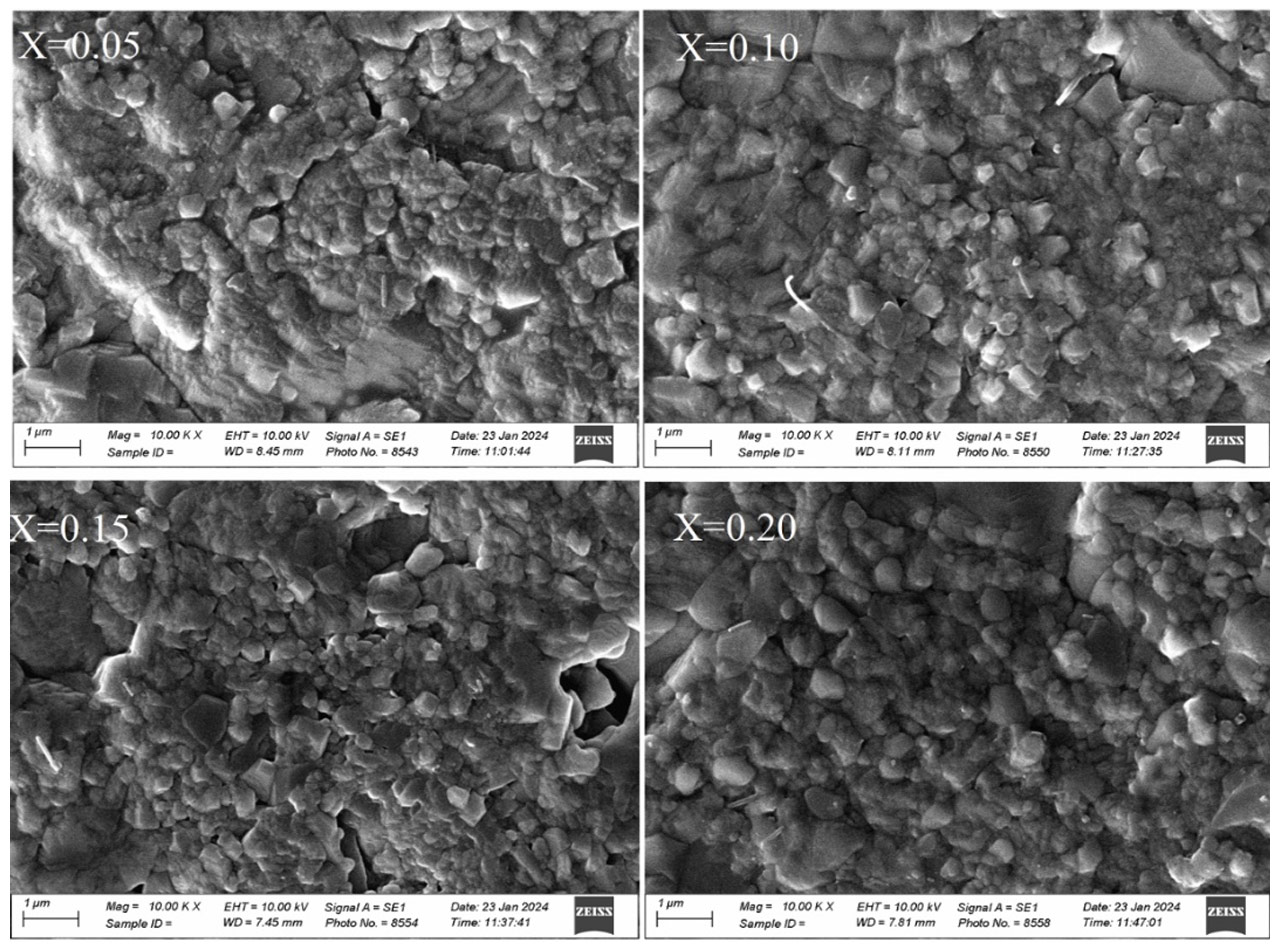
Lead-free (1-$x$)SrTiO$_3$-$x$CaZrO$_3$ solid-solution ceramics ($x$ = 0.05, 0.10, 0.15, 0.20) were synthesized via the conventional solid-state route to investigate structure-microstructure-dielectric relationships. X-ray diffraction patterns of the samples confirmed single-phase formation for all compositions, forming cubic perovskite structure (space group $Pm-3m$). Raman spectra were consistent with the perovskite lattice and local vibrational features, confirming perovskite structure. SEM micrographs revealed noticeable porosity for lower CaZrO$_3$ contents ($x$ = 0.05-0.15) and a more compact morphology at higher CaZrO$_3$ content, with a slight decrease in grain size as $x$ increases (average grain size $\approx 0.49 \, \mu\text{m}$). Dielectric measurements show pronounced frequency dispersion: the relative permittivity decreases with increasing frequency, consistent with dielectric relaxation behavior. Increasing CaZrO$_3$ content decreases the relative permittivity and decreases dielectric loss. The $x = 0.20$ sample showed reduced low-frequency loss, consistent with improved resistivity and densification. These results show that composition control in the SrTiO$_3$-CaZrO$_3$ system provides a practical route to tailor dielectric response in lead-free perovskite ceramics.
Graphical Abstract
Keywords
Data Availability Statement
Funding
Conflicts of Interest
AI Use Statement
Ethical Approval and Consent to Participate
References
- Khan, A., Ali, A., & Khan, I. (2021). Sintering behavior and microwave dielectric properties of CaTi1-x (Nb1/2Al1/2)xO3. Synthesis and Sintering, 1(3), 197-201.
[CrossRef] [Google Scholar] - Yang, H., Yan, F., Lin, Y., & Wang, T. (2017). Improvement of dielectric and energy storage properties in SrTiO3-based lead-free ceramics. Journal of Alloys and Compounds, 728, 780-787.
[CrossRef] [Google Scholar] - Petrov, P. K., Carlsson, E. F., Larsson, P., Friesel, M., & Ivanov, Z. G. (1998). Improved SrTiO3 multilayers for microwave application: Growth and properties. Journal of Applied Physics, 84(6), 3134-3140.
[CrossRef] [Google Scholar] - Shende, R. V., Krueger, D. S., Rossetti, G. A., & Lombardo, S. J. (2001). Strontium zirconate and strontium titanate ceramics for high‐voltage applications: synthesis, processing, and dielectric properties. Journal of the American Ceramic Society, 84(7), 1648-1650.
[CrossRef] [Google Scholar] - Parida, S., Rout, S. K., Subramanian, V., Barhai, P. K., Gupta, N., & Gupta, V. R. (2012). Structural, microwave dielectric properties and dielectric resonator antenna studies of Sr (ZrxTi1-x) O3 ceramics. Journal of Alloys and Compounds, 528, 126-134.
[CrossRef] [Google Scholar] - Yu, Z., Ang, C., & Cross, L. (1999). Oxygen-vacancy-related dielectric anomalies in La: SrTiO3. Applied Physics Letters, 74(20), 3044-3046.
[CrossRef] [Google Scholar] - Ang, C., Yu, Z., & Cross, L. (2000). Oxygen-vacancy-related low-frequency dielectric relaxation and electrical conduction in Bi:SrTiO3. Physical Review B, 62(1), 228.
[CrossRef] [Google Scholar] - Wang, Z., Cao, M., Yao, Z., Song, Z., Li, G., Hu, W., ... & Liu, H. (2014). Dielectric relaxation behavior and energy storage properties in SrTiO3 ceramics with trace amounts of ZrO2 additives. Ceramics International, 40(9), 14127-14132.
[CrossRef] [Google Scholar] - Lu, Z., Zhang, H., Lei, W., Sinclair, D. C., & Reaney, I. M. (2016). High-figure-of-merit thermoelectric La-doped A-site-deficient SrTiO3 ceramics. Chemistry of Materials, 28(3), 925-935.
[CrossRef] [Google Scholar] - Alay-e-Abbas, S. M., Nazir, S., Cottenier, S., & Shaukat, A. (2017). Evaluation of thermodynamics, formation energetics and electronic properties of vacancy defects in CaZrO3. Scientific Reports, 7(1), 8439.
[CrossRef] [Google Scholar] - Levin, I., Amos, T. G., Bell, S. M., Farber, L., Vanderah, T. A., Roth, R. S., & Toby, B. H. (2003). Phase equilibria, crystal structures, and dielectric anomaly in the BaZrO3–CaZrO3 system. Journal of Solid State Chemistry, 175(2), 170-181.
[CrossRef] [Google Scholar] - Hou, Z. (2008). Ab initio calculations of elastic modulus and electronic structures of cubic CaZrO3. Physica B: Condensed Matter, 403(17), 2624-2628.
[CrossRef] [Google Scholar] - Pollet, M., Marinel, S., & Desgardin, G. (2004). CaZrO3, a Ni-co-sinterable dielectric material for base metal-multilayer ceramic capacitor applications. Journal of the European Ceramic Society, 24(1), 119-127.
[CrossRef] [Google Scholar] - Prasanth, C., Kumar, H. P., Pazhani, R., Solomon, S., & Thomas, J. (2008). Synthesis, characterization and microwave dielectric properties of nanocrystalline CaZrO3 ceramics. Journal of Alloys and Compounds, 464(1-2), 306-309.
[CrossRef] [Google Scholar] - Wang, X., Hu, Q., Wang, Z., Zhou, F., & Li, L. (2022). High temperature dielectric relaxation and energy storage properties achieved in the CaZrO3–SrTiO3 composite ceramics. Modern Physics Letters B, 36(31), 2250160.
[CrossRef] [Google Scholar]
Cite This Article
TY  - JOUR
AU  - Ahmad, Basit
AU  - Khan, Akbar
PY  - 2026
DA  - 2026/04/02
TI  - Dielectric Properties of Lead-Free (1-x)SrTiO$_{3}$-xCaZrO$_3$ Solid-Solution Ceramics Prepared by Solid-State Sintering
JO  - Journal of Advanced Electronic Materials
T2  - Journal of Advanced Electronic Materials
JF  - Journal of Advanced Electronic Materials
VL  - 2
IS  - 2
SP  - 38
EP  - 43
DO  - 10.62762/JAEM.2026.626525
UR  - https://www.icck.org/article/abs/JAEM.2026.626525
KW  - SrTiO$_3$-CaZrO$_3$
KW  - solid solution
KW  - perovskite ceramics
KW  - dielectric constant
KW  - dielectric loss
KW  - dielectric relaxation
KW  - solid-state sintering
KW  - lead-free dielectrics
AB  - Lead-free (1-$x$)SrTiO$_3$-$x$CaZrO$_3$ solid-solution ceramics ($x$ = 0.05, 0.10, 0.15, 0.20) were synthesized via the conventional solid-state route to investigate structure-microstructure-dielectric relationships. X-ray diffraction patterns of the samples confirmed single-phase formation for all compositions, forming cubic perovskite structure (space group $Pm-3m$). Raman spectra were consistent with the perovskite lattice and local vibrational features, confirming perovskite structure. SEM micrographs revealed noticeable porosity for lower CaZrO$_3$ contents ($x$ = 0.05-0.15) and a more compact morphology at higher CaZrO$_3$ content, with a slight decrease in grain size as $x$ increases (average grain size $\approx 0.49 \, \mu\text{m}$). Dielectric measurements show pronounced frequency dispersion: the relative permittivity decreases with increasing frequency, consistent with dielectric relaxation behavior. Increasing CaZrO$_3$ content decreases the relative permittivity and decreases dielectric loss. The $x = 0.20$ sample showed reduced low-frequency loss, consistent with improved resistivity and densification. These results show that composition control in the SrTiO$_3$-CaZrO$_3$ system provides a practical route to tailor dielectric response in lead-free perovskite ceramics.
SN  - 3070-5649
PB  - Institute of Central Computation and Knowledge
LA  - English
ER  -
@article{Ahmad2026Dielectric,
  author = {Basit Ahmad and Akbar Khan},
  title = {Dielectric Properties of Lead-Free (1-x)SrTiO\$\_{3}\$-xCaZrO\$\_3\$ Solid-Solution Ceramics Prepared by Solid-State Sintering},
  journal = {Journal of Advanced Electronic Materials},
  year = {2026},
  volume = {2},
  number = {2},
  pages = {38-43},
  doi = {10.62762/JAEM.2026.626525},
  url = {https://www.icck.org/article/abs/JAEM.2026.626525},
  abstract = {Lead-free (1-\$x\$)SrTiO\$\_3\$-\$x\$CaZrO\$\_3\$ solid-solution ceramics (\$x\$ = 0.05, 0.10, 0.15, 0.20) were synthesized via the conventional solid-state route to investigate structure-microstructure-dielectric relationships. X-ray diffraction patterns of the samples confirmed single-phase formation for all compositions, forming cubic perovskite structure (space group \$Pm-3m\$). Raman spectra were consistent with the perovskite lattice and local vibrational features, confirming perovskite structure. SEM micrographs revealed noticeable porosity for lower CaZrO\$\_3\$ contents (\$x\$ = 0.05-0.15) and a more compact morphology at higher CaZrO\$\_3\$ content, with a slight decrease in grain size as \$x\$ increases (average grain size \$\approx 0.49 \, \mu\text{m}\$). Dielectric measurements show pronounced frequency dispersion: the relative permittivity decreases with increasing frequency, consistent with dielectric relaxation behavior. Increasing CaZrO\$\_3\$ content decreases the relative permittivity and decreases dielectric loss. The \$x = 0.20\$ sample showed reduced low-frequency loss, consistent with improved resistivity and densification. These results show that composition control in the SrTiO\$\_3\$-CaZrO\$\_3\$ system provides a practical route to tailor dielectric response in lead-free perovskite ceramics.},
  keywords = {SrTiO\$\_3\$-CaZrO\$\_3\$, solid solution, perovskite ceramics, dielectric constant, dielectric loss, dielectric relaxation, solid-state sintering, lead-free dielectrics},
  issn = {3070-5649},
  publisher = {Institute of Central Computation and Knowledge}
}
Article Metrics
Publisher's Note
ICCK stays neutral with regard to jurisdictional claims in published maps and institutional affiliations.
Rights and Permissions
 Copyright © 2026 by the Author(s). Published by Institute of Central Computation and Knowledge. This article is an open access article distributed under the terms and conditions of the Creative Commons Attribution (CC BY) license (https://creativecommons.org/licenses/by/4.0/), which permits use, sharing, adaptation, distribution and reproduction in any medium or format, as long as you give appropriate credit to the original author(s) and the source, provide a link to the Creative Commons licence, and indicate if changes were made.


Portico
