

High-Loading Waste-Derived Fillers in Poly (Vinylidene Fluoride) Composites: Comparative Effects of Alum Sludge and Wood Dust on Mechanical, Thermal and Dielectric Properties




Article Information
Abstract
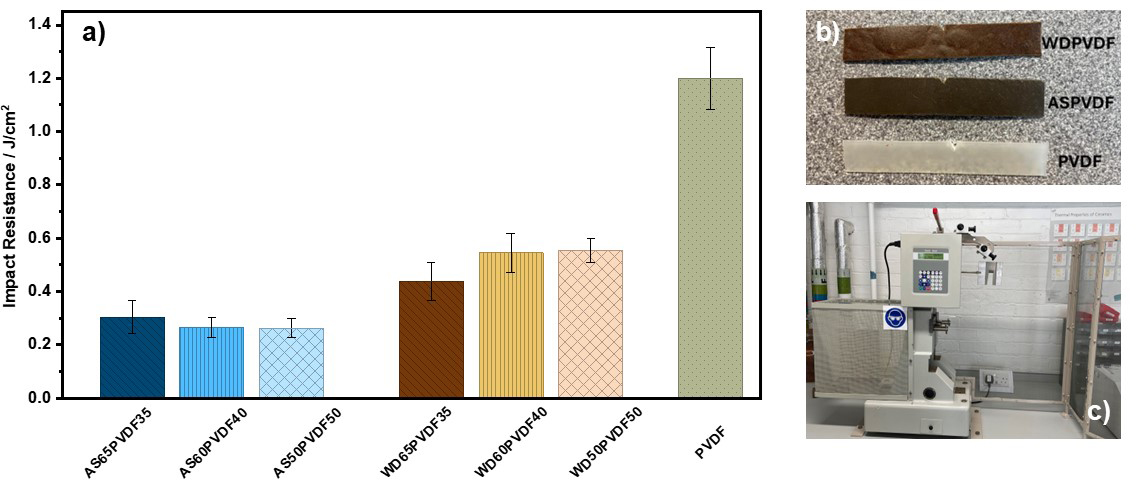
Poly (vinylidene fluoride) (PVDF) composites with high loadings (50-65 wt%) of waste-derived fillers—alum sludge (AS), an inorganic water treatment residue, and wood dust (WD), a lignocellulosic timber by-product—were prepared via melt compounding and compression moulding without compatibilisers. Mechanical, thermal, and dielectric properties were systematically characterised. Increasing filler loading enhanced Young’s modulus but reduced elongation and impact resistance due to restricted chain mobility and stress concentration. Dielectric behaviour differed markedly between the two systems: AS composites exhibited progressive increases in relative permittivity (up to ~70%) attributed to interfacial polarisation, whereas WD composites showed only modest changes due to the low dielectric contrast of lignocellulosic fillers. Differential scanning calorimetry revealed reduced PVDF crystallinity in composites, indicating hindered crystal formation at high filler concentrations. Overall, PVDF can accommodate substantial waste-derived filler fractions while maintaining processability and functional dielectric performance, offering a sustainable pathway for valorising industrial and biomass residues in dielectric materials.
Graphical Abstract
Keywords
Data Availability Statement
Funding
Conflicts of Interest
AI Use Statement
Ethical Approval and Consent to Participate
References
- Gregorio, R., & Ueno, E. M. (1999). Effect of crystalline phase, orientation and temperature on the dielectric properties of poly (vinylidene fluoride) (PVDF). Journal of Materials Science, 34(18), 4489–4500.
[CrossRef] [Google Scholar] - Sukumaran, S., Szewczyk, P. K., Knapczyk‐Korczak, J., & Stachewicz, U. (2023). Optimizing piezoelectric coefficient in PVDF fibers: key strategies for energy harvesting and smart textiles. Advanced Electronic Materials, 9(12), 2300404.
[CrossRef] [Google Scholar] - Almadhoun, M. N., Khan, M. A., Rajab, K., Park, J. H., Buriak, J. M., & Alshareef, H. N. (2019). UV‐Induced Ferroelectric Phase Transformation in PVDF Thin Films. Advanced Electronic Materials, 5(1), 1800363.
[CrossRef] [Google Scholar] - Saxena, P., & Shukla, P. (2021). A comprehensive review on fundamental properties and applications of poly (vinylidene fluoride) (PVDF). Advanced Composites and Hybrid Materials, 4(1), 8–26.
[CrossRef] [Google Scholar] - Xia, W., & Zhang, Z. (2018). PVDF‐based dielectric polymers and their applications in electronic materials. IET Nanodielectrics, 1(1), 17–31.
[CrossRef] [Google Scholar] - Martins, P., Lopes, A. C., & Lanceros-Mendez, S. (2014). Electroactive phases of poly(vinylidene fluoride): Determination, processing and applications. Progress in Polymer Science, 39(4), 683–706.
[CrossRef] [Google Scholar] - Niu, Y., Yu, K., Bai, Y., & Wang, H. (2015). Enhanced dielectric performance of BaTiO 3/PVDF composites prepared by modified process for energy storage applications. IEEE transactions on ultrasonics, ferroelectrics, and frequency control, 62(1), 108-115.
[CrossRef] [Google Scholar] - Zha, X. J., Pu, J. H., Ma, L. F., Li, T., Bao, R. Y., Bai, L., ... & Yang, W. (2018). A particular interfacial strategy in PVDF/OBC/MWCNT nanocomposites for high dielectric performance and electromagnetic interference shielding. Composites Part A: Applied Science and Manufacturing, 105, 118-125.
[CrossRef] [Google Scholar] - Jaleh, B., Sodagar, S., Momeni, A., & Jabbari, A. (2016). Nanodiamond particles/PVDF nanocomposite flexible films: thermal, mechanical and physical properties. Materials research express, 3(8), 085028. 10.1088/2053-1591/3/8/085028
[Google Scholar] - Babatunde, A. O., & Zhao, Y. Q. (2007). Constructive approaches toward water treatment works sludge management: an international review of beneficial reuses. Critical reviews In environmental science and technology, 37(2), 129-164.
[CrossRef] [Google Scholar] - Simpson, A., Burgess, P., & Coleman, S. J. (2002). The management of potable water treatment sludge: present situation in the UK. Water and Environment Journal, 16(4), 260-263.
[CrossRef] [Google Scholar] - Owen, P. G. (2002). Water‐Treatment Works’ Sludge Management. Water and Environment Journal, 16(4), 282-285.
[CrossRef] [Google Scholar] - Dassanayake, K. B., Jayasinghe, G. Y., Surapaneni, A., & Hetherington, C. (2015). A review on alum sludge reuse with special reference to agricultural applications and future challenges. Waste Management, 38, 321-335.
[CrossRef] [Google Scholar] - Pandey, S. (2022). Wood waste utilization and associated product development from under-utilized low-quality wood and its prospects in Nepal. SN Applied Sciences, 4(6), 168.
[CrossRef] [Google Scholar] - Mohammed, M., Jawad, A. J. A. M., Mohammed, A. M., Oleiwi, J. K., Adam, T., Osman, A. F., ... & Jaafar, M. (2023). Challenges and advancement in water absorption of natural fiber-reinforced polymer composites. Polymer Testing, 124, 108083.
[CrossRef] [Google Scholar] - Sun, D., Saw, B. L., Onyianta, A. J., Wang, B., Wilson, C., O’Rourke, D., ... & Lu, Z. (2023). Preparation of elastomeric nanocomposites using nanocellulose and recycled alum sludge for flexible dielectric materials. Journal of Advanced Dielectrics, 13(01), 2242008.
[CrossRef] [Google Scholar] - Purushothaman, S. M., Tronco, M. F., Ponçot, M., CS, C., Guigo, N., Malfois, M., ... & Rouxel, D. (2024). Quantifying the crystalline polymorphism in PVDF: comparative criteria using DSC, WAXS, FT-IR, and Raman spectroscopy. ACS Applied Polymer Materials, 6(14), 8291-8305.
[CrossRef] [Google Scholar] - Wang, S., Liu, L., Zeng, Y., Zhou, B., Teng, K., Ma, M., ... & Xu, Z. (2015). Improving dielectric properties of poly (vinylidene fluoride) composites: effects of surface functionalization of exfoliated graphene. Journal of Adhesion Science and Technology, 29(7), 678-690.
[CrossRef] [Google Scholar] - Yu, Q., Wang, H., Yuan, C., Wang, T., & Yan, C. (2024). PVDF-based dielectric composites with high energy density by coloading of C-MWCNTs and CTAB@ sepiolite nanofibers. ACS Applied Polymer Materials, 6(18), 11213-11222.
[CrossRef] [Google Scholar] - Elloumi, I., Koubaa, A., Kharrat, W., Bradai, C., & Elloumi, A. (2021). Dielectric properties of wood-polymer composites: Effects of frequency, fiber nature, proportion, and chemical composition. Journal of Composites Science, 5(6), 141.
[CrossRef] [Google Scholar] - Zhang, X., Li, B. W., Dong, L., Liu, H., Chen, W., Shen, Y., & Nan, C. W. (2018). Superior energy storage performances of polymer nanocomposites via modification of filler/polymer interfaces. Advanced Materials Interfaces, 5(11), 1800096.
[CrossRef] [Google Scholar] - Kremer, F., & Schönhals, A. (Eds.). (2002). Broadband dielectric spectroscopy. Springer Science & Business Media.
[CrossRef] [Google Scholar] - Li, B., Randall, C. A., & Manias, E. (2022). Polarization mechanism underlying strongly enhanced dielectric permittivity in polymer composites with conductive fillers. The Journal of Physical Chemistry C, 126(17), 7596-7604.
[CrossRef] [Google Scholar] - Popielarz, R., Chiang, C. K., Nozaki, R., & Obrzut, J. (2001). Dielectric properties of polymer/ferroelectric ceramic composites from 100 Hz to 10 GHz. Macromolecules, 34(17), 5910-5915.
[CrossRef] [Google Scholar] - Jonscher, A. K. (1999). Dielectric relaxation in solids. Journal of Physics D: Applied Physics, 32(14), R57–R70.
[CrossRef] [Google Scholar] - Yuan, M., Wang, H., Wang, T., Yang, H., & Yuan, C. (2023). Synergistic improvement in $\gamma$-phase content and dielectric properties of PVDF/deep eutectic solvent/montmorillonite composite films. ACS Applied Polymer Materials, 5(4), 2664–2673.
[CrossRef] [Google Scholar] - Tu, S., Qiu, L., Liu, C., Zeng, F., Yuan, Y. Y., Hedhili, M. N., ... & Zhang, X. (2024). Suppressing dielectric loss in MXene/polymer nanocomposites through interfacial interactions. ACS nano, 18(14), 10196-10205.
[CrossRef] [Google Scholar] - Al-Mufti, S. M. S., Almontasser, A., & Rizvi, S. J. A. (2023). Unsaturated polyester resin filled with cementitious materials: A comprehensive study of filler loading impact on mechanical properties, microstructure, and water absorption. ACS Omega, 8(23), 20389–20403.
[CrossRef] [Google Scholar] - Sun, D., Henthorn, T., Popescu, C. M., & Salehiyan, R. (2025). Upcycling alum sludge as a reinforcement in PBAT composites: a sustainable approach to waste valorisation. Applied Sciences, 15(5), 2591.
[CrossRef] [Google Scholar] - Hirçin, B. Ş., & Yörür, H. (2021). Effects of filler type and content on the mechanical, morphological, and thermal properties of waste casting polyamide 6 (W-PA6G)-based wood plastic composites. BioResources, 16(1), 655.
[CrossRef] [Google Scholar] - Ning, N. Y., Yin, Q. J., Luo, F., Zhang, Q., Du, R., & Fu, Q. (2007). Crystallization behavior and mechanical properties of polypropylene/halloysite composites. Polymer, 48(25), 7374-7384.
[CrossRef] [Google Scholar] - Cao, J., Wang, Y., Ke, K., Luo, Y., Yang, W., Xie, B. H., & Yang, M. B. (2012). Crystallization, rheological behavior and mechanical properties of poly (vinylidene fluoride) composites containing graphitic fillers: a comparative study. Polymer international, 61(6), 1031-1040.
[CrossRef] [Google Scholar] - Ming, Y., Zhou, Z., Hao, T., & Nie, Y. (2022). Polymer Nanocomposites: Role of modified filler content and interfacial interaction on crystallization. European Polymer Journal, 162, 110894.
[CrossRef] [Google Scholar] - Galeski, A. (2003). Strength and toughness of crystalline polymer systems. Progress in polymer science, 28(12), 1643-1699.
[CrossRef] [Google Scholar] - Franciszczak, P., Wojnowski, J., Kalniņš, K., & Piesowicz, E. (2019). The influence of matrix crystallinity on the mechanical performance of short-fibre composites–Based on homo-polypropylene and a random polypropylene copolymer reinforced with man-made cellulose and glass fibres. Composites Part B: Engineering, 166, 516-526.
[CrossRef] [Google Scholar]
Cite This Article
TY  - JOUR
AU  - Lasseuguette, Elsa
AU  - Doger, Alperen Hamit
AU  - Salehiyan, Reza
AU  - Sun, Dongyang
PY  - 2026
DA  - 2026/03/29
TI  - High-Loading Waste-Derived Fillers in Poly (Vinylidene Fluoride) Composites: Comparative Effects of Alum Sludge and Wood Dust on Mechanical, Thermal and Dielectric Properties
JO  - Journal of Advanced Electronic Materials
T2  - Journal of Advanced Electronic Materials
JF  - Journal of Advanced Electronic Materials
VL  - 2
IS  - 1
SP  - 25
EP  - 37
DO  - 10.62762/JAEM.2026.709014
UR  - https://www.icck.org/article/abs/JAEM.2026.709014
KW  - alum sludge
KW  - PVDF
KW  - wood dust
KW  - dielectric
KW  - composites
KW  - high filler loading
AB  - Poly (vinylidene fluoride) (PVDF) composites with high loadings (50-65 wt%) of waste-derived fillers—alum sludge (AS), an inorganic water treatment residue, and wood dust (WD), a lignocellulosic timber by-product—were prepared via melt compounding and compression moulding without compatibilisers. Mechanical, thermal, and dielectric properties were systematically characterised. Increasing filler loading enhanced Young’s modulus but reduced elongation and impact resistance due to restricted chain mobility and stress concentration. Dielectric behaviour differed markedly between the two systems: AS composites exhibited progressive increases in relative permittivity (up to ~70%) attributed to interfacial polarisation, whereas WD composites showed only modest changes due to the low dielectric contrast of lignocellulosic fillers. Differential scanning calorimetry revealed reduced PVDF crystallinity in composites, indicating hindered crystal formation at high filler concentrations. Overall, PVDF can accommodate substantial waste-derived filler fractions while maintaining processability and functional dielectric performance, offering a sustainable pathway for valorising industrial and biomass residues in dielectric materials.
SN  - 3070-5649
PB  - Institute of Central Computation and Knowledge
LA  - English
ER  -
@article{Lasseuguette2026HighLoadin,
  author = {Elsa Lasseuguette and Alperen Hamit Doger and Reza Salehiyan and Dongyang Sun},
  title = {High-Loading Waste-Derived Fillers in Poly (Vinylidene Fluoride) Composites: Comparative Effects of Alum Sludge and Wood Dust on Mechanical, Thermal and Dielectric Properties},
  journal = {Journal of Advanced Electronic Materials},
  year = {2026},
  volume = {2},
  number = {1},
  pages = {25-37},
  doi = {10.62762/JAEM.2026.709014},
  url = {https://www.icck.org/article/abs/JAEM.2026.709014},
  abstract = {Poly (vinylidene fluoride) (PVDF) composites with high loadings (50-65 wt\%) of waste-derived fillers—alum sludge (AS), an inorganic water treatment residue, and wood dust (WD), a lignocellulosic timber by-product—were prepared via melt compounding and compression moulding without compatibilisers. Mechanical, thermal, and dielectric properties were systematically characterised. Increasing filler loading enhanced Young’s modulus but reduced elongation and impact resistance due to restricted chain mobility and stress concentration. Dielectric behaviour differed markedly between the two systems: AS composites exhibited progressive increases in relative permittivity (up to ~70\%) attributed to interfacial polarisation, whereas WD composites showed only modest changes due to the low dielectric contrast of lignocellulosic fillers. Differential scanning calorimetry revealed reduced PVDF crystallinity in composites, indicating hindered crystal formation at high filler concentrations. Overall, PVDF can accommodate substantial waste-derived filler fractions while maintaining processability and functional dielectric performance, offering a sustainable pathway for valorising industrial and biomass residues in dielectric materials.},
  keywords = {alum sludge, PVDF, wood dust, dielectric, composites, high filler loading},
  issn = {3070-5649},
  publisher = {Institute of Central Computation and Knowledge}
}
Article Metrics
Publisher's Note
ICCK stays neutral with regard to jurisdictional claims in published maps and institutional affiliations.
Rights and Permissions
 Copyright © 2026 by the Author(s). Published by Institute of Central Computation and Knowledge. This article is an open access article distributed under the terms and conditions of the Creative Commons Attribution (CC BY) license (https://creativecommons.org/licenses/by/4.0/), which permits use, sharing, adaptation, distribution and reproduction in any medium or format, as long as you give appropriate credit to the original author(s) and the source, provide a link to the Creative Commons licence, and indicate if changes were made.


Portico
