

Ferroelectric and Dielectric Properties of Lead-free $K_{0.5}Bi_{0.5}TiO_3$-BiFeO$_3$ Ceramics


Article Information
Abstract
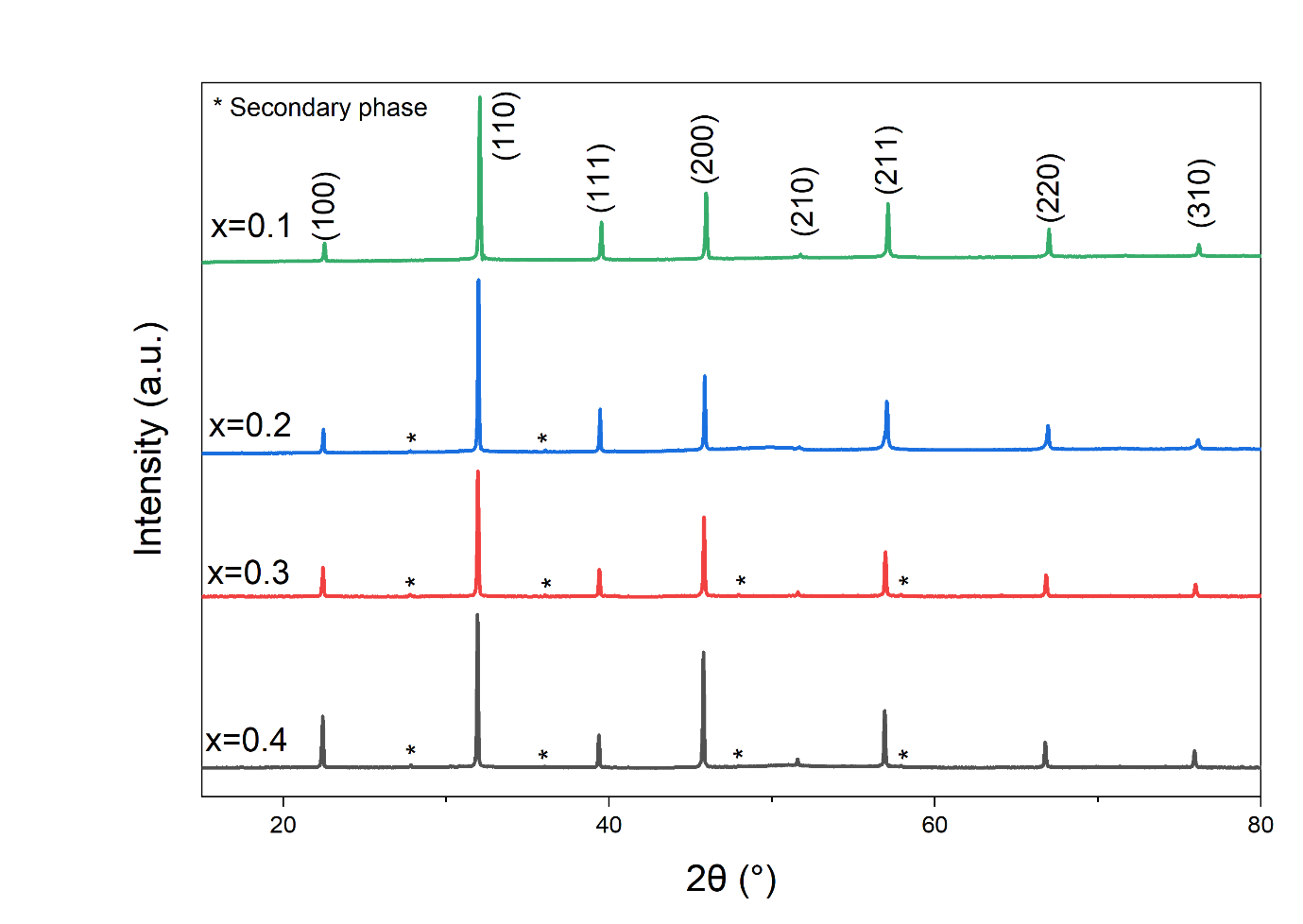
Lead-free (1-$x$)K$_{0.5}$Bi$_{0.5}$TiO$_3$-$x$BiFeO$_3$ ceramics with $x = 0.1$-0.4 were prepared by a conventional solid-state reaction. X-ray diffraction coupled with Rietveld refinement confirmed main perovskite phase with pseudo-cubic structure. Temperature-dependent dielectric measurements revealed broad dielectric anomalies and frequency dispersion, indicating relaxor behaviour. At 100 kHz, the highest room-temperature relative permittivity of 925 was obtained at $x = 0.2$. The highest maximum and remanent polarisation were obtained at $x = 0.3$ with 30 and 16 $\mu$C cm$^{-2}$, respectively. This work demonstrates a new lead-free solid solution for dielectric and ferroelectric applications.
Graphical Abstract
Keywords
Data Availability Statement
Funding
Conflicts of Interest
AI Use Statement
Ethical Approval and Consent to Participate
References
- Jo, W., Dittmer, R., Acosta, M., Zang, J., Groh, C., Sapper, E., ... & Rödel, J. (2012). Giant electric-field-induced strains in lead-free ceramics for actuator applications–status and perspective. Journal of Electroceramics, 29(1), 71-93.
[CrossRef] [Google Scholar] - Bell, A. J., & Deubzer, O. (2018). Lead-free piezoelectrics—The environmental and regulatory issues. Mrs bulletin, 43(8), 581-587.
[CrossRef] [Google Scholar] - Rödel, J., Jo, W., Seifert, K. T., Anton, E. M., Granzow, T., & Damjanovic, D. (2009). Perspective on the development of lead‐free piezoceramics. Journal of the American Ceramic Society, 92(6), 1153-1177.
[CrossRef] [Google Scholar] - Hiruma, Y., Aoyagi, R., Nagata, H., & Takenaka, T. (2005). Ferroelectric and piezoelectric properties of (Bi1/2K1/2) TiO3 ceramics. Japanese journal of applied physics, 44(7R), 5040.
[CrossRef] [Google Scholar] - König, J., Spreitzer, M., Jančar, B., Suvorov, D., Samardžija, Z., & Popovič, A. (2009). The thermal decomposition of K0. 5Bi0. 5TiO3 ceramics. Journal of the European Ceramic Society, 29(9), 1695-1701.
[CrossRef] [Google Scholar] - Fisher, J. G., Kim, M. G., Kim, D., Cha, S. J., Vu, H. V., Nguyen, D., ... & Kim, M. H. (2015). Reactive sintering of (K0. 5Bi0. 5) TiO3-BiFeO3 lead-free piezoelectric ceramics. Journal of the Korean Physical Society, 66(9), 1426-1438.
[CrossRef] [Google Scholar] - Lebeugle, D., Colson, D., Forget, A., & Viret, M. (2007). Very large spontaneous electric polarization in BiFeO3 single crystals at room temperature and its evolution under cycling fields. Applied Physics Letters, 91(2), 022907.
[CrossRef] [Google Scholar] - Matsuo, H., Kitanaka, Y., Noguchi, Y., Miyayama, M., Moriwake, H., Kuwabara, A., & Tanaka, I. (2010). Structural and piezoelectric properties of high-density (Bi0.5K0.5)TiO3–BiFeO3 ceramics. Journal of Applied Physics, 108(10), 104103.
[CrossRef] [Google Scholar] - Morozov, M. I., Einarsrud, M. A., Grande, T., & Damjanovic, D. (2012). Lead-free relaxor-like 0.75 Bi0. 5K0. 5TiO3–0.25 BiFeO3 ceramics with large electric field-induced strain. Ferroelectrics, 439(1), 88-94.
[CrossRef] [Google Scholar] - Wang, H., Li, E., Wei, K., Li, H., Xing, M., & Zhong, C. (2022). Significantly Enhanced Energy Storage Performance in High Hardness BKT-Based Ceramic via Defect Engineering and Relaxor Tuning. ACS Applied Materials & Interfaces, 14(48), 54021–54033.
[CrossRef] [Google Scholar] - Wefring, E. T., Einarsrud, M. A., & Grande, T. (2015). Electrical conductivity and thermopower of (1-x) BiFeO 3-x Bi 0.5 K 0.5 TiO 3 (x= 0.1, 0.2) ceramics near the ferroelectric to paraelectric phase transition. Physical Chemistry Chemical Physics, 17(14), 9420-9428.
[CrossRef] [Google Scholar] - Zhang, Q., Zhang, Y., Wang, F., Wang, Y., Lin, D., Zhao, X., ... & Viehland, D. (2009). Enhanced piezoelectric and ferroelectric properties in Mn-doped Na0. 5Bi0. 5TiO3–BaTiO3 single crystals. Applied Physics Letters, 95(10), 102904.
[CrossRef] [Google Scholar] - Leontsev, S. O., & Eitel, R. E. (2009). Dielectric and piezoelectric properties in Mn‐modified (1-x) BiFeO3-xBaTiO3 ceramics. Journal of the American Ceramic Society, 92(12), 2957-2961.
[CrossRef] [Google Scholar] - Stewart, M., Cain, M. G., & Hall, D. A. (1999). Ferroelectric hysteresis measurement and analysis. NPL Report CMMT(A)152. National Physical Laboratory.
[Google Scholar] - König, J., & Suvorov, D. (2015). Evolution of the electrical properties of K0. 5Bi0. 5TiO3 as a result of prolonged sintering. Journal of the European Ceramic Society, 35(10), 2791-2799.
[CrossRef] [Google Scholar] - Suchanicz, J., Kania, A., Czaja, P., Budziak, A., & Niewiadomski, A. (2018). Structural, thermal, dielectric and ferroelectric properties of K0. 5Bi0. 5TiO3 ceramics. Journal of the European Ceramic Society, 38(2), 567-574.
[CrossRef] [Google Scholar] - Zaremba, T. (2003). Application of thermal analysis to study of the synthesis of K 0.5 Bi 0.5 Tio 3 ferroelectric. Journal of thermal analysis and calorimetry, 74(2), 653-658.
[CrossRef] [Google Scholar] - Shannon, R. D. (1976). Revised effective ionic radii and systematic studies of interatomic distances in halides and chalcogenides. Foundations of Crystallography, 32(5), 751-767.
[CrossRef] [Google Scholar]
Cite This Article
TY  - JOUR
AU  - Wen, Jianxi
AU  - Wang, Ge
PY  - 2026
DA  - 2026/06/22
TI  - Ferroelectric and Dielectric Properties of Lead-free $K_{0.5}Bi_{0.5}TiO_3$-BiFeO$_3$ Ceramics
JO  - Journal of Advanced Electronic Materials
T2  - Journal of Advanced Electronic Materials
JF  - Journal of Advanced Electronic Materials
VL  - 2
IS  - 2
SP  - 51
EP  - 57
DO  - 10.62762/JAEM.2026.712321
UR  - https://www.icck.org/article/abs/JAEM.2026.712321
KW  - lead-free
KW  - KBT-BF
KW  - dielectric
KW  - ferroelectric
KW  - relaxor
AB  - Lead-free (1-$x$)K$_{0.5}$Bi$_{0.5}$TiO$_3$-$x$BiFeO$_3$ ceramics with $x = 0.1$-0.4 were prepared by a conventional solid-state reaction. X-ray diffraction coupled with Rietveld refinement confirmed main perovskite phase with pseudo-cubic structure. Temperature-dependent dielectric measurements revealed broad dielectric anomalies and frequency dispersion, indicating relaxor behaviour. At 100 kHz, the highest room-temperature relative permittivity of 925 was obtained at $x = 0.2$. The highest maximum and remanent polarisation were obtained at $x = 0.3$ with 30 and 16 $\mu$C cm$^{-2}$, respectively. This work demonstrates a new lead-free solid solution for dielectric and ferroelectric applications.
SN  - 3070-5649
PB  - Institute of Central Computation and Knowledge
LA  - English
ER  -
@article{Wen2026Ferroelect,
  author = {Jianxi Wen and Ge Wang},
  title = {Ferroelectric and Dielectric Properties of Lead-free \$K\_{0.5}Bi\_{0.5}TiO\_3\$-BiFeO\$\_3\$ Ceramics},
  journal = {Journal of Advanced Electronic Materials},
  year = {2026},
  volume = {2},
  number = {2},
  pages = {51-57},
  doi = {10.62762/JAEM.2026.712321},
  url = {https://www.icck.org/article/abs/JAEM.2026.712321},
  abstract = {Lead-free (1-\$x\$)K\$\_{0.5}\$Bi\$\_{0.5}\$TiO\$\_3\$-\$x\$BiFeO\$\_3\$ ceramics with \$x = 0.1\$-0.4 were prepared by a conventional solid-state reaction. X-ray diffraction coupled with Rietveld refinement confirmed main perovskite phase with pseudo-cubic structure. Temperature-dependent dielectric measurements revealed broad dielectric anomalies and frequency dispersion, indicating relaxor behaviour. At 100 kHz, the highest room-temperature relative permittivity of 925 was obtained at \$x = 0.2\$. The highest maximum and remanent polarisation were obtained at \$x = 0.3\$ with 30 and 16 \$\mu\$C cm\$^{-2}\$, respectively. This work demonstrates a new lead-free solid solution for dielectric and ferroelectric applications.},
  keywords = {lead-free, KBT-BF, dielectric, ferroelectric, relaxor},
  issn = {3070-5649},
  publisher = {Institute of Central Computation and Knowledge}
}
Article Metrics
Publisher's Note
ICCK stays neutral with regard to jurisdictional claims in published maps and institutional affiliations.
Rights and Permissions
 Copyright © 2026 by the Author(s). Published by Institute of Central Computation and Knowledge. This article is an open access article distributed under the terms and conditions of the Creative Commons Attribution (CC BY) license (https://creativecommons.org/licenses/by/4.0/), which permits use, sharing, adaptation, distribution and reproduction in any medium or format, as long as you give appropriate credit to the original author(s) and the source, provide a link to the Creative Commons licence, and indicate if changes were made.


Portico
