
MDH-Pose: Multimodal Deep Hashing with Adaptive Graph Fusion for Efficient Retrieval of Similar Protein Structures





Article Information
Abstract
The Protein Data Bank (PDB) and, even more, predicted-structure databases have grown to a size at which pairwise structural alignment is no longer a practical way to search them. Alignment tools are accurate, but their cost grows superlinearly with protein length and linearly with database size, which rules out interactive search over hundreds of millions of entries. We present MDH-Pose, a multimodal deep hashing framework that maps each protein structure to a compact binary code. Separate encoders process the amino acid sequence, the C$\alpha$ geometry and residue-level physicochemical properties, and a cross-modal attention module fuses the three streams. In the structural stream, the edge weights of the residue graph are learned from spatial proximity, BLOSUM62 substitution similarity and physicochemical similarity, so that the graph attention network can also use residue pairs that are functionally related but not in direct contact. Codes are trained with a triplet objective whose margin grows with the TM-score gap between the positive and negative pair and with training progress. On SCOPe, CATH and PDB40, MDH-Pose reaches a mean average precision (mAP) of 94.2% $\pm$ 0.8%, 91.7% $\pm$ 0.9% and 89.5% $\pm$ 1.0%, respectively, with an average query time of 0.54~ms and 98.7% less storage than C$\alpha$ coordinates (128-bit codes, proteins of about 103 residues), which makes large-scale structure retrieval feasible on standard hardware. The margin over TM-align widens from 6.9 percentage points on SCOPe to 7.9 on the harder PDB40 set, and ablation studies show that removing any of the three modalities lowers accuracy on all datasets.
Graphical Abstract
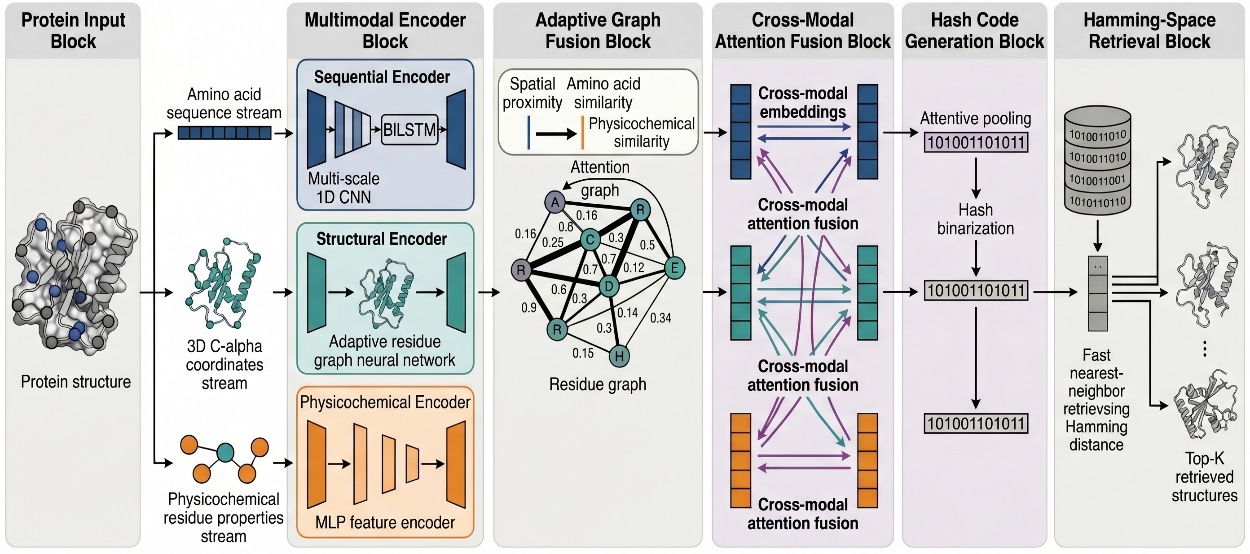
Keywords
Data Availability Statement
Funding
Conflicts of Interest
AI Use Statement
Ethical Approval and Consent to Participate
References
- Holm, L., & Sander, C. (1993). Protein structure comparison by alignment of distance matrices. Journal of molecular biology, 233(1), 123-138.
[CrossRef] [Google Scholar] - Zhang, Y., & Skolnick, J. (2005). TM-align: a protein structure alignment algorithm based on the TM-score. Nucleic acids research, 33(7), 2302-2309.
[CrossRef] [Google Scholar] - Shindyalov, I. N., & Bourne, P. E. (1998). Protein structure alignment by incremental combinatorial extension (CE) of the optimal path. Protein engineering, 11(9), 739-747.
[CrossRef] [Google Scholar] - Meng, Y., Zhang, Z., Zhou, C., Tang, X., Hu, X., Tian, G., ... & Yao, Y. (2025). Protein structure prediction via deep learning: an in-depth review. Frontiers in Pharmacology, 16, 1498662.
[CrossRef] [Google Scholar] - Chen, L., Li, Q., Nasif, K. F. A., Xie, Y., Deng, B., Niu, S., ... & Xie, C. Y. (2024). AI-driven deep learning techniques in protein structure prediction. International journal of molecular sciences, 25(15), 8426.
[CrossRef] [Google Scholar] - Varadi, M., Anyango, S., Deshpande, M., Nair, S., Natassia, C., Yordanova, G., ... & Velankar, S. (2022). AlphaFold Protein Structure Database: massively expanding the structural coverage of protein-sequence space with high-accuracy models. Nucleic acids research, 50(D1), D439-D444.
[CrossRef] [Google Scholar] - Lin, Z., Akin, H., Rao, R., Hie, B., Zhu, Z., Lu, W., ... & Rives, A. (2023). Evolutionary-scale prediction of atomic-level protein structure with a language model. Science, 379(6637), 1123-1130.
[CrossRef] [Google Scholar] - Van Kempen, M., Kim, S. S., Tumescheit, C., Mirdita, M., Lee, J., Gilchrist, C. L., ... & Steinegger, M. (2024). Fast and accurate protein structure search with Foldseek. Nature biotechnology, 42(2), 243-246.
[CrossRef] [Google Scholar] - Hong, L., Hu, Z., Sun, S., Tang, X., Wang, J., Tan, Q., ... & Li, Y. (2025). Fast, sensitive detection of protein homologs using deep dense retrieval. Nature Biotechnology, 43(6), 983-995.
[CrossRef] [Google Scholar] - Elnaggar, A., Heinzinger, M., Dallago, C., Rehawi, G., Wang, Y., Jones, L., ... & Rost, B. (2021). ProtTrans: toward understanding the language of life through self-supervised learning. IEEE transactions on pattern analysis and machine intelligence, 44(10), 7112-7127.
[CrossRef] [Google Scholar] - Rives, A., Meier, J., Sercu, T., Goyal, S., Lin, Z., Liu, J., ... & Fergus, R. (2021). Biological structure and function emerge from scaling unsupervised learning to 250 million protein sequences. Proceedings of the national academy of sciences, 118(15), e2016239118.
[CrossRef] [Google Scholar] - Gligorijević, V., Renfrew, P. D., Kosciolek, T., Leman, J. K., Berenberg, D., Vatanen, T., ... & Bonneau, R. (2021). Structure-based protein function prediction using graph convolutional networks. Nature communications, 12(1), 3168.
[CrossRef] [Google Scholar] - Zhang, Z., Xu, M., Jamasb, A., Chenthamarakshan, V., Lozano, A., Das, P., & Tang, J. (2022). Protein representation learning by geometric structure pretraining. arXiv preprint arXiv:2203.06125.
[CrossRef] [Google Scholar] - Abdine, H., Chatzianastasis, M., Bouyioukos, C., & Vazirgiannis, M. (2024, March). Prot2text: Multimodal protein’s function generation with gnns and transformers. In Proceedings of the AAAI conference on artificial intelligence (Vol. 38, No. 10, pp. 10757-10765).
[CrossRef] [Google Scholar] - Liu, X., Jiang, S., Tien, C. C., Xu, J., & Stevens, R. L. (2025). Bidirectional hierarchical protein multi-modal representation learning. In Proceedings of the 10th Machine Learning for Healthcare Conference, PMLR 298. https://proceedings.mlr.press/v298/liu25a.html
[Google Scholar] - Gionis, A., Indyk, P., & Motwani, R. (1999). Similarity search in high dimensions via hashing. In Proceedings of the 25th International Conference on Very Large Data Bases (VLDB) (pp. 518-529). https://www.cs.princeton.edu/courses/archive/spring13/cos598C/Gionis.pdf
[Google Scholar] - Gong, Y., Lazebnik, S., Gordo, A., & Perronnin, F. (2012). Iterative quantization: A procrustean approach to learning binary codes for large-scale image retrieval. IEEE transactions on pattern analysis and machine intelligence, 35(12), 2916-2929.
[CrossRef] [Google Scholar] - Liu, H., Wang, R., Shan, S., & Chen, X. (2016). Deep supervised hashing for fast image retrieval. In Proceedings of the IEEE Conference on Computer Vision and Pattern Recognition (CVPR) (pp. 2064-2072).
[CrossRef] [Google Scholar] - Cao, Z., Long, M., Wang, J., & Yu, P. S. (2017). HashNet: Deep learning to hash by continuation. In Proceedings of the IEEE International Conference on Computer Vision (ICCV) (pp. 5608-5617).
[CrossRef] [Google Scholar] - Wang, J., Zhang, T., Song, J., Sebe, N., & Shen, H. T. (2017). A survey on learning to hash. IEEE transactions on pattern analysis and machine intelligence, 40(4), 769-790.
[CrossRef] [Google Scholar] - Han, J., & Li, W. J. (2024). Hashing for protein structure similarity search. arXiv preprint arXiv:2411.08286.
[CrossRef] [Google Scholar] - Holm, L., & Sander, C. (1996). Mapping the protein universe. Science, 273(5275), 595-602.
[CrossRef] [Google Scholar] - Zhang, Y., & Skolnick, J. (2004). Scoring function for automated assessment of protein structure template quality. Proteins: Structure, Function, and Bioinformatics, 57(4), 702-710.
[CrossRef] [Google Scholar] - Tung, C. H., Huang, J. W., & Yang, J. M. (2007). Kappa-alpha plot derived structural alphabet and BLOSUM-like substitution matrix for rapid search of protein structure database. Genome biology, 8(3), R31.
[CrossRef] [Google Scholar] - Jing, B., Eismann, S., Suriana, P., Townshend, R. J., & Dror, R. (2020). Learning from protein structure with geometric vector perceptrons. arXiv preprint arXiv:2009.01411. https://arxiv.org/abs/2009.01411
[Google Scholar] - Chen, T., Kornblith, S., Norouzi, M., & Hinton, G. (2020, November). A simple framework for contrastive learning of visual representations. In International conference on machine learning (pp. 1597-1607). PmLR. https://proceedings.mlr.press/v119/chen20j.html
[Google Scholar] - Datar, M., Immorlica, N., Indyk, P., & Mirrokni, V. S. (2004, June). Locality-sensitive hashing scheme based on p-stable distributions. In Proceedings of the twentieth annual symposium on Computational geometry (pp. 253-262).
[CrossRef] [Google Scholar] - Norouzi, M., & Fleet, D. J. (2011). Minimal loss hashing for compact binary codes. In Proceedings of the 28th International Conference on Machine Learning (ICML)(pp. 353-360). http://www.icml-2011.org/papers/246_icmlpaper.pdf
[Google Scholar] - Xia, R., Pan, Y., Lai, H., Liu, C., & Yan, S. (2014, June). Supervised hashing for image retrieval via image representation learning. In Proceedings of the AAAI conference on artificial intelligence (Vol. 28, No. 1).
[CrossRef] [Google Scholar] - Zhao, F., Huang, Y., Wang, L., & Tan, T. (2015). Deep semantic ranking based hashing for multi-label image retrieval. In Proceedings of the IEEE conference on computer vision and pattern recognition (pp. 1556-1564).
[CrossRef] [Google Scholar] - Su, S., Zhang, C., Han, K., & Tian, Y. (2018). Greedy hash: Towards fast optimization for accurate hash coding in CNN. In Advances in Neural Information Processing Systems 31 (NeurIPS) (pp. 798-807).
[Google Scholar] - Yuan, L., Wang, T., Zhang, X., Tay, F. E., Jie, Z., Liu, W., & Feng, J. (2020, June). Central similarity quantization for efficient image and video retrieval. In 2020 IEEE/CVF conference on computer vision and pattern recognition (CVPR) (pp. 3080-3089). IEEE.
[CrossRef] [Google Scholar] - Chen, L., Liu, R., Zhou, Y., Ma, X., Chen, Y., & Zhang, D. (2025). Deep hashing with semantic hash centers for image retrieval. ACM Transactions on Information Systems, 43(6), 1-38.
[CrossRef] [Google Scholar] - Jiang, Q. Y., & Li, W. J. (2017, July). Deep cross-modal hashing. In 2017 IEEE conference on computer vision and pattern recognition (CVPR) (pp. 3270-3278). IEEE.
[CrossRef] [Google Scholar] - Song, J., Yang, Y., Huang, Z., Shen, H. T., & Luo, J. (2013). Effective multiple feature hashing for large-scale near-duplicate video retrieval. IEEE Transactions on Multimedia, 15(8), 1997-2008.
[CrossRef] [Google Scholar] - Henikoff, S., & Henikoff, J. G. (1992). Amino acid substitution matrices from protein blocks. Proceedings of the national academy of sciences, 89(22), 10915-10919.
[CrossRef] [Google Scholar] - Veličković, P., Cucurull, G., Casanova, A., Romero, A., Lio, P., & Bengio, Y. (2017). Graph attention networks. arXiv preprint arXiv:1710.10903.
[CrossRef] [Google Scholar] - Kyte, J., & Doolittle, R. F. (1982). A simple method for displaying the hydropathic character of a protein. Journal of molecular biology, 157(1), 105-132.
[CrossRef] [Google Scholar] - Jones, D. T. (1999). Protein secondary structure prediction based on position-specific scoring matrices. Journal of molecular biology, 292(2), 195-202.
[CrossRef] [Google Scholar] - Ward, J. J., McGuffin, L. J., Bryson, K., Buxton, B. F., & Jones, D. T. (2004). The DISOPRED server for the prediction of protein disorder. Bioinformatics, 20(13), 2138-2139.
[CrossRef] [Google Scholar] - Ioffe, S., & Szegedy, C. (2015, June). Batch normalization: Accelerating deep network training by reducing internal covariate shift. In International conference on machine learning (pp. 448-456). pmlr. https://proceedings.mlr.press/v37/ioffe15.html
[Google Scholar] - Schroff, F., Kalenichenko, D., & Philbin, J. (2015). Facenet: A unified embedding for face recognition and clustering. In Proceedings of the IEEE conference on computer vision and pattern recognition (pp. 815-823).
[CrossRef] [Google Scholar] - Wu, C. Y., Manmatha, R., Smola, A. J., & Krähenbühl, P. (2017, October). Sampling matters in deep embedding learning. In 2017 IEEE International Conference on Computer Vision (ICCV) (pp. 2859-2867). IEEE.
[CrossRef] [Google Scholar] - Bengio, Y., Louradour, J., Collobert, R., & Weston, J. (2009, June). Curriculum learning. In Proceedings of the 26th annual international conference on machine learning (pp. 41-48).
[CrossRef] [Google Scholar] - Wen, Y., Zhang, K., Li, Z., & Qiao, Y. (2016, September). A discriminative feature learning approach for deep face recognition. In European conference on computer vision (pp. 499-515). Cham: Springer International Publishing.
[CrossRef] [Google Scholar] - Fox, N. K., Brenner, S. E., & Chandonia, J.-M. (2014). SCOPe: Structural Classification of Proteins--extended, integrating SCOP and ASTRAL data and classification of new structures. Nucleic Acids Research, 42(D1), D304-D309.
[CrossRef] [Google Scholar] - Orengo, C. A., Michie, A. D., Jones, S., Jones, D. T., Swindells, M. B., & Thornton, J. M. (1997). CATH–a hierarchic classification of protein domain structures. Structure, 5(8), 1093-1108.
[CrossRef] [Google Scholar] - Li, W., & Godzik, A. (2006). Cd-hit: a fast program for clustering and comparing large sets of protein or nucleotide sequences. Bioinformatics, 22(13), 1658-1659.
[CrossRef] [Google Scholar] - Fu, L., Niu, B., Zhu, Z., Wu, S., & Li, W. (2012). CD-HIT: accelerated for clustering the next-generation sequencing data. Bioinformatics, 28(23), 3150-3152.
[CrossRef] [Google Scholar] - Loshchilov, I., & Hutter, F. (2017). Decoupled weight decay regularization. arXiv preprint arXiv:1711.05101.
[CrossRef] [Google Scholar]
Cite This Article
TY  - JOUR
AU  - Hussain, Abid
AU  - Abbas, Haider
AU  - Hussain, Ijlal
PY  - 2026
DA  - 2026/11/28
TI  - MDH-Pose: Multimodal Deep Hashing with Adaptive Graph Fusion for Efficient Retrieval of Similar Protein Structures
JO  - Journal of Artificial Intelligence in Bioinformatics
T2  - Journal of Artificial Intelligence in Bioinformatics
JF  - Journal of Artificial Intelligence in Bioinformatics
VL  - 3
IS  - 1
SP  - 13
EP  - 26
DO  - 10.62762/JAIB.2026.100792
UR  - https://www.icck.org/article/abs/jaib.2026.100792
KW  - protein structure retrieval
KW  - deep hashing
KW  - multimodal learning
KW  - graph neural networks
KW  - bioinformatics
KW  - similarity search
AB  - The Protein Data Bank (PDB) and, even more, predicted-structure databases have grown to a size at which pairwise structural alignment is no longer a practical way to search them. Alignment tools are accurate, but their cost grows superlinearly with protein length and linearly with database size, which rules out interactive search over hundreds of millions of entries. We present MDH-Pose, a multimodal deep hashing framework that maps each protein structure to a compact binary code. Separate encoders process the amino acid sequence, the C$\alpha$ geometry and residue-level physicochemical properties, and a cross-modal attention module fuses the three streams. In the structural stream, the edge weights of the residue graph are learned from spatial proximity, BLOSUM62 substitution similarity and physicochemical similarity, so that the graph attention network can also use residue pairs that are functionally related but not in direct contact. Codes are trained with a triplet objective whose margin grows with the TM-score gap between the positive and negative pair and with training progress. On SCOPe, CATH and PDB40, MDH-Pose reaches a mean average precision (mAP) of 94.2% $\pm$ 0.8%, 91.7% $\pm$ 0.9% and 89.5% $\pm$ 1.0%, respectively, with an average query time of 0.54~ms and 98.7% less storage than C$\alpha$ coordinates (128-bit codes, proteins of about 103 residues), which makes large-scale structure retrieval feasible on standard hardware. The margin over TM-align widens from 6.9 percentage points on SCOPe to 7.9 on the harder PDB40 set, and ablation studies show that removing any of the three modalities lowers accuracy on all datasets.
SN  - 3068-7535
PB  - Institute of Central Computation and Knowledge
LA  - English
ER  -
@article{Hussain2026MDHPose,
  author = {Abid Hussain and Haider Abbas and Ijlal Hussain},
  title = {MDH-Pose: Multimodal Deep Hashing with Adaptive Graph Fusion for Efficient Retrieval of Similar Protein Structures},
  journal = {Journal of Artificial Intelligence in Bioinformatics},
  year = {2026},
  volume = {3},
  number = {1},
  pages = {13-26},
  doi = {10.62762/JAIB.2026.100792},
  url = {https://www.icck.org/article/abs/jaib.2026.100792},
  abstract = {The Protein Data Bank (PDB) and, even more, predicted-structure databases have grown to a size at which pairwise structural alignment is no longer a practical way to search them. Alignment tools are accurate, but their cost grows superlinearly with protein length and linearly with database size, which rules out interactive search over hundreds of millions of entries. We present MDH-Pose, a multimodal deep hashing framework that maps each protein structure to a compact binary code. Separate encoders process the amino acid sequence, the C\$\alpha\$ geometry and residue-level physicochemical properties, and a cross-modal attention module fuses the three streams. In the structural stream, the edge weights of the residue graph are learned from spatial proximity, BLOSUM62 substitution similarity and physicochemical similarity, so that the graph attention network can also use residue pairs that are functionally related but not in direct contact. Codes are trained with a triplet objective whose margin grows with the TM-score gap between the positive and negative pair and with training progress. On SCOPe, CATH and PDB40, MDH-Pose reaches a mean average precision (mAP) of 94.2\% \$\pm\$ 0.8\%, 91.7\% \$\pm\$ 0.9\% and 89.5\% \$\pm\$ 1.0\%, respectively, with an average query time of 0.54~ms and 98.7\% less storage than C\$\alpha\$ coordinates (128-bit codes, proteins of about 103 residues), which makes large-scale structure retrieval feasible on standard hardware. The margin over TM-align widens from 6.9 percentage points on SCOPe to 7.9 on the harder PDB40 set, and ablation studies show that removing any of the three modalities lowers accuracy on all datasets.},
  keywords = {protein structure retrieval, deep hashing, multimodal learning, graph neural networks, bioinformatics, similarity search},
  issn = {3068-7535},
  publisher = {Institute of Central Computation and Knowledge}
}
Article Metrics
Publisher's Note
ICCK stays neutral with regard to jurisdictional claims in published maps and institutional affiliations.
Rights and Permissions
 Copyright © 2026 by the Author(s). Published by Institute of Central Computation and Knowledge. This article is an open access article distributed under the terms and conditions of the Creative Commons Attribution (CC BY) license (https://creativecommons.org/licenses/by/4.0/), which permits use, sharing, adaptation, distribution and reproduction in any medium or format, as long as you give appropriate credit to the original author(s) and the source, provide a link to the Creative Commons licence, and indicate if changes were made.


Portico
