
The Evolution of Artificial Intelligence in Healthcare: From LLMs to Multimodal and Agentic Systems




Article Information
Abstract
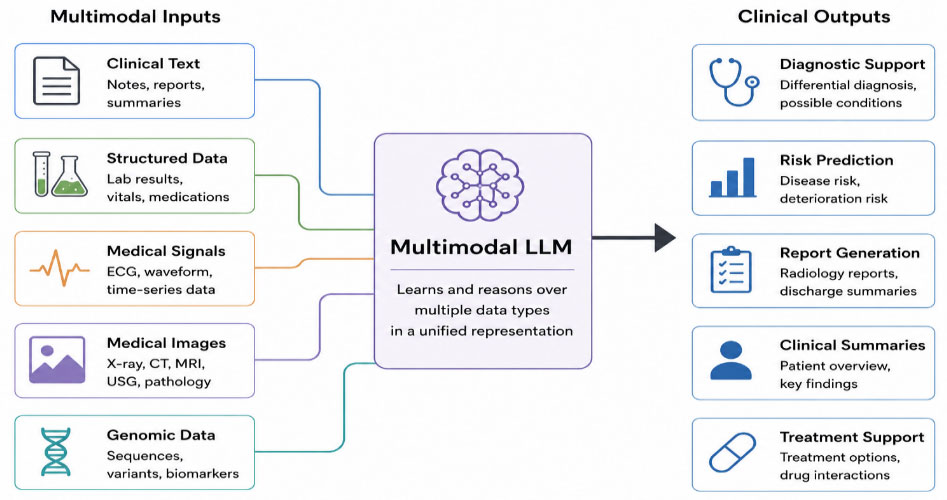
Artificial intelligence (AI) in healthcare has moved from rule-based expert systems to statistical and deep learning methods and, more recently, to large language models (LLMs), multimodal models, and agentic AI systems. This review treats these developments as connected stages rather than separate technologies. We conducted a focused review of foundational and recent literature, giving priority to studies that report clinical applications and quantitative evaluation. Representative applications are summarised in medical question answering, diagnosis, radiology, pathology, chronic disease management, clinical decision support, and healthcare administration. LLMs have improved medical language understanding and reasoning; multimodal models extend these abilities by combining clinical text, medical images, and structured data; and agentic systems add planning, tool use, memory, and multi-step workflow execution, with multi-agent designs now appearing in diagnosis, oncology, and pharmacovigilance. Routine clinical adoption is still limited by unreliable outputs, data privacy, lack of prospective real-world validation, unsettled regulation, infrastructure gaps, and the continued need for clinician oversight. We argue that each stage addresses limitations of the previous one while introducing new risks, most notably error propagation across agents and the consequences of autonomous actions.
Graphical Abstract
Keywords
Data Availability Statement
Funding
Conflicts of Interest
AI Use Statement
Ethical Approval and Consent to Participate
References
- Buchanan, B. G., & Shortliffe, E. H. (1984). Rule based expert systems: the MYCIN experiments of the Stanford Heuristic Programming Project (the Addison-Wesley series in artificial intelligence). Addison-Wesley Longman Publishing Co., Inc. https://dl.acm.org/doi/abs/10.5555/1096485
[Google Scholar] - Shortliffe, E. H., & Buchanan, B. G. (1975). A model of inexact reasoning in medicine. Mathematical Biosciences, 23(3-4), 351-379.
[CrossRef] [Google Scholar] - Miller, R. A., Pople Jr, H. E., & Myers, J. D. (1985). INTERNIST-I, an experimental computer-based diagnostic consultant for general internal medicine. In Computer-assisted medical decision making (pp. 139-158). New York, NY: Springer New York.
[CrossRef] [Google Scholar] - Esteva, A., Kuprel, B., Novoa, R. A., Ko, J., Swetter, S. M., Blau, H. M., & Thrun, S. (2017). Dermatologist-level classification of skin cancer with deep neural networks. Nature, 542(7639), 115-118.
[CrossRef] [Google Scholar] - Gulshan, V., Peng, L., Coram, M., Stumpe, M. C., Wu, D., Narayanaswamy, A., ... & Webster, D. R. (2016). Development and validation of a deep learning algorithm for detection of diabetic retinopathy in retinal fundus photographs. JAMA, 316(22), 2402-2410.
[CrossRef] [Google Scholar] - Vaswani, A., Shazeer, N., Parmar, N., Uszkoreit, J., Jones, L., Gomez, A. N., ... & Polosukhin, I. (2017). Attention is all you need. Advances in Neural Information Processing Systems, 30.
[Google Scholar] - Kung, T. H., Cheatham, M., Medenilla, A., Sillos, C., De Leon, L., Elepaño, C., ... & Tseng, V. (2023). Performance of ChatGPT on USMLE: potential for AI-assisted medical education using large language models. PLOS Digital Health, 2(2), e0000198.
[CrossRef] [Google Scholar] - Singhal, K., Tu, T., Gottweis, J., Sayres, R., Wulczyn, E., Amin, M., ... & Natarajan, V. (2025). Toward expert-level medical question answering with large language models. Nature Medicine, 31(3), 943-950.
[CrossRef] [Google Scholar] - Moor, M., Huang, Q., Wu, S., Yasunaga, M., Dalmia, Y., Leskovec, J., ... & Rajpurkar, P. (2023, December). Med-Flamingo: a multimodal medical few-shot learner. In Machine Learning for Health (ML4H) (pp. 353-367). PMLR. https://proceedings.mlr.press/v225/moor23a.html
[Google Scholar] - Li, C., Wong, C., Zhang, S., Usuyama, N., Liu, H., Yang, J., ... & Gao, J. (2023). LLaVA-Med: Training a large language-and-vision assistant for biomedicine in one day. Advances in Neural Information Processing Systems, 36, 28541-28564.
[CrossRef] [Google Scholar] - Luo, R., Sun, L., Xia, Y., Qin, T., Zhang, S., Poon, H., & Liu, T. Y. (2022). BioGPT: generative pre-trained transformer for biomedical text generation and mining. Briefings in Bioinformatics, 23(6), bbac409.
[CrossRef] [Google Scholar] - Singhal, K., Azizi, S., Tu, T., Mahdavi, S. S., Wei, J., Chung, H. W., ... & Natarajan, V. (2023). Large language models encode clinical knowledge. Nature, 620(7972), 172-180.
[CrossRef] [Google Scholar] - Peng, C., Yang, X., Chen, A., Smith, K. E., PourNejatian, N., Costa, A. B., ... & Wu, Y. (2023). A study of generative large language model for medical research and healthcare. npj Digital Medicine, 6(1), 210.
[CrossRef] [Google Scholar] - Wu, C., Lin, W., Zhang, X., Zhang, Y., Xie, W., & Wang, Y. (2024). PMC-LLaMA: toward building open-source language models for medicine. Journal of the American Medical Informatics Association, 31(9), 1833-1843.
[CrossRef] [Google Scholar] - Toma, A., Lawler, P. R., Ba, J., Krishnan, R. G., Rubin, B. B., & Wang, B. (2023). Clinical Camel: An open expert-level medical language model with dialogue-based knowledge encoding. arXiv preprint arXiv:2305.12031.
[CrossRef] [Google Scholar] - Chen, Z., Cano, A. H., Romanou, A., Bonnet, A., Matoba, K., Salvi, F., ... & Bosselut, A. (2023). MEDITRON-70B: Scaling medical pretraining for large language models. arXiv preprint arXiv:2311.16079.
[CrossRef] [Google Scholar] - Labrak, Y., Bazoge, A., Morin, E., Gourraud, P. A., Rouvier, M., & Dufour, R. (2024, August). BioMistral: A collection of open-source pretrained large language models for medical domains. In Findings of the association for computational linguistics: ACL 2024 (pp. 5848-5864).
[CrossRef] [Google Scholar] - Lee, J., Yoon, W., Kim, S., Kim, D., Kim, S., So, C. H., & Kang, J. (2020). BioBERT: a pre-trained biomedical language representation model for biomedical text mining. Bioinformatics, 36(4), 1234-1240.
[CrossRef] [Google Scholar] - Alsentzer, E., Murphy, J., Boag, W., Weng, W. H., Jindi, D., Naumann, T., & McDermott, M. (2019, June). Publicly available clinical BERT embeddings. In Proceedings of the 2nd Clinical Natural Language Processing Workshop(pp. 72-78).
[CrossRef] [Google Scholar] - Gu, Y., Tinn, R., Cheng, H., Lucas, M., Usuyama, N., Liu, X., ... & Poon, H. (2021). Domain-specific language model pretraining for biomedical natural language processing. ACM Transactions on Computing for Healthcare (HEALTH), 3(1), 1-23.
[CrossRef] [Google Scholar] - Rasool, A., Aslam, S., Hussain, N., Imtiaz, S., & Riaz, W. (2025). nBERT: Harnessing NLP for emotion recognition in psychotherapy to transform mental health care. Information, 16(4), 301.
[CrossRef] [Google Scholar] - Van Veen, D., Van Uden, C., Blankemeier, L., Delbrouck, J.-B., Aali, A., Bluethgen, C., ... & Chaudhari, A. S. (2024). Adapted large language models can outperform medical experts in clinical text summarization. Nature Medicine, 30(4), 1134-1142.
[CrossRef] [Google Scholar] - Tierney, A. A., Gayre, G., Hoberman, B., Mattern, B., Ballesca, M., Kipnis, P., ... & Lee, K. (2024). Ambient artificial intelligence scribes to alleviate the burden of clinical documentation. NEJM Catalyst Innovations in Care Delivery, 5(3), CAT-23.
[CrossRef] [Google Scholar] - Moor, M., Banerjee, O., Abad, Z. S. H., Krumholz, H. M., Leskovec, J., Topol, E. J., & Rajpurkar, P. (2023). Foundation models for generalist medical artificial intelligence. Nature, 616(7956), 259-265.
[CrossRef] [Google Scholar] - AlSaad, R., Abd-Alrazaq, A., Boughorbel, S., Ahmed, A., Renault, M. A., Damseh, R., & Sheikh, J. (2024). Multimodal large language models in health care: applications, challenges, and future outlook. Journal of Medical Internet Research, 26(1), e59505.
[CrossRef] [Google Scholar] - Tu, T., Azizi, S., Driess, D., Schaekermann, M., Amin, M., Chang, P. C., ... & Natarajan, V. (2024). Towards generalist biomedical AI. NEJM AI, 1(3), AIoa2300138.
[CrossRef] [Google Scholar] - Lu, M. Y., Chen, B., Williamson, D. F., Chen, R. J., Zhao, M., Chow, A. K., ... & Mahmood, F. (2024). A multimodal generative AI copilot for human pathology. Nature, 634(8033), 466-473.
[CrossRef] [Google Scholar] - Wu, C., Zhang, X., Zhang, Y., Hui, H., Wang, Y., & Xie, W. (2025). Towards generalist foundation model for radiology by leveraging web-scale 2D&3D medical data. Nature Communications, 16(1), 7866.
[CrossRef] [Google Scholar] - Bai, F., Du, Y., Huang, T., Meng, M. Q. H., & Zhao, B. (2024). M3d: Advancing 3d medical image analysis with multi-modal large language models. arXiv preprint arXiv:2404.00578.
[CrossRef] [Google Scholar] - Bannur, S., Bouzid, K., Castro, D. C., Schwaighofer, A., Thieme, A., Bond-Taylor, S., ... & Hyland, S. L. (2024). MAIRA-2: Grounded radiology report generation. arXiv preprint arXiv:2406.04449.
[CrossRef] [Google Scholar] - Yang, L., Xu, S., Sellergren, A., Kohlberger, T., Zhou, Y., Ktena, I., ... & Golden, D. (2024). Advancing multimodal medical capabilities of Gemini. arXiv preprint arXiv:2405.03162.
[CrossRef] [Google Scholar] - Wooldridge, M., & Jennings, N. R. (1995). Intelligent agents: Theory and practice. The Knowledge Engineering Review, 10(2), 115-152.
[CrossRef] [Google Scholar] - Karunanayake, N. (2025). Next-generation agentic AI for transforming healthcare. Informatics and Health, 2(2), 73-83.
[CrossRef] [Google Scholar] - Croatti, A., Montagna, S., Ricci, A., Gamberini, E., Albarello, V., & Agnoletti, V. (2019). BDI personal medical assistant agents: The case of trauma tracking and alerting. Artificial Intelligence in Medicine, 96, 187-197.
[CrossRef] [Google Scholar] - Alhazba, S. A., Ali, M. H., Alawi, D. A., Al-Betar, M. A., & Abd Elaziz, M. (2026). From reactive AI to agentic systems: A review of autonomous medical AI agents in healthcare. Archives of Computational Methods in Engineering, 33(8), 11693-11730.
[CrossRef] [Google Scholar] - Srinivasu, P. N., Aruna Kumari, G. L., Ahmed, S., & Alhumam, A. (2026). Exploring agentic AI in healthcare: A study on its working mechanism. Frontiers in Medicine, 12, 1753443.
[CrossRef] [Google Scholar] - Njei, B., Al-Ajlouni, Y. A., Sidney Kanmounye, U., Boateng, S., Loic Nguefang, G., Njei, N., ... & Al-Ajlouni, A. F. (2026). Artificial intelligence agents in healthcare research: A scoping review. PLOS ONE, 21(2), e0342182.
[CrossRef] [Google Scholar] - Collaco, B. G., Haider, S. A., Prabha, S., Gomez-Cabello, C. A., Genovese, A., Wood, N. G., ... & Forte, A. J. (2026). The role of agentic artificial intelligence in healthcare: a scoping review. npj Digital Medicine, 9(1), 345.
[CrossRef] [Google Scholar] - Huang, K. A., Choudhary, H. K., & Kuo, P. C. (2024). Artificial intelligent agent architecture and clinical decision-making in the healthcare sector. Cureus, 16(7).
[CrossRef] [Google Scholar] - Vatsal, S., Dubey, H., & Singh, A. (2026). Agentic AI in healthcare and medicine: A seven-dimensional taxonomy for empirical evaluation of LLM-based agents. IEEE Access, 14, 4840-4863.
[CrossRef] [Google Scholar] - Li, B., Yan, T., Pan, Y., Luo, J., Ji, R., Ding, J., ... & Wang, Y. (2024, November). MMedAgent: Learning to use medical tools with multi-modal agent. In Findings of the Association for Computational Linguistics: EMNLP 2024 (pp. 8745-8760).
[CrossRef] [Google Scholar] - Shi, W., Xu, R., Zhuang, Y., Yu, Y., Zhang, J., Wu, H., ... & Wang, M. D. (2024, November). EHRAgent: Code empowers large language models for few-shot complex tabular reasoning on electronic health records. In Proceedings of the 2024 Conference on Empirical Methods in Natural Language Processing (pp. 22315-22339).
[CrossRef] [Google Scholar] - Kim, Y., Park, C., Jeong, H., Chan, Y. S., Xu, X., McDuff, D., ... & Park, H. W. (2024). MDAgents: An adaptive collaboration of llms for medical decision-making. Advances in Neural Information Processing Systems, 37, 79410-79452.
[CrossRef] [Google Scholar] - Choi, J., Palumbo, N., Chalasani, P., Engelhard, M. M., Jha, S., Kumar, A., & Page, D. (2024). MALADE: Orchestration of LLM-powered agents with retrieval augmented generation for pharmacovigilance. In Proceedings of the 9th Machine Learning for Healthcare Conference (PMLR 252). https://proceedings.mlr.press/v252/choi24a.html
[Google Scholar] - Yue, L., Xing, S., Chen, J., & Fu, T. (2024, November). ClinicalAgent: Clinical trial multi-agent system with large language model-based reasoning. In Proceedings of the 15th ACM International Conference on Bioinformatics, Computational Biology and Health Informatics (pp. 1-10).
[CrossRef] [Google Scholar] - Ren, Z., Zhan, Y., Yu, B., Ding, L., Xu, P., & Tao, D. (2025). Healthcare Agent: Eliciting the power of large language models for medical consultation. npj Artificial Intelligence, 1(1), 24.
[CrossRef] [Google Scholar] - Ferber, D., El Nahhas, O. S., Wölflein, G., Wiest, I. C., Clusmann, J., Leßmann, M. E., ... & Kather, J. N. (2025). Development and validation of an autonomous artificial intelligence agent for clinical decision-making in oncology. Nature cancer, 6(8), 1337-1349.
[CrossRef] [Google Scholar] - Ferber, D., Hilgers, L., Höper, C., Kinny-Köster, B., Eckardt, J. N., Egger-Heidrich, K., ... & Kather, J. N. (2026). Towards autonomous medical artificial intelligence agents. Nature, 1-10.
[CrossRef] [Google Scholar] - Tu, T., Schaekermann, M., Palepu, A., Saab, K., Freyberg, J., Tanno, R., ... & Natarajan, V. (2025). Towards conversational diagnostic artificial intelligence. Nature, 642(8067), 442-450.
[CrossRef] [Google Scholar] - Saab, K., Park, C., Strother, T., Freyberg, J., Barrett, D. G., Cheng, Y., ... & Tanno, R. (2026). Advancing conversational diagnostic AI with multimodal reasoning. Nature Medicine, 1-11.
[CrossRef] [Google Scholar] - Liévin, V., Palepu, A., Weng, W. H., Saab, K., Stutz, D., Cheng, Y., ... & Schaekermann, M. (2026). Towards conversational artificial intelligence for disease management. Nature, 655(8125), 1292-1299.
[CrossRef] [Google Scholar] - Tang, X., Zou, A., Zhang, Z., Li, Z., Zhao, Y., Zhang, X., ... & Gerstein, M. (2024, August). MedAgents: Large language models as collaborators for zero-shot medical reasoning. In Findings of the Association for Computational Linguistics: ACL 2024 (pp. 599-621).
[CrossRef] [Google Scholar] - Zhang, Y., Bunting, K. V., Champsi, A., Wang, X., Lu, W., Thorley, A., Hothi, S. S., Qiu, Z., Buyukates, B., Kotecha, D., & Duan, J. (2026). CardAIc-Agents: A multimodal framework with hierarchical adaptation for cardiac care support. In Proceedings of the 9th International Conference on Medical Imaging with Deep Learning (PMLR 315, pp. 2143-2170). https://proceedings.mlr.press/v315/zhang26a.html
[Google Scholar] - Wu, Y., Chen, T., Hochberg, I., Sun, Z., Edry, R., Huang, Z., & Peleg, M. (2025). Lessons learned from evaluation of LLM-based multi-agents in safer therapy recommendation. arXiv preprint arXiv:2507.10911.
[CrossRef] [Google Scholar] - Zeng, F., Lyu, Z., Li, Q., & Li, X. (2024). Enhancing LLMs for impression generation in radiology reports through a multi-agent system. arXiv preprint arXiv:2412.06828.
[CrossRef] [Google Scholar] - Ghezloo, F., Seyfioglu, M. S., Soraki, R., Ikezogwo, W. O., Li, B., Vivekanandan, T., ... & Shapiro, L. (2025). PathFinder: A multi-modal multi-agent system for medical diagnostic decision-making applied to histopathology. In Proceedings of the IEEE/CVF International Conference on Computer Vision (pp. 23431-23441).
[CrossRef] [Google Scholar] - Maity, S., & Saikia, M. J. (2025). Large language models in healthcare and medical applications: a review. Bioengineering, 12(6), 631.
[CrossRef] [Google Scholar] - Wang, D., & Zhang, S. (2024). Large language models in medical and healthcare fields: Applications, advances, and challenges. Artificial Intelligence Review, 57(11), 299.
[CrossRef] [Google Scholar] - Rahim, S., Kong, X., & Abdullah, F. (2025). Navigating ethical boundaries in federated learning for biomedical research. Journal of Artificial Intelligence in Bioinformatics, 1(2), 72-78.
[CrossRef] [Google Scholar] - Rieke, N., Hancox, J., Li, W., Milletari, F., Roth, H. R., Albarqouni, S., ... & Cardoso, M. J. (2020). The future of digital health with federated learning. npj Digital Medicine, 3(1), 119.
[CrossRef] [Google Scholar] - Mehandru, N., Miao, B. Y., Almaraz, E. R., Sushil, M., Butte, A. J., & Alaa, A. (2024). Evaluating large language models as agents in the clinic. npj Digital Medicine, 7(1), 84.
[CrossRef] [Google Scholar]
Cite This Article
TY  - JOUR
AU  - Bilal, Muhammad
AU  - Gulzar, Hafsa
AU  - Ahmed, Sibtain
AU  - Aslam, Muhammad Saqlain
PY  - 2026
DA  - 2026/11/27
TI  - The Evolution of Artificial Intelligence in Healthcare: From LLMs to Multimodal and Agentic Systems
JO  - Journal of Artificial Intelligence in Bioinformatics
T2  - Journal of Artificial Intelligence in Bioinformatics
JF  - Journal of Artificial Intelligence in Bioinformatics
VL  - 3
IS  - 1
SP  - 1
EP  - 12
DO  - 10.62762/JAIB.2026.839612
UR  - https://www.icck.org/article/abs/jaib.2026.839612
KW  - agentic AI
KW  - large language models
KW  - multimodal models
KW  - healthcare artificial intelligence
KW  - clinical decision support
AB  - Artificial intelligence (AI) in healthcare has moved from rule-based expert systems to statistical and deep learning methods and, more recently, to large language models (LLMs), multimodal models, and agentic AI systems. This review treats these developments as connected stages rather than separate technologies. We conducted a focused review of foundational and recent literature, giving priority to studies that report clinical applications and quantitative evaluation. Representative applications are summarised in medical question answering, diagnosis, radiology, pathology, chronic disease management, clinical decision support, and healthcare administration. LLMs have improved medical language understanding and reasoning; multimodal models extend these abilities by combining clinical text, medical images, and structured data; and agentic systems add planning, tool use, memory, and multi-step workflow execution, with multi-agent designs now appearing in diagnosis, oncology, and pharmacovigilance. Routine clinical adoption is still limited by unreliable outputs, data privacy, lack of prospective real-world validation, unsettled regulation, infrastructure gaps, and the continued need for clinician oversight. We argue that each stage addresses limitations of the previous one while introducing new risks, most notably error propagation across agents and the consequences of autonomous actions.
SN  - 3068-7535
PB  - Institute of Central Computation and Knowledge
LA  - English
ER  -
@article{Bilal2026The,
  author = {Muhammad Bilal and Hafsa Gulzar and Sibtain Ahmed and Muhammad Saqlain Aslam},
  title = {The Evolution of Artificial Intelligence in Healthcare: From LLMs to Multimodal and Agentic Systems},
  journal = {Journal of Artificial Intelligence in Bioinformatics},
  year = {2026},
  volume = {3},
  number = {1},
  pages = {1-12},
  doi = {10.62762/JAIB.2026.839612},
  url = {https://www.icck.org/article/abs/jaib.2026.839612},
  abstract = {Artificial intelligence (AI) in healthcare has moved from rule-based expert systems to statistical and deep learning methods and, more recently, to large language models (LLMs), multimodal models, and agentic AI systems. This review treats these developments as connected stages rather than separate technologies. We conducted a focused review of foundational and recent literature, giving priority to studies that report clinical applications and quantitative evaluation. Representative applications are summarised in medical question answering, diagnosis, radiology, pathology, chronic disease management, clinical decision support, and healthcare administration. LLMs have improved medical language understanding and reasoning; multimodal models extend these abilities by combining clinical text, medical images, and structured data; and agentic systems add planning, tool use, memory, and multi-step workflow execution, with multi-agent designs now appearing in diagnosis, oncology, and pharmacovigilance. Routine clinical adoption is still limited by unreliable outputs, data privacy, lack of prospective real-world validation, unsettled regulation, infrastructure gaps, and the continued need for clinician oversight. We argue that each stage addresses limitations of the previous one while introducing new risks, most notably error propagation across agents and the consequences of autonomous actions.},
  keywords = {agentic AI, large language models, multimodal models, healthcare artificial intelligence, clinical decision support},
  issn = {3068-7535},
  publisher = {Institute of Central Computation and Knowledge}
}
Article Metrics
Publisher's Note
ICCK stays neutral with regard to jurisdictional claims in published maps and institutional affiliations.
Rights and Permissions
 Copyright © 2026 by the Author(s). Published by Institute of Central Computation and Knowledge. This article is an open access article distributed under the terms and conditions of the Creative Commons Attribution (CC BY) license (https://creativecommons.org/licenses/by/4.0/), which permits use, sharing, adaptation, distribution and reproduction in any medium or format, as long as you give appropriate credit to the original author(s) and the source, provide a link to the Creative Commons licence, and indicate if changes were made.


Portico
