
Global Convergence Regimes of the Return Dynamics in the Class ${O}_C$



Article Information
Abstract
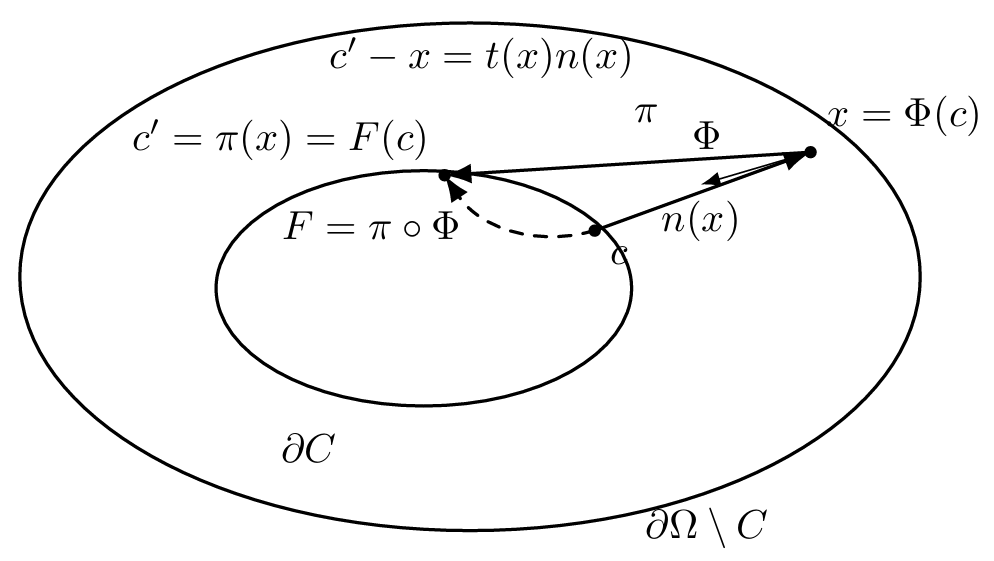
We study the global dynamics of the geometrically generated return map associated with domains in the class ${O}_C$. Starting from a convex core $C\subset\mathbb R^N$ and a positive thickness function $d:\partial C\to(0,\infty)$, the return construction defines a discrete self-map $F:\partial C\longrightarrow\partial C$ through an outward normal displacement to the outer boundary followed by the inward normal first return to the core. Building on the local geometric theory of the return map, we derive a uniform global one-step estimate $F(c)-c = B_c\nabla_{\partial C}d(c) + O\!\left(|\nabla_{\partial C}d(c)|^2\right)$, $B_c=d(c)\bigl(I-d(c)S_c\bigr)^{-1}$, under explicit smoothness, transversality, and small-slope assumptions. The tangential remainder is shown to be of cubic order. This yields a second-order expansion of the thickness increment governed by the self-adjoint preconditioned Hessian $K_c=B_c^{1/2}H_cB_c^{1/2}$. A directional positivity condition, and in particular the sufficient spectral bound $\lambda_{\min}(K_c)\geq -2+\delta$, implies strict global thickness ascent, $d(F(c))-d(c) \geq \gamma |\nabla_{\partial C}d(c)|^2$. Consequently, $\mathcal V(c)=d_{\max}-d(c)$ is a strict Lyapunov function. We prove finite Lyapunov dissipation, square summability of the thickness gradient, vanishing return-step size, and, when the critical points of $d$ are isolated, convergence of every orbit to a unique critical point. At nondegenerate attracting maxima we obtain exponential convergence rates from the exact linearization $DF(c_*)=I+B_*H_*$. Within the strict-ascent regime, nontrivial periodic and recurrent orbits are excluded. Finally, numerical computations performed with the exact unit-circle return formula show that the spectral value $-2$ also marks the local loss of attraction. In a profile for which a multiplier has crossed $-1$, the exact first-return branch remains globally real, negative thickness increments are detected, and a stable nontrivial period-two orbit is numerically resolved. This provides a concrete exact-map example of the transition from curvature-preconditioned global convergence toward periodic return dynamics.
Graphical Abstract
Keywords
Data Availability Statement
Funding
Conflicts of Interest
AI Use Statement
Ethical Approval and Consent to Participate
References
- Barkatou, M. (2002). Some geometric properties for a class of non-Lipschitz domains. New York Journal of Mathematics, 8, 189-213. https://nyjm.albany.edu/j/2002/8-13.html
[Google Scholar] - Barkatou, M., & El Morsalani, M. (2026). The return map in the class $\mathcal{O_{C$: Geometry, dynamics, and thickness regularity. Journal of Nonlinear Dynamics and Applications, 2(3), 192-216.
[CrossRef] [Google Scholar] - Schulz, V. H. (2014). A Riemannian view on shape optimization. Foundations of Computational Mathematics, 14(3), 483-501.
[CrossRef] [Google Scholar] - Welker, K. (2021). Suitable spaces for shape optimization. Applied Mathematics & Optimization, 84(Suppl. 1), S869-S902.
[CrossRef] [Google Scholar] - Plotnikov, P. I., & Sokolowski, J. (2023). Geometric aspects of shape optimization. The Journal of Geometric Analysis, 33(7), 206.
[CrossRef] [Google Scholar] - Huang, W., & Wei, K. (2022). Riemannian proximal gradient methods. Mathematical Programming, 194(1-2), 371-413.
[CrossRef] [Google Scholar] - Huang, W., & Wei, K. (2023). An inexact Riemannian proximal gradient method. Computational Optimization and Applications, 85(1), 1-32.
[CrossRef] [Google Scholar] - Attouch, H., Bolte, J., & Svaiter, B. F. (2013). Convergence of descent methods for semi-algebraic and tame problems: proximal algorithms, forward-backward splitting, and regularized Gauss-Seidel methods. Mathematical Programming, 137(1-2), 91-129.
[CrossRef] [Google Scholar] - Bento, G., Mordukhovich, B., Mota, T., & Nesterov, Y. (2025). Convergence of descent optimization algorithms under Polyak-Łojasiewicz-Kurdyka conditions. Journal of Optimization Theory and Applications, 207(3), 41.
[CrossRef] [Google Scholar] - Kurdyka, K. (1998). On gradients of functions definable in o-minimal structures. Annales de l'Institut Fourier, 48(3), 769-783.
[CrossRef] [Google Scholar] - Absil, P.-A., Mahony, R., & Sepulchre, R. (2008). Optimization Algorithms on Matrix Manifolds. Princeton University Press.
[CrossRef] [Google Scholar] - Luchnikov, I. A., Krechetov, M. E., & Filippov, S. N. (2021). Riemannian geometry and automatic differentiation for optimization problems of quantum physics and quantum technologies. New Journal of Physics, 23(7), 073006.
[CrossRef] [Google Scholar] - Absil, P. A., Mahony, R., & Andrews, B. (2005). Convergence of the iterates of descent methods for analytic cost functions. SIAM Journal on Optimization, 16(2), 531-547.
[CrossRef] [Google Scholar] - Katok, A., & Hasselblatt, B. (1995). Introduction to the Modern Theory of Dynamical Systems (Encyclopedia of Mathematics and its Applications, Vol. 54). Cambridge University Press.
[CrossRef] [Google Scholar] - Palis, J., Jr., & de Melo, W. (1982). Geometric Theory of Dynamical Systems: An Introduction. Springer-Verlag.
[CrossRef] [Google Scholar] - Lee, J. D., Simchowitz, M., Jordan, M. I., & Recht, B. (2016). Gradient descent only converges to minimizers. In Proceedings of the 29th Annual Conference on Learning Theory (PMLR, Vol. 49, pp. 1246-1257). https://proceedings.mlr.press/v49/lee16.html
[Google Scholar] - Smale, S. (1961). On gradient dynamical systems. Annals of Mathematics, 74(1), 199-206.
[CrossRef] [Google Scholar] - Guckenheimer, J., & Holmes, P. (1983). Nonlinear Oscillations, Dynamical Systems, and Bifurcations of Vector Fields (Applied Mathematical Sciences, Vol. 42). Springer-Verlag.
[CrossRef] [Google Scholar]
Cite This Article
TY  - JOUR
AU  - Morsalani, Mohamed El
AU  - Barkatou, Mohammed
PY  - 2026
DA  - 2026/11/24
TI  - Global Convergence Regimes of the Return Dynamics in the Class ${O}_C$
JO  - Journal of Nonlinear Dynamics and Applications
T2  - Journal of Nonlinear Dynamics and Applications
JF  - Journal of Nonlinear Dynamics and Applications
VL  - 2
IS  - 4
SP  - 222
EP  - 260
DO  - 10.62762/JNDA.2026.138289
UR  - https://www.icck.org/article/abs/jnda.2026.138289
KW  - Return map
KW  - Gradient-like dynamics
KW  - Lyapunov function
KW  - Thickness function
KW  - Convex core
KW  - Class $\mathcal{O}_{C}$
KW  - Discrete dynamical system
KW  - Global convergence
KW  - Curvature-preconditioned dynamics
KW  - Basins of attraction
KW  - Period-two orbit
AB  - We study the global dynamics of the geometrically generated return map associated with domains in the class ${O}_C$. Starting from a convex core $C\subset\mathbb R^N$ and a positive thickness function $d:\partial C\to(0,\infty)$, the return construction defines a discrete self-map $F:\partial C\longrightarrow\partial C$ through an outward normal displacement to the outer boundary followed by the inward normal first return to the core. Building on the local geometric theory of the return map, we derive a uniform global one-step estimate $F(c)-c = B_c\nabla_{\partial C}d(c) + O\!\left(|\nabla_{\partial C}d(c)|^2\right)$, $B_c=d(c)\bigl(I-d(c)S_c\bigr)^{-1}$, under explicit smoothness, transversality, and small-slope assumptions. The tangential remainder is shown to be of cubic order. This yields a second-order expansion of the thickness increment governed by the self-adjoint preconditioned Hessian $K_c=B_c^{1/2}H_cB_c^{1/2}$. A directional positivity condition, and in particular the sufficient spectral bound $\lambda_{\min}(K_c)\geq -2+\delta$, implies strict global thickness ascent, $d(F(c))-d(c) \geq \gamma |\nabla_{\partial C}d(c)|^2$. Consequently, $\mathcal V(c)=d_{\max}-d(c)$ is a strict Lyapunov function. We prove finite Lyapunov dissipation, square summability of the thickness gradient, vanishing return-step size, and, when the critical points of $d$ are isolated, convergence of every orbit to a unique critical point. At nondegenerate attracting maxima we obtain exponential convergence rates from the exact linearization $DF(c_*)=I+B_*H_*$. Within the strict-ascent regime, nontrivial periodic and recurrent orbits are excluded. Finally, numerical computations performed with the exact unit-circle return formula show that the spectral value $-2$ also marks the local loss of attraction. In a profile for which a multiplier has crossed $-1$, the exact first-return branch remains globally real, negative thickness increments are detected, and a stable nontrivial period-two orbit is numerically resolved. This provides a concrete exact-map example of the transition from curvature-preconditioned global convergence toward periodic return dynamics.
SN  - 3069-6313
PB  - Institute of Central Computation and Knowledge
LA  - English
ER  -
@article{Morsalani2026Global,
  author = {Mohamed El Morsalani and Mohammed Barkatou},
  title = {Global Convergence Regimes of the Return Dynamics in the Class \${O}\_C\$},
  journal = {Journal of Nonlinear Dynamics and Applications},
  year = {2026},
  volume = {2},
  number = {4},
  pages = {222-260},
  doi = {10.62762/JNDA.2026.138289},
  url = {https://www.icck.org/article/abs/jnda.2026.138289},
  abstract = {We study the global dynamics of the geometrically generated return map associated with domains in the class \${O}\_C\$. Starting from a convex core \$C\subset\mathbb R^N\$ and a positive thickness function \$d:\partial C\to(0,\infty)\$, the return construction defines a discrete self-map \$F:\partial C\longrightarrow\partial C\$ through an outward normal displacement to the outer boundary followed by the inward normal first return to the core. Building on the local geometric theory of the return map, we derive a uniform global one-step estimate \$F(c)-c = B\_c\nabla\_{\partial C}d(c) + O\!\left(|\nabla\_{\partial C}d(c)|^2\right)\$, \$B\_c=d(c)\bigl(I-d(c)S\_c\bigr)^{-1}\$, under explicit smoothness, transversality, and small-slope assumptions. The tangential remainder is shown to be of cubic order. This yields a second-order expansion of the thickness increment governed by the self-adjoint preconditioned Hessian \$K\_c=B\_c^{1/2}H\_cB\_c^{1/2}\$. A directional positivity condition, and in particular the sufficient spectral bound \$\lambda\_{\min}(K\_c)\geq -2+\delta\$, implies strict global thickness ascent, \$d(F(c))-d(c) \geq \gamma |\nabla\_{\partial C}d(c)|^2\$. Consequently, \$\mathcal V(c)=d\_{\max}-d(c)\$ is a strict Lyapunov function. We prove finite Lyapunov dissipation, square summability of the thickness gradient, vanishing return-step size, and, when the critical points of \$d\$ are isolated, convergence of every orbit to a unique critical point. At nondegenerate attracting maxima we obtain exponential convergence rates from the exact linearization \$DF(c\_*)=I+B\_*H\_*\$. Within the strict-ascent regime, nontrivial periodic and recurrent orbits are excluded. Finally, numerical computations performed with the exact unit-circle return formula show that the spectral value \$-2\$ also marks the local loss of attraction. In a profile for which a multiplier has crossed \$-1\$, the exact first-return branch remains globally real, negative thickness increments are detected, and a stable nontrivial period-two orbit is numerically resolved. This provides a concrete exact-map example of the transition from curvature-preconditioned global convergence toward periodic return dynamics.},
  keywords = {Return map, Gradient-like dynamics, Lyapunov function, Thickness function, Convex core, Class \$\mathcal{O}\_{C}\$, Discrete dynamical system, Global convergence, Curvature-preconditioned dynamics, Basins of attraction, Period-two orbit},
  issn = {3069-6313},
  publisher = {Institute of Central Computation and Knowledge}
}
Article Metrics
Publisher's Note
ICCK stays neutral with regard to jurisdictional claims in published maps and institutional affiliations.
Rights and Permissions


Portico
