

The Return Map in the Class $\mathcal{O}_C$: Geometry, Dynamics, and Thickness Regularity



Article Information
Abstract
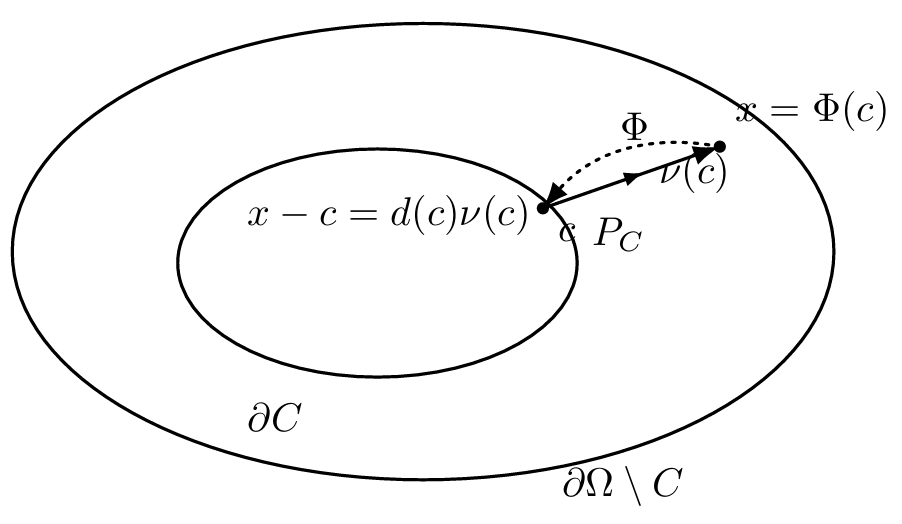
We study a geometrically defined return map associated with domains in the class $\mathcal O_C$, where a fixed convex core $C\subset\mathbb R^N$ is linked to the outer boundary $\partial\Omega$ through outward normal rays and a thickness function $d:\partial C\to(0,\infty)$. The radial map $\Phi(c)=c+d(c)\nu(c)$ is combined with a reciprocal map that follows the inward normal to $\partial\Omega$ back to its first intersection with the convex core. Their composition $F=\pi\circ\Phi:\partial C\to\partial C$ defines a geometrically generated discrete dynamical system on $\partial C$. Using the exact normal geometry of the radial parametrization, we derive the local quadratic-remainder formula $F(c)-c=d(c)\bigl(I-d(c)S_c\bigr)^{-1}\nabla_{\partial C}d(c) +O\!\left(|\nabla_{\partial C}d(c)|^2\right)$, where $S_c$ is the shape operator of $\partial C$. Thus curvature enters the leading-order dynamics through a positive anisotropic preconditioning of the thickness gradient. At points where the relevant derivatives exist, fixed points of the return map coincide with critical points of the thickness function. Under additional smoothness assumptions, we obtain the linearization $DF(c_*)=I+d_*\bigl(I-d_*S_*\bigr)^{-1}H_*$, with $H_*$ the Hessian operator of $d$ at $c_*$. This yields a local stability classification governed jointly by thickness variation and curvature. The analytical results are validated by exact unit-circle computations. We also establish regularity transfer between the thickness function and the outer boundary and derive global bi-Lipschitz bounds for the radial parametrization from convex metric projection. These results provide a geometric foundation for the study of boundary-induced discrete dynamics generated by normal interactions.
Graphical Abstract
Keywords
Data Availability Statement
Funding
Conflicts of Interest
AI Use Statement
Ethical Approval and Consent to Participate
References
- Schneider, R. (2014). Convex bodies: The Brunn-Minkowski theory (2nd expanded ed.; Encyclopedia of Mathematics and Its Applications, vol.~151). Cambridge University Press.
[CrossRef] [Google Scholar] - Henrot, A., & Pierre, M. (2005). Variation et optimisation de formes: Une analyse géométrique (Mathématiques & Applications, vol.~48). Springer.
[CrossRef] [Google Scholar] - Sokolowski, J., & Zolesio, J.-P. (1992). Introduction to shape optimization: Shape sensitivity analysis (Springer Series in Computational Mathematics, vol.~16). Springer.
[CrossRef] [Google Scholar] - Plotnikov, P. I., & Sokolowski, J. (2023). Geometric aspects of shape optimization. The Journal of Geometric Analysis, 33(7), 206.
[CrossRef] [Google Scholar] - Welker, K. (2021). Suitable spaces for shape optimization. Applied Mathematics & Optimization, 84, 869-902.
[CrossRef] [Google Scholar] - Barkatou, M. (2002). Some geometric properties for a class of non-Lipschitz domains. New York Journal of Mathematics, 8, 189-213. https://ftp.gwdg.de/pub/misc/EMIS/journals/NYJM/j/2002/8-13.pdf
[Google Scholar] - Ambrosio, L., & Mantegazza, C. (1998). Curvature and distance function from a manifold. The Journal of Geometric Analysis, 8(5), 723-748.
[CrossRef] [Google Scholar] - Lytchak, A. (2024). A note on subsets of positive reach. Mathematische Nachrichten, 297(3), 932-942.
[CrossRef] [Google Scholar] - Hug, D., & Santilli, M. (2022). Curvature measures and soap bubbles beyond convexity. Advances in Mathematics, 411, 108802.
[CrossRef] [Google Scholar] - Boumal, N. (2023). An introduction to optimization on smooth manifolds. Cambridge University Press.
[CrossRef] [Google Scholar] - do Carmo, M. P. (1976). Differential geometry of curves and surfaces. Prentice-Hall. https://docenti.ing.unipi.it/griff/files/dC.pdf
[Google Scholar] - Rockafellar, R. T. (1970). Convex analysis. Princeton University Press. https://www.jstor.org/stable/j.ctt14bs1ff
[Google Scholar]
Cite This Article
TY  - JOUR
AU  - Barkatou, Mohammed
AU  - Morsalani, Mohamed El
PY  - 2026
DA  - 2026/09/23
TI  - The Return Map in the Class $\mathcal{O}_C$: Geometry, Dynamics, and Thickness Regularity
JO  - Journal of Nonlinear Dynamics and Applications
T2  - Journal of Nonlinear Dynamics and Applications
JF  - Journal of Nonlinear Dynamics and Applications
VL  - 2
IS  - 3
SP  - 192
EP  - 216
DO  - 10.62762/JNDA.2026.569839
UR  - https://www.icck.org/article/abs/JNDA.2026.569839
KW  - return map
KW  - geometric dynamics
KW  - thickness function
KW  - convex geometry
KW  - normal parametrization
KW  - curvature-preconditioned dynamics
KW  - discrete dynamical systems
KW  - bi-Lipschitz maps
AB  - We study a geometrically defined return map associated with domains in the class $\mathcal O_C$, where a fixed convex core $C\subset\mathbb R^N$ is linked to the outer boundary $\partial\Omega$ through outward normal rays and a thickness function $d:\partial C\to(0,\infty)$. The radial map $\Phi(c)=c+d(c)\nu(c)$ is combined with a reciprocal map that follows the inward normal to $\partial\Omega$ back to its first intersection with the convex core. Their composition $F=\pi\circ\Phi:\partial C\to\partial C$ defines a geometrically generated discrete dynamical system on $\partial C$. Using the exact normal geometry of the radial parametrization, we derive the local quadratic-remainder formula $F(c)-c=d(c)\bigl(I-d(c)S_c\bigr)^{-1}\nabla_{\partial C}d(c) +O\!\left(|\nabla_{\partial C}d(c)|^2\right)$, where $S_c$ is the shape operator of $\partial C$. Thus curvature enters the leading-order dynamics through a positive anisotropic preconditioning of the thickness gradient. At points where the relevant derivatives exist, fixed points of the return map coincide with critical points of the thickness function. Under additional smoothness assumptions, we obtain the linearization $DF(c_*)=I+d_*\bigl(I-d_*S_*\bigr)^{-1}H_*$, with $H_*$ the Hessian operator of $d$ at $c_*$. This yields a local stability classification governed jointly by thickness variation and curvature. The analytical results are validated by exact unit-circle computations. We also establish regularity transfer between the thickness function and the outer boundary and derive global bi-Lipschitz bounds for the radial parametrization from convex metric projection. These results provide a geometric foundation for the study of boundary-induced discrete dynamics generated by normal interactions.
SN  - 3069-6313
PB  - Institute of Central Computation and Knowledge
LA  - English
ER  -
@article{Barkatou2026The,
  author = {Mohammed Barkatou and Mohamed El Morsalani},
  title = {The Return Map in the Class \$\mathcal{O}\_C\$: Geometry, Dynamics, and Thickness Regularity},
  journal = {Journal of Nonlinear Dynamics and Applications},
  year = {2026},
  volume = {2},
  number = {3},
  pages = {192-216},
  doi = {10.62762/JNDA.2026.569839},
  url = {https://www.icck.org/article/abs/JNDA.2026.569839},
  abstract = {We study a geometrically defined return map associated with domains in the class \$\mathcal O\_C\$, where a fixed convex core \$C\subset\mathbb R^N\$ is linked to the outer boundary \$\partial\Omega\$ through outward normal rays and a thickness function \$d:\partial C\to(0,\infty)\$. The radial map \$\Phi(c)=c+d(c)\nu(c)\$ is combined with a reciprocal map that follows the inward normal to \$\partial\Omega\$ back to its first intersection with the convex core. Their composition \$F=\pi\circ\Phi:\partial C\to\partial C\$ defines a geometrically generated discrete dynamical system on \$\partial C\$. Using the exact normal geometry of the radial parametrization, we derive the local quadratic-remainder formula \$F(c)-c=d(c)\bigl(I-d(c)S\_c\bigr)^{-1}\nabla\_{\partial C}d(c) +O\!\left(|\nabla\_{\partial C}d(c)|^2\right)\$, where \$S\_c\$ is the shape operator of \$\partial C\$. Thus curvature enters the leading-order dynamics through a positive anisotropic preconditioning of the thickness gradient. At points where the relevant derivatives exist, fixed points of the return map coincide with critical points of the thickness function. Under additional smoothness assumptions, we obtain the linearization \$DF(c\_*)=I+d\_*\bigl(I-d\_*S\_*\bigr)^{-1}H\_*\$, with \$H\_*\$ the Hessian operator of \$d\$ at \$c\_*\$. This yields a local stability classification governed jointly by thickness variation and curvature. The analytical results are validated by exact unit-circle computations. We also establish regularity transfer between the thickness function and the outer boundary and derive global bi-Lipschitz bounds for the radial parametrization from convex metric projection. These results provide a geometric foundation for the study of boundary-induced discrete dynamics generated by normal interactions.},
  keywords = {return map, geometric dynamics, thickness function, convex geometry, normal parametrization, curvature-preconditioned dynamics, discrete dynamical systems, bi-Lipschitz maps},
  issn = {3069-6313},
  publisher = {Institute of Central Computation and Knowledge}
}
Article Metrics
Publisher's Note
ICCK stays neutral with regard to jurisdictional claims in published maps and institutional affiliations.
Rights and Permissions


Portico
