

State-Dependent Intermittent Synchronization Control for Coupled Switched Neural Networks: A Prescribed-Time Approach


Article Information
Abstract
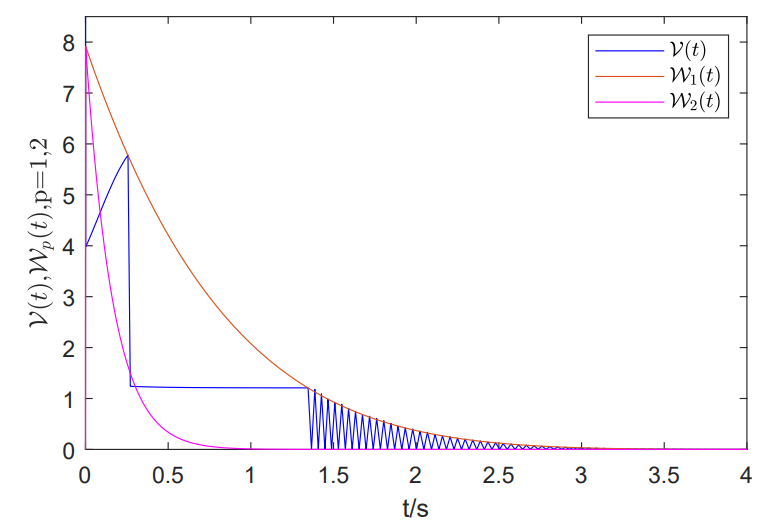
This paper addresses the problem of achieving prescribed-time synchronization of coupled switched neural networks (CSNNs) using state-dependent intermittent control. Unlike traditional intermittent control, the intervals for work and rest in this approach are not pre-designed but determined by the relationship between the designed Lyapunov function and the boundary auxiliary functions. The proposed control strategy can effectively mitigate chattering behavior arising from rapid switching in traditional intermittent control. Subsequently, leveraging Lyapunov theory and various inequality techniques, we develop a new set of sufficient conditions, formulated as linear matrix inequalities (LMIs), to ensure prescribed-time synchronization of CSNNs under the designed intermittent control strategy. In the end, a numerical example is given to verify the obtained theoretical results.
Graphical Abstract
Keywords
Data Availability Statement
Funding
Conflicts of Interest
Ethical Approval and Consent to Participate
References
- Wang, X., Cao, J., Yang, B., & Chen, F. (2022). Fast fixed-time synchronization control analysis for a class of coupled delayed Cohen-Grossberg neural networks. Journal of the Franklin Institute, 359(4), 1612-1639.
[CrossRef] [Google Scholar] - Zhu, S., & Bao, H. (2022). Event-triggered synchronization of coupled memristive neural networks. Applied Mathematics and Computation, 415, 126715.
[CrossRef] [Google Scholar] - Zhao, H., Liu, A., Wang, Q., Zheng, M., Chen, C., Niu, S., & Li, L. (2021). Predefined-time stability/synchronization of coupled memristive neural networks with multi-links and application in secure communication. Frontiers in Neurorobotics, 15, 783809.
[CrossRef] [Google Scholar] - Ding, S., & Wang, Z. (2020). Synchronization of coupled neural networks via an event-dependent intermittent pinning control. IEEE Transactions on Systems, Man, and Cybernetics: Systems, 52(3), 1928-1934.
[CrossRef] [Google Scholar] - Mei, J., Lu, Z., Hu, J., & Fan, Y. (2020). Guaranteed cost finite-time control of uncertain coupled neural networks. IEEE Transactions on Cybernetics, 52(1), 481-494.
[CrossRef] [Google Scholar] - Gong, S., Guo, Z., Wen, S., & Huang, T. (2019). Finite-time and fixed-time synchronization of coupled memristive neural networks with time delay. IEEE Transactions on Cybernetics, 51(6), 2944-2955.
[CrossRef] [Google Scholar] - Li, N., Wu, X., Feng, J., Xu, Y., & Lü, J. (2020). Fixed-time synchronization of coupled neural networks with discontinuous activation and mismatched parameters. IEEE Transactions on Neural Networks and Learning Systems, 32(6), 2470-2482.
[CrossRef] [Google Scholar] - Chen, T., Liu, X., & Wu, Y. (2023). Prescribed-time stabilization of complex networks with intermittent control. IEEE Transactions on Circuits and Systems II: Express Briefs, 71(4), 2069-2073.
[CrossRef] [Google Scholar] - Zhou, X., Cao, J., & Wang, X. (2023). Predefined-time synchronization of coupled neural networks with switching parameters and disturbed by Brownian motion. Neural Networks, 160, 97-107.
[CrossRef] [Google Scholar] - Zhou, L., Lin, H., & Tan, F. (2023). Fixed/predefined-time synchronization of coupled memristor-based neural networks with stochastic disturbance. Chaos, Solitons & Fractals, 173, 113643.
[CrossRef] [Google Scholar] - Shao, S., Liu, X., & Cao, J. (2021). Prespecified-time synchronization of switched coupled neural networks via smooth controllers. Neural Networks, 133, 32-39.
[CrossRef] [Google Scholar] - Bao, Y., Zhang, Y., Zhang, B., & Guo, Y. (2021). Prescribed-time synchronization of coupled memristive neural networks with heterogeneous impulsive effects. Neural Processing Letters, 53(2), 1615-1632.
[CrossRef] [Google Scholar] - Wang, Q., He, Y., Tan, G., & Wu, M. (2016, July). Stabilization of linear systems via state-dependent intermittent control. In 2016 35th Chinese Control Conference (CCC) (pp. 1556-1561). IEEE.
[CrossRef] [Google Scholar] - Wang, Q., He, Y., Tan, G., & Wu, M. (2017). State‐dependent intermittent control of non‐linear systems. IET Control Theory & Applications, 11(12), 1884-1893.
[CrossRef] [Google Scholar] - Yu, Z., Yu, S., & Jiang, H. (2023). Finite/fixed-time event-triggered aperiodic intermittent control for nonlinear systems. Chaos, Solitons & Fractals, 173, 113735.
[CrossRef] [Google Scholar] - Song, C., Zhou, J., & Wang, J. (2022). Finite time inter-layer synchronization of duplex networks via event-dependent intermittent control. IEEE Transactions on Circuits and Systems II: Express Briefs, 69(12), 4889-4893.
[CrossRef] [Google Scholar] - Ding, S., Wang, Z., & Zhang, H. (2018). Quasi-synchronization of delayed memristive neural networks via region-partitioning-dependent intermittent control. IEEE Transactions on Cybernetics, 49(12), 4066-4077.
[CrossRef] [Google Scholar] - JAubin, P., & Cellina, A. (1984). Differential Inclusions: Set-Valued Maps and Viability Theory.
[Google Scholar]
Cited By (3)
-
Mutti-Ur Rehman, Saima Akram, Ali Algefary. Matrix Nearness Problems, D-Stability and μ-Values in Economic Models.
IEEE Access, 2026 , 14 .
[CrossRef] -
Sanbo Ding, Shuai Fang, Nannan Rong. Finite-/Fixed-Time Synchronization of Dynamic Memristor Cellular Neural Networks: A Method Based on Event-Dependent Intermittent Control.
IEEE Systems, Man, and Cybernetics Magazine, 2026 , 12 (3).
[CrossRef] -
Leimin Wang, Zheng Zhou, Guanghui Jiang, Qingyi Wang, Zhouchao Wei. Fixed-/Preassigned-time synchronization of differential-dimensional chaotic systems with stochastic disturbances.
Applied Mathematics and Computation, 2026 , 519 .
[CrossRef]
Cite This Article
TY  - JOUR
AU  - Yao, Yu
AU  - Long, Changqing
PY  - 2025
DA  - 2025/08/24
TI  - State-Dependent Intermittent Synchronization Control for Coupled Switched Neural Networks: A Prescribed-Time Approach
JO  - Journal of Nonlinear Dynamics and Applications
T2  - Journal of Nonlinear Dynamics and Applications
JF  - Journal of Nonlinear Dynamics and Applications
VL  - 1
IS  - 1
SP  - 3
EP  - 9
DO  - 10.62762/JNDA.2025.493957
UR  - https://www.icck.org/article/abs/JNDA.2025.493957
KW  - coupled switched neural networks
KW  - intermittent control
KW  - prescribed-time synchronization
KW  - Lyapunov function
KW  - linear matrix inequalities
AB  - This paper addresses the problem of achieving prescribed-time synchronization of coupled switched neural networks (CSNNs) using state-dependent intermittent control. Unlike traditional intermittent control, the intervals for work and rest in this approach are not pre-designed but determined by the relationship between the designed Lyapunov function and the boundary auxiliary functions. The proposed control strategy can effectively mitigate chattering behavior arising from rapid switching in traditional intermittent control. Subsequently, leveraging Lyapunov theory and various inequality techniques, we develop a new set of sufficient conditions, formulated as linear matrix inequalities (LMIs), to ensure prescribed-time synchronization of CSNNs under the designed intermittent control strategy. In the end, a numerical example is given to verify the obtained theoretical results.
SN  - 3069-6313
PB  - Institute of Central Computation and Knowledge
LA  - English
ER  -
@article{Yao2025StateDepen,
  author = {Yu Yao and Changqing Long},
  title = {State-Dependent Intermittent Synchronization Control for Coupled Switched Neural Networks: A Prescribed-Time Approach},
  journal = {Journal of Nonlinear Dynamics and Applications},
  year = {2025},
  volume = {1},
  number = {1},
  pages = {3-9},
  doi = {10.62762/JNDA.2025.493957},
  url = {https://www.icck.org/article/abs/JNDA.2025.493957},
  abstract = {This paper addresses the problem of achieving prescribed-time synchronization of coupled switched neural networks (CSNNs) using state-dependent intermittent control. Unlike traditional intermittent control, the intervals for work and rest in this approach are not pre-designed but determined by the relationship between the designed Lyapunov function and the boundary auxiliary functions. The proposed control strategy can effectively mitigate chattering behavior arising from rapid switching in traditional intermittent control. Subsequently, leveraging Lyapunov theory and various inequality techniques, we develop a new set of sufficient conditions, formulated as linear matrix inequalities (LMIs), to ensure prescribed-time synchronization of CSNNs under the designed intermittent control strategy. In the end, a numerical example is given to verify the obtained theoretical results.},
  keywords = {coupled switched neural networks, intermittent control, prescribed-time synchronization, Lyapunov function, linear matrix inequalities},
  issn = {3069-6313},
  publisher = {Institute of Central Computation and Knowledge}
}
Publisher's Note
ICCK stays neutral with regard to jurisdictional claims in published maps and institutional affiliations.
Rights and Permissions


Portico
