

On Mathematical Study of Juvenile Delinquency with Precautionary Measure, Public Education and Intervention Programs as Control Strategies



Article Information
Abstract
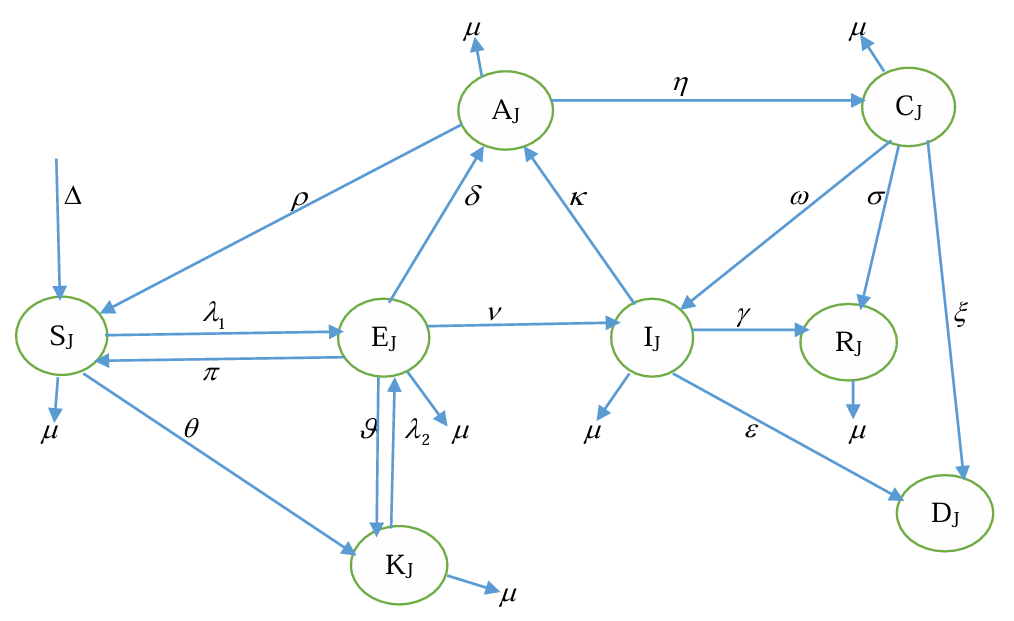
In this paper, we develop a mathematical model for juvenile delinquency transmission dynamics by incorporating key control strategies, namely precautionary measures, public education, and intervention programs. The model aims to identify effective prevention and control measures for curbing the spread of delinquent behavior among youths, with particular emphasis on evaluating the efficacy of public education. Adopting an epidemiological modelling framework, we derive a system of nonlinear differential equations governing the dynamics of juvenile delinquency over time. Stability analysis of the model is conducted, and the basic reproduction number along with the equilibrium points for both delinquency-free and endemic scenarios are established. Numerical simulations reveal that controlling the entry rate of juveniles into the population, reducing the transition rate from susceptible to delinquent status, and minimizing the rate at which individuals return to delinquency from correctional centers are critical for mitigating the spread of delinquent behavior. Moreover, while public education shows limited impact among susceptible individuals, it proves highly effective among the exposed, delinquent, and those in correctional facilities. Enhanced public education on the consequences of delinquency also contributes to reducing both arrest rates and juvenile homicides. This work offers valuable insights for researchers in applied mathematics, behavioral science, and healthcare management, while providing evidence-based guidance for policymakers seeking to manage and control juvenile delinquency.
Graphical Abstract
Keywords
Data Availability Statement
Funding
Conflicts of Interest
AI Use Statement
Ethical Approval and Consent to Participate
References
- Nuno, J. C., Herrero, M. A., & Primicerio, M. (2008). A triangle model of criminality. Physica A: Statistical Mechanics and its Applications, 387(12), 2926-2936.
[CrossRef] [Google Scholar] - New York State Unified Court System. (n.d.). Youthful offender. Retrieved October 28, 2022, from https://www.nycourts.gov/courthelp/Criminal/youthfulOffender.shtml
[Google Scholar] - Browning, K., Thornberry, T. P., & Porter, P. K. (1999). Highlights of findings from the Rochester youth development study. US Department of Justice, Office of Justice Programs: Office of Juvenile Justice and Delinquency Prevention, 1-2.
[Google Scholar] - Wilson, R. F., Fortson, B. L., Zhou, H., Lyons, B. H., Sheats, K. J., Betz, C. J., ... & Self-Brown, S. (2023). Trends in homicide rates for US children aged 0 to 17 years, 1999 to 2020. JAMA pediatrics, 177(2), 187-197.
[CrossRef] [Google Scholar] - Lee, Y. S., & Do, T. S. (2011). A modeling perspective of juvenile crimes. International Journal of Numerical Analysis and Modeling, B, 2(4), 369-378.
[Google Scholar] - Barrett, D. E., Katsiyannis, A., Zhang, D., & Zhang, D. (2014). A structural equation modeling analysis of influences on juvenile delinquency. Behavioral disorders, 39(3), 113-127.
[CrossRef] [Google Scholar] - Sooknanan, J., & Comissiong, D. M. G. (2018). A mathematical model for the treatment of delinquent behaviour. Socio-Economic Planning Sciences, 63, 60-69.
[CrossRef] [Google Scholar] - Mebratie, M. A., & Dawed, M. Y. (2021). Mathematical model analysis of crime dynamics incorporating media coverage and police force. Journal of Mathematics and Computer Science, 11(1), 125-148.
[CrossRef] [Google Scholar] - Sooknanan, J., & Seemungal, T. A. (2023). Criminals and their models-a review of epidemiological models describing criminal behaviour. Applied Mathematics and Computation, 458, 128212.
[CrossRef] [Google Scholar] - Ibrahim, O. M. (2023). A mathematical model of juvenile delinquency in the New York State. Rochester Institute of Technology. Available at: https://repository.rit.edu/article/2079
[Google Scholar] - Crokidakis, N. (2025). A mathematical model for the bullying dynamics in schools. Applied Mathematics and Computation, 492, 129254.
[CrossRef] [Google Scholar] - Nkeki, C. I., & Batubo, T. B. (2025). On a mathematical model for backsliding and repentance from sin with biblical supports. SASA Journal of Modern Science and Engineering, 1, 46-79.
[Google Scholar] - Hockenberry, S., & Puzzanchera, C. (2024). Juvenile Court Statistics, 2021. National Center for Juvenile Justice. Available at: https://www.ojjdp.gov/ojstatbb/njcda/pdf/jcs2021.pdf
[Google Scholar] - Florida Department of Juvenile Justice. (2025). Delinquency intake 2024-25. In 2024-25 comprehensive accountability report. Available at: https://www.djj.state.fl.us/content/download/1866582/file/(2024-25%20CAR)%20Intake.pdf?version=1
[Google Scholar] - Tapp, S. N., Thompson, A., Smith, E. L., & Remrey, L. (2024). Crimes involving juveniles, 1993-2022. Bureau of Justice Statistics, Office of Justice Programs, U.S. Department of Justice. Available at: https://bjs.ojp.gov/library/publications/crimes-involving-juveniles-1993-2022
[Google Scholar] - U.S. Census Bureau. (2023, December 7). U.S. Census Bureau Releases 2018-2022 ACS 5-Year Estimates [Press release]. United States Census Bureau. Retrieved from https://www.census.gov/programs-surveys/acs/news/updates/2023.html
[Google Scholar] - Zeng, Z., Carson, E. A., & Kluckow, R. (2023). Juveniles incarcerated in U.S. adult jails and prisons, 2002–2021 (NCJ 306140). Bureau of Justice Statistics, Office of Justice Programs, U.S. Department of Justice. Available at: https://bjs.ojp.gov/juveniles-incarcerated-us-adult-jails-and-prisons-2002-2021
[Google Scholar]
Cited By (3)
-
Faizah A. H. Alomari, G. M. Bahaa. Fractional-order analysis of a fear-induced ecoepidemiological predator–prey model with optimal control and bifurcation dynamics.
Scientific Reports, 2026 , 16 (1).
[CrossRef] -
Carlo Bianca, Luca Guerrini, Stefania Ragni. Stability and Hopf Criteria in a Malware Dissemination Model for Wireless Sensor Networks with Distributed Recovery Delays.
AppliedMath, 2026 , 6 (9).
[CrossRef] -
Saleh Fahad Aljurbua, Moustafa El-Shahed. Cost-effective strategies for controlling date palm mite infestations: an optimal control approach.
AIMS Mathematics, 2026 , 11 (8).
[CrossRef]
Cite This Article
TY  - JOUR
AU  - Nkeki, Charles Iwebuke
AU  - Mbarie, Imuwahen Anthonia
PY  - 2026
DA  - 2026/03/04
TI  - On Mathematical Study of Juvenile Delinquency with Precautionary Measure, Public Education and Intervention Programs as Control Strategies
JO  - Journal of Nonlinear Dynamics and Applications
T2  - Journal of Nonlinear Dynamics and Applications
JF  - Journal of Nonlinear Dynamics and Applications
VL  - 2
IS  - 1
SP  - 20
EP  - 38
DO  - 10.62762/JNDA.2025.195550
UR  - https://www.icck.org/article/abs/JNDA.2025.195550
KW  - mathematical model
KW  - juvenile delinquency
KW  - nonlinear dynamics
KW  - basic JD-reproduction number
KW  - JD equilibrium points
KW  - precautionary measure
KW  - public education program
KW  - intervention program
AB  - In this paper, we develop a mathematical model for juvenile delinquency transmission dynamics by incorporating key control strategies, namely precautionary measures, public education, and intervention programs. The model aims to identify effective prevention and control measures for curbing the spread of delinquent behavior among youths, with particular emphasis on evaluating the efficacy of public education. Adopting an epidemiological modelling framework, we derive a system of nonlinear differential equations governing the dynamics of juvenile delinquency over time. Stability analysis of the model is conducted, and the basic reproduction number along with the equilibrium points for both delinquency-free and endemic scenarios are established. Numerical simulations reveal that controlling the entry rate of juveniles into the population, reducing the transition rate from susceptible to delinquent status, and minimizing the rate at which individuals return to delinquency from correctional centers are critical for mitigating the spread of delinquent behavior. Moreover, while public education shows limited impact among susceptible individuals, it proves highly effective among the exposed, delinquent, and those in correctional facilities. Enhanced public education on the consequences of delinquency also contributes to reducing both arrest rates and juvenile homicides. This work offers valuable insights for researchers in applied mathematics, behavioral science, and healthcare management, while providing evidence-based guidance for policymakers seeking to manage and control juvenile delinquency.
SN  - 3069-6313
PB  - Institute of Central Computation and Knowledge
LA  - English
ER  -
@article{Nkeki2026On,
  author = {Charles Iwebuke Nkeki and Imuwahen Anthonia Mbarie},
  title = {On Mathematical Study of Juvenile Delinquency with Precautionary Measure, Public Education and Intervention Programs as Control Strategies},
  journal = {Journal of Nonlinear Dynamics and Applications},
  year = {2026},
  volume = {2},
  number = {1},
  pages = {20-38},
  doi = {10.62762/JNDA.2025.195550},
  url = {https://www.icck.org/article/abs/JNDA.2025.195550},
  abstract = {In this paper, we develop a mathematical model for juvenile delinquency transmission dynamics by incorporating key control strategies, namely precautionary measures, public education, and intervention programs. The model aims to identify effective prevention and control measures for curbing the spread of delinquent behavior among youths, with particular emphasis on evaluating the efficacy of public education. Adopting an epidemiological modelling framework, we derive a system of nonlinear differential equations governing the dynamics of juvenile delinquency over time. Stability analysis of the model is conducted, and the basic reproduction number along with the equilibrium points for both delinquency-free and endemic scenarios are established. Numerical simulations reveal that controlling the entry rate of juveniles into the population, reducing the transition rate from susceptible to delinquent status, and minimizing the rate at which individuals return to delinquency from correctional centers are critical for mitigating the spread of delinquent behavior. Moreover, while public education shows limited impact among susceptible individuals, it proves highly effective among the exposed, delinquent, and those in correctional facilities. Enhanced public education on the consequences of delinquency also contributes to reducing both arrest rates and juvenile homicides. This work offers valuable insights for researchers in applied mathematics, behavioral science, and healthcare management, while providing evidence-based guidance for policymakers seeking to manage and control juvenile delinquency.},
  keywords = {mathematical model, juvenile delinquency, nonlinear dynamics, basic JD-reproduction number, JD equilibrium points, precautionary measure, public education program, intervention program},
  issn = {3069-6313},
  publisher = {Institute of Central Computation and Knowledge}
}
Publisher's Note
ICCK stays neutral with regard to jurisdictional claims in published maps and institutional affiliations.
Rights and Permissions


Portico
