

Asynchronous Intermittent Event-Triggered Control for a Class of Coupled Stochastic Strict-Feedback Nonlinear Systems


Article Information
Abstract
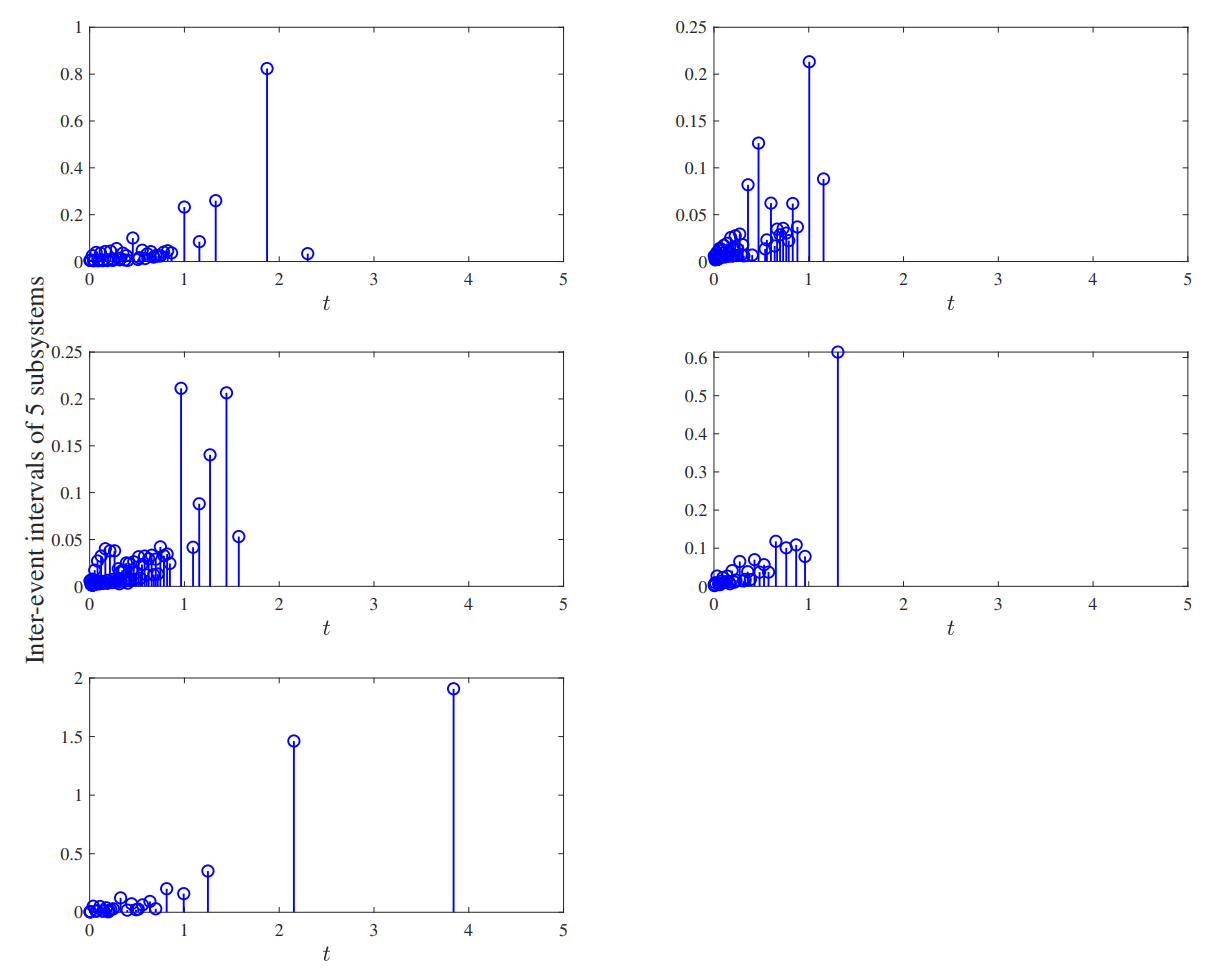
This paper investigates a class of coupled stochastic strict-feedback nonlinear systems under asynchronous intermittent event-triggered control (AIETC). Initially, stochastic analysis technique, Lyapunov method and backstepping design method are employed to design the virtual and actual controllers. AIETC is achieved by an auxiliary timer that grants each subsystem its own control and rest time. In the meantime the control input is applied only at the last node of each subsystem. Then, a global Lyapunov function is constructed. By utilizing graph theory, the global exponential ultimate boundedness in mean square of the systems can be obtained and Zeno behavior is eliminated successfully. Finally, a simulation example is provided to demonstrate the effectiveness of our results.
Graphical Abstract
Keywords
Data Availability Statement
Funding
Conflicts of Interest
Ethical Approval and Consent to Participate
References
- Xu, B., Yang, C. G., & Pan, Y. P. (2015). Global neural dynamic surface tracking control of strict-feedback systems with application to hypersonic flight vehicle. IEEE Transactions on Neural Networks and Learning Systems, 26(10), 2563-2575.
[CrossRef] [Google Scholar] - Xu, B. (2016). Disturbance observer-based dynamic surface control of transport aircraft with continuous heavy cargo airdrop. IEEE Transactions on Systems, Man, and Cybernetics: Systems, 47(1), 161-170.
[CrossRef] [Google Scholar] - He, S. D., Dai, S. L., & Dong, C. (2022). Adaptive synchronization control of uncertain multiple USVs with prescribed performance and preserved connectivity. Science China. Information Sciences, 65(9), 199201.
[CrossRef] [Google Scholar] - Zhang, D., Van, M., Mcllvanna, S., Sun, Y., & McLoone, S. (2023). Adaptive safety-critical control with uncertainty estimation for human–robot collaboration. IEEE Transactions on Automation Science and Engineering, 21(4), 5983-5996.
[CrossRef] [Google Scholar] - Deng, H., & Krsti\'c, M. (1997). Stochastic nonlinear stabilization—I: A backstepping design. Systems & Control Letters, 32(3), 143-150.
[CrossRef] [Google Scholar] - Pan, Z. G., & Basar, T. (1999). Backstepping controller design for nonlinear stochastic systems under a risk-sensitive cost criterion. SIAM Journal on Control and optimization, 37(3), 957-995.
[CrossRef] [Google Scholar] - Deng, H., Krsti\'c, M., & Williams, R. J. (2001). Stabilization of stochastic nonlinear systems driven by noise of unknown covariance. IEEE Transactions on Automatic Control, 46(8), 1237-1253.
[CrossRef] [Google Scholar] - Tong, S. C., Li, Y., Li, Y. M., & Liu, Y. J. (2011). Observer-based adaptive fuzzy backstepping control for a class of stochastic nonlinear strict-feedback systems. IEEE Transactions on Systems, Man, and Cybernetics, Part B (Cybernetics), 41(6), 1693-1704.
[CrossRef] [Google Scholar] - Khoo, S. Y., Yin, J. L., Man, Z. H., & Yu, X. H. (2013). Finite-time stabilization of stochastic nonlinear systems in strict-feedback form. Automatica, 49(5), 1403-1410.
[CrossRef] [Google Scholar] - Wang, H., & Zhu, Q. X. (2015). Finite-time stabilization of high-order stochastic nonlinear systems in strict-feedback form. Automatica, 54, 284-291.
[CrossRef] [Google Scholar] - Chen, C., Liu, Z., Zhang, Y., Chen, C. P., & Xie, S. L. (2016). Asymptotic fuzzy tracking control for a class of stochastic strict-feedback systems. IEEE Transactions on Fuzzy Systems, 25(3), 556-568.
[CrossRef] [Google Scholar] - Li, W. Q., Yao, X. X., & Krstic, M. (2020). Adaptive-gain observer-based stabilization of stochastic strict-feedback systems with sensor uncertainty. Automatica, 120, 109112.
[CrossRef] [Google Scholar] - Li, W. Q., & Krstic, M. (2021). Stochastic nonlinear prescribed-time stabilization and inverse optimality. Transactions on Automatic Control, 67(3), 1179-1193.
[CrossRef] [Google Scholar] - Guo, W. Y., Zhang, Y. F., & Li, W. X. (2023). Synchronization for the coupled stochastic strict-feedback nonlinear systems with delays under pinning control. Nonlinear Analysis: Hybrid Systems, 48, 101326.
[CrossRef] [Google Scholar] - Guo, W. Y., Zhao, Y., & Li, W. X. (2023). Pinning control for stabilization of coupled stochastic strict-feedback nonlinear systems. International Journal of Robust and Nonlinear Control, 33(18), 10893-10915.
[CrossRef] [Google Scholar] - Guo, W. Y., Du, S. Q., Yuan, R., & Li, W. X. (2024). Stability analysis of the stochastic strict-feedback nonlinear systems with time-varying delays on networks under pinning control. International Journal of Control, 97(8), 1887-1903.
[CrossRef] [Google Scholar] - Liu, X. W., & Chen, T. P. (2015). Synchronization of complex networks via aperiodically intermittent pinning control. IEEE Transactions on Automatic Control, 60(12), 3316-3321.
[CrossRef] [Google Scholar] - Li, S., Lv, C. Y., & Ding, X. H. (2020). Synchronization of stochastic hybrid coupled systems with multi-weights and mixed delays via aperiodically adaptive intermittent control. Nonlinear Analysis: Hybrid Systems, 35, 100819.
[CrossRef] [Google Scholar] - Wang, P. F., Hong, Y., & Su, H. (2018). Stabilization of stochastic complex-valued coupled delayed systems with Markovian switching via periodically intermittent control. Nonlinear Analysis: Hybrid Systems, 29, 395-413.
[CrossRef] [Google Scholar] - Liu, Y., Li, Y. M., & Wang, J. L. (2021). Intermittent control to stabilization of stochastic highly non-linear coupled systems with multiple time delays. IEEE Transactions on Neural Networks and Learning Systems, 34(8), 4674-4686.
[CrossRef] [Google Scholar] - Mao, W., You, S. R., Jiang, Y. N., & Mao, X. R. (2023). Stochastic stabilization of hybrid neural networks by periodically intermittent control based on discrete-time state observations. Nonlinear Analysis: Hybrid Systems, 48, 101331.
[CrossRef] [Google Scholar] - Li, F. Z., & Liu, Y. G. (2019). Event-triggered stabilization for continuous-time stochastic systems. IEEE Transactions on Automatic Control, 65(10), 4031-4046.
[CrossRef] [Google Scholar] - Zhang, J., & Fridman, E. (2021). Dynamic event-triggered control of networked stochastic systems with scheduling protocols. IEEE Transactions on Automatic Control, 66(12), 6139-6147.
[CrossRef] [Google Scholar] - Yu, H., Chen, T. W., & Hao, F. (2022). A new event-triggered control scheme for stochastic systems. IEEE Transactions on Automatic Control, 68(3), 1463-1478.
[CrossRef] [Google Scholar] - Li, B. M., Xia, J. W., Zhang, H. S., Shen, H., & Wang, Z. (2020). Event-triggered adaptive fuzzy tracking control for stochastic nonlinear systems. Journal of the Franklin Institute, 357(14), 9505-9522.
[CrossRef] [Google Scholar] - Lu, H., Jiang, Y., & Luo, S. X. (2023). Adaptive event-triggered tracking control for a class of stochastic nonlinear systems with full-state constraints. Asian Journal of Control, 25(2), 1202-1215.
[CrossRef] [Google Scholar] - Hu, A. H., & Cao, J. D. (2017). Consensus of multi-agent systems via intermittent event-triggered control. International Journal of Systems Science, 48(2), 280-287.
[CrossRef] [Google Scholar] - Wu, Y. B., Shen, B., Ahn, C. K., & Li, W. X. (2021). Intermittent dynamic event-triggered control for synchronization of stochastic complex networks. IEEE Transactions on Circuits and Systems I: Regular Papers, 68(6), 2639-2650.
[CrossRef] [Google Scholar] - Tang, W., Sheng, Y., Xiao, Q., Huang, T. W., & Zeng, Z. G. (2024). Synchronization of complex dynamical networks on time scales via intermittent dynamic event-triggered control. IEEE Transactions on Systems, Man, and Cybernetics: Systems, 54(5), 2897-2906.
[CrossRef] [Google Scholar] - Wang, P. F., Su, H., & Wang, R. H. (2022). Asynchronously intermittent decentralized control of large-scale systems. IEEE Control Systems Letters, 6, 2737-2742.
[CrossRef] [Google Scholar] - Wu, Y. B., Guo, Z. R., Xue, L., Ahn, C. K., & Liu, J. (2024). Stabilization of complex networks under asynchronously intermittent event-triggered control. Automatica, 161, 111493.
[CrossRef] [Google Scholar] - Wang, P., Wang, R., & Su, H. (2021). Stability of time-varying hybrid stochastic delayed systems with application to aperiodically intermittent stabilization. IEEE Transactions on Cybernetics, 52(9), 9026-9035.
[CrossRef] [Google Scholar] - Xu, L. G., & Ge, S. S. (2015). The pth moment exponential ultimate boundedness of impulsive stochastic differential systems. Applied Mathematics Letters, 42, 22-29.
[CrossRef] [Google Scholar] - Xing, L. T., Wen, C. Y., Liu, Z. T., Su, H. Y., & Cai, J. P. (2016). Event-triggered adaptive control for a class of uncertain nonlinear systems. IEEE Transactions on Automatic Control, 62(4), 2071-2076.
[CrossRef] [Google Scholar] - Li, M. Y., & Shuai, Z. S. (2010). Global-stability problem for coupled systems of differential equations on networks. Journal of Differential Equations, 248(1), 1-20.
[CrossRef] [Google Scholar] - Mao, X. R. (2007). Stochastic differential equations and applications. Elsevier.
[CrossRef] [Google Scholar]
Cited By (1)
-
Peng Liu, Yiwei Shao, Yin Sheng, Qiang Xiao, Jian Yong. Predefined-time cluster lag synchronization of inertial neural networks: A dynamic event-triggered control.
Neural Networks, 2026 , 201 .
[CrossRef]
Cite This Article
TY  - JOUR
AU  - Lu, Ji
AU  - Li, Yan
AU  - Pan, Yujie
PY  - 2025
DA  - 2025/12/24
TI  - Asynchronous Intermittent Event-Triggered Control for a Class of Coupled Stochastic Strict-Feedback Nonlinear Systems
JO  - Journal of Nonlinear Dynamics and Applications
T2  - Journal of Nonlinear Dynamics and Applications
JF  - Journal of Nonlinear Dynamics and Applications
VL  - 1
IS  - 2
SP  - 112
EP  - 126
DO  - 10.62762/JNDA.2025.753314
UR  - https://www.icck.org/article/abs/JNDA.2025.753314
KW  - stochastic nonlinear systems
KW  - intermittent control
KW  - event-triggered
KW  - backstepping
AB  - This paper investigates a class of coupled stochastic strict-feedback nonlinear systems under asynchronous intermittent event-triggered control (AIETC). Initially, stochastic analysis technique, Lyapunov method and backstepping design method are employed to design the virtual and actual controllers. AIETC is achieved by an auxiliary timer that grants each subsystem its own control and rest time. In the meantime the control input is applied only at the last node of each subsystem. Then, a global Lyapunov function is constructed. By utilizing graph theory, the global exponential ultimate boundedness in mean square of the systems can be obtained and Zeno behavior is eliminated successfully. Finally, a simulation example is provided to demonstrate the effectiveness of our results.
SN  - 3069-6313
PB  - Institute of Central Computation and Knowledge
LA  - English
ER  -
@article{Lu2025Asynchrono,
  author = {Ji Lu and Yan Li and Yujie Pan},
  title = {Asynchronous Intermittent Event-Triggered Control for a Class of Coupled Stochastic Strict-Feedback Nonlinear Systems},
  journal = {Journal of Nonlinear Dynamics and Applications},
  year = {2025},
  volume = {1},
  number = {2},
  pages = {112-126},
  doi = {10.62762/JNDA.2025.753314},
  url = {https://www.icck.org/article/abs/JNDA.2025.753314},
  abstract = {This paper investigates a class of coupled stochastic strict-feedback nonlinear systems under asynchronous intermittent event-triggered control (AIETC). Initially, stochastic analysis technique, Lyapunov method and backstepping design method are employed to design the virtual and actual controllers. AIETC is achieved by an auxiliary timer that grants each subsystem its own control and rest time. In the meantime the control input is applied only at the last node of each subsystem. Then, a global Lyapunov function is constructed. By utilizing graph theory, the global exponential ultimate boundedness in mean square of the systems can be obtained and Zeno behavior is eliminated successfully. Finally, a simulation example is provided to demonstrate the effectiveness of our results.},
  keywords = {stochastic nonlinear systems, intermittent control, event-triggered, backstepping},
  issn = {3069-6313},
  publisher = {Institute of Central Computation and Knowledge}
}
Publisher's Note
ICCK stays neutral with regard to jurisdictional claims in published maps and institutional affiliations.
Rights and Permissions


Portico
