

Chemotaxis–Reaction Models in Microbial Ecology: Theory, Analysis, and Applications



Article Information
Abstract
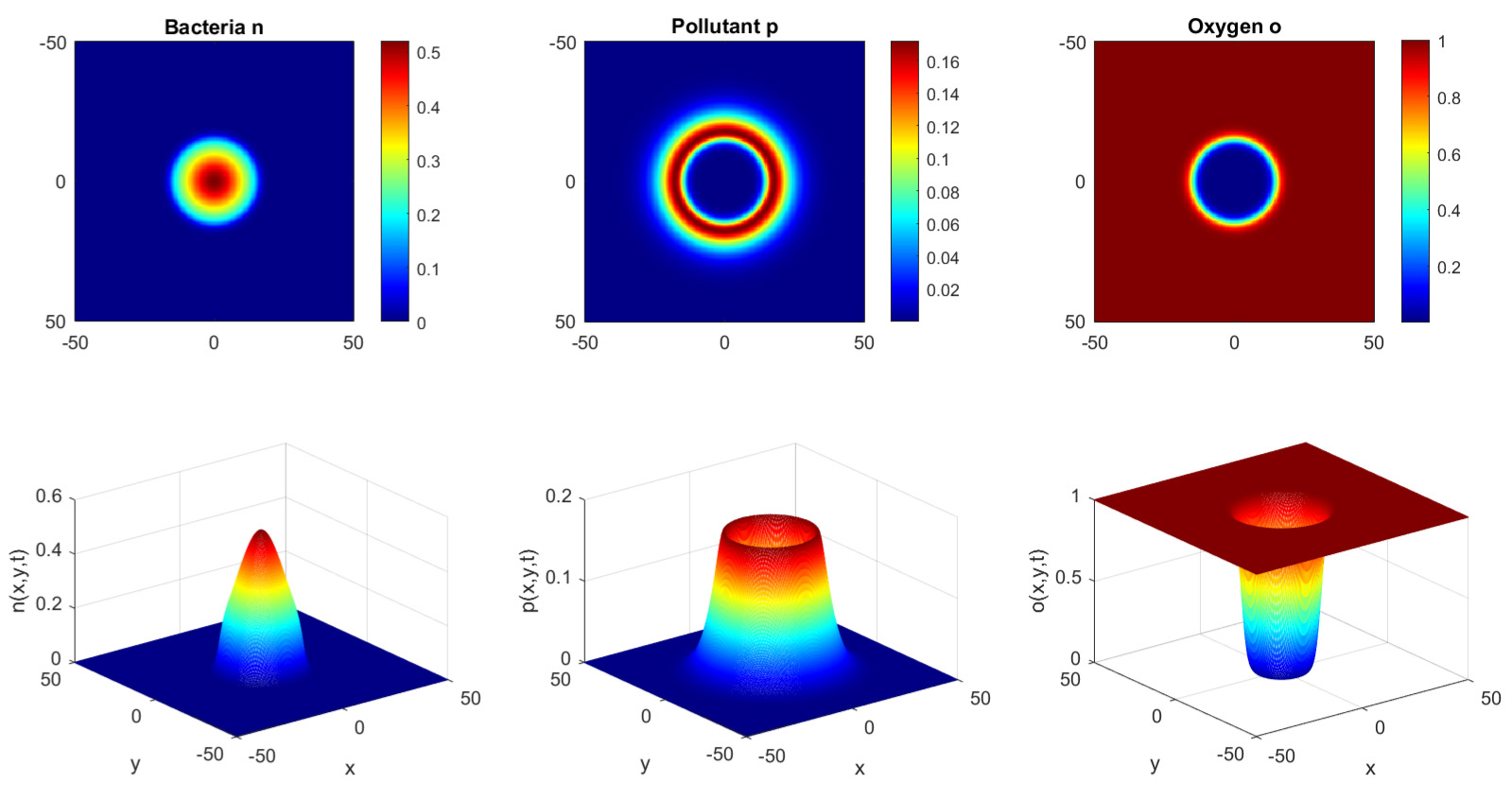
Chemotaxis, the directed movement of microorganisms in response to chemical gradients, plays a pivotal role in microbial ecology. This article provides a comprehensive review of mathematical models that couple chemotaxis with reaction dynamics to describe microbial population behavior. We discuss how such chemotaxis–reaction models capture essential ecological phenomena, from nutrient foraging and biofilm formation to inter-species competition and environmental processes. Key model formulations, starting from the classical Keller--Segel system, are presented alongside extensions incorporating multiple species, complex reaction terms, and fluid flow coupling. We survey rigorous mathematical results on well-posedness, pattern formation, and stability, highlighting analytical tools in partial differential equations (PDEs) and functional analysis. Numerical simulation techniques are reviewed, illustrating how computational methods can capture chemotactic pattern formation. Biological applications are emphasized throughout, drawing connections between model predictions and experimental observations of bacterial aggregation patterns, biofilm spatial structure, and microbial competition. Finally, we outline open problems and future directions, including stochastic modeling, multiscale approaches, and data-driven techniques, underscoring the interdisciplinary outlook. The contributions of this article lie in synthesizing recent advances in chemotaxis–reaction modeling and analysis, and in elucidating the interplay between theory and experiment in microbial ecology.
Graphical Abstract
Keywords
Data Availability Statement
Funding
Conflicts of Interest
AI Use Statement
Ethical Approval and Consent to Participate
References
- Adler, J. (1966). Chemotaxis in Bacteria: Motile Escherichia coli migrate in bands that are influenced by oxygen and organic nutrients. Science, 153(3737), 708-716.
[CrossRef] [Google Scholar] - Keller, E. F., & Segel, L. A. (1971). Model for chemotaxis. Journal of theoretical biology, 30(2), 225-234.
[CrossRef] [Google Scholar] - Hillen, T., & Painter, K. J. (2009). A user’s guide to PDE models for chemotaxis. Journal of mathematical biology, 58(1), 183-217.
[CrossRef] [Google Scholar] - Painter, K. J. (2019). Mathematical models for chemotaxis and their applications in self-organisation phenomena. Journal of theoretical biology, 481, 162-182.
[CrossRef] [Google Scholar] - Winkler, M. (2010). Boundedness in the higher-dimensional parabolic-parabolic chemotaxis system with logistic source. Communications in Partial Differential Equations, 35(8), 1516-1537.
[CrossRef] [Google Scholar] - Wang, Z. (2013). Mathematics of traveling waves in chemotaxis-Review paper. Discrete and Continuous Dynamical Systems-Series B, 18(3), 601-641.
[CrossRef] [Google Scholar] - Owolabi, K. M., Mare, E., Ijalana, C. O., & Adegbie, K. S. (2026). Multi-Species Keller--Segel Systems: Analysis, Pattern Formation, and Emerging Mathematical Structures. arXiv preprint arXiv:2603.04931.
[CrossRef] [Google Scholar] - Keller, E. F., & Segel, L. A. (1971). Traveling bands of chemotactic bacteria: a theoretical analysis. Journal of theoretical biology, 30(2), 235-248.
[CrossRef] [Google Scholar] - Bellomo, N., Bellouquid, A., Tao, Y., & Winkler, M. (2015). Toward a mathematical theory of Keller–Segel models of pattern formation in biological tissues. Mathematical Models and Methods in Applied Sciences, 25(09), 1663-1763.
[CrossRef] [Google Scholar] - Horstmann, D. (2003). From 1970 until present: The Keller-Segel model in chemotaxis and its consequences (Preprint No. 3). Max-Planck-Institut für Mathematik in den Naturwissenschaften Leipzig. https://webdoc.sub.gwdg.de/ebook/serien/e/MPI_Math_Nat/preprint2003_3.pdf
[Google Scholar] - Perthame, B. (2007). Transport Equations in Biology. Birkhäuser.
[CrossRef] [Google Scholar] - Winkler, M. (2010). Aggregation vs. global diffusive behavior in the higher-dimensional Keller–Segel model. Journal of Differential Equations, 248(12), 2889-2905.
[CrossRef] [Google Scholar] - Fuest, M. (2020). Finite-time blow-up in a two-dimensional Keller–Segel system with an environmental dependent logistic source. Nonlinear Analysis: Real World Applications, 52, 103022.
[CrossRef] [Google Scholar] - Tao, Y., & Winkler, M. (2012). Boundedness in a quasilinear parabolic–parabolic Keller–Segel system with subcritical sensitivity. Journal of Differential Equations, 252(1), 692-715.
[CrossRef] [Google Scholar] - Arumugam, G., & Tyagi, J. (2021). Keller-Segel chemotaxis models: a review. Acta Applicandae Mathematicae, 171(1), 6.
[CrossRef] [Google Scholar] - Fraga Delfino Kunz, C., Gerisch, A., Glover, J., Headon, D., Painter, K. J., & Matthäus, F. (2024). Novel aspects in pattern formation arise from coupling turing reaction–diffusion and chemotaxis. Bulletin of Mathematical Biology, 86(1), 4.
[CrossRef] [Google Scholar] - Cremer, J., Honda, T., Tang, Y., Wong-Ng, J., Vergassola, M., & Hwa, T. (2019). Chemotaxis as a navigation strategy to boost range expansion. Nature, 575(7784), 658-663.
[CrossRef] [Google Scholar] - Wadhams, G. H., & Armitage, J. P. (2004). Making sense of it all: bacterial chemotaxis. Nature reviews Molecular cell biology, 5(12), 1024-1037.
[CrossRef] [Google Scholar] - Raina, J. B., Lambert, B. S., Parks, D. H., Rinke, C., Siboni, N., Bramucci, A., ... & Seymour, J. R. (2022). Chemotaxis shapes the microscale organization of the ocean’s microbiome. Nature, 605(7908), 132-138.
[CrossRef] [Google Scholar] - Narla, A. V., Cremer, J., & Hwa, T. (2021). A traveling-wave solution for bacterial chemotaxis with growth. Proceedings of the National Academy of Sciences, 118(48), e2105138118.
[CrossRef] [Google Scholar] - Chertock, A., Kurganov, A., Ricchiuto, M., & Wu, T. (2019). Adaptive moving mesh upwind scheme for the two-species chemotaxis model. Computers \textnormal{& Mathematics with Applications, 77(12), 3172-3185.
[CrossRef] [Google Scholar] - Xue, C., & Othmer, H. G. (2009). Multiscale models of taxis-driven patterning in bacterial populations. SIAM Journal on Applied Mathematics, 70(1), 133-167.
[CrossRef] [Google Scholar] - Budrene, E. O., & Berg, H. C. (1991). Complex patterns formed by motile cells of Escherichia coli. Nature, 349(6310), 630--633.
[CrossRef] [Google Scholar] - Blanchet, A., Dolbeault, J., & Perthame, B. (2006). Two-dimensional Keller-Segel model: optimal critical mass and qualitative properties of solutions. Electronic Journal of Differential Equations, 2006(44), 1-33. https://eudml.org/doc/127363
[Google Scholar] - Tello, J. I., & Winkler, M. (2007). A chemotaxis system with logistic source. Communications in Partial Differential Equations, 32(6), 849--877.
[CrossRef] [Google Scholar] - Issa, T. B., & Shen, W. (2019). Persistence, coexistence and extinction in two species chemotaxis models on heterogeneous environments. Journal of Dynamics and Differential Equations, 31(4), 1839--1871.
[CrossRef] [Google Scholar] - Issa, T. B., & Shen, W. (2019). Uniqueness and stability of coexistence states in two species models with/without chemotaxis on bounded heterogeneous environments. Journal of Dynamics and Differential Equations, 31(4), 2305-2338.
[CrossRef] [Google Scholar] - Tuval, I., Cisneros, L., Dombrowski, C., Wolgemuth, C. W., Kessler, J. O., & Goldstein, R. E. (2005). Bacterial swimming and oxygen transport near contact lines. Proceedings of the National Academy of Sciences, 102(7), 2277-2282.
[CrossRef] [Google Scholar] - Winkler, M. (2012). Global large-data solutions in a chemotaxis-(Navier–) Stokes system modeling cellular swimming in fluid drops. Communications in Partial Differential Equations, 37(2), 319-351.
[CrossRef] [Google Scholar] - Keegstra, J. M., Carrara, F., & Stocker, R. (2022). The ecological roles of bacterial chemotaxis. Nature Reviews Microbiology, 20(8), 491-504.
[CrossRef] [Google Scholar] - Brumley, D. R., Carrara, F., Hein, A. M., Hagstrom, G. I., Levin, S. A., & Stocker, R. (2020). Cutting through the noise: bacterial chemotaxis in marine microenvironments. Frontiers in Marine Science, 7, 527.
[CrossRef] [Google Scholar] - Jeong, H. H. (2021). Recent developments in bacterial chemotaxis analysis based on the microfluidic system. SLAS TECHNOLOGY: Translating Life Sciences Innovation, 26(2), 159-164.
[CrossRef] [Google Scholar] - Zhao, X., & Gao, B. (2026). AI and Microfluidics: Unlocking Cellular Motility for Bioengineering. Bioengineering, 13(2), 172.
[CrossRef] [Google Scholar] - Jäger, W., & Luckhaus, S. (1992). On explosions of solutions to a system of partial differential equations modelling chemotaxis. Transactions of the american mathematical society, 329(2), 819-824.
[CrossRef] [Google Scholar] - Budrene, E. O., & Berg, H. C. (1995). Dynamics of formation of symmetrical patterns by chemotactic bacteria. Nature, 376(6535), 49-53.
[CrossRef] [Google Scholar] - Patlak, C. S. (1953). Random walk with persistence and external bias. The bulletin of mathematical biophysics, 15(3), 311-338.
[CrossRef] [Google Scholar] - Alt, W. (1980). Biased random walk models for chemotaxis and related diffusion approximations. Journal of mathematical biology, 9(2), 147-177.
[CrossRef] [Google Scholar] - Stevens, A., & Othmer, H. G. (1997). Aggregation, blowup, and collapse: the ABC's of taxis in reinforced random walks. SIAM Journal on Applied Mathematics, 57(4), 1044-1081.
[CrossRef] [Google Scholar] - Painter, K. J., & Hillen, T. (2011). Spatio-temporal chaos in a chemotaxis model. Physica D: Nonlinear Phenomena, 240(4-5), 363-375.
[CrossRef] [Google Scholar] - Owolabi, K. M., Pindza, E., & Jain, S. (2025). Complex spatiotemporal phenomena in multi-dimensional reaction–diffusion system. The European Physical Journal Special Topics, 234(8), 2565-2599.
[CrossRef] [Google Scholar] - Cox, S. M., & Matthews, P. C. (2002). Exponential time differencing for stiff systems. Journal of Computational Physics, 176(2), 430-455.
[CrossRef] [Google Scholar] - Kassam, A. K., & Trefethen, L. N. (2005). Fourth-order time-stepping for stiff PDEs. SIAM Journal on Scientific Computing, 26(4), 1214-1233.
[CrossRef] [Google Scholar] - Boyd, J. P. (2001). Chebyshev and Fourier spectral methods. Courier Corporation.
[Google Scholar] - Canuto, C., Hussaini, M. Y., Quarteroni, A., & Zang, T. A. (2006). Spectral methods. Berlin: springer.
[CrossRef] [Google Scholar] - Tsimring, L., Levine, H., Aranson, I., Ben-Jacob, E., Cohen, I., Shochet, O., & Reynolds, W. N. (1995). Aggregation patterns in stressed bacteria. Physical review letters, 75(9), 1859.
[CrossRef] [Google Scholar] - Ben-Jacob, E. (1997). From snowflake formation to growth of bacterial colonies II: Cooperative formation of complex colonial patterns. Contemporary physics, 38(3), 205-241.
[CrossRef] [Google Scholar] - Pratt, L. A., & Kolter, R. (1998). Genetic analysis of Escherichia coli biofilm formation: roles of flagella, motility, chemotaxis and type I pili. Molecular microbiology, 30(2), 285-293.
[CrossRef] [Google Scholar] - Tao, Y., & Winkler, M. (2022). Existence theory and qualitative analysis for a fully cross-diffusive predator-prey system. SIAM Journal on Mathematical Analysis, 54(4), 4806-4864.
[CrossRef] [Google Scholar] - Darrah, P. R. (1991). Models of the rhizosphere: I. Microbial population dynamics around a root releasing soluble and insoluble carbon. Plant and Soil, 133(2), 187-199.
[CrossRef] [Google Scholar] - Blackburn, N., Fenchel, T., & Mitchell, J. (1998). Microscale nutrient patches in planktonic habitats shown by chemotactic bacteria. Science, 282(5397), 2254-2256.
[CrossRef] [Google Scholar] - Stocker, R. (2012). Marine microbes see a sea of gradients. science, 338(6107), 628-633.
[CrossRef] [Google Scholar] - Verwer, J. G., & Sportisse, B. (1998). A note on operator splitting in a stiff linear case. Report-Modelling, analysis and simulation, (30), 1-13. http://pascal-francis.inist.fr/vibad/index.php?action=getRecordDetail&idt=1806182
[Google Scholar] - Strang, G. (1968). On the construction and comparison of difference schemes. SIAM journal on numerical analysis, 5(3), 506-517.
[CrossRef] [Google Scholar] - Ebert, U., & van Saarloos, W. (2000). Front propagation into unstable states: universal algebraic convergence towards uniformly translating pulled fronts. Physica D: Nonlinear Phenomena, 146(1-4), 1-99.
[CrossRef] [Google Scholar] - Kreft, J. U., Picioreanu, C., Wimpenny, J. W., & van Loosdrecht, M. C. (2001). Individual-based modelling of biofilms. Microbiology, 147(11), 2897-2912.
[CrossRef] [Google Scholar] - Proverbio, D. (2024). Chemotaxis in heterogeneous environments: A multi-agent model of decentralized gathering past obstacles. Journal of Theoretical Biology, 586, 111820.
[CrossRef] [Google Scholar] - Farmer, A., & Harris, P. J. (2023). A mathematical model of cell movement and clustering due to chemotaxis. Journal of Theoretical Biology, 575, 111646.
[CrossRef] [Google Scholar] - Arshadi, S., Pishevar, A., Javanbakht, M., & Javanmard, S. H. (2025). Chemotaxis effects on the vascular tumor growth: Phase-field model and simulations. Mathematical biosciences, 380, 109366.
[CrossRef] [Google Scholar] - Amorim, P., de Lima, R., & Telch, B. (2025). An ant territory formation model with chemotaxis and alarm pheromones. Mathematical Biosciences, 109498.
[CrossRef] [Google Scholar] - An, J., Kiselev, A., & Yao, Y. (2026). Reaction enhancement by flux-limited chemotaxis. Journal of Mathematical Biology, 92(4), 57.
[CrossRef] [Google Scholar] - Sharma, I., Nagpal, S., & Mishra, A. K. (2025). Navigating bacterial motility through chemotaxis: from molecular mechanisms to physiological perspectives. Folia Microbiologica, 70(4), 753-777.
[CrossRef] [Google Scholar] - Yang, Y., Yang, J., Li, L., Shao, Y., Liu, L., & Sun, B. (2024). Neutrophil chemotaxis score and chemotaxis-related genes have the potential for clinical application to prognosticate the survival of patients with tumours. BMC cancer, 24(1), 1244.
[CrossRef] [Google Scholar]
Cited By (1)
-
Louis Shuo Wang, Jiguang Yu, Ye Liang, Jilin Zhang. Elliptic criticality versus Volterra memory in indirect chemotaxis cascades.
Transport Phenomena, 2026 , 1 (2).
[CrossRef]
Cite This Article
TY  - JOUR
AU  - Owolabi, Kolade M.
AU  - Maré, Eben
AU  - Ijalana, Clara O.
PY  - 2026
DA  - 2026/05/27
TI  - Chemotaxis–Reaction Models in Microbial Ecology: Theory, Analysis, and Applications
JO  - Journal of Nonlinear Dynamics and Applications
T2  - Journal of Nonlinear Dynamics and Applications
JF  - Journal of Nonlinear Dynamics and Applications
VL  - 2
IS  - 2
SP  - 76
EP  - 107
DO  - 10.62762/JNDA.2026.783618
UR  - https://www.icck.org/article/abs/JNDA.2026.783618
KW  - Keller-Segel model
KW  - Chemotaxis
KW  - reaction-diffusion systems
KW  - lyapunov stability
KW  - pattern formation
KW  - nonlinear PDEs
KW  - microbial ecology
AB  - Chemotaxis, the directed movement of microorganisms in response to chemical gradients, plays a pivotal role in microbial ecology. This article provides a comprehensive review of mathematical models that couple chemotaxis with reaction dynamics to describe microbial population behavior. We discuss how such chemotaxis–reaction models capture essential ecological phenomena, from nutrient foraging and biofilm formation to inter-species competition and environmental processes. Key model formulations, starting from the classical Keller--Segel system, are presented alongside extensions incorporating multiple species, complex reaction terms, and fluid flow coupling. We survey rigorous mathematical results on well-posedness, pattern formation, and stability, highlighting analytical tools in partial differential equations (PDEs) and functional analysis. Numerical simulation techniques are reviewed, illustrating how computational methods can capture chemotactic pattern formation. Biological applications are emphasized throughout, drawing connections between model predictions and experimental observations of bacterial aggregation patterns, biofilm spatial structure, and microbial competition. Finally, we outline open problems and future directions, including stochastic modeling, multiscale approaches, and data-driven techniques, underscoring the interdisciplinary outlook. The contributions of this article lie in synthesizing recent advances in chemotaxis–reaction modeling and analysis, and in elucidating the interplay between theory and experiment in microbial ecology.
SN  - 3069-6313
PB  - Institute of Central Computation and Knowledge
LA  - English
ER  -
@article{Owolabi2026Chemotaxis,
  author = {Kolade M. Owolabi and Eben Maré and Clara O. Ijalana},
  title = {Chemotaxis–Reaction Models in Microbial Ecology: Theory, Analysis, and Applications},
  journal = {Journal of Nonlinear Dynamics and Applications},
  year = {2026},
  volume = {2},
  number = {2},
  pages = {76-107},
  doi = {10.62762/JNDA.2026.783618},
  url = {https://www.icck.org/article/abs/JNDA.2026.783618},
  abstract = {Chemotaxis, the directed movement of microorganisms in response to chemical gradients, plays a pivotal role in microbial ecology. This article provides a comprehensive review of mathematical models that couple chemotaxis with reaction dynamics to describe microbial population behavior. We discuss how such chemotaxis–reaction models capture essential ecological phenomena, from nutrient foraging and biofilm formation to inter-species competition and environmental processes. Key model formulations, starting from the classical Keller--Segel system, are presented alongside extensions incorporating multiple species, complex reaction terms, and fluid flow coupling. We survey rigorous mathematical results on well-posedness, pattern formation, and stability, highlighting analytical tools in partial differential equations (PDEs) and functional analysis. Numerical simulation techniques are reviewed, illustrating how computational methods can capture chemotactic pattern formation. Biological applications are emphasized throughout, drawing connections between model predictions and experimental observations of bacterial aggregation patterns, biofilm spatial structure, and microbial competition. Finally, we outline open problems and future directions, including stochastic modeling, multiscale approaches, and data-driven techniques, underscoring the interdisciplinary outlook. The contributions of this article lie in synthesizing recent advances in chemotaxis–reaction modeling and analysis, and in elucidating the interplay between theory and experiment in microbial ecology.},
  keywords = {Keller-Segel model, Chemotaxis, reaction-diffusion systems, lyapunov stability, pattern formation, nonlinear PDEs, microbial ecology},
  issn = {3069-6313},
  publisher = {Institute of Central Computation and Knowledge}
}
Article Metrics
Publisher's Note
ICCK stays neutral with regard to jurisdictional claims in published maps and institutional affiliations.
Rights and Permissions


Portico
