

A Deep Learning Based Framework for Skin Cancer Detection Using a Layered Software Architecture with Transfer Learning




Article Information
Abstract
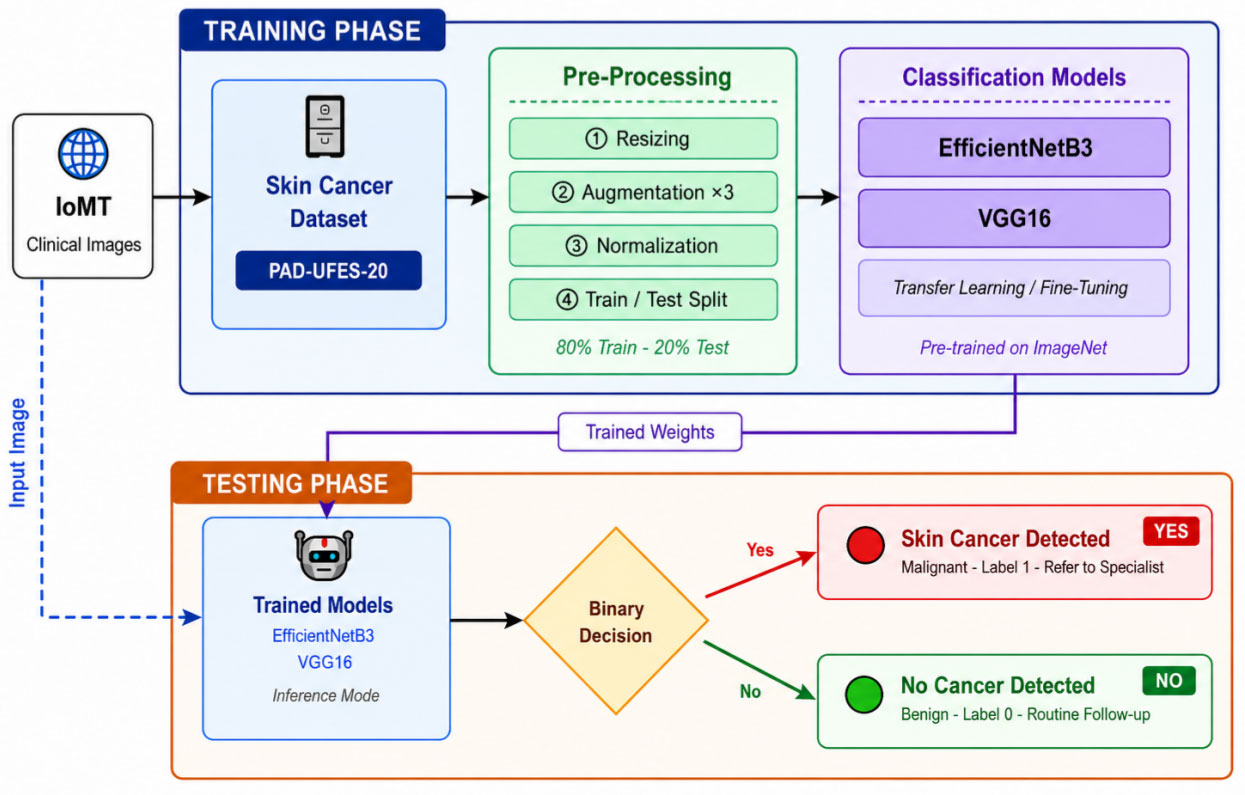
Skin cancer has become a serious public health issue worldwide. The number of cases is rising due to higher UV exposure and changing lifestyle patterns. Early detection is the best way to save lives. However, many areas still lack specialized doctors and equipment needed for a quick diagnosis. In this paper, we develop and test an automated skin cancer detection method based on standard smartphone photography. It provides a practical solution for resource-limited settings by removing the need for expensive clinical dermoscopy equipment, making diagnosis accessible in areas with limited infrastructure. The system was trained and tested on PAD-UFES-20, which contains 2,298 clinical smartphone images of skin lesions. The images were grouped into two categories: malignant and benign. Malignant cases involved Basal Cell Carcinoma, Squamous Cell Carcinoma, and Melanoma. Benign lesions consisted of Actinic Keratosis, Nevus, and Seborrheic Keratosis. Transfer learning was used to fine-tune two models: EfficientNetB3 and VGG16. Both were pre-trained on ImageNet. EfficientNetB3 achieved a test accuracy of 82.61%. It outperformed VGG16, which achieved an accuracy of 79.78%. The system follows a modular pipeline covering data ingestion, preprocessing, model training, and inference. Unlike many existing approaches that require high-end hardware, our approach provides high accuracy using standard technology. This design allows easy adaptation in clinical settings with limited infrastructure. The proposed four-layer modular pipeline embodies software engineering principles of separation of concerns and component independence, enabling maintainable and scalable deployment in resource-constrained environments.
Graphical Abstract
Keywords
Data Availability Statement
Funding
Conflicts of Interest
AI Use Statement
Ethical Approval and Consent to Participate
References
- Sung, H., Ferlay, J., Siegel, R. L., Laversanne, M., Soerjomataram, I., Jemal, A., & Bray, F. (2021). Global cancer statistics 2020: GLOBOCAN estimates of incidence and mortality worldwide for 36 cancers in 185 countries. CA: a cancer journal for clinicians, 71 (3), 209-249.
[CrossRef] [Google Scholar] - Wolff, K., Johnson, R. A., Saavedra, A. P., & Roh, E. K. (2017). Eczema/Dermatitis. Fitzpatrick's Color Atlas and Synopsis of Clinical Dermatology , 25-49. Available at: https://doctorlib.org/medical/fitzpatrick-atlas-dermatology/5.html
[Google Scholar] - Sinz, C., Tschandl, P., Rosendahl, C., Akay, B. N., Argenziano, G., Blum, A., ... & Kittler, H. (2017). Accuracy of dermatoscopy for the diagnosis of nonpigmented cancers of the skin. Journal of the American Academy of Dermatology, 77 (6), 1100-1109.
[CrossRef] [Google Scholar] - Nachbar, F., Stolz, W., Merkle, T., Cognetta, A. B., Vogt, T., Landthaler, M., ... & Plewig, G. (1994). The ABCD rule of dermatoscopy: high prospective value in the diagnosis of doubtful melanocytic skin lesions. Journal of the American Academy of Dermatology, 30 (4), 551-559.
[CrossRef] [Google Scholar] - Robinson, J. K., & Turrisi, R. (2006). Skills training to learn discrimination of ABCDE criteria by those at risk of developing melanoma. Archives of dermatology, 142 (4), 447-452.
[CrossRef] [Google Scholar] - Healsmith, M. F., Bourke, J. F., Osborne, J. E., & Graham‐Brown, R. A. C. (1994). An evaluation of the revised seven‐point checklist for the early diagnosis of cutaneous malignant melanoma. British Journal of Dermatology, 130 (1), 48-50.
[CrossRef] [Google Scholar] - Dal Pozzo, V., Benelli, C., & Roscetti, E. (1999). The seven features for melanoma: a new dermoscopic algorithm for the diagnosis of malignant melanma. European Journal of Dermatology, 9 (4), 303-8. https://www.jle.com/en/revues/ejd/e-docs/the_seven_features_for_melanoma_a_new_dermoscopic_algorithm_for_the_diagnosis_of_malignant_melanma_100088/article.phtml?cle_doc=000186F8
[Google Scholar] - Smith, L., & MacNeil, S. (2011). State of the art in non‐invasive imaging of cutaneous melanoma. Skin Research and Technology, 17 (3), 257-269.
[CrossRef] [Google Scholar] - Masood, A., & Al-Jumaily, A. A. (2013). Computer aided diagnostic support system for skin cancer: a review of techniques and algorithms. International journal of biomedical imaging, 2013 (1), 323268.
[CrossRef] [Google Scholar] - Pacheco, A. G., Lima, G. R., Salomao, A. S., Krohling, B., Biral, I. P., De Angelo, G. G., ... & De Barros, L. F. (2020). PAD-UFES-20: A skin lesion dataset composed of patient data and clinical images collected from smartphones. Data in brief, 32 , 106221.
[CrossRef] [Google Scholar] - Udrea, A., Mitra, G. D., Costea, D., Noels, E. C., Wakkee, M., Siegel, D. M., ... & Nijsten, T. E. C. (2020). Accuracy of a smartphone application for triage of skin lesions based on machine learning algorithms. Journal of the European Academy of Dermatology and Venereology, 34 (3), 648-655.
[CrossRef] [Google Scholar] - Goyal, M., Knackstedt, T., Yan, S., & Hassanpour, S. (2020). Artificial intelligence-based image classification methods for diagnosis of skin cancer: Challenges and opportunities. Computers in biology and medicine, 127 , 104065.
[CrossRef] [Google Scholar] - Esteva, A., Kuprel, B., Novoa, R. A., Ko, J., Swetter, S. M., Blau, H. M., & Thrun, S. (2017). Dermatologist-level classification of skin cancer with deep neural networks. Nature, 542 (7639), 115-118.
[CrossRef] [Google Scholar] - Haenssle, H. A., Fink, C., Schneiderbauer, R., Toberer, F., Buhl, T., Blum, A., ... & Zalaudek, I. (2018). Man against machine: diagnostic performance of a deep learning convolutional neural network for dermoscopic melanoma recognition in comparison to 58 dermatologists. Annals of oncology, 29 (8), 1836-1842.
[CrossRef] [Google Scholar] - Brinker, T. J., Hekler, A., Enk, A. H., Klode, J., Hauschild, A., Berking, C., ... & Schrüfer, P. (2019). A convolutional neural network trained with dermoscopic images performed on par with 145 dermatologists in a clinical melanoma image classification task. European journal of cancer, 111 , 148-154.
[CrossRef] [Google Scholar] - Pacheco, A. G., & Krohling, R. A. (2020). The impact of patient clinical information on automated skin cancer detection. Computers in biology and medicine, 116 , 103545.
[CrossRef] [Google Scholar] - Kadampur, M. A., & Al Riyaee, S. (2020). Skin cancer detection: Applying a deep learning based model driven architecture in the cloud for classifying dermal cell images. Informatics in Medicine Unlocked, 18 , 100282.
[CrossRef] [Google Scholar] - Khullar, V., Kaur, P., Gargrish, S., Mishra, A. M., Singh, P., Diwakar, M., ... & Gupta, I. (2025). Minimal sourced and lightweight federated transfer learning models for skin cancer detection. Scientific reports, 15 (1), 2605.
[CrossRef] [Google Scholar] - Sasithradevi, A., Kanimozhi, S., Sasidhar, P., Pulipati, P. K., Sruthi, E., & Prakash, P. (2025). EffiCAT: A synergistic approach to skin disease classification through multi-dataset fusion and attention mechanisms. Biomedical Signal Processing and Control, 100 , 107141.
[CrossRef] [Google Scholar] - Sakl, M., Essid, C., Salah, B. B., & Sakli, H. (2023, June). Dl methods for skin lesions automated diagnosis in smartphone images. In 2023 International Wireless Communications and Mobile Computing (IWCMC) (pp. 1142-1147). IEEE.
[CrossRef] [Google Scholar] - Agarwal, S., & Mahto, A. K. (2025). Skin cancer classification: Hybrid CNN-transformer models with KAN-Based fusion. arXiv preprint arXiv:2508.12484 .
[CrossRef] [Google Scholar] - Codella, N. C., Gutman, D., Celebi, M. E., Helba, B., Marchetti, M. A., Dusza, S. W., ... & Halpern, A. (2018, April). Skin lesion analysis toward melanoma detection: A challenge at the 2017 international symposium on biomedical imaging (isbi), hosted by the international skin imaging collaboration (isic). In 2018 IEEE 15th international symposium on biomedical imaging (ISBI 2018) (pp. 168-172). IEEE.
[CrossRef] [Google Scholar] - ISIC Archive. (2019). ISIC 2019: Skin lesion analysis towards melanoma detection. Retrieved from https://challenge2019.isic-archive.com/
[Google Scholar] - Tschandl, P., Rosendahl, C., & Kittler, H. (2018). The HAM10000 dataset, a large collection of multi-source dermatoscopic images of common pigmented skin lesions. Scientific data, 5 (1), 180161.
[CrossRef] [Google Scholar] - Khan, I. U., Aslam, N., Anwar, T., Aljameel, S. S., Ullah, M., Khan, R., ... & Akhtar, N. (2021). Remote diagnosis and triaging model for skin cancer using EfficientNet and extreme gradient boosting. Complexity, 2021 (1), 5591614.
[CrossRef] [Google Scholar] - Efimenko, M., Ignatev, A., & Koshechkin, K. (2020). Review of medical image recognition technologies to detect melanomas using neural networks. BMC bioinformatics, 21 (Suppl 11), 270.
[CrossRef] [Google Scholar] - Pham, T. C., Luong, C. M., Hoang, V. D., & Doucet, A. (2021). AI outperformed every dermatologist in dermoscopic melanoma diagnosis, using an optimized deep-CNN architecture with custom mini-batch logic and loss function. Scientific Reports, 11 (1), 17485.
[CrossRef] [Google Scholar] - Jinnai, S., Yamazaki, N., Hirano, Y., Sugawara, Y., Ohe, Y., & Hamamoto, R. (2020). The development of a skin cancer classification system for pigmented skin lesions using deep learning. Biomolecules, 10 (8), 1123.
[CrossRef] [Google Scholar] - Wei, L., Ding, K., & Hu, H. (2020). Automatic skin cancer detection in dermoscopy images based on ensemble lightweight deep learning network. IEEE Access, 8 , 99633-99647.
[CrossRef] [Google Scholar] - Kassem, M. A., Hosny, K. M., & Fouad, M. M. (2020). Skin lesions classification into eight classes for ISIC 2019 using deep convolutional neural network and transfer learning. IEEE Access, 8 , 114822-114832.
[CrossRef] [Google Scholar] - Anjum, M. A., Amin, J., Sharif, M., Khan, H. U., Malik, M. S. A., & Kadry, S. (2020). Deep semantic segmentation and multi-class skin lesion classification based on convolutional neural network. IEEE Access, 8 , 129668-129678.
[CrossRef] [Google Scholar] - Goceri, E. (2021). Deep learning based classification of facial dermatological disorders. Computers in Biology and Medicine, 128 , 104118.
[CrossRef] [Google Scholar] - Gessert, N., Nielsen, M., Shaikh, M., Werner, R., & Schlaefer, A. (2020). Skin lesion classification using ensembles of multi-resolution EfficientNets with meta data. MethodsX, 7 , 100864.
[CrossRef] [Google Scholar] - Tan, M., & Le, Q. (2019, May). Efficientnet: Rethinking model scaling for convolutional neural networks. In International conference on machine learning (pp. 6105-6114). PmLR.
[Google Scholar] - Karki, S., Kulkarni, P., & Stranieri, A. (2021, February). Melanoma classification using EfficientNets and Ensemble of models with different input resolution. In Proceedings of the 2021 Australasian Computer Science Week Multiconference (pp. 1-5).
[CrossRef] [Google Scholar] - Chen, T., & Guestrin, C. (2016, August). Xgboost: A scalable tree boosting system. In Proceedings of the 22nd acm sigkdd international conference on knowledge discovery and data mining (pp. 785-794).
[CrossRef] [Google Scholar] - Yin, W., Huang, J., Chen, J., & Ji, Y. (2022). A study on skin tumor classification based on dense convolutional networks with fused metadata. Frontiers in Oncology, 12 , 989894.
[CrossRef] [Google Scholar] - O'Reilly, C. (2024). Enhancing dermatological skin lesion classification with multi-modal attention-based models and explainability [Doctoral dissertation, Technological University Dublin]. Arrow@TU Dublin.
[CrossRef] [Google Scholar] - Azeem, M., Kiani, K., Mansouri, T., & Topping, N. (2023). SkinLesNet: classification of skin lesions and detection of melanoma cancer using a novel multi-layer deep convolutional neural network. Cancers, 16 (1), 108.
[CrossRef] [Google Scholar] - Uliana, J. J., & Krohling, R. A. (2025). Diffusion models applied to skin and oral cancer classification. arXiv preprint arXiv:2504.00026 .
[CrossRef] [Google Scholar] - Oztel, I., Yolcu Oztel, G., & Sahin, V. H. (2023). Deep learning‐based skin diseases classification using smartphones. Advanced Intelligent Systems, 5 (12), 2300211.
[CrossRef] [Google Scholar] - Jain, S., Singhania, U., Tripathy, B., Nasr, E. A., Aboudaif, M. K., & Kamrani, A. K. (2021). Deep learning-based transfer learning for classification of skin cancer. Sensors, 21 (23), 8142.
[CrossRef] [Google Scholar] - Pacheco, A. G., & Krohling, R. A. (2021). An attention-based mechanism to combine images and metadata in deep learning models applied to skin cancer classification. IEEE journal of biomedical and health informatics, 25 (9), 3554-3563.
[CrossRef] [Google Scholar] - Xie, Q., Luong, M. T., Hovy, E., & Le, Q. V. (2020, June). Self-training with noisy student improves imagenet classification. In 2020 IEEE/CVF Conference on Computer Vision and Pattern Recognition (CVPR) (pp. 10684-10695). IEEE.
[CrossRef] [Google Scholar] - Simonyan, K., & Zisserman, A. (2015). Very deep convolutional networks for large-scale image recognition. In Proceedings of the International Conference on Learning Representations (ICLR) . https://ora.ox.ac.uk/objects/uuid:60713f18-a6d1-4d97-8f45-b60ad8aebbce
[Google Scholar]
Cite This Article
TY  - JOUR
AU  - Mubarik, Tuba
AU  - Aftab, Shabib
PY  - 2026
DA  - 2026/08/19
TI  - A Deep Learning Based Framework for Skin Cancer Detection Using a Layered Software Architecture with Transfer Learning
JO  - ICCK Journal of Software Engineering
T2  - ICCK Journal of Software Engineering
JF  - ICCK Journal of Software Engineering
VL  - 2
IS  - 3
SP  - 185
EP  - 196
DO  - 10.62762/JSE.2026.541211
UR  - https://www.icck.org/article/abs/JSE.2026.541211
KW  - skin cancer
KW  - binary classification
KW  - transfer learning
KW  - EfficientNetB3
KW  - VGG16
KW  - PAD-UFES-20
KW  - deep learning
KW  - medical image analysis
KW  - modular pipeline architecture
KW  - layered system design
AB  - Skin cancer has become a serious public health issue worldwide. The number of cases is rising due to higher UV exposure and changing lifestyle patterns. Early detection is the best way to save lives. However, many areas still lack specialized doctors and equipment needed for a quick diagnosis. In this paper, we develop and test an automated skin cancer detection method based on standard smartphone photography. It provides a practical solution for resource-limited settings by removing the need for expensive clinical dermoscopy equipment, making diagnosis accessible in areas with limited infrastructure. The system was trained and tested on PAD-UFES-20, which contains 2,298 clinical smartphone images of skin lesions. The images were grouped into two categories: malignant and benign. Malignant cases involved Basal Cell Carcinoma, Squamous Cell Carcinoma, and Melanoma. Benign lesions consisted of Actinic Keratosis, Nevus, and Seborrheic Keratosis. Transfer learning was used to fine-tune two models: EfficientNetB3 and VGG16. Both were pre-trained on ImageNet. EfficientNetB3 achieved a test accuracy of 82.61%. It outperformed VGG16, which achieved an accuracy of 79.78%. The system follows a modular pipeline covering data ingestion, preprocessing, model training, and inference. Unlike many existing approaches that require high-end hardware, our approach provides high accuracy using standard technology. This design allows easy adaptation in clinical settings with limited infrastructure. The proposed four-layer modular pipeline embodies software engineering principles of separation of concerns and component independence, enabling maintainable and scalable deployment in resource-constrained environments.
SN  - 3069-1834
PB  - Institute of Central Computation and Knowledge
LA  - English
ER  -
@article{Mubarik2026A,
  author = {Tuba Mubarik and Shabib Aftab},
  title = {A Deep Learning Based Framework for Skin Cancer Detection Using a Layered Software Architecture with Transfer Learning},
  journal = {ICCK Journal of Software Engineering},
  year = {2026},
  volume = {2},
  number = {3},
  pages = {185-196},
  doi = {10.62762/JSE.2026.541211},
  url = {https://www.icck.org/article/abs/JSE.2026.541211},
  abstract = {Skin cancer has become a serious public health issue worldwide. The number of cases is rising due to higher UV exposure and changing lifestyle patterns. Early detection is the best way to save lives. However, many areas still lack specialized doctors and equipment needed for a quick diagnosis. In this paper, we develop and test an automated skin cancer detection method based on standard smartphone photography. It provides a practical solution for resource-limited settings by removing the need for expensive clinical dermoscopy equipment, making diagnosis accessible in areas with limited infrastructure. The system was trained and tested on PAD-UFES-20, which contains 2,298 clinical smartphone images of skin lesions. The images were grouped into two categories: malignant and benign. Malignant cases involved Basal Cell Carcinoma, Squamous Cell Carcinoma, and Melanoma. Benign lesions consisted of Actinic Keratosis, Nevus, and Seborrheic Keratosis. Transfer learning was used to fine-tune two models: EfficientNetB3 and VGG16. Both were pre-trained on ImageNet. EfficientNetB3 achieved a test accuracy of 82.61\%. It outperformed VGG16, which achieved an accuracy of 79.78\%. The system follows a modular pipeline covering data ingestion, preprocessing, model training, and inference. Unlike many existing approaches that require high-end hardware, our approach provides high accuracy using standard technology. This design allows easy adaptation in clinical settings with limited infrastructure. The proposed four-layer modular pipeline embodies software engineering principles of separation of concerns and component independence, enabling maintainable and scalable deployment in resource-constrained environments.},
  keywords = {skin cancer, binary classification, transfer learning, EfficientNetB3, VGG16, PAD-UFES-20, deep learning, medical image analysis, modular pipeline architecture, layered system design},
  issn = {3069-1834},
  publisher = {Institute of Central Computation and Knowledge}
}
Article Metrics
Publisher's Note
ICCK stays neutral with regard to jurisdictional claims in published maps and institutional affiliations.
Rights and Permissions
 Copyright © 2026 by the Author(s). Published by Institute of Central Computation and Knowledge. This article is an open access article distributed under the terms and conditions of the Creative Commons Attribution (CC BY) license (https://creativecommons.org/licenses/by/4.0/), which permits use, sharing, adaptation, distribution and reproduction in any medium or format, as long as you give appropriate credit to the original author(s) and the source, provide a link to the Creative Commons licence, and indicate if changes were made.


Portico
