

Design and Implementation of a Software Engineering-Driven Deep Transfer Learning Framework for Seafood Fish Detection



Article Information
Abstract
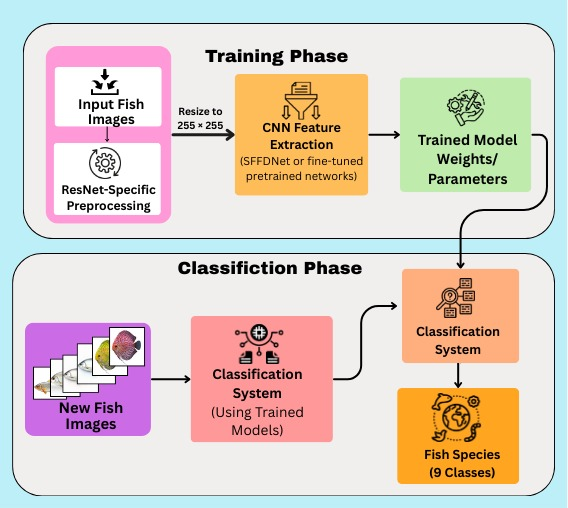
Seafood quality inspection is critical for ensuring food safety and minimizing economic losses from spoilage. While traditional methods are slow and labor-intensive, computer vision and machine learning have emerged as efficient automated alternatives. This study presents SFFDNet, a software engineering-driven convolutional neural network featuring a lightweight 19-layer architecture with optimized feature extraction blocks and regularization strategies. With only 2.49 million parameters—significantly fewer than VGG16 (138M) and ResNet50 (25.6M)—our model achieves 98.80% accuracy on the Large-Scale Fish Segmentation and Classification Dataset. SFFDNet outperforms both transfer learning models (VGG16: 96.54%, ResNet50: 53.34%, InceptionV3: 58.39%) and conventional approaches (CNN: 96.00%, SegNet: 88.69%, YOLO+ResNet50: 91.64%). The framework emphasizes computational efficiency, modularity, and scalability, bridging high-accuracy deep learning with practical industrial seafood inspection through software engineering principles.
Graphical Abstract
Keywords
Data Availability Statement
Funding
Conflicts of Interest
Ethical Approval and Consent to Participate
References
- Vianna, G. M., Zeller, D., & Pauly, D. (2020). Fisheries and policy implications for human nutrition. Current Environmental Health Reports, 7(3), 161-169.
[CrossRef] [Google Scholar] - Kruijssen, F., Tedesco, I., Ward, A., Pincus, L., Love, D., & Thorne-Lyman, A. L. (2020). Loss and waste in fish value chains: A review of the evidence from low and middle-income countries. Global Food Security, 26, 100434.
[CrossRef] [Google Scholar] - Sagar Naik, C., Mohan, C. O., Remya, S., Kishore, P., & Bindu, J. (2025). Artificial Intelligence Tools for Processing and Quality Detection of Fish and Fisheries Products.
[CrossRef] [Google Scholar] - Kibriya, H., Rafique, R., Ahmad, W., & Adnan, S. M. (2021, January). Tomato leaf disease detection using convolution neural network. In 2021 International Bhurban Conference on Applied Sciences and Technologies (IBCAST) (pp. 346-351). IEEE.
[CrossRef] [Google Scholar] - Wang, J., Yue, H., & Zhou, Z. (2017). An improved traceability system for food quality assurance and evaluation based on fuzzy classification and neural network. Food control, 79, 363-370.
[CrossRef] [Google Scholar] - Tao, X., Li, H., Lu, J., & Wang, X. (2012, August). Computer vision technology for seafood quality evaluation. In 2012 International Conference on Computer Science and Service System (pp. 1888-1891). IEEE.
[CrossRef] [Google Scholar] - Linsen, Z., Guanglei, S., & Junbiao, D. (2006). Research on management of traceability of beef safety system through the Internet based on JSP. Chinese Agricultural Science Bulletin, 22(12), 13-16.
[Google Scholar] - Wang, Y., Zhang, H., Shi, J., Wang, S., Zhou, M., & Wang, D. (2015). Quality information traceability system based on seafood's production process. Transactions of the Chinese Society of Agricultural Engineering, 31(14), 264-271.
[CrossRef] [Google Scholar] - Yan, B., Shi, P., & Huang, G. (2013). Development of traceability system of aquatic foods supply chain based on RFID and EPC internet of things. Transactions of the Chinese Society of Agricultural Engineering, 29(15), 172-183.
[CrossRef] [Google Scholar] - Wang, Y., Yan, H., & Yin, Z. (2016). A quality traceability system for seafood based on bill of lots. Revista de la Facultad de Ingeniería, 31(4), 264-271.
[CrossRef] [Google Scholar] - Nicolae, C. G., Moga, L. M., Bahaciu, G. V., & Marin, M. P. (2017). Traceability system structure design for fish and fish products based on supply chain actors needs. Scientific Papers. Series D. Animal Science, 60.
[Google Scholar] - Cui, S., Zhou, Y., Wang, Y., & Zhai, L. (2020). Fish detection using deep learning. Applied Computational Intelligence and Soft Computing, 2020(1), 3738108.
[CrossRef] [Google Scholar] - Howard, A. G., Zhu, M., Chen, B., Kalenichenko, D., Wang, W., Weyand, T., ... & Adam, H. (2017). MobileNets: Efficient Convolutional Neural Networks for Mobile Vision Applications. arXiv preprint arXiv:1704.04861.
[Google Scholar] - Misra, N. N., Dixit, Y., Al-Mallahi, A., Bhullar, M. S., Upadhyay, R., & Martynenko, A. (2020). IoT, big data and artificial intelligence in agriculture and food industry. IEEE Internet of Things Journal, 9(9), 6305-6324.
[CrossRef] [Google Scholar] - Rasheed, J. (2021, September). A sustainable deep learning based computationally intelligent seafood monitoring system for fish species screening. In 2021 International conference on artificial intelligence of things (ICAIoT) (pp. 1-6). IEEE.
[CrossRef] [Google Scholar] - Yildiz, M. B., Yasin, E. T., & Koklu, M. (2024). Fisheye freshness detection using common deep learning algorithms and machine learning methods with a developed mobile application. European Food Research and Technology, 250(7), 1919-1932.
[CrossRef] [Google Scholar] - Kumaravel, B., Amutha, A. L., Mary, T. P., Agrawal, A., Singh, A., Saran, S., & Govindarajan, N. (2025). Automated seafood freshness detection and preservation analysis using machine learning and paper-based pH sensors. Scientific Reports, 15(1), 1-14.
[CrossRef] [Google Scholar] - Simonyan, K., & Zisserman, A. (2014). Very deep convolutional networks for large-scale image recognition. arXiv preprint arXiv:1409.1556.
[Google Scholar] - Tan, M., & Le, Q. (2019, May). Efficientnet: Rethinking model scaling for convolutional neural networks. In International conference on machine learning (pp. 6105-6114). PMLR.
[Google Scholar] - Huang, G., Liu, Z., Van Der Maaten, L., & Weinberger, K. Q. (2017). Densely connected convolutional networks. In Proceedings of the IEEE conference on computer vision and pattern recognition (pp. 4700-4708).
[CrossRef] [Google Scholar] - Sandler, M., Howard, A., Zhu, M., Zhmoginov, A., & Chen, L. C. (2018). Mobilenetv2: Inverted residuals and linear bottlenecks. In Proceedings of the IEEE conference on computer vision and pattern recognition (pp. 4510-4520).
[CrossRef] [Google Scholar] - Chollet, F. (2017). Xception: Deep learning with depthwise separable convolutions. In Proceedings of the IEEE conference on computer vision and pattern recognition (pp. 1251-1258).
[CrossRef] [Google Scholar] - Szegedy, C., Vanhoucke, V., Ioffe, S., Shlens, J., & Wojna, Z. (2016). Rethinking the inception architecture for computer vision. In Proceedings of the IEEE conference on computer vision and pattern recognition (pp. 2818-2826).
[CrossRef] [Google Scholar] - He, K., Zhang, X., Ren, S., & Sun, J. (2016). Deep residual learning for image recognition. In Proceedings of the IEEE conference on computer vision and pattern recognition (pp. 770-778).
[CrossRef] [Google Scholar] - Ulucan, O., Karakaya, D., & Turkan, M. (2020, October). A large-scale dataset for fish segmentation and classification. In 2020 Innovations in Intelligent Systems and Applications Conference (ASYU) (pp. 1-5). IEEE.
[CrossRef] [Google Scholar] - Chuang, M. C., Hwang, J. N., & Williams, K. (2016). A feature learning and object recognition framework for underwater fish images. IEEE Transactions on Image Processing, 25(4), 1862-1872.
[CrossRef] [Google Scholar] - dos Santos, A. A., & Gonçalves, W. N. (2019). Improving Pantanal fish species recognition through taxonomic ranks in convolutional neural networks. Ecological Informatics, 53, 100977.
[CrossRef] [Google Scholar] - Jalal, A., Salman, A., Mian, A., Shortis, M., & Shafait, F. (2020). Fish detection and species classification in underwater environments using deep learning with temporal information. Ecological Informatics, 57, 101088.
[CrossRef] [Google Scholar] - Saitoh, T., Shibata, T., & Miyazono, T. (2016). Feature Points based Fish Image Recognition. International Journal of Computer Information Systems & Industrial Management Applications, 8.
[Google Scholar] - Alsmadi, M. K., Tayfour, M., Alkhasawneh, R. A., Badawi, U., Almarashdeh, I., & Haddad, F. (2019). Robust feature extraction methods for general fish classification. International Journal of Electrical & Computer Engineering (2088-8708), 9(6), 5192-5204.
[CrossRef] [Google Scholar] - Szegedy, C., Vanhoucke, V., Ioffe, S., Shlens, J., & Wojna, Z. (2016). Rethinking the Inception Architecture for Computer Vision. In Proceedings of the IEEE Conference on Computer Vision and Pattern Recognition (CVPR) (pp. 2818-2826).
[CrossRef] [Google Scholar] - He, K., Zhang, X., Ren, S., & Sun, J. (2016). Deep Residual Learning for Image Recognition. In Proceedings of the IEEE Conference on Computer Vision and Pattern Recognition (CVPR) (pp. 770-778).
[CrossRef] [Google Scholar]
Cite This Article
TY  - JOUR
AU  - Hameed, Muzzamal
AU  - Haroon, Muhammad
AU  - Farooq, Amna
AU  - Ali, Abdul Karim Sajid
PY  - 2025
DA  - 2025/11/03
TI  - Design and Implementation of a Software Engineering-Driven Deep Transfer Learning Framework for Seafood Fish Detection
JO  - ICCK Journal of Software Engineering
T2  - ICCK Journal of Software Engineering
JF  - ICCK Journal of Software Engineering
VL  - 1
IS  - 2
SP  - 109
EP  - 123
DO  - 10.62762/JSE.2025.535801
UR  - https://www.icck.org/article/abs/JSE.2025.535801
KW  - feature extraction
KW  - image segmentation
KW  - task-specific analysis
KW  - quality evaluation
KW  - color-based image analysis
KW  - classification
KW  - food quality inspection
KW  - convolutional neural networks
KW  - SFFDNet
AB  - Seafood quality inspection is critical for ensuring food safety and minimizing economic losses from spoilage. While traditional methods are slow and labor-intensive, computer vision and machine learning have emerged as efficient automated alternatives. This study presents SFFDNet, a software engineering-driven convolutional neural network featuring a lightweight 19-layer architecture with optimized feature extraction blocks and regularization strategies. With only 2.49 million parameters—significantly fewer than VGG16 (138M) and ResNet50 (25.6M)—our model achieves 98.80% accuracy on the Large-Scale Fish Segmentation and Classification Dataset. SFFDNet outperforms both transfer learning models (VGG16: 96.54%, ResNet50: 53.34%, InceptionV3: 58.39%) and conventional approaches (CNN: 96.00%, SegNet: 88.69%, YOLO+ResNet50: 91.64%). The framework emphasizes computational efficiency, modularity, and scalability, bridging high-accuracy deep learning with practical industrial seafood inspection through software engineering principles.
SN  - 3069-1834
PB  - Institute of Central Computation and Knowledge
LA  - English
ER  -
@article{Hameed2025Design,
  author = {Muzzamal Hameed and Muhammad Haroon and Amna Farooq and Abdul Karim Sajid Ali},
  title = {Design and Implementation of a Software Engineering-Driven Deep Transfer Learning Framework for Seafood Fish Detection},
  journal = {ICCK Journal of Software Engineering},
  year = {2025},
  volume = {1},
  number = {2},
  pages = {109-123},
  doi = {10.62762/JSE.2025.535801},
  url = {https://www.icck.org/article/abs/JSE.2025.535801},
  abstract = {Seafood quality inspection is critical for ensuring food safety and minimizing economic losses from spoilage. While traditional methods are slow and labor-intensive, computer vision and machine learning have emerged as efficient automated alternatives. This study presents SFFDNet, a software engineering-driven convolutional neural network featuring a lightweight 19-layer architecture with optimized feature extraction blocks and regularization strategies. With only 2.49 million parameters—significantly fewer than VGG16 (138M) and ResNet50 (25.6M)—our model achieves 98.80\% accuracy on the Large-Scale Fish Segmentation and Classification Dataset. SFFDNet outperforms both transfer learning models (VGG16: 96.54\%, ResNet50: 53.34\%, InceptionV3: 58.39\%) and conventional approaches (CNN: 96.00\%, SegNet: 88.69\%, YOLO+ResNet50: 91.64\%). The framework emphasizes computational efficiency, modularity, and scalability, bridging high-accuracy deep learning with practical industrial seafood inspection through software engineering principles.},
  keywords = {feature extraction, image segmentation, task-specific analysis, quality evaluation, color-based image analysis, classification, food quality inspection, convolutional neural networks, SFFDNet},
  issn = {3069-1834},
  publisher = {Institute of Central Computation and Knowledge}
}
Article Metrics
Publisher's Note
ICCK stays neutral with regard to jurisdictional claims in published maps and institutional affiliations.
Rights and Permissions
 Copyright © 2025 by the Author(s). Published by Institute of Central Computation and Knowledge. This article is an open access article distributed under the terms and conditions of the Creative Commons Attribution (CC BY) license (https://creativecommons.org/licenses/by/4.0/), which permits use, sharing, adaptation, distribution and reproduction in any medium or format, as long as you give appropriate credit to the original author(s) and the source, provide a link to the Creative Commons licence, and indicate if changes were made.


Portico
