Requirements Elicitation in Transition: A Review of Conventional and Contemporary Approaches


Article Information
Abstract
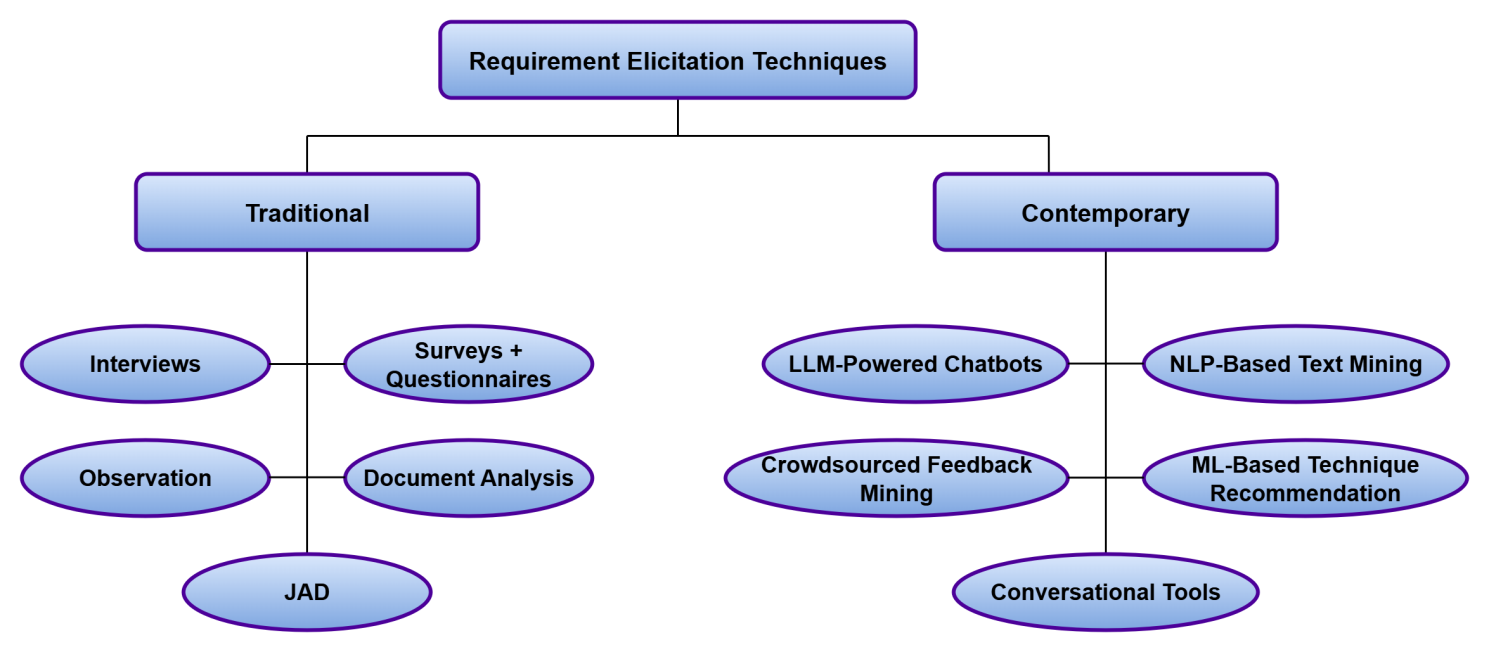
Requirements elicitation is one of the most important steps in the software development process. It involves understanding what users and stakeholders need from a system before it is built. Traditionally, this has been done using methods like interviews, questionnaires, document reviews, and direct observation. These approaches work well in structured environments but often fall short when dealing with large, fast-changing, or agile projects. In recent years, software development has shifted toward more flexible and fast-paced practices. This change has also affected how requirements are gathered. New techniques now include collaborative tools, user feedback from online platforms, and the use of artificial intelligence (AI) and natural language processing (NLP) to extract requirements from text automatically. This paper presents a comparative narrative review based on recent literature and practical insights. It presents both traditional and modern requirements elicitation methods, comparing them in terms of how they work, where they are most useful, and what challenges they present. A detailed comparison highlights key differences such as level of user interaction, tool support, scalability, and suitability for ongoing development cycles. By reviewing recent research and real-world practices, this paper identifies current trends, challenges, and open areas for future work. The goal is to help researchers, software engineers, and project teams choose the most suitable elicitation methods based on their specific project needs. In the end, this review supports the idea that a flexible, hybrid approach-blending old and new techniques-may be the most effective way forward in today's evolving software engineering landscape.
Graphical Abstract
Keywords
Data Availability Statement
Funding
Conflicts of Interest
Ethical Approval and Consent to Participate
References
- Gobov, D., & Huchenko, I. (2021). Software Requirements Elicitation Techniques Selection Method for the Project Scope Management. ITPM, 1-10.
[Google Scholar] - Görer, B., & Aydemir, F. B. (2023). Generating requirements elicitation interview scripts with large language models. 2023 IEEE 31st International Requirements Engineering Conference Workshops (REW), 44-51.
[CrossRef] [Google Scholar] - Canedo, E. D., Calazans, A. T. S., Bandeira, I. N., Costa, P. H. T., & Masson, E. T. S. (2022). Guidelines adopted by agile teams in privacy requirements elicitation after the Brazilian general data protection law (LGPD) implementation. Requirements Engineering, 27(4), 545-567.
[CrossRef] [Google Scholar] - Ronanki, K., Berger, C., & Horkoff, J. (2023). Investigating chatgpt's potential to assist in requirements elicitation processes. 2023 49th Euromicro Conference on Software Engineering and Advanced Applications (SEAA), 354-361.
[CrossRef] [Google Scholar] - Wang, Z., Chen, C. H., Zheng, P., Li, X., & Khoo, L. P. (2021). A graph-based context-aware requirement elicitation approach in smart product-service systems. International Journal of Production Research, 59(2), 635-651.
[CrossRef] [Google Scholar] - Zhang, K., Lin, K. Y., Wang, J., Ma, Y., Li, H., Zhang, L., ... & Feng, L. (2023). UNISON framework for user requirement elicitation and classification of smart product-service system. Advanced Engineering Informatics, 57, 101996.
[CrossRef] [Google Scholar] - Alturaief, N., Aljamaan, H., & Baslyman, M. (2021). Aware: Aspect-based sentiment analysis dataset of apps reviews for requirements elicitation. 2021 36th IEEE/ACM International Conference on Automated Software Engineering Workshops (ASEW), 211-218.
[CrossRef] [Google Scholar] - White, J., Hays, S., Fu, Q., Spencer-Smith, J., & Schmidt, D. C. (2024). Chatgpt prompt patterns for improving code quality, refactoring, requirements elicitation, and software design. Generative AI for Effective Software Development, 71-108.
[CrossRef] [Google Scholar] - Faik, I., & Sengupta, A. (2024). INCLUSION BY DESIGN: REQUIREMENTS ELICITATION WITH DIGITALLY MARGINALIZED COMMUNITIES. MIS Quarterly, 48(1).
[CrossRef] [Google Scholar] - Gupta, S. (2022). Non-functional requirements elicitation for edge computing. Internet of Things, 18, 100503.
[CrossRef] [Google Scholar] - Rahamathunnisa, U., Subhashini, P., Aancy, H. M., Meenakshi, S., & Boopathi, S. (2023). Solutions for software requirement risks using artificial intelligence techniques. Handbook of Research on Data Science and Cybersecurity Innovations in Industry 4.0 Technologies, 45-64.
[CrossRef] [Google Scholar] - Arora, C., Grundy, J., & Abdelrazek, M. (2024). Advancing requirements engineering through generative ai: Assessing the role of llms. Generative AI for Effective Software Development, 129-148.
[CrossRef] [Google Scholar] - Nazim, Z., Ishaq, K., Alvi, A., Rosdi, F., Nawaz, N. A., & Dogar, A. B. (2025). Toward a Gamification Framework for Requirement Elicitation: Insights From a Systematic Literature Review. Human Behavior and Emerging Technologies, 2025(1), 3255995.
[CrossRef] [Google Scholar] - Aqeel, S., & Khan, N. A. (2025). Challenges and Issues in Requirements Elicitation for Based Systems: A Systematic Literature Review. Bridging Global Divides for Transnational Higher Education in the AI Era, 423-446.
[CrossRef] [Google Scholar] - Ozkan, B., Jungerius, N., Adali, O. E., & Turetken, O. (2025). Value cocreation-oriented digital platform design: a method for requirements elicitation and platform assessment. Production Planning & Control, 1-19.
[CrossRef] [Google Scholar] - Davis, A. M. (1993). Software requirements: objects, functions, and states. Prentice-Hall, Inc.
[Google Scholar] - Sommerville, I., & Sawyer, P. (1997). Requirements engineering: a good practice guide. John Wiley & Sons, Inc.
[Google Scholar] - Zowghi, D., & Coulin, C. (2005). Requirements elicitation: A survey of techniques, approaches, and tools. Engineering and Managing Software Requirements, 19-46.
[CrossRef] [Google Scholar] - Cohn, M. (2004). User stories applied: For agile software development. Addison-Wesley Professional.
[Google Scholar] - Paetsch, F., Eberlein, A., & Maurer, F. (2003). Requirements engineering and agile software development. WET ICE 2003. Proceedings. Twelfth IEEE International Workshops on Enabling Technologies: Infrastructure for Collaborative Enterprises, 2003, 308-313.
[CrossRef] [Google Scholar] - Sonbol, R., Rebdawi, G., & Ghneim, N. (2022). The use of nlp-based text representation techniques to support requirement engineering tasks: A systematic mapping review. IEEE Access, 10, 62811-62830.
[CrossRef] [Google Scholar] - Kolahdouz-Rahimi, S., Lano, K., & Lin, C. (2023). Requirement formalisation using natural language processing and machine learning: A systematic review. arXiv preprint arXiv:2303.13365.
[CrossRef] [Google Scholar] - Voria, G., Casillo, F., Gravino, C., Catolino, G., & Palomba, F. (2025). RECOVER: Toward Requirements Generation from Stakeholders' Conversations. IEEE Transactions on Software Engineering.
[CrossRef] [Google Scholar] - Ataei, M., Cheong, H., Grandi, D., Wang, Y., Morris, N., & Tessier, A. (2025). Elicitron: A large language model agent-based simulation framework for design requirements elicitation. Journal of Computing and Information Science in Engineering, 25(2), 021012.
[CrossRef] [Google Scholar] - Cheligeer, C., Huang, J., Wu, G., Bhuiyan, N., Xu, Y., & Zeng, Y. (2022). Machine learning in requirements elicitation: A literature review. AI EDAM, 36, e32.
[CrossRef] [Google Scholar] - Gobov, D., & Solovei, O. (2023). Approaches to improving the accuracy of machine learning models in requirements elicitation techniques selection. International Conference on Computer Science, Engineering and Education Applications, 574-584.
[CrossRef] [Google Scholar] - Akram, F., Ahmad, T., & Sadiq, M. (2024). Recommendation systems-based software requirements elicitation process—a systematic literature review. Journal of Engineering and Applied Science, 71(1), 29.
[CrossRef] [Google Scholar] - Dąbrowski, J., Letier, E., Perini, A., & Susi, A. (2023). Mining and searching app reviews for requirements engineering: Evaluation and replication studies. Information Systems, 114, 102181.
[CrossRef] [Google Scholar] - Maalej, W., Biryuk, V., Wei, J., & Panse, F. (2025). On the automated processing of user feedback. Handbook on Natural Language Processing for Requirements Engineering, 279-308.
[CrossRef] [Google Scholar] - Haq, I. U., Saddique, T., Basharat, M., & Butt, W. H. (2024). A Hybrid S/W Requirement Elicitation Approach to Improve Quality of Requirements. International conference on WorldS4, 75-85.
[CrossRef] [Google Scholar] - Dunsin, D. Business Analysis Techniques for Effective Project Requirements Gathering.
[Google Scholar] - Liu, K., Reddivari, S., & Reddivari, K. (2022). Artificial intelligence in software requirements engineering: State-of-the-art. 2022 IEEE 23rd International Conference on Information Reuse and Integration for Data Science (IRI), 106-111.
[CrossRef] [Google Scholar] - Ali, N., Hong, J. E., & Chung, L. (2021). Social network sites and requirements engineering: A systematic literature review. Journal of Software: Evolution and Process, 33(4), e2332.
[CrossRef] [Google Scholar] - Ferrari, A., Spoletini, P., & Debnath, S. (2022). How do requirements evolve during elicitation? An empirical study combining interviews and app store analysis. Requirements Engineering, 27(4), 489-519.
[CrossRef] [Google Scholar] - Shahzad, B., Javed, I., Shaikh, A., Sulaiman, A., Abro, A., & Ali Memon, M. (2021). Reliable requirements engineering practices for COVID-19 using blockchain. Sustainability, 13(12), 6748.
[CrossRef] [Google Scholar] - Pei, Z., Liu, L., Wang, C., & Wang, J. (2022). Requirements engineering for machine learning: A review and reflection. 2022 IEEE 30th International Requirements Engineering Conference Workshops (REW), 166-175.
[CrossRef] [Google Scholar] - Sari, D. A. P., Putri, A. Y., Hanggareni, M., Anjani, A., Siswondo, M. L. O., & Raharjana, I. K. (2021). Crowdsourcing as a tool to elicit software requirements. AIP Conference Proceedings, 2329(1), 050001.
[CrossRef] [Google Scholar] - Khairat, M. I. S. B., Priyadi, Y., & Adrian, M. (2022). Usability measurement in user interface design using heuristic evaluation & severity rating (case study: Mobile ta application based on MVVM). 2022 IEEE 12th Annual Computing and Communication Workshop and Conference (CCWC), 0974-0979.
[CrossRef] [Google Scholar] - Dalpiaz, F., Gieske, P., & Sturm, A. (2021). On deriving conceptual models from user requirements: An empirical study. Information and Software Technology, 131, 106484.
[CrossRef] [Google Scholar] - Oleson, A., Solomon, M., Perdriau, C., & Ko, A. (2023). Teaching inclusive design skills with the cider assumption elicitation technique. ACM Transactions on Computer-Human Interaction, 30(1), 1-49.
[CrossRef] [Google Scholar] - Villamizar, H., Escovedo, T., & Kalinowski, M. (2021). Requirements engineering for machine learning: A systematic mapping study. 2021 47th Euromicro Conference on Software Engineering and Advanced Applications (SEAA), 29-36.
[CrossRef] [Google Scholar] - Olukoya, O. (2022). Assessing frameworks for eliciting privacy & security requirements from laws and regulations. Computers & Security, 117, 102697.
[CrossRef] [Google Scholar] - Atoum, I., Baklizi, M. K., Alsmadi, I., Otoom, A. A., Alhersh, T., Ababneh, J., ... & Alshahrani, S. M. (2021). Challenges of software requirements quality assurance and validation: A systematic literature review. IEEE Access, 9, 137613-137634.
[CrossRef] [Google Scholar] - Dar, H., Lali, M. I., Ashraf, H., Ramzan, M., Amjad, T., & Shahzad, B. (2018). A systematic study on software requirements elicitation techniques and its challenges in mobile application development. IEEE Access, 6, 63859-63867.
[CrossRef] [Google Scholar] - Kiran, H. M., & Ali, Z. (2018). Requirement elicitation techniques for open source systems: a review. International Journal of Advanced Computer Science and Applications, 9(1).
[CrossRef] [Google Scholar] - Saeed, S., Fatima, U., & Iqbal, F. (2018). A review of Requirement Elicitation techniques in OSSD. Int. J. Comput. Sci. Netw. Secur, 18, 86.
[Google Scholar] - Okesola, O. J., Okokpujie, K., Goddy-Worlu, R., Ogunbanwo, A., & Iheanetu, O. (2019). Qualitative comparisons of elicitation techniques in requirement engineering. ARPN J. Eng. Appl. Sci, 14(2), 565-570.
[Google Scholar] - Lim, T. Y., Chua, F. F., & Tajuddin, B. B. (2018). Elicitation techniques for internet of things applications requirements: A systematic review. Proceedings of the 2018 VII International Conference on Network, Communication and Computing, 182-188.
[CrossRef] [Google Scholar] - Mishra, D., Aydin, S., Mishra, A., & Ostrovska, S. (2018). Knowledge management in requirement elicitation: Situational methods view. Computer Standards & Interfaces, 56, 49-61.
[CrossRef] [Google Scholar]
Cited By (1)
-
Claudio Ciano, Marcello Pelosi, Alessandro Del Prete, Flora Amato. .
Advanced Information Networking and Applications, 2026 , 299 .
[CrossRef]
Cite This Article
TY  - JOUR
AU  - Akhtar, Asma
AU  - Akhtar, Samia
PY  - 2025
DA  - 2025/08/18
TI  - Requirements Elicitation in Transition: A Review of Conventional and Contemporary Approaches
JO  - ICCK Journal of Software Engineering
T2  - ICCK Journal of Software Engineering
JF  - ICCK Journal of Software Engineering
VL  - 1
IS  - 1
SP  - 32
EP  - 45
DO  - 10.62762/JSE.2025.862549
UR  - https://www.icck.org/article/abs/JSE.2025.862549
KW  - requirements elicitation
KW  - software engineering
KW  - agile development
KW  - artificial intelligence
KW  - stakeholder analysis
KW  - requirements extraction
AB  - Requirements elicitation is one of the most important steps in the software development process. It involves understanding what users and stakeholders need from a system before it is built. Traditionally, this has been done using methods like interviews, questionnaires, document reviews, and direct observation. These approaches work well in structured environments but often fall short when dealing with large, fast-changing, or agile projects. In recent years, software development has shifted toward more flexible and fast-paced practices. This change has also affected how requirements are gathered. New techniques now include collaborative tools, user feedback from online platforms, and the use of artificial intelligence (AI) and natural language processing (NLP) to extract requirements from text automatically. This paper presents a comparative narrative review based on recent literature and practical insights. It presents both traditional and modern requirements elicitation methods, comparing them in terms of how they work, where they are most useful, and what challenges they present. A detailed comparison highlights key differences such as level of user interaction, tool support, scalability, and suitability for ongoing development cycles. By reviewing recent research and real-world practices, this paper identifies current trends, challenges, and open areas for future work. The goal is to help researchers, software engineers, and project teams choose the most suitable elicitation methods based on their specific project needs. In the end, this review supports the idea that a flexible, hybrid approach-blending old and new techniques-may be the most effective way forward in today's evolving software engineering landscape.
SN  - 3069-1834
PB  - Institute of Central Computation and Knowledge
LA  - English
ER  -
@article{Akhtar2025Requiremen,
  author = {Asma Akhtar and Samia Akhtar},
  title = {Requirements Elicitation in Transition: A Review of Conventional and Contemporary Approaches},
  journal = {ICCK Journal of Software Engineering},
  year = {2025},
  volume = {1},
  number = {1},
  pages = {32-45},
  doi = {10.62762/JSE.2025.862549},
  url = {https://www.icck.org/article/abs/JSE.2025.862549},
  abstract = {Requirements elicitation is one of the most important steps in the software development process. It involves understanding what users and stakeholders need from a system before it is built. Traditionally, this has been done using methods like interviews, questionnaires, document reviews, and direct observation. These approaches work well in structured environments but often fall short when dealing with large, fast-changing, or agile projects. In recent years, software development has shifted toward more flexible and fast-paced practices. This change has also affected how requirements are gathered. New techniques now include collaborative tools, user feedback from online platforms, and the use of artificial intelligence (AI) and natural language processing (NLP) to extract requirements from text automatically. This paper presents a comparative narrative review based on recent literature and practical insights. It presents both traditional and modern requirements elicitation methods, comparing them in terms of how they work, where they are most useful, and what challenges they present. A detailed comparison highlights key differences such as level of user interaction, tool support, scalability, and suitability for ongoing development cycles. By reviewing recent research and real-world practices, this paper identifies current trends, challenges, and open areas for future work. The goal is to help researchers, software engineers, and project teams choose the most suitable elicitation methods based on their specific project needs. In the end, this review supports the idea that a flexible, hybrid approach-blending old and new techniques-may be the most effective way forward in today's evolving software engineering landscape.},
  keywords = {requirements elicitation, software engineering, agile development, artificial intelligence, stakeholder analysis, requirements extraction},
  issn = {3069-1834},
  publisher = {Institute of Central Computation and Knowledge}
}
Publisher's Note
ICCK stays neutral with regard to jurisdictional claims in published maps and institutional affiliations.
Rights and Permissions
 Copyright © 2025 by the Author(s). Published by Institute of Central Computation and Knowledge. This article is an open access article distributed under the terms and conditions of the Creative Commons Attribution (CC BY) license (https://creativecommons.org/licenses/by/4.0/), which permits use, sharing, adaptation, distribution and reproduction in any medium or format, as long as you give appropriate credit to the original author(s) and the source, provide a link to the Creative Commons licence, and indicate if changes were made.


Portico