

Electroluminescence Imaging–Driven Software Systems for Solar Cell Defect Detection



Article Information
Abstract
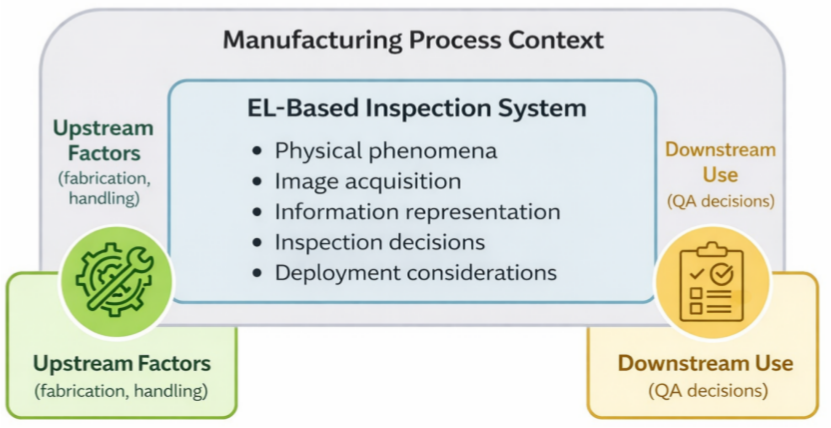
Electroluminescence imaging is widely used for detecting defects in solar cells. It reveals electrically active damage that remains invisible under conventional optical inspection. Most existing studies apply machine learning models to classify electroluminescence images and report performance mainly through accuracy scores. Inspection is often treated as an isolated prediction task, while physical defect mechanisms, sensing variability, representation bias, decision risk, and deployment constraints receive limited attention. As a result, strong benchmark results may not translate into reliable inspection outcomes in manufacturing environments. This paper presents a conceptual, non-systematic framework that reframes electroluminescence inspection as a layered system rather than an isolated prediction task. The analysis synthesizes existing research through this structured lens to identify recurring blind spots and system level misalignments. The objective is not to conduct a systematic review or empirical benchmarking study, but to provide a conceptual foundation for positioning automated inspection within a broader physical and operational context.
Graphical Abstract
Keywords
Data Availability Statement
Funding
Conflicts of Interest
AI Use Statement
Ethical Approval and Consent to Participate
References
- Khan, A., Sohail, A., Zahoora, U., & Qureshi, A. S. (2020). A survey of the recent architectures of deep convolutional neural networks. Artificial Intelligence Review, 53(8), 5455–5516.
[CrossRef] [Google Scholar] - Al-Mashhadani, R., Alkawsi, G., Baashar, Y., Alkahtani, A. A., Nordin, F. H., Hashim, W., & Kiong, T. S. Deep Learning Methods for Solar Fault Detection and Classification: A Review. solar cells, 11, 12. http://dx.doi.org/10.18576/isl/100213
[Google Scholar] - Al-Otum, H. M. (2023). Deep learning-based automated defect classification in electroluminescence images of solar panels. Advanced Engineering Informatics, 58, 102147.
[CrossRef] [Google Scholar] - Al-Otum, H. M. (2026). Defect classification of photovoltaic solar cells using electroluminescence imaging and enhanced deep learning approaches. Solar Energy, 303, 114085.
[CrossRef] [Google Scholar] - Shahbazi, N., Lin, Y., Asudeh, A., & Jagadish, H. V. (2023). Representation Bias in Data: A Survey on Identification and Resolution Techniques. ACM Computing Surveys, 55(13s), 1–39.
[CrossRef] [Google Scholar] - Kausik, A. K., Rashid, A. B., Baki, R. F., & Jannat Maktum, M. M. (2025). Machine learning algorithms for manufacturing quality assurance: A systematic review of performance metrics and applications. Array, 26, 100393.
[CrossRef] [Google Scholar] - Abdelsattar, M., Abdelmoety, A., Ismeil, M. A., & Emad-Eldeen, A. (2025). Automated defect detection in solar cell images using deep learning algorithms. IEEE Access, 13, 4136-4157.
[CrossRef] [Google Scholar] - Ahan, M. R., Nambi, A., Ganu, T., Nahata, D., & Kalyanaraman, S. (2021, November). AI-assisted cell-level fault detection and localization in solar PV electroluminescence images. In Proceedings of the 19th ACM conference on embedded networked sensor systems (pp. 485-491).
[CrossRef] [Google Scholar] - Puranik, V. E., Kumar, R., & Gupta, R. (2023). Progress in module level quantitative electroluminescence imaging of crystalline silicon PV module: A review. Solar Energy, 264, 111994.
[CrossRef] [Google Scholar] - Frisch, M., Baumgärtner, J., Heider, I., Puchta, A., & Fleischer, J. (2024). Efficient Deployment of Machine Learning Models in Manufacturing and Industrial Environments using ROS. Procedia CIRP, 130, 188–193.
[CrossRef] [Google Scholar] - Xia, B., Li, S., Li, N., Li, H., & Tian, X. (2023). Surface defect recognition of solar panel based on percolation-based image processing and serre standard model. IEEE Access, 11, 55126–55138.
[CrossRef] [Google Scholar] - Tang, W., Yang, Q., Xiong, K., & Yan, W. (2020). Deep learning based automatic defect identification of photovoltaic module using electroluminescence images. Solar Energy, 201, 453-460.
[CrossRef] [Google Scholar] - Sun, M., Lv, S., Zhao, X., Li, R., Zhang, W., & Zhang, X. (2017, August). Defect detection of photovoltaic modules based on convolutional neural network. In International Conference on Machine Learning and Intelligent Communications (pp. 122-132). Cham: Springer International Publishing.
[CrossRef] [Google Scholar] - Wang, C., Chen, H., & Zhao, S. (2023). RERN: Rich edge features refinement detection network for polycrystalline solar cell defect segmentation. IEEE Transactions on Industrial Informatics, 20(2), 1408-1419.
[CrossRef] [Google Scholar] - Lee, I. B., Kim, Y., & Kim, S. (2025). A Data-Driven Machine Vision Framework for Quality Management in Photovoltaic Module Manufacturing. Machines, 13(4), 285.
[CrossRef] [Google Scholar] - Drir, N., Mellit, A., Blasuttigh, N., & Pavan, A. M. (2026). Enhancing defect detection in photovoltaic cells through advanced cascade CNN with attention mechanisms on electroluminescence images. Energy Conversion and Management, 348, 120636.
[CrossRef] [Google Scholar] - Balzategui, J., Eciolaza, L., & Maestro-Watson, D. (2021). Anomaly detection and automatic labeling for solar cell quality inspection based on generative adversarial network. Sensors, 21(13), 4361.
[CrossRef] [Google Scholar] - Rodriguez, A., Gonzalez, C., Fernandez, A., Rodriguez, F., Delgado, T., & Bellman, M. (2021). Automatic solar cell diagnosis and treatment. Journal of Intelligent Manufacturing, 32(4), 1163–1172.
[CrossRef] [Google Scholar] - Masita, K., Hasan, A., Shongwe, T., & Hilal, H. A. (2025). Deep learning in defects detection of PV modules: A review. Solar Energy Advances, 5, 100090.
[CrossRef] [Google Scholar] - Hussain, T., Hussain, M., Al-Aqrabi, H., Alsboui, T., & Hill, R. (2023). A review on defect detection of electroluminescence-based photovoltaic cell surface images using computer vision. Energies, 16(10), 4012.
[CrossRef] [Google Scholar] - Paleyes, A., Urma, R. G., & Lawrence, N. D. (2022). Challenges in deploying machine learning: a survey of case studies. ACM computing surveys, 55(6), 1-29.
[CrossRef] [Google Scholar] - Zheng, J., Lv, F., Ding, Y., Guo, C., Wang, Y., Yi, D., ... & Sun, X. (2026). Physics-informed deep learning for surface defect detection on optical wedge plates: enhancing accuracy and generalization. Journal of Intelligent Manufacturing, 1-15.
[CrossRef] [Google Scholar] - Ebied, M. A., Munshi, A., Alhuzali, S. A., El-Sotouhy, M. M., Shehta, A. I., & Elborlsy, M. S. (2025). Advanced deep learning modeling to enhance detection of defective photovoltaic cells in electroluminescence images. Scientific Reports, 15(1), 31640.
[CrossRef] [Google Scholar] - Sezen, B., & Cerasi, C. C. (2023). Solar cell busbars surface defect detection based on deep convolutional neural network. IEEE Latin America Transactions, 21(2), 242-250.
[CrossRef] [Google Scholar] - Chen, H., Pang, Y., Hu, Q., & Liu, K. (2020). Solar cell surface defect inspection based on multispectral convolutional neural network. Journal of Intelligent Manufacturing, 31(2), 453-468.
[CrossRef] [Google Scholar]
Cite This Article
TY  - JOUR
AU  - Ghulam, Rehana
AU  - Ramay, Muhammad Fahad Amin
AU  - Mukhtar, Aiza
AU  - Kainat
AU  - Farid, Saba
AU  - Fatima, Nikhat
AU  - Syed, Khaleelullah
PY  - 2026
DA  - 2026/04/22
TI  - Electroluminescence Imaging–Driven Software Systems for Solar Cell Defect Detection
JO  - ICCK Journal of Software Engineering
T2  - ICCK Journal of Software Engineering
JF  - ICCK Journal of Software Engineering
VL  - 2
IS  - 2
SP  - 85
EP  - 101
DO  - 10.62762/JSE.2026.195385
UR  - https://www.icck.org/article/abs/JSE.2026.195385
KW  - electroluminescence imaging
KW  - solar cell inspection
KW  - defect semantics
KW  - automated inspection systems
KW  - representation learning
KW  - decision-making under uncertainty
KW  - photovoltaic quality assurance
KW  - system-level analysis
AB  - Electroluminescence imaging is widely used for detecting defects in solar cells. It reveals electrically active damage that remains invisible under conventional optical inspection. Most existing studies apply machine learning models to classify electroluminescence images and report performance mainly through accuracy scores. Inspection is often treated as an isolated prediction task, while physical defect mechanisms, sensing variability, representation bias, decision risk, and deployment constraints receive limited attention. As a result, strong benchmark results may not translate into reliable inspection outcomes in manufacturing environments. This paper presents a conceptual, non-systematic framework that reframes electroluminescence inspection as a layered system rather than an isolated prediction task. The analysis synthesizes existing research through this structured lens to identify recurring blind spots and system level misalignments. The objective is not to conduct a systematic review or empirical benchmarking study, but to provide a conceptual foundation for positioning automated inspection within a broader physical and operational context.
SN  - 3069-1834
PB  - Institute of Central Computation and Knowledge
LA  - English
ER  -
@article{Ghulam2026Electrolum,
  author = {Rehana Ghulam and Muhammad Fahad Amin Ramay and Aiza Mukhtar and Kainat and Saba Farid and Nikhat Fatima and Khaleelullah Syed},
  title = {Electroluminescence Imaging–Driven Software Systems for Solar Cell Defect Detection},
  journal = {ICCK Journal of Software Engineering},
  year = {2026},
  volume = {2},
  number = {2},
  pages = {85-101},
  doi = {10.62762/JSE.2026.195385},
  url = {https://www.icck.org/article/abs/JSE.2026.195385},
  abstract = {Electroluminescence imaging is widely used for detecting defects in solar cells. It reveals electrically active damage that remains invisible under conventional optical inspection. Most existing studies apply machine learning models to classify electroluminescence images and report performance mainly through accuracy scores. Inspection is often treated as an isolated prediction task, while physical defect mechanisms, sensing variability, representation bias, decision risk, and deployment constraints receive limited attention. As a result, strong benchmark results may not translate into reliable inspection outcomes in manufacturing environments. This paper presents a conceptual, non-systematic framework that reframes electroluminescence inspection as a layered system rather than an isolated prediction task. The analysis synthesizes existing research through this structured lens to identify recurring blind spots and system level misalignments. The objective is not to conduct a systematic review or empirical benchmarking study, but to provide a conceptual foundation for positioning automated inspection within a broader physical and operational context.},
  keywords = {electroluminescence imaging, solar cell inspection, defect semantics, automated inspection systems, representation learning, decision-making under uncertainty, photovoltaic quality assurance, system-level analysis},
  issn = {3069-1834},
  publisher = {Institute of Central Computation and Knowledge}
}
Article Metrics
Publisher's Note
ICCK stays neutral with regard to jurisdictional claims in published maps and institutional affiliations.
Rights and Permissions
 Copyright © 2026 by the Author(s). Published by Institute of Central Computation and Knowledge. This article is an open access article distributed under the terms and conditions of the Creative Commons Attribution (CC BY) license (https://creativecommons.org/licenses/by/4.0/), which permits use, sharing, adaptation, distribution and reproduction in any medium or format, as long as you give appropriate credit to the original author(s) and the source, provide a link to the Creative Commons licence, and indicate if changes were made.


Portico
