

Fused-CNN-LSTM: A Software-Oriented Multimodal Deep Learning Framework for Intelligent Hypertension Risk Prediction




Article Information
Abstract
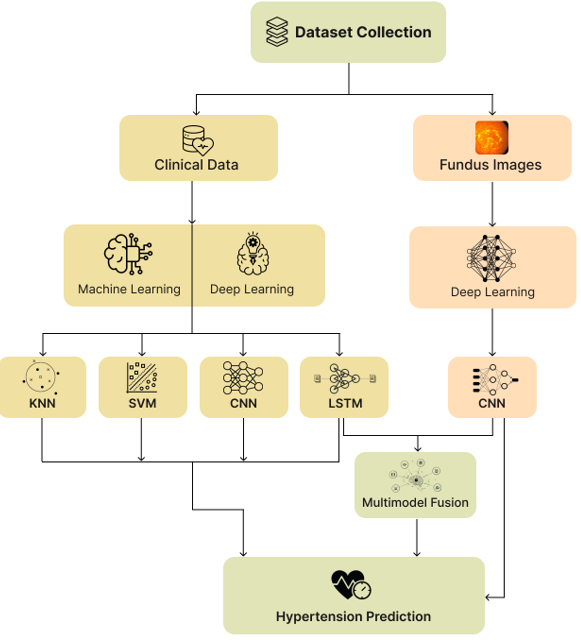
Hypertension, a life-threatening global health challenge, requires early detection to prevent severe cardiovascular complications. Fundus imaging reveals microvascular alterations, yet conventional diagnosis often misses subtle early changes. This study introduces a multimodal deep learning framework that integrates clinical data, fundus images, and demographic features to improve hypertension prediction. Unlike single-modality approaches, our method captures complementary risk factors from both structured and unstructured data. We evaluate machine learning and deep learning models on clinical data, confirming DL's superior accuracy. For fundus images alone, a CNN achieves 74.44% accuracy, highlighting the limitations of unimodal image analysis. To overcome this, we propose a fused CNN-LSTM architecture that models both spatial biomarkers and temporal clinical trends. The framework achieves robust performance, with an overall accuracy of 98% and minimal variation across datasets. Implemented in TensorFlow/Keras, the system adopts a modular, software-oriented design, ensuring flexibility, ease of maintenance, and seamless integration into clinical workflows. This holistic approach enables timely intervention, improves patient outcomes, and reduces healthcare burdens.
Graphical Abstract
Keywords
Data Availability Statement
Funding
Conflicts of Interest
AI Use Statement
Ethical Approval and Consent to Participate
References
- Alizargar, A., Tan, T. H., Chang, Y. L., & Alkhaleefah, M. (2022, May). Hypertension disease predictions with various models using data science framework. In Proceedings of the 6th International Conference on Medical and Health Informatics (pp. 107-112).
[CrossRef] [Google Scholar] - Khan, K. B., Khaliq, A. A., Jalil, A., Iftikhar, M. A., Ullah, N., Aziz, M. W., ... & Shahid, M. (2019). A review of retinal blood vessels extraction techniques: challenges, taxonomy, and future trends. Pattern Analysis and Applications, 22(3), 767-802.
[CrossRef] [Google Scholar] - Mroz, T., Griffin, M., Cartabuke, R., Laffin, L., Russo-Alvarez, G., Thomas, G., ... & Habboub, G. (2024). Predicting hypertension control using machine learning. Plos one, 19(3), e0299932.
[CrossRef] [Google Scholar] - Sivaji, U., Chatrapathy, K., Kiran, A., Reddy, P. C. S., Rao, P. V., & Partheeban, N. (2023, December). An Accurate Blood Pressure Prediction Based on Clinical and Physiological Data Using Machine Learning. In 2023 Global Conference on Information Technologies and Communications (GCITC) (pp. 1-5). IEEE.
[CrossRef] [Google Scholar] - Chen, Z., Cao, Y., Liu, Y., Wang, H., Xie, T., & Liu, X. (2020, November). A comprehensive study on challenges in deploying deep learning based software. In Proceedings of the 28th ACM joint meeting on European software engineering conference and symposium on the foundations of software engineering (pp. 750-762).
[CrossRef] [Google Scholar] - White, T., Selvarajah, V., Wolfhagen‐Sand, F., Svangård, N., Mohankumar, G., Fenici, P., ... & Parker, V. E. (2024). Prediction of cardiovascular risk factors from retinal fundus photographs: Validation of a deep learning algorithm in a prospective non‐interventional study in Kenya. Diabetes, Obesity and Metabolism, 26(7), 2722-2731.
[CrossRef] [Google Scholar] - Sharma, M., Rajput, J. S., Tan, R. S., & Acharya, U. R. (2021). Automated detection of hypertension using physiological signals: a review. International Journal of Environmental Research and Public Health, 18(11), 5838.
[CrossRef] [Google Scholar] - Martinez-Ríos, E., Montesinos, L., Alfaro-Ponce, M., & Pecchia, L. (2021). A review of machine learning in hypertension detection and blood pressure estimation based on clinical and physiological data. Biomedical Signal Processing and Control, 68, 102813.
[CrossRef] [Google Scholar] - Poplin, R., Varadarajan, A. V., Blumer, K., Liu, Y., McConnell, M. V., Corrado, G. S., Peng, L., & Webster, D. R. (2018). Prediction of cardiovascular risk factors from retinal fundus photographs via deep learning. Nature Biomedical Engineering, 2(3), 158–164.
[CrossRef] [Google Scholar] - Li, H., Cao, J., Grzybowski, A., Jin, K., Lou, L., & Ye, J. (2023). Diagnosing systemic disorders with AI algorithms based on ocular images. Healthcare, 11(12), 1739.
[CrossRef] [Google Scholar] - American College of Cardiology. (2017). Guideline for the prevention, detection, evaluation, and management of high blood pressure in adults. J. Amer. College Cardiol, 71(19), 4-28.
[Google Scholar] - An, Y., Huang, N., Chen, X., Wu, F., & Wang, J. (2019). High-risk prediction of cardiovascular diseases via attention-based deep neural networks. IEEE/ACM transactions on computational biology and bioinformatics, 18(3), 1093-1105.
[CrossRef] [Google Scholar] - LaFreniere, D., Zulkernine, F., Barber, D., & Martin, K. (2016, December). Using machine learning to predict hypertension from a clinical dataset. In 2016 IEEE symposium series on computational intelligence (SSCI) (pp. 1-7). IEEE.
[CrossRef] [Google Scholar] - Ye, C., Fu, T., Hao, S., Zhang, Y., Wang, O., Jin, B., ... & Ling, X. (2018). Prediction of incident hypertension within the next year: prospective study using statewide electronic health records and machine learning. Journal of medical Internet research, 20(1), e22.
[CrossRef] [Google Scholar] - Hwang, S. H., Lee, H., Lee, J. H., Lee, M., Koyanagi, A., Smith, L., ... & Lee, J. (2024). Machine Learning–Based Prediction for Incident Hypertension Based on Regular Health Checkup Data: Derivation and Validation in 2 Independent Nationwide Cohorts in South Korea and Japan. Journal of Medical Internet Research, 26, e52794.
[CrossRef] [Google Scholar] - Asadullah, M., Hossain, M. M., Rahaman, S., Amin, M. S., Sumy, M. S. A., Parh, M. Y. A., & Hossain, M. A. (2023). Evaluation of machine learning techniques for hypertension risk prediction based on medical data in Bangladesh. Indonesian Journal of Electrical Engineering and Computer Science, 31(3), 1794-1802.
[CrossRef] [Google Scholar] - Binu, D. (2025). Comprehensive framework for ocular disease detection: utilizing Gegenbauer graph neural networks and fundus image data fusion techniques for enhanced classification of diverse ocular conditions. Biomedical Signal Processing and Control, 110, 108275.
[CrossRef] [Google Scholar] - Saleh, H., Younis, E. M., Sahal, R., & Ali, A. A. (2021). Predicting systolic blood pressure in real-time using streaming data and deep learning. Mobile Networks and Applications, 26(1), 326-335.
[CrossRef] [Google Scholar] - Liang, Y., Chen, Z., Ward, R., & Elgendi, M. (2018). Photoplethysmography and deep learning: Enhancing hypertension risk stratification. Biosensors, 8(4), 101.
[CrossRef] [Google Scholar] - Balasubramaniam, S., Kadry, S., & Kumar, K. S. (2024). Osprey Gannet optimization enabled CNN based Transfer learning for optic disc detection and cardiovascular risk prediction using retinal fundus images. Biomedical Signal Processing and Control, 93, 106177.
[CrossRef] [Google Scholar] - Sunil, D. M., & Joshi, P. V. (2025, March). Early Prediction of Chronic Diseases Through Multimodal Data Fusion in Machine Learning: A Survey. In 2025 7th International Conference on Intelligent Sustainable Systems (ICISS) (pp. 1108-1115). IEEE.
[CrossRef] [Google Scholar] - Abbas, S., Sampedro, G. A., Krichen, M., Alamro, M. A., Mihoub, A., & Kulhanek, R. (2024). Effective hypertension detection using predictive feature engineering and deep learning. IEEE Access, 12, 89055–89068.
[CrossRef] [Google Scholar] - Suvon, M. N., Tripathi, P. C., Alabed, S., Swift, A. J., & Lu, H. (2022, December). Multimodal learning for predicting mortality in patients with pulmonary arterial hypertension. In 2022 IEEE International Conference on Bioinformatics and Biomedicine (BIBM) (pp. 2704-2710). IEEE.
[CrossRef] [Google Scholar] - Iao, W. C., Zhang, W., Wang, X., Wu, Y., Lin, D., & Lin, H. (2023). Deep learning algorithms for screening and diagnosis of systemic diseases based on ophthalmic manifestations: A systematic review. Diagnostics, 13(5), 900.
[CrossRef] [Google Scholar] - Barriada, R. G., & Masip, D. (2023). An overview of deep-learning-based methods for cardiovascular risk assessment with retinal images. Diagnostics, 13(1), 68.
[CrossRef] [Google Scholar] - Baharoon, M., Almatar, H., Alduhayan, R., Aldebasi, T., Alahmadi, B., Bokhari, Y., ... & Aljouie, A. (2024). HyMNet: A multimodal deep learning system for hypertension prediction using fundus images and cardiometabolic risk factors. Bioengineering, 11(11), 1080.
[CrossRef] [Google Scholar] - Dai, G., Zhang, C., & He, W. (2019). Screening of diabetes and hypertension based on retinal fundus photographs using deep learning. medRxiv, 2019-12.
[CrossRef] [Google Scholar] - Lee, Y. C., Cha, J., Shim, I., Park, W. Y., Kang, S. W., Lim, D. H., & Won, H. H. (2023). Multimodal deep learning of fundus abnormalities and traditional risk factors for cardiovascular risk prediction. npj Digital Medicine, 6(1), 14.
[CrossRef] [Google Scholar] - Al-Absi, H. R. H., Islam, M. T., Refaee, M. A., Chowdhury, M. E. H., & Alam, T. (2022). Cardiovascular disease diagnosis from DXA scan and retinal images using deep learning. Sensors, 22(12), 4310.
[CrossRef] [Google Scholar] - Khan, K. B., Siddique, M. S., Ahmad, M., & Mazzara, M. (2020). A hybrid unsupervised approach for retinal vessel segmentation. BioMed Research International, 2020(1), 8365783.
[CrossRef] [Google Scholar] - Huang, Y., Wittmann, B., Demler, O., Menze, B., & Davoudi, N. (2024, October). Predicting stroke through retinal graphs and multimodal self-supervised learning. In International Conference on Medical Image Computing and Computer-Assisted Intervention (pp. 223-234). Cham: Springer Nature Switzerland.
[CrossRef] [Google Scholar] - Khan, K. B., Khaliq, A., & Shahid, M. (2017). A novel fast GLM approach for retinal vascular segmentation and denoising. Journal of Information Science and Engineering, 33(6), 1611–1627.
[CrossRef] [Google Scholar] - Qin, G., Xu, N., & Xu, J. (2025, August). Multimodal Deep Learning for Diabetic Retinopathy: A Survey. In 2025 IEEE 8th International Conference on Multimedia Information Processing and Retrieval (MIPR) (pp. 151-157). IEEE.
[CrossRef] [Google Scholar] - Hao, R., Xiang, Y., Du, J., He, Q., Hu, J., & Xu, T. (2025). A Hybrid CNN-Transformer Model for Heart Disease Prediction Using Life History Data. arXiv preprint arXiv:2503.02124.
[Google Scholar] - Zhang, L., Yuan, M., An, Z., Zhao, X., Wu, H., Li, H., Wang, Y., Sun, D., Liu, X., & Chen, Y. (2020). Prediction of hypertension, hyperglycemia and dyslipidemia from retinal fundus photographs via deep learning: A cross-sectional study of chronic diseases in central China. PLOS ONE, 15(5), e0233166.
[CrossRef] [Google Scholar] - Abdollahi, M., Jafarizadeh, A., Ghafouri‐Asbagh, A., Sobhi, N., Pourmoghtader, K., Pedrammehr, S., ... & Acharya, U. R. (2024). Artificial intelligence in assessing cardiovascular diseases and risk factors via retinal fundus images: A review of the last decade. Wiley Interdisciplinary Reviews: Data Mining and Knowledge Discovery, 14(6), e1560.
[CrossRef] [Google Scholar]
Cited By (1)
-
Geng Gao, Tao Gan, Jinlin Yang, Nini Rao. Multimodal information compression, completion, and adaptive fusion for cancer survival prediction.
Information Fusion, 2026 , 136 .
[CrossRef]
Cite This Article
TY  - JOUR
AU  - Farooq, Wajiha
AU  - Ali, Aamir
AU  - Fatima, Hafza Mehreen
AU  - Rafiq, Wasif
AU  - Zainab, Noor E
AU  - Ali, Misbah
PY  - 2026
DA  - 2026/01/30
TI  - Fused-CNN-LSTM: A Software-Oriented Multimodal Deep Learning Framework for Intelligent Hypertension Risk Prediction
JO  - ICCK Journal of Software Engineering
T2  - ICCK Journal of Software Engineering
JF  - ICCK Journal of Software Engineering
VL  - 2
IS  - 1
SP  - 11
EP  - 29
DO  - 10.62762/JSE.2025.995217
UR  - https://www.icck.org/article/abs/JSE.2025.995217
KW  - convolutional neural network
KW  - long short-term memory
KW  - hypertension
KW  - machine learning
KW  - deep learning
AB  - Hypertension, a life-threatening global health challenge, requires early detection to prevent severe cardiovascular complications. Fundus imaging reveals microvascular alterations, yet conventional diagnosis often misses subtle early changes. This study introduces a multimodal deep learning framework that integrates clinical data, fundus images, and demographic features to improve hypertension prediction. Unlike single-modality approaches, our method captures complementary risk factors from both structured and unstructured data. We evaluate machine learning and deep learning models on clinical data, confirming DL's superior accuracy. For fundus images alone, a CNN achieves 74.44% accuracy, highlighting the limitations of unimodal image analysis. To overcome this, we propose a fused CNN-LSTM architecture that models both spatial biomarkers and temporal clinical trends. The framework achieves robust performance, with an overall accuracy of 98% and minimal variation across datasets. Implemented in TensorFlow/Keras, the system adopts a modular, software-oriented design, ensuring flexibility, ease of maintenance, and seamless integration into clinical workflows. This holistic approach enables timely intervention, improves patient outcomes, and reduces healthcare burdens.
SN  - 3069-1834
PB  - Institute of Central Computation and Knowledge
LA  - English
ER  -
@article{Farooq2026FusedCNNLS,
  author = {Wajiha Farooq and Aamir Ali and Hafza Mehreen Fatima and Wasif Rafiq and Noor E Zainab and Misbah Ali},
  title = {Fused-CNN-LSTM: A Software-Oriented Multimodal Deep Learning Framework for Intelligent Hypertension Risk Prediction},
  journal = {ICCK Journal of Software Engineering},
  year = {2026},
  volume = {2},
  number = {1},
  pages = {11-29},
  doi = {10.62762/JSE.2025.995217},
  url = {https://www.icck.org/article/abs/JSE.2025.995217},
  abstract = {Hypertension, a life-threatening global health challenge, requires early detection to prevent severe cardiovascular complications. Fundus imaging reveals microvascular alterations, yet conventional diagnosis often misses subtle early changes. This study introduces a multimodal deep learning framework that integrates clinical data, fundus images, and demographic features to improve hypertension prediction. Unlike single-modality approaches, our method captures complementary risk factors from both structured and unstructured data. We evaluate machine learning and deep learning models on clinical data, confirming DL's superior accuracy. For fundus images alone, a CNN achieves 74.44\% accuracy, highlighting the limitations of unimodal image analysis. To overcome this, we propose a fused CNN-LSTM architecture that models both spatial biomarkers and temporal clinical trends. The framework achieves robust performance, with an overall accuracy of 98\% and minimal variation across datasets. Implemented in TensorFlow/Keras, the system adopts a modular, software-oriented design, ensuring flexibility, ease of maintenance, and seamless integration into clinical workflows. This holistic approach enables timely intervention, improves patient outcomes, and reduces healthcare burdens.},
  keywords = {convolutional neural network, long short-term memory, hypertension, machine learning, deep learning},
  issn = {3069-1834},
  publisher = {Institute of Central Computation and Knowledge}
}
Publisher's Note
ICCK stays neutral with regard to jurisdictional claims in published maps and institutional affiliations.
Rights and Permissions
 Copyright © 2026 by the Author(s). Published by Institute of Central Computation and Knowledge. This article is an open access article distributed under the terms and conditions of the Creative Commons Attribution (CC BY) license (https://creativecommons.org/licenses/by/4.0/), which permits use, sharing, adaptation, distribution and reproduction in any medium or format, as long as you give appropriate credit to the original author(s) and the source, provide a link to the Creative Commons licence, and indicate if changes were made.


Portico
