

MARTE-Based Modeling and Analysis for Real-Time Neuromorphic Computing in Embedded Systems



Article Information
Abstract
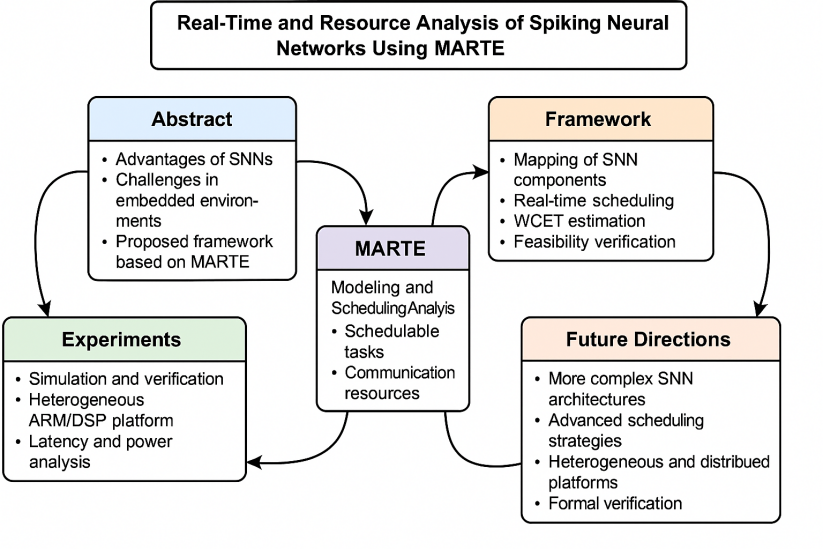
With the rapid advancement of deep learning, Spiking Neural Networks (SNNs) have attracted growing interest due to their low power consumption, sensitivity to temporal information, and biological plausibility. However, deploying SNNs in resource-constrained, real-time embedded environments presents significant challenges--chiefly their complex training processes, limited hardware acceleration support, and the difficulty of performing scheduling analysis. This paper presents an integrated modeling and scheduling analysis framework for SNNs based on the MARTE (Modeling and Analysis of Real-Time and Embedded Systems) standard defined by the OMG. Key SNN components--such as neurons, synapses, and spike events--are mapped to schedulable tasks and communication resources within the MARTE profile. Leveraging the Papyrus MARTE tool, we conduct simulation and verification on a heterogeneous embedded platform comprising multi-core ARM and DSP processors. Experimental results show that the proposed framework effectively satisfies end-to-end latency and power constraints, while significantly reducing system integration risks and enhancing design efficiency. Finally, we discuss future research directions, including support for more complex SNN architectures, advanced scheduling strategies, deployment on heterogeneous and distributed platforms, and formal verification for safety-critical applications.
Graphical Abstract
Keywords
Data Availability Statement
Funding
Conflicts of Interest
Ethical Approval and Consent to Participate
References
- Brette, R., & Gerstner, W. (2005). Adaptive exponential integrate-and-fire model as an effective description of neuronal activity. Journal of Neurophysiology, 94(5), 3637-3642.
[CrossRef] [Google Scholar] - Izhikevich, E. M. (2003). Simple model of spiking neurons. IEEE Transactions on Neural Networks, 14(6), 1569-1572.
[CrossRef] [Google Scholar] - Selic, B., & Gérard, S. (2013). Modeling and analysis of real-time and embedded systems with UML and MARTE: Developing cyber-physical systems. Elsevier.
[Google Scholar] - Shailesh, T., Nayak, A., & Prasad, D. (2020). An UML based performance evaluation of real-time systems using timed petri net. Computers, 9(4), 94.
[CrossRef] [Google Scholar] - Davies, M., Srinivasa, N., Lin, T. H., Chinya, G., Cao, Y., Choday, S. H., ... & Wang, H. (2018). Loihi: A neuromorphic manycore processor with on-chip learning. IEEE Micro, 38(1), 82-99.
[CrossRef] [Google Scholar] - Di Alesio, S., & Sen, S. (2018). Using UML/MARTE to support performance tuning and stress testing in real-time systems. Software & Systems Modeling, 17(2), 479-508.
[CrossRef] [Google Scholar] - Warnett, S. J., & Zdun, U. (2022). Architectural design decisions for machine learning deployment. 2022 IEEE 19th International Conference on Software Architecture (ICSA), 90-100.
[CrossRef] [Google Scholar] - Perez-Palacin, D., Merseguer, J., Requeno, J. I., Guerriero, M., Di Nitto, E., & Tamburri, D. A. (2019). A UML profile for the design, quality assessment and deployment of data-intensive applications. Software and Systems Modeling, 18(6), 3577-3614.
[CrossRef] [Google Scholar] - Priyanka, E. B., Thangavel, S., Meenakshipriya, B., Prabu, D. V., & Sivakumar, N. S. (2021). Big data technologies with computational model computing using hadoop with scheduling challenges. Deep Learning and Big Data for Intelligent Transportation: Enabling Technologies and Future Trends, 3-19.
[CrossRef] [Google Scholar] - Díaz-Pace, J. A., Tommasel, A., & Capilla, R. (2024). Helping novice architects to make quality design decisions using an llm-based assistant. European Conference on Software Architecture, 324-332.
[CrossRef] [Google Scholar]
Cited By (1)
-
Samia Akhtar, Shabib Aftab, Muhammad Anwaar Saeed, Usama Ahmed. .
2025 6th International Conference on Innovative Computing (ICIC), 2025 .
[CrossRef]
Cite This Article
TY  - JOUR
AU  - Wu, Liangshun
AU  - Tao, Tao
PY  - 2025
DA  - 2025/08/15
TI  - MARTE-Based Modeling and Analysis for Real-Time Neuromorphic Computing in Embedded Systems
JO  - ICCK Journal of Software Engineering
T2  - ICCK Journal of Software Engineering
JF  - ICCK Journal of Software Engineering
VL  - 1
IS  - 1
SP  - 9
EP  - 16
DO  - 10.62762/JSE.2025.495949
UR  - https://www.icck.org/article/abs/JSE.2025.495949
KW  - spiking neural network (SNN)
KW  - MARTE
KW  - embedded system
KW  - real-time scheduling
KW  - model-driven engineering (MDE)
KW  - energy optimization
KW  - papyrus MARTE
KW  - system modeling and verification
AB  - With the rapid advancement of deep learning, Spiking Neural Networks (SNNs) have attracted growing interest due to their low power consumption, sensitivity to temporal information, and biological plausibility. However, deploying SNNs in resource-constrained, real-time embedded environments presents significant challenges--chiefly their complex training processes, limited hardware acceleration support, and the difficulty of performing scheduling analysis. This paper presents an integrated modeling and scheduling analysis framework for SNNs based on the MARTE (Modeling and Analysis of Real-Time and Embedded Systems) standard defined by the OMG. Key SNN components--such as neurons, synapses, and spike events--are mapped to schedulable tasks and communication resources within the MARTE profile. Leveraging the Papyrus MARTE tool, we conduct simulation and verification on a heterogeneous embedded platform comprising multi-core ARM and DSP processors. Experimental results show that the proposed framework effectively satisfies end-to-end latency and power constraints, while significantly reducing system integration risks and enhancing design efficiency. Finally, we discuss future research directions, including support for more complex SNN architectures, advanced scheduling strategies, deployment on heterogeneous and distributed platforms, and formal verification for safety-critical applications.
SN  - 3069-1834
PB  - Institute of Central Computation and Knowledge
LA  - English
ER  -
@article{Wu2025MARTEBased,
  author = {Liangshun Wu and Tao Tao},
  title = {MARTE-Based Modeling and Analysis for Real-Time Neuromorphic Computing in Embedded Systems},
  journal = {ICCK Journal of Software Engineering},
  year = {2025},
  volume = {1},
  number = {1},
  pages = {9-16},
  doi = {10.62762/JSE.2025.495949},
  url = {https://www.icck.org/article/abs/JSE.2025.495949},
  abstract = {With the rapid advancement of deep learning, Spiking Neural Networks (SNNs) have attracted growing interest due to their low power consumption, sensitivity to temporal information, and biological plausibility. However, deploying SNNs in resource-constrained, real-time embedded environments presents significant challenges--chiefly their complex training processes, limited hardware acceleration support, and the difficulty of performing scheduling analysis. This paper presents an integrated modeling and scheduling analysis framework for SNNs based on the MARTE (Modeling and Analysis of Real-Time and Embedded Systems) standard defined by the OMG. Key SNN components--such as neurons, synapses, and spike events--are mapped to schedulable tasks and communication resources within the MARTE profile. Leveraging the Papyrus MARTE tool, we conduct simulation and verification on a heterogeneous embedded platform comprising multi-core ARM and DSP processors. Experimental results show that the proposed framework effectively satisfies end-to-end latency and power constraints, while significantly reducing system integration risks and enhancing design efficiency. Finally, we discuss future research directions, including support for more complex SNN architectures, advanced scheduling strategies, deployment on heterogeneous and distributed platforms, and formal verification for safety-critical applications.},
  keywords = {spiking neural network (SNN), MARTE, embedded system, real-time scheduling, model-driven engineering (MDE), energy optimization, papyrus MARTE, system modeling and verification},
  issn = {3069-1834},
  publisher = {Institute of Central Computation and Knowledge}
}
Publisher's Note
ICCK stays neutral with regard to jurisdictional claims in published maps and institutional affiliations.
Rights and Permissions
 Copyright © 2025 by the Author(s). Published by Institute of Central Computation and Knowledge. This article is an open access article distributed under the terms and conditions of the Creative Commons Attribution (CC BY) license (https://creativecommons.org/licenses/by/4.0/), which permits use, sharing, adaptation, distribution and reproduction in any medium or format, as long as you give appropriate credit to the original author(s) and the source, provide a link to the Creative Commons licence, and indicate if changes were made.


Portico
